Motorcycles and powder coating are a natural match. Unlike cars, where most of the mechanical components are hidden under body panels, motorcycles wear their engineering on the outside. The frame, swingarm, engine cases, fork legs, triple clamps, foot pegs, brackets, and dozens of other metal components are all visible, all exposed to the elements, and all contributing to the motorcycle's visual identity. The finish on these parts matters — both for protection and for appearance.
Automotive
Powder Coating for Motorcycle Parts: Frames, Engine Covers, Custom Colors, and Restoration
Sundial Powder Coating·April 22, 2026·13 min
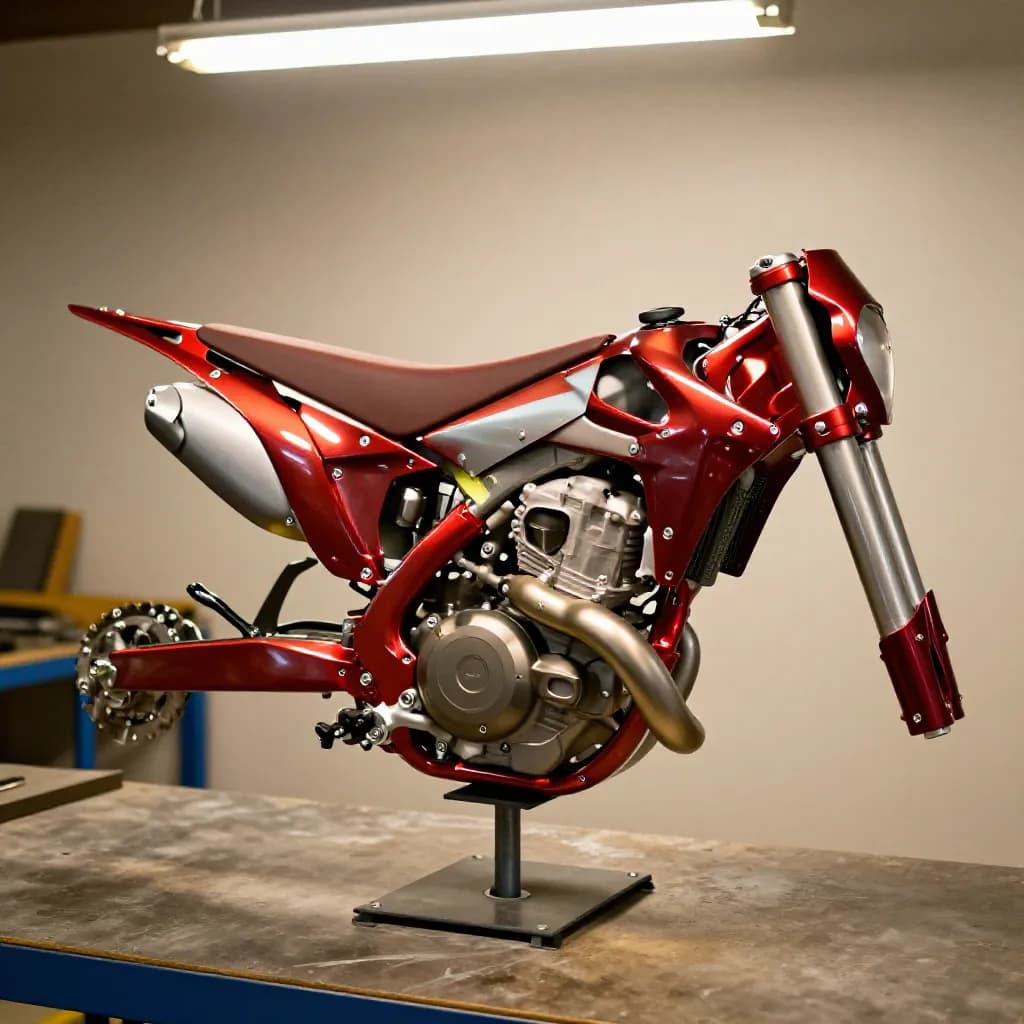
Powder coating has become the finish of choice for motorcycle builders, restorers, and customizers because it delivers a combination of durability, appearance, and versatility that liquid paint struggles to match in this application. A powder coated motorcycle frame resists stone chips from the front wheel, withstands chain lube and brake fluid contact, shrugs off road salt and rain, and maintains its color and gloss through years of riding — all while providing a finish quality that ranges from subtle factory-correct to wild custom show bike.
Ready to Start Your Project?
From one-off customs to 15,000-part production runs — get precise pricing in 24 hours.
On This Page
Why Motorcyclists Choose Powder Coating
The motorcycle aftermarket has embraced powder coating enthusiastically. Custom builders use it to create one-of-a-kind color schemes. Restorers use it to bring vintage bikes back to factory-fresh condition. Weekend riders use it to refresh tired frames and components. Racing teams use it for its weight advantage over thick liquid paint systems and its resistance to the vibration, heat, and chemical exposure that racing imposes. Whatever the motivation, powder coating has become an essential tool in the motorcycle enthusiast's arsenal.
Frames and Swingarms: The Big Pieces
The frame is the largest and most visually prominent component on most motorcycles, and it is also one of the most rewarding to powder coat. A freshly coated frame transforms the entire appearance of a motorcycle, providing a clean, uniform foundation for the rest of the build.
Frame preparation is critical and often time-consuming. The frame must be completely stripped of all components — engine, suspension, wiring, brackets, fasteners, and any pressed-in bearings or bushings that cannot withstand cure temperature. Every threaded hole, bearing race, and mating surface must be masked to prevent powder from interfering with assembly. The bare frame is then stripped of its old finish (by chemical stripping, media blasting, or both), inspected for cracks or damage, and repaired as needed.
The complex tubular geometry of motorcycle frames creates Faraday cage challenges during powder application. The inside surfaces of frame tubes, the areas where tubes intersect, and the tight spaces around gussets and brackets are difficult to coat uniformly with standard corona spray guns. Experienced motorcycle coaters use a combination of techniques: tribo-charging guns that penetrate Faraday cage areas better than corona guns, manual gun manipulation to direct powder into recessed areas, and strategic racking that orients the frame to maximize spray access to critical surfaces.
Swingarms present similar challenges on a smaller scale. Cast aluminum swingarms require the same outgassing management as cast wheels — a degassing bake before coating to prevent pinholes. Tubular steel swingarms are more straightforward but still require thorough preparation and careful masking of pivot bearings and axle surfaces. Both frame and swingarm coatings should be polyester-based for UV resistance, applied at 60 to 80 microns, with particular attention to coverage in high-wear areas like chain guard mounting points and stand contact areas.
Engine Covers and Heat-Resistant Coatings
Engine covers — valve covers, clutch covers, stator covers, and crankcase covers — are popular candidates for powder coating because they are highly visible and relatively easy to remove for coating. However, their proximity to the engine introduces a thermal challenge that must be addressed in the coating specification.
Engine surface temperatures vary significantly depending on the location and the engine type. Air-cooled engines run hotter than liquid-cooled engines, and surfaces near the combustion chambers and exhaust ports are hotter than those near the bottom of the crankcase. Valve covers on air-cooled engines can reach 150 to 200°C during normal operation — within the range of standard powder coating cure temperatures. Surfaces near exhaust ports can exceed 250°C.
For engine covers that operate below 200°C, standard polyester powder coatings perform well. The coating was cured at this temperature during application, so it is thermally stable at operating temperatures up to the cure point. For covers that operate above 200°C, high-temperature powder coatings are necessary. These formulations — typically silicone-modified polyester or pure silicone resins — withstand continuous temperatures of 300 to 500°C without degradation. They are available in a more limited color range than standard powders (black, silver, grey, and a few other colors are common), but they provide reliable protection and appearance in high-heat environments.
Ceramic-based thermal barrier coatings are another option for extreme-heat applications. These coatings — applied as a powder or liquid and cured at high temperature — provide thermal insulation that reduces heat transfer from the engine to surrounding components. They are used on exhaust headers, turbo housings, and other components where heat management is as important as appearance. Ceramic coatings are typically applied by specialist shops with experience in thermal barrier applications.
Custom Colors and Show-Quality Finishes
The custom motorcycle scene thrives on individuality, and powder coating provides an enormous palette of colors and effects for builders to express their vision. From subtle factory-correct finishes for concours restorations to wild candy coats and color-shift chameleon effects for show bikes, powder coating can deliver virtually any aesthetic the builder can imagine.
Popular custom motorcycle color categories include solid colors in the full RAL range and beyond, metallic finishes with aluminum flake or mica pigments for sparkle and depth, candy coat transparents over metallic bases for jewel-like luminosity, textured finishes like wrinkle and hammer-tone for a vintage or industrial aesthetic, and matte or satin finishes for a modern, understated look. Multi-color schemes using masking techniques allow two-tone frames, contrasting engine covers, and color-coded component groups.
Achieving show-quality results requires meticulous preparation and application. The substrate must be flawless — every weld ground smooth, every surface defect filled and sanded, every edge radiused. The powder must be applied with exceptional uniformity, and the cure must be precisely controlled to achieve optimal flow and crosslinking. For candy coat and metallic finishes, the base coat must be perfect before the topcoat is applied, as any defect in the base will be visible through the transparent or translucent topcoat.
Show-quality powder coating is a premium service that commands premium pricing, and it is worth seeking out coaters who specialize in motorcycle and custom work. These specialists understand the unique requirements of motorcycle components — the complex geometries, the heat considerations, the masking challenges, and the exacting appearance standards that motorcycle enthusiasts demand. A portfolio of previous motorcycle work is the best indicator of a coater's capability in this niche.
Restoration: Period-Correct and Factory Finishes
Motorcycle restoration — returning a vintage or classic bike to its original factory condition — presents a different set of powder coating challenges than custom work. The goal is not to create something new and unique but to faithfully reproduce the original factory finish, including the correct color, gloss level, texture, and even the subtle imperfections that characterized factory coating processes of the era.
Research is the first step. Identify the original finish specification for the motorcycle model and year. Factory service manuals, parts catalogs, and marque-specific reference books often include paint codes and finish descriptions. Online forums and marque clubs are invaluable resources where experienced restorers share knowledge about original finishes. If possible, find an unrestored example of the same model to use as a color and finish reference.
Color matching for restoration work requires physical reference samples rather than catalog codes, because original factory colors often do not correspond exactly to standard RAL or other color system codes. A chip from the original finish, an unrestored component, or a factory color sample card provides the best reference for the powder manufacturer to match. Specify the gloss level carefully — many vintage motorcycles used semi-gloss or satin finishes that look wrong if reproduced in modern high-gloss powder.
Some vintage motorcycles used finishes that are difficult to replicate exactly in powder coating. Early Japanese bikes often used thin, single-coat enamel finishes with a specific appearance that thick powder coating does not perfectly mimic. British bikes of the 1960s and 1970s used distinctive colors and textures that require careful formulation to reproduce. In these cases, working with a powder manufacturer experienced in custom color matching and a coater experienced in restoration work produces the best results. The goal is a finish that looks correct to knowledgeable enthusiasts, even if the coating technology is different from the original.
Practical Considerations: Masking, Assembly, and Fitment
Successful motorcycle powder coating requires careful planning around masking, assembly sequence, and component fitment. Unlike a simple bracket or panel, motorcycle components must fit together precisely after coating, and the added film thickness of powder coating can interfere with tight-tolerance assemblies if not accounted for.
Masking is extensive on motorcycle components. Frame head tube bearings, swingarm pivot bearings, engine mount surfaces, brake caliper mounting faces, axle surfaces, and all threaded holes must be masked to prevent powder from building up on mating surfaces. Powder in a threaded hole can prevent a bolt from threading in; powder on a bearing race can cause premature bearing failure; powder on a brake caliper mount can misalign the caliper. Create a detailed masking plan for each component, documenting every area that must remain uncoated.
Fitment should be verified before and after coating. Dry-assemble critical components before sending them for coating to confirm that everything fits correctly. After coating, verify fitment again — the 60 to 80 micron coating thickness on each mating surface effectively reduces clearances by 120 to 160 microns (coating on both surfaces). For most motorcycle assemblies, this is not a problem, but for tight-tolerance fits — such as engine case halves or close-fitting covers — the added thickness may require light sanding of the coating on mating surfaces.
Assembly sequence matters. Plan the coating schedule around the build sequence. Components that must be assembled before other components can be coated should be coated first. Components that will be installed last can be coated later. For a full frame-up restoration, the typical sequence is: strip and coat the frame first, then engine covers and brackets, then smaller components. This allows the build to progress while later components are still being coated.
Durability in Service: What Riders Need to Know
Powder coated motorcycle components deliver excellent durability in real-world riding conditions, but understanding the specific threats and how to manage them helps riders maintain their finish for the long term.
Stone chips are the most common form of coating damage on motorcycle frames. The front wheel throws road debris directly at the frame downtubes and engine, and no coating is completely immune to high-velocity stone impact. Powder coating's thick film and tough crosslinked structure resist chipping better than thin liquid paint, but chips will occur over time. Applying a clear protective film (similar to automotive paint protection film) to high-impact areas like the front downtube and behind the front wheel provides an additional layer of defense.
Chemical exposure is another concern. Chain lube, brake fluid (DOT 3 and DOT 4 are particularly aggressive), fuel, and aggressive cleaning chemicals can attack powder coatings if left in contact for extended periods. Polyester powder coatings have good chemical resistance, but prolonged exposure to brake fluid can soften and discolor the coating. Clean up chemical spills promptly, and avoid using harsh degreasers or solvent-based cleaners on powder coated surfaces.
Vibration is a constant companion on motorcycles, and it can cause coating fatigue at stress concentration points — sharp bends in frame tubes, weld toes, and areas where brackets are welded to the frame. Properly applied powder coating with good adhesion to a well-prepared substrate handles vibration well, but coating applied over poorly prepared surfaces or with inadequate film thickness may crack at stress points over time.
Regular maintenance extends coating life. Wash the motorcycle regularly with mild soap and water, paying attention to areas where road grime and salt accumulate. Inspect the coating periodically for chips or damage, and touch up any bare metal promptly with color-matched touch-up paint to prevent corrosion from starting. A coat of quality wax or ceramic sealant provides additional UV and chemical protection.
Frequently Asked Questions
Can I powder coat my motorcycle frame without removing the engine?
No. The frame must be completely stripped of all components before powder coating. The cure oven temperature (180-200°C) would damage the engine, wiring, bearings, seals, and other components. Complete disassembly also allows proper preparation and coating of all frame surfaces, including areas hidden by the engine.
Will powder coating add noticeable weight to my motorcycle?
The weight added by powder coating is minimal — typically 100-300 grams for a complete frame coating at 60-80 microns thickness. This is comparable to or less than a liquid paint system and is negligible relative to the motorcycle's total weight. Powder coating is actually preferred by some racing teams for its thin, consistent film build.
Can engine covers be powder coated?
Yes. Covers that operate below 200°C can use standard polyester powder coating. Covers near exhaust ports or on air-cooled engines that exceed 200°C require high-temperature powder coatings rated for 300-500°C. Cast aluminum covers need a degassing bake before coating to prevent pinholes.
How do I get a factory-correct finish for a vintage motorcycle restoration?
Research the original finish specification using factory manuals, marque references, and enthusiast forums. Provide a physical color sample (original paint chip or unrestored component) to the powder manufacturer for matching. Specify the correct gloss level — many vintage bikes used semi-gloss or satin finishes. Work with a coater experienced in restoration work.
Does powder coating interfere with motorcycle component fitment?
The 60-80 micron coating thickness can reduce clearances on tight-tolerance assemblies. All mating surfaces, bearing races, threaded holes, and brake mounting faces must be masked before coating. After coating, verify fitment of critical assemblies and lightly sand coating on mating surfaces if needed.
Ready to Start Your Project?
From one-off customs to 15,000-part production runs — get precise pricing in 24 hours.