The marine environment is the most corrosive operating condition that any coating system faces. Saltwater contains approximately 3.5% dissolved salts — primarily sodium chloride — that act as an electrolyte accelerating galvanic and crevice corrosion. Salt spray deposits on surfaces above the waterline, creating a persistent corrosive film that is renewed with every wave, wind gust, and tidal cycle. UV radiation reflected off the water surface amplifies photodegradation. And the constant motion of a vessel generates vibration and impact loads that stress coating adhesion.
Marine
Powder Coating for Marine Hardware and Fittings: Saltwater-Resistant Finishes for Boats
Sundial Powder Coating·April 22, 2026·12 min
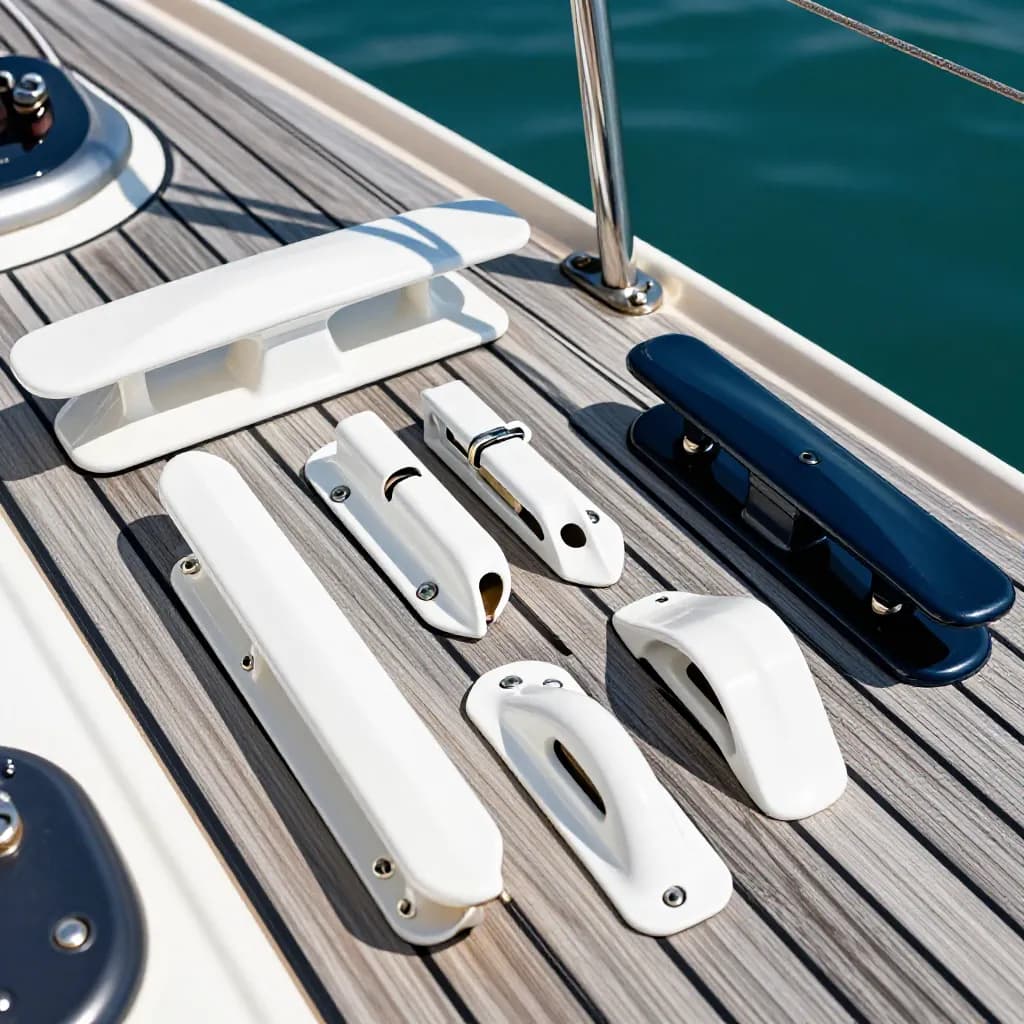
Marine hardware and fittings — cleats, chocks, hinges, latches, fairleads, rod holders, grab rails, and deck plates — are the most exposed components on any vessel. They protrude from the deck surface, catching spray and rain. They are handled frequently, creating wear at contact points. They are loaded mechanically during mooring, anchoring, and line handling. And they must maintain both function and appearance for the vessel's service life, which may be 20-30 years for a well-maintained boat.
Ready to Start Your Project?
From one-off customs to 15,000-part production runs — get precise pricing in 24 hours.
On This Page
The Marine Environment: The Ultimate Coating Challenge
Traditionally, marine hardware has been finished with chrome plating, anodizing, or left as bare stainless steel or bronze. Powder coating has emerged as a compelling alternative that offers advantages in corrosion resistance, color options, and cost-effectiveness. While chrome plating provides excellent corrosion resistance when intact, any breach in the chrome layer leads to rapid substrate corrosion. Powder coating provides a thicker, more forgiving barrier that tolerates minor damage without catastrophic failure.
Marine-Grade Substrates and Pretreatment Protocols
Marine hardware is fabricated from substrates chosen for their inherent corrosion resistance: 316 stainless steel, bronze, aluminum alloys (5000 and 6000 series), and occasionally galvanized steel. Each substrate requires specific pretreatment to ensure reliable powder coating adhesion in the marine environment.
316 stainless steel is the premium substrate for marine hardware due to its molybdenum content, which provides superior resistance to chloride-induced pitting and crevice corrosion. However, the passive chromium oxide layer that provides this corrosion resistance also inhibits coating adhesion. Pretreatment involves abrasive blasting with aluminum oxide media (80-120 grit) to create a surface profile of 25-50 micrometers, followed by solvent cleaning and application of a stainless steel-compatible adhesion promoter or wash primer. Some applicators use phosphoric acid-based pretreatments specifically formulated for stainless steel.
Marine-grade aluminum alloys (5052, 5083, 6061, 6063) are widely used for lightweight hardware and structural fittings. Chromate-free pretreatment using zirconium or titanium-based conversion coatings provides adhesion promotion and enhanced corrosion resistance. The pretreatment must be compatible with the specific alloy — some aluminum alloys contain copper or zinc alloying elements that can cause galvanic effects if the pretreatment chemistry is not properly formulated.
Bronze and brass hardware — traditional materials for marine fittings — can be powder coated for decorative purposes or to prevent the green patina (verdigris) that develops on copper alloys in marine environments. Pretreatment involves solvent degreasing, light abrasive blasting or chemical etching, and application of a copper-compatible primer. The thermal expansion coefficient of copper alloys differs significantly from steel and aluminum, requiring flexible powder coating formulations that accommodate differential thermal movement.
Galvanized steel is used for economy marine hardware and structural fittings. The zinc coating provides cathodic protection, and the powder coating provides barrier protection and aesthetics. Outgassing management through pre-baking at 200-230°C is essential to prevent pinhole defects in the powder coating film.
Powder Coating Systems for Maximum Salt Spray Resistance
Marine hardware powder coating specifications are defined by salt spray resistance requirements that far exceed standard industrial specifications. While general industrial coatings may specify 500-1000 hours of salt spray resistance per ASTM B117, marine hardware coatings must achieve 2000-5000 hours to provide adequate protection in the saltwater environment.
The highest-performing marine powder coating systems use a three-layer approach: zinc-rich epoxy primer, epoxy intermediate coat, and superdurable polyester topcoat. The zinc-rich primer (15-25 microns) provides cathodic protection at any coating breach, similar to galvanizing. The epoxy intermediate coat (30-50 microns) provides maximum barrier protection against moisture and chloride ion penetration. The polyester topcoat (50-70 microns) provides UV resistance, color retention, and the aesthetic finish quality expected on marine hardware. Total system thickness of 95-145 microns provides comprehensive protection.
For less demanding applications or where weight is a concern, a two-coat system of epoxy primer (25-40 microns) and superdurable polyester topcoat (60-80 microns) provides 2000-3000 hours of salt spray resistance. This system is suitable for hardware on freshwater vessels, sheltered marina equipment, and above-deck fittings that are regularly maintained.
Single-coat marine-grade polyester powders with enhanced corrosion inhibitors can achieve 1000-1500 hours of salt spray resistance at 70-90 microns. These formulations incorporate zinc phosphate, strontium chromate-free, or calcium-exchanged silica corrosion inhibitors directly into the powder formulation, providing active corrosion protection within the coating film. Single-coat systems are suitable for hardware on trailered boats that spend limited time in the water.
Edge and fastener hole protection is critical for marine hardware because these are the most vulnerable points for corrosion initiation. Powder coating must achieve minimum 40-micron thickness on all edges, and fastener holes should be coated before hardware installation. Stainless steel fasteners should be used with powder-coated hardware to prevent galvanic corrosion at the fastener-hardware interface.
Qualicoat Seaside and Marine Certification Standards
The marine powder coating industry is supported by certification standards that provide confidence in coating performance for saltwater applications. These standards define pretreatment, application, and testing requirements specific to the marine environment.
Qualicoat Seaside is the leading European certification for powder coatings in marine and coastal environments. Building on the standard Qualicoat certification for architectural aluminum, Qualicoat Seaside adds requirements for enhanced pretreatment (multi-stage chromate-free processes), increased film thickness, and extended accelerated corrosion testing. Qualicoat Seaside-certified coatings must pass 1000 hours of acetic acid salt spray testing per ISO 9227 (AASS), which is significantly more aggressive than standard neutral salt spray testing.
GSB Master Seaside certification from GSB International provides similar assurance for marine and coastal applications. GSB Master Seaside requires filiform corrosion testing in addition to salt spray testing, evaluating the coating's resistance to the thread-like corrosion that commonly occurs on aluminum in marine environments. Maximum filiform corrosion length of 2 mm after 1000 hours of testing is the acceptance criterion.
NACE (National Association of Corrosion Engineers) standards provide guidance for corrosion protection in marine environments, though they do not specifically certify powder coatings. NACE SP0188 (Discontinuity Testing of New Protective Coatings on Conductive Substrates) is relevant for marine hardware coating inspection, using holiday detection to identify pinholes and discontinuities that could initiate corrosion.
ISO 12944 (Corrosion Protection of Steel Structures by Protective Paint Systems) classifies marine environments as corrosivity category C5-M (very high, marine) and defines coating system requirements for this category. While ISO 12944 was developed for liquid paint systems, its environmental classification and performance requirements are increasingly referenced in powder coating specifications for marine applications.
ASTM B117 salt spray testing remains the most widely used accelerated corrosion test for marine hardware coatings, despite its limitations as a predictor of real-world marine performance. Cyclic corrosion testing per ASTM G85 (Prohesion) or SAE J2334 provides more realistic simulation of marine exposure by alternating salt spray, humidity, and drying cycles.
Galvanic Corrosion Prevention in Multi-Metal Assemblies
Marine hardware assemblies frequently combine dissimilar metals — stainless steel fasteners in aluminum fittings, bronze through-hulls in fiberglass with aluminum backing plates, steel brackets with stainless steel hardware. These dissimilar metal combinations create galvanic cells in the presence of saltwater electrolyte, accelerating corrosion of the less noble metal. Powder coating plays a critical role in preventing galvanic corrosion by electrically isolating dissimilar metals.
The galvanic series in seawater ranks metals by their electrochemical potential. When two metals with different potentials are in electrical contact in seawater, the more active (anodic) metal corrodes preferentially to protect the more noble (cathodic) metal. Common problematic combinations in marine hardware include aluminum (anodic) with stainless steel (cathodic), mild steel (anodic) with bronze (cathodic), and zinc (anodic) with copper alloys (cathodic).
Powder coating prevents galvanic corrosion by providing an electrically insulating barrier between dissimilar metals. When aluminum hardware is powder coated before assembly with stainless steel fasteners, the coating prevents direct metal-to-metal contact and blocks the ionic current path through the electrolyte. The coating must be continuous and defect-free at the metal interface to provide effective galvanic isolation.
Coating thickness at fastener interfaces is critical. The compressive force of tightened fasteners can thin or breach the coating at the contact area, re-establishing the galvanic circuit. Specifying minimum 60-micron coating thickness at fastener bearing surfaces, using insulating washers (nylon or PTFE), and applying marine-grade sealant at fastener penetrations provides multiple layers of galvanic isolation.
For through-hull fittings and underwater hardware, powder coating alone may not provide sufficient galvanic protection due to the continuous immersion in electrolyte. These applications typically combine powder coating with sacrificial zinc anodes and proper bonding systems per ABYC E-11 (AC and DC Electrical Systems on Boats) to provide comprehensive corrosion protection.
Application Techniques for Complex Marine Hardware Geometry
Marine hardware presents challenging coating geometry — small, complex shapes with tight radii, threaded holes, bearing surfaces, and functional features that must be precisely masked or coated. Achieving uniform, defect-free coverage on these components requires specialized application techniques.
Small hardware items — cleats, hinges, latches, and deck plates — are typically coated in batches using rack-mounted fixtures. The fixtures must provide reliable electrical ground contact for electrostatic powder deposition while minimizing fixture marks on the finished product. Fixture design for marine hardware is particularly important because the small size of the components means that fixture marks represent a larger proportion of the total surface area.
Fluidized bed coating is an alternative application method well-suited to small marine hardware. Components are preheated to 200-250°C and dipped into a fluidized bed of powder, which melts and adheres on contact with the hot surface. Fluidized bed coating achieves very uniform coverage on complex shapes, including recessed areas that are difficult to reach with electrostatic spray. Film thickness is controlled by substrate temperature and immersion time, typically achieving 200-400 microns — significantly thicker than spray application. This extra thickness provides enhanced corrosion protection for marine applications.
Masking of functional surfaces is essential for marine hardware. Threaded holes, bearing surfaces, mating faces, and areas that require metal-to-metal contact for structural or electrical purposes must be masked before coating. Silicone plugs, caps, and tape provide precise masking that withstands the cure temperature without leaving residue. Custom masking fixtures for high-volume hardware items ensure consistent masking placement across production runs.
Post-coating inspection for marine hardware is more rigorous than standard industrial inspection. Holiday detection using a low-voltage wet sponge detector (per NACE SP0188) identifies pinholes and discontinuities that could initiate corrosion in the marine environment. Every piece of marine hardware should be holiday-tested before shipment, with any detected discontinuities repaired or the part rejected.
Edge coverage verification is performed using a magnetic or eddy current film thickness gauge at all edges, corners, and transitions. Minimum 40-micron edge coverage is the standard requirement for marine hardware, with 60 microns preferred for hardware exposed to direct saltwater contact.
Maintenance and Long-Term Performance in Marine Service
Powder-coated marine hardware requires regular maintenance to achieve its full service life potential. The marine environment is relentless, and even the best coating system will eventually degrade without proper care.
Freshwater rinsing after every saltwater exposure is the single most effective maintenance practice for powder-coated marine hardware. Salt deposits left on the coating surface attract moisture and create concentrated corrosion cells that accelerate coating degradation. A thorough freshwater rinse removes salt deposits before they can cause damage. For vessels that remain in saltwater, monthly freshwater washing of all above-deck hardware is recommended.
Periodic inspection of powder-coated hardware should focus on high-stress areas: fastener holes, edges, contact points with lines and chains, and areas subject to mechanical wear. Any coating damage that exposes the substrate should be repaired promptly with marine-grade touch-up paint (two-component epoxy or polyurethane) to prevent corrosion initiation. Early repair of small defects prevents the progressive coating failure that occurs when corrosion undermines the surrounding intact coating.
UV degradation manifests as chalking and gloss loss on the topcoat surface. While this does not immediately compromise corrosion protection, it indicates that the UV stabilizers in the coating are being consumed. Annual application of a marine-grade UV protectant or wax extends the topcoat's UV resistance and maintains the aesthetic appearance of the hardware.
The expected service life of powder-coated marine hardware depends on the coating system, substrate, and maintenance regimen. A three-coat system on stainless steel with regular maintenance can achieve 15-20 years of service. A two-coat system on aluminum with moderate maintenance provides 8-12 years. A single-coat system on steel with minimal maintenance may show significant degradation within 3-5 years in saltwater service.
Recoating of marine hardware is feasible and cost-effective compared to replacement. The existing coating is evaluated for adhesion — if adhesion is good, the surface is lightly abraded and overcoated. If adhesion has failed, the coating is stripped to bare metal and the full coating system is reapplied. Recoating extends the hardware's service life by another full cycle, making it an economically attractive alternative to replacement for quality hardware.
Frequently Asked Questions
How many hours of salt spray resistance should marine hardware powder coating achieve?
Marine hardware powder coatings should achieve 2000-5000 hours of salt spray resistance per ASTM B117 depending on the application. Three-coat systems with zinc-rich primer achieve the highest ratings, while single-coat marine-grade formulations provide 1000-1500 hours suitable for trailered boats.
Can powder coating prevent galvanic corrosion on boats?
Yes. Powder coating electrically isolates dissimilar metals, preventing the galvanic current that causes accelerated corrosion. The coating must be continuous and at least 60 microns thick at fastener interfaces, supplemented by insulating washers and marine sealant for maximum protection.
Is powder coating better than chrome plating for marine hardware?
Powder coating offers advantages in thickness (60-145 microns vs. 10-25 microns for chrome), color options, and damage tolerance. Chrome plating corrodes rapidly when breached, while powder coating damage remains localized. However, chrome provides superior abrasion resistance for high-wear applications like winch drums.
What maintenance does powder-coated marine hardware need?
Freshwater rinsing after every saltwater exposure is essential. Monthly washing, periodic inspection of high-stress areas, prompt touch-up of any coating damage, and annual UV protectant application maximize service life. With proper maintenance, powder-coated marine hardware can last 15-20 years.
What is Qualicoat Seaside certification?
Qualicoat Seaside is a European certification for powder coatings in marine and coastal environments. It requires enhanced pretreatment, increased film thickness, and 1000 hours of acetic acid salt spray testing — significantly more demanding than standard Qualicoat certification for architectural applications.
Ready to Start Your Project?
From one-off customs to 15,000-part production runs — get precise pricing in 24 hours.