Boat trailers face a corrosion challenge that is unique in the transportation industry. No other vehicle is routinely submerged in saltwater as part of its normal operation. Every launch and retrieval cycle immerses the trailer's frame, axles, springs, and fenders in corrosive saltwater, then exposes the wet, salt-laden surfaces to road spray, UV radiation, and atmospheric oxygen during the drive home. This combination of immersion corrosion, atmospheric corrosion, and mechanical stress from road vibration creates the most demanding coating environment outside of offshore industrial applications.
Marine
Powder Coating for Boat Trailers: Saltwater-Proof Finishes for Trailer Longevity
Sundial Powder Coating·April 22, 2026·12 min
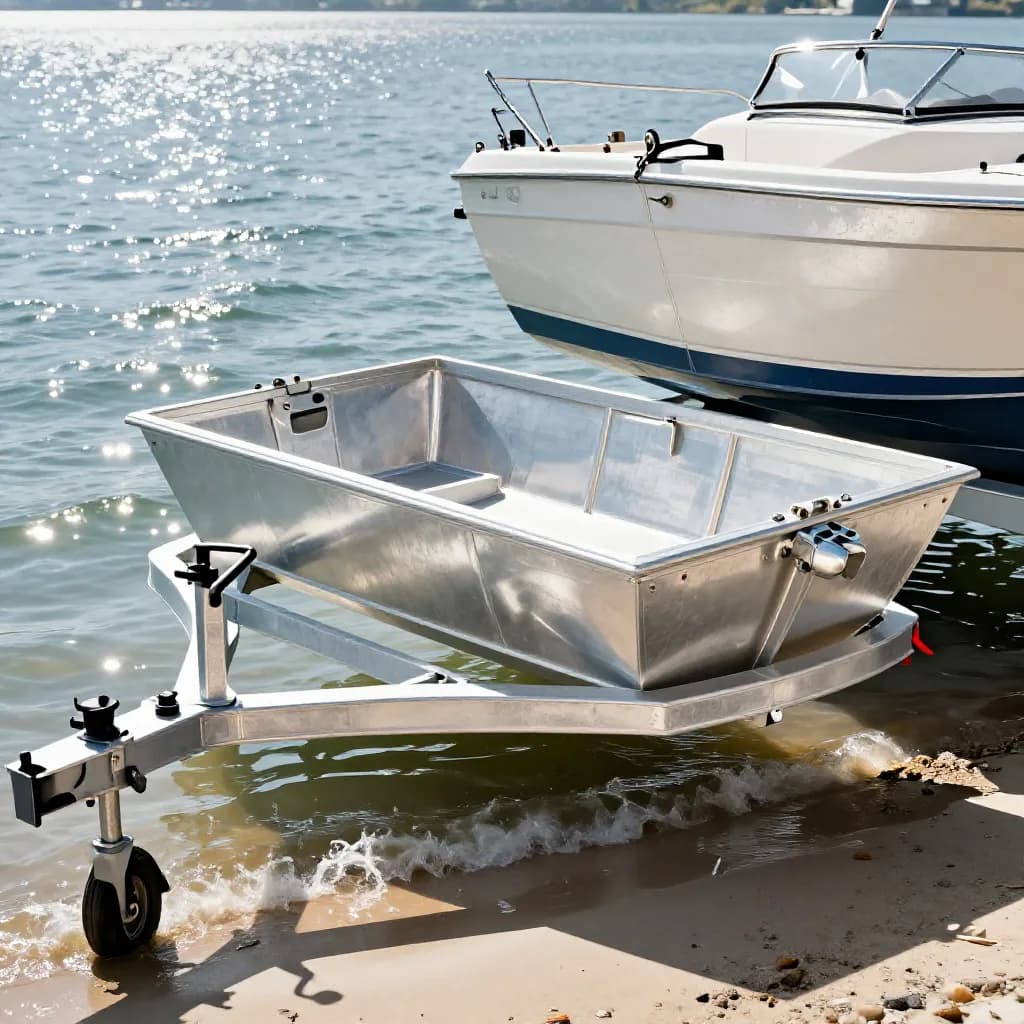
The consequences of coating failure on boat trailers are severe. Structural corrosion can compromise frame integrity, leading to catastrophic failure during towing. Corroded brake components can fail, creating a safety hazard. Corroded bunks and rollers can damage the boat hull during loading and retrieval. And the visual appearance of a corroded trailer diminishes the value of both the trailer and the boat it carries.
Ready to Start Your Project?
From one-off customs to 15,000-part production runs — get precise pricing in 24 hours.
On This Page
The Extreme Corrosion Challenge of Boat Trailers
Powder coating has become a popular finishing option for boat trailers, offering advantages over traditional liquid paint in thickness, adhesion, and chemical resistance. However, the extreme conditions of boat trailer service require coating systems that go well beyond standard industrial powder coating specifications. Understanding the specific challenges and solutions for boat trailer powder coating is essential for trailer manufacturers, aftermarket coating shops, and boat owners considering coating options.
Galvanized Steel: The Preferred Substrate for Marine Trailers
Hot-dip galvanized steel is the preferred substrate for boat trailers because the zinc coating provides cathodic (sacrificial) protection that continues to protect the steel even when the coating is damaged. When powder coating is applied over galvanizing, the result is a dual-protection system that combines the cathodic protection of zinc with the barrier protection of the powder coating.
Hot-dip galvanizing per ASTM A123 provides a zinc coating of 45-85 microns on structural steel, depending on the steel thickness and galvanizing bath conditions. This zinc layer corrodes sacrificially to protect the underlying steel at any coating breach, preventing the red rust formation that occurs when bare steel is exposed to saltwater. The galvanized surface also provides a more corrosion-resistant substrate for the powder coating, extending the time before substrate corrosion undermines the coating from beneath.
Powder coating over hot-dip galvanized steel requires careful management of the outgassing phenomenon. The zinc coating traps moisture and volatile compounds during the galvanizing process, and these are released as gases when the substrate is heated during powder coating cure. If not properly managed, outgassing creates pinholes, bubbles, and craters in the powder coating film that compromise both appearance and corrosion protection.
The standard approach to outgassing management is a pre-bake cycle at 230-260°C for 15-30 minutes before powder application. This temperature exceeds the powder coating cure temperature, ensuring that all volatile compounds are driven off before the powder is applied. The pre-bake also oxidizes the zinc surface, creating a zinc oxide layer that improves powder coating adhesion. After pre-baking, the substrate is cooled to ambient temperature, pretreated with a zinc-compatible conversion coating, and powder coated using standard application parameters.
Alternative outgassing management approaches include the use of outgassing-tolerant primer formulations that allow gas to escape through the coating film during cure without creating permanent defects. These primers are applied at 15-25 microns and cured before the topcoat is applied, providing a gas-permeable first layer that prevents defects in the visible topcoat.
Multi-Coat Powder Systems for Maximum Corrosion Protection
Boat trailer powder coating specifications must deliver salt spray resistance of 2000+ hours to provide adequate protection in saltwater service. Achieving this level of performance requires multi-coat systems that combine different powder chemistries for optimized corrosion protection.
The premium boat trailer coating system consists of three layers. A zinc-rich epoxy primer at 50-75 microns provides cathodic protection at any coating breach, supplementing the galvanized substrate's sacrificial protection. An epoxy barrier coat at 40-60 microns provides maximum resistance to moisture and chloride ion penetration. A superdurable polyester topcoat at 60-80 microns provides UV resistance, color retention, and aesthetic quality. Total system thickness of 150-215 microns provides comprehensive protection that can achieve 3000-5000 hours of salt spray resistance.
A two-coat system of epoxy primer (40-60 microns) and polyester topcoat (60-80 microns) provides 1500-2500 hours of salt spray resistance and is suitable for trailers used primarily in freshwater with occasional saltwater exposure. This system offers a good balance of protection and cost for recreational boat trailers.
Single-coat systems using marine-grade polyester with corrosion inhibitors at 80-100 microns can achieve 800-1200 hours of salt spray resistance. While this is adequate for freshwater-only trailers, it falls short of the protection needed for regular saltwater use. Single-coat systems are the most economical option but should be reserved for trailers that will not be submerged in saltwater.
Regardless of the system chosen, edge and weld coverage is the critical quality factor for boat trailer coating. The structural steel sections, weld seams, and sheared edges of trailer frames are the most vulnerable points for corrosion initiation. Minimum 50-micron film thickness on all edges and welds is essential, with 75 microns preferred for saltwater trailers. Manual touch-up application after the automatic spray pass ensures adequate coverage at these critical points.
Submersion Resistance and Immersion Testing
Standard salt spray testing per ASTM B117 evaluates coating performance under spray conditions, but boat trailers are actually submerged in saltwater during launch and retrieval. Immersion testing provides a more relevant assessment of coating performance for this application.
ASTM D870 (Standard Practice for Testing Water Resistance of Coatings Using Water Immersion) evaluates coating performance under continuous water immersion. For boat trailer applications, this test is modified to use synthetic seawater (per ASTM D1141) at ambient temperature. Coated test panels are immersed for 500-2000 hours and evaluated for blistering (per ASTM D714), adhesion loss, and corrosion. Marine-grade powder coating systems should show no blistering larger than size 8 (few) and no adhesion loss after 1000 hours of seawater immersion.
Cyclic immersion testing more closely simulates actual boat trailer use by alternating immersion and drying cycles. A typical protocol involves 4 hours of seawater immersion followed by 20 hours of air drying at ambient conditions, repeated for 30-90 cycles. This cycling creates the wet-dry conditions that are particularly aggressive for coating systems because salt concentration increases during the drying phase, creating highly corrosive conditions at the coating surface.
Cathodic disbondment testing per ASTM G8 evaluates the coating's resistance to the electrochemical forces that cause coating delamination in immersed conditions. When a coated metal is immersed in an electrolyte and a coating defect exposes the substrate, cathodic reactions at the defect generate hydroxyl ions that can undermine the coating-substrate bond, causing progressive delamination. Coatings with strong adhesion to the substrate and resistance to alkaline attack perform best in cathodic disbondment testing.
For boat trailers, the most realistic performance assessment combines laboratory testing with real-world exposure. Coating manufacturers and trailer builders should maintain test trailers in active saltwater service, inspecting them periodically to correlate laboratory test results with actual field performance. This correlation data informs coating specification decisions and provides confidence in the predicted service life of the coating system.
Road Hazard and Mechanical Damage Resistance
Boat trailers face significant mechanical abuse during road transport in addition to their marine corrosion exposure. Road debris impacts the frame and fenders at highway speeds. Gravel and sand abrade the underside during travel on unpaved boat ramp access roads. Loading and retrieval operations subject bunks, rollers, and guide posts to concentrated mechanical loads from the boat hull.
Chip resistance is evaluated using ASTM D3170 (Gravelometer test), which subjects coated panels to a stream of gravel at controlled velocity. Boat trailer coatings should achieve ratings of 7A or better, indicating minimal chipping with no substrate exposure. The multi-coat systems recommended for marine trailers inherently provide better chip resistance than single-coat systems because the primer layer maintains protection even if the topcoat is chipped.
Abrasion resistance is critical for trailer components that contact the boat hull — bunks, rollers, and guide posts. These components experience sliding contact under heavy loads during every launch and retrieval cycle. The powder coating on these components must resist this abrasion without generating coating debris that could scratch the boat hull. Smooth, hard coatings with low friction coefficients are preferred for hull-contact components, while textured finishes are appropriate for frame and fender surfaces.
Flexibility is important for trailer frame coatings because the frame flexes under load during towing. A loaded boat trailer experiences significant frame deflection over road irregularities, and the coating must accommodate this flexion without cracking. Conical mandrel bend testing per ASTM D522 at 1/8 inch mandrel diameter verifies adequate coating flexibility. Coatings that pass this test can accommodate the frame deflection typical of properly loaded boat trailers.
Fastener and connection point protection requires special attention. Trailer frames use bolted connections at cross-members, axle mounts, and tongue assemblies. These connections are subject to vibration-induced fretting that wears through the coating at contact surfaces. Applying marine-grade sealant at bolted connections before assembly prevents moisture ingress at these vulnerable points and supplements the powder coating's protection.
Aftermarket Powder Coating for Existing Boat Trailers
Aftermarket powder coating is a popular option for boat trailer owners seeking to extend the life of existing trailers or upgrade from factory liquid paint to a more durable powder coating system. The aftermarket process requires careful preparation to achieve results comparable to factory-applied coating.
Disassembly is the first step in aftermarket boat trailer powder coating. All removable components — lights, wiring, bunks, rollers, winch, jack, and coupler — must be removed before coating. Brake components, bearings, and axle assemblies should be removed or thoroughly masked to prevent coating interference with their function. Complete disassembly provides access to all surfaces for thorough preparation and coating, including the interior surfaces of box-section frame members that are inaccessible on an assembled trailer.
Stripping the existing coating is essential for optimal results. Chemical stripping, media blasting, or a combination of both removes the old coating and any corrosion products. For galvanized trailers, care must be taken to preserve the zinc coating during stripping — chemical strippers that attack zinc should be avoided, and blast media pressure should be limited to prevent excessive zinc removal. For bare steel trailers with significant corrosion, blasting to Sa 2.5 (near-white metal) removes all corrosion and provides an ideal surface for coating.
The aftermarket coating process follows the same multi-coat approach as factory application: pretreatment, primer application and cure, topcoat application and cure, and quality inspection. The primary challenge in aftermarket coating is achieving uniform coverage on the complex geometry of trailer frames, which include box sections, gussets, cross-members, and numerous weld joints. Manual application with experienced operators is typically required to ensure complete coverage in all recessed areas.
Reassembly after coating requires attention to fastener torque specifications, electrical connections for lights and brakes, and proper alignment of bunks and rollers. New stainless steel fasteners should be used throughout to prevent galvanic corrosion at fastener interfaces. All electrical connections should use marine-grade heat-shrink connectors with adhesive lining to prevent moisture ingress.
The aftermarket powder coating process adds significant value to a boat trailer, potentially doubling its remaining service life compared to leaving the original deteriorated coating in place. For trailers with sound structural steel, aftermarket powder coating is substantially more cost-effective than trailer replacement.
Maintenance Protocols for Powder-Coated Boat Trailers
Even the best powder coating system requires regular maintenance to achieve its full service life potential in marine service. A structured maintenance program protects the coating investment and prevents the progressive corrosion that leads to structural failure.
Post-use freshwater rinsing is the most important maintenance practice for saltwater boat trailers. Immediately after retrieval from saltwater, the entire trailer should be rinsed thoroughly with fresh water, paying particular attention to recessed areas, weld joints, and fastener connections where salt deposits accumulate. A garden hose with moderate pressure is adequate — high-pressure washing should be avoided because it can force water beneath coating chips and accelerate corrosion at damaged areas.
Monthly inspection during the boating season should focus on high-stress and high-wear areas: frame joints, axle mounts, bunk and roller contact surfaces, fender mounting points, and any areas where the coating has been damaged by road debris or loading operations. Coating damage should be documented and repaired promptly using marine-grade two-component epoxy touch-up paint.
Annual maintenance should include a thorough cleaning with marine-grade soap, inspection of all coating surfaces with particular attention to the underside of the frame, and application of marine wax or UV protectant to the topcoat surface. Fastener connections should be checked for tightness and any signs of galvanic corrosion at dissimilar metal interfaces.
Winterization for trailers stored outdoors includes thorough cleaning, touch-up of any coating damage, and application of a corrosion-inhibiting spray to exposed metal surfaces and fastener connections. Trailers should be stored with tires off the ground to prevent flat-spotting and with the frame slightly tilted to prevent water accumulation in box sections.
The expected service life of a properly maintained powder-coated boat trailer depends on the coating system and usage pattern. A three-coat system on galvanized steel with diligent maintenance can achieve 15-20 years in saltwater service. A two-coat system with moderate maintenance provides 8-12 years. Freshwater-only trailers with any coating system can expect 15-25 years of service with basic maintenance.
Frequently Asked Questions
Should a boat trailer be galvanized before powder coating?
Yes, galvanizing before powder coating creates a dual-protection system that provides the best corrosion resistance for marine service. The zinc layer provides cathodic protection at any coating breach, while the powder coating provides barrier protection and aesthetics. This combination can achieve 3000-5000 hours of salt spray resistance.
How do you prevent outgassing when powder coating a galvanized trailer?
Pre-bake the galvanized trailer at 230-260°C for 15-30 minutes before powder application to drive off trapped moisture and volatile compounds. After cooling, apply a zinc-compatible pretreatment and powder coat normally. Alternatively, use outgassing-tolerant primer formulations designed for galvanized substrates.
How long does powder coating last on a saltwater boat trailer?
With a three-coat system on galvanized steel and diligent maintenance including post-use freshwater rinsing, powder coating can last 15-20 years in saltwater service. Two-coat systems provide 8-12 years, while single-coat systems may show degradation within 3-5 years of regular saltwater submersion.
Can an existing boat trailer be powder coated?
Yes. Aftermarket powder coating involves complete disassembly, stripping of the old coating, surface preparation, multi-coat powder application, and reassembly with new stainless steel fasteners. The process can double the trailer's remaining service life and is substantially more cost-effective than replacement.
What is the most important maintenance for a powder-coated boat trailer?
Freshwater rinsing immediately after every saltwater use is the single most important maintenance practice. Salt deposits left on the coating surface create concentrated corrosion cells that accelerate coating degradation. Monthly inspection and prompt repair of any coating damage are also essential.
Ready to Start Your Project?
From one-off customs to 15,000-part production runs — get precise pricing in 24 hours.