Modern libraries have evolved from quiet book repositories into dynamic community spaces that serve as study halls, meeting venues, maker spaces, and digital resource centers. This evolution has transformed furniture requirements — library furniture must now accommodate diverse activities, withstand heavy public use, support frequent reconfiguration, and contribute to welcoming, contemporary interior design. Powder-coated metal furniture meets all these demands while offering the longevity and sustainability that public institutions require.
Commercial
Powder Coating for Library Furniture: Shelving, Study Carrels, Quiet Finishes, Durability, and Sustainability
Sundial Powder Coating·April 22, 2026·10 min
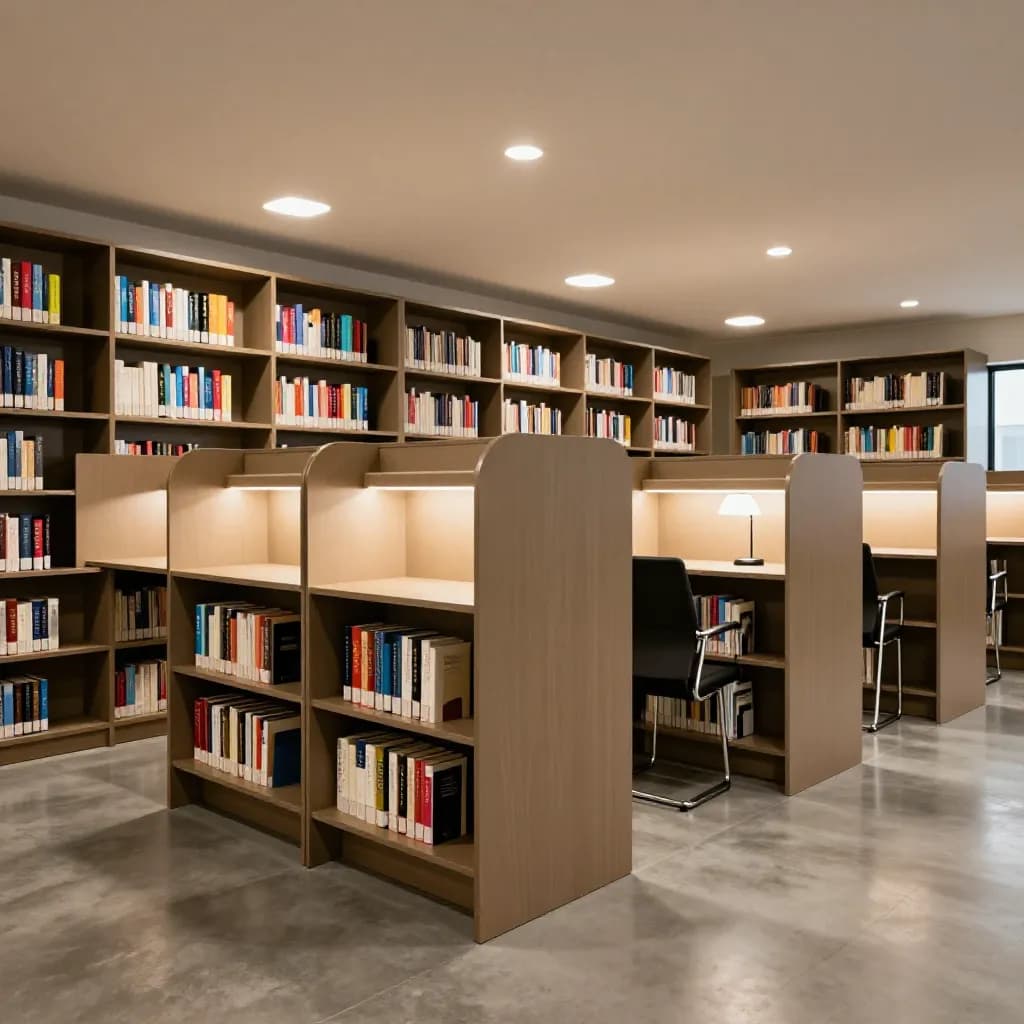
Library furniture operates in a high-traffic public environment where durability is paramount. Public libraries may serve hundreds of visitors daily, with furniture experiencing constant use, movement, and the occasional rough treatment that comes with open public access. The finish on library furniture must withstand this use rate for 15-25 years — the typical lifecycle expected of institutional furniture — without degrading to the point where replacement is necessary.
Ready to Start Your Project?
From one-off customs to 15,000-part production runs — get precise pricing in 24 hours.
On This Page
Libraries and the Case for Powder-Coated Metal Furniture
Sustainability is a core value for public libraries, and the environmental credentials of powder coating align with institutional sustainability goals. Zero VOC emissions during application, 95-98% material utilization rates, and the long service life that reduces replacement frequency all contribute to the environmental case for powder-coated library furniture. Many libraries pursuing LEED certification or other green building standards find that powder-coated metal furniture supports their sustainability objectives.
Acoustic performance is a unique consideration for library furniture that is rarely relevant in other commercial environments. Libraries maintain quiet environments for study and reading, and furniture that generates noise during use — metal-on-metal contact, scraping on floors, rattling components — disrupts the quiet atmosphere. Powder coating contributes to acoustic management by dampening metal-on-metal contact noise and providing a softer surface than bare metal for incidental contact.
Shelving Systems: The Library's Core Infrastructure
Library shelving is the most extensive application of powder-coated metal in any library, with large facilities containing thousands of linear feet of steel shelving that houses the collection. These shelving systems must support significant weight loads — a fully loaded shelf of books can weigh 30-40 kg per linear meter — while providing the adjustability needed to accommodate materials of varying sizes and the aesthetic quality appropriate for a public space.
Steel library shelving systems are universally powder coated, with the finish serving both protective and functional purposes. The coating protects the steel from the humidity fluctuations that occur in buildings with large numbers of occupants and from the occasional water exposure from roof leaks, plumbing failures, or spilled beverages. Functionally, the smooth powder coating surface allows books to slide easily during shelving and retrieval, reducing the effort needed for collection maintenance.
Color selection for library shelving affects both the aesthetic character of the space and the functional visibility of the collection. Light colors — white, light gray, cream — reflect ambient lighting into the shelf bays, improving visibility of book spines and reducing the need for supplemental shelf lighting. Dark colors create a more dramatic, contemporary aesthetic but may require additional lighting to maintain adequate visibility within the shelf bays.
End panels on library shelving are the most visible components and serve as design elements that define the character of the shelving system. Powder coating end panels in accent colors or with textured finishes creates visual interest that transforms utilitarian shelving into architectural elements. Some libraries use different end panel colors to identify different collection sections — fiction, non-fiction, reference, children's — creating an intuitive wayfinding system.
Shelving adjustability requires that shelf clips, bracket slots, and adjustment holes function smoothly after coating. The powder coating must not fill or obstruct adjustment holes, and the coating on shelf clips must allow easy insertion and removal for shelf repositioning. Quality control during the coating process should verify that all adjustment features function correctly after curing.
Mobile shelving systems — compact shelving on rails that maximizes storage density — require powder coating that withstands the mechanical stress of shelf movement. The coating at rail interfaces, wheel housings, and drive mechanism contact points must resist the friction and wear of daily operation. These high-wear points benefit from reinforced coating thickness and high-hardness formulations.
Study Carrels, Reading Tables, and Work Surfaces
Study carrels and reading tables are the primary work surfaces in library environments, supporting activities ranging from quiet reading to laptop computing to group study. The metal frames and structural components of these furniture pieces must provide stable support while the powder coating finish contributes to the quiet, comfortable environment that library users expect.
Study carrel frames — typically constructed from steel tube with privacy panels — require powder coating that provides a comfortable surface for arm and hand contact during extended study sessions. The finish should be smooth and warm to the touch, without the cold, clinical feel of bare metal that discourages prolonged contact. Satin finishes in warm neutral tones provide the tactile comfort and visual warmth appropriate for study environments.
Reading table legs and frames support heavy loads from books, laptops, and the occasional student who sits on the table edge. The powder coating at structural joints and leg-to-top connections must maintain adhesion under the stress of heavy loading and the vibration transmitted through the table when users type on laptops or write. Flexible powder coating formulations accommodate this stress without cracking at connection points.
Computer workstation frames integrate cable management, monitor mounts, and keyboard trays with the structural frame. The powder coating must accommodate these integrated features without interfering with cable routing or mechanism operation. Grommets, cable clips, and monitor mount interfaces should be designed for installation after coating to avoid masking complications during the coating process.
Collaborative furniture — group study tables, project tables, and maker space work surfaces — experiences more intense use than individual study furniture, with multiple users sharing the space and the furniture being reconfigured for different group sizes. The powder coating on collaborative furniture should be specified with enhanced impact and abrasion resistance to account for the increased use intensity.
Height-adjustable tables and sit-stand workstations incorporate mechanical adjustment mechanisms that require coating compatibility. The powder coating on telescoping leg sections must not create friction that impedes smooth height adjustment. Low-friction powder coating formulations or the use of mechanical bushings at sliding interfaces ensures that adjustment mechanisms operate smoothly throughout the furniture's service life.
Children's library furniture requires special attention to safety and durability. Rounded edges, non-toxic coating formulations, and bright, engaging colors create a welcoming environment for young library users. The powder coating must withstand the more energetic use patterns of children while meeting safety standards for children's furniture including ASTM F963 for toy safety where applicable.
Acoustic Considerations and Quiet Finishes
Libraries are among the few commercial environments where acoustic performance of furniture finishes is a meaningful design consideration. The quiet atmosphere that libraries cultivate can be disrupted by the sounds of metal furniture — chairs scraping on floors, books placed on metal shelves, table legs contacting each other during reconfiguration. Powder coating contributes to acoustic management by providing a softer contact surface than bare metal and by enabling design details that reduce noise generation.
The powder coating film itself provides a thin but meaningful acoustic buffer between metal surfaces. When a book is placed on a powder-coated shelf, the coating absorbs a portion of the impact energy that would otherwise be transmitted as sound through the metal shelf and upright structure. This damping effect is subtle but cumulative — across thousands of book placements per day, the noise reduction compared to bare metal shelving is noticeable.
Textured powder coating finishes provide enhanced acoustic damping compared to smooth finishes. The texture creates a slightly compressible surface that absorbs more impact energy than a hard, smooth surface. Fine sand textures and light wrinkle finishes provide meaningful acoustic benefit without compromising the cleanability or aesthetic quality of the furniture.
Furniture glides and floor contact points are the primary source of furniture noise in libraries. Powder-coated metal glides generate less noise than bare metal glides when furniture is moved across hard floors, but the most effective noise reduction comes from non-metallic glide materials — felt, nylon, or rubber — applied over the powder-coated leg bottom. These glide materials also protect the powder coating from the abrasion of floor contact.
Shelf clip and bracket insertion noise can be reduced through powder coating design. Coating the shelf clips and the bracket slots with compatible powder coating formulations creates a polymer-on-polymer contact that generates less noise than metal-on-metal contact during shelf adjustment. This detail is particularly valuable in open-plan libraries where shelf adjustment occurs during operating hours.
Acoustic panels and sound-absorbing screens with powder-coated metal frames combine acoustic function with aesthetic design. The powder coating on acoustic panel frames should be specified in colors that coordinate with the library's interior scheme while the frame design accommodates the acoustic panel material without creating gaps or rattling connections that would undermine the panel's sound-absorbing function.
Durability for Institutional Service Life
Public libraries expect furniture to provide 15-25 years of service, reflecting the long budget cycles and capital planning horizons of public institutions. Powder coating's durability is a key factor in achieving this extended service life, providing the protective barrier and aesthetic resilience needed to maintain furniture in acceptable condition through decades of public use.
Abrasion resistance is the primary durability metric for library furniture coatings. The constant sliding of books across shelves, the dragging of chairs across floors, and the daily contact of bags, coats, and personal items with furniture surfaces create cumulative abrasion that gradually wears the coating. Powder coating's typical film thickness of 60-100 microns provides substantially more material to absorb this wear than the 25-40 micron films of liquid paint, directly extending the time before the coating wears through to the substrate.
Chemical resistance in library environments addresses the cleaning products used for routine maintenance and the occasional exposure to hand sanitizer, beverages, and adhesive residues from labels and tape. Standard polyester powder coatings resist these common library chemicals without degradation, maintaining their appearance through thousands of cleaning cycles over the furniture's service life.
UV resistance is relevant for library furniture positioned near windows where direct sunlight can cause fading and chalking of UV-sensitive coatings. Super-durable polyester formulations should be specified for furniture in sun-exposed locations, while standard polyester is adequate for interior locations away from direct sunlight. Identifying sun-exposed zones during the furniture planning phase ensures that the appropriate coating chemistry is specified for each location.
Impact resistance protects against the bumps and knocks that occur in a busy public environment — book carts colliding with shelving, chairs bumping into tables, and the general rough handling that public furniture experiences. Powder coating's combination of hardness and flexibility absorbs these impacts without the chipping that characterizes more brittle finishes, maintaining the coating's protective barrier and visual appearance.
Repairability extends the service life of powder-coated library furniture beyond the point where the original coating begins to show wear. Touch-up paint matched to the original powder coating color addresses localized damage, while professional recoating of heavily worn components restores the original finish quality. The ability to repair and recoat rather than replace supports both the library's budget constraints and its sustainability objectives.
Sustainability and Environmental Credentials
Public libraries are increasingly committed to sustainability, and the environmental profile of furniture finishes is a consideration in procurement decisions. Powder coating's environmental credentials — zero VOC emissions, high material efficiency, and long service life — align with the sustainability values that public institutions espouse and the green building standards that many new library buildings pursue.
Zero VOC emissions during powder coating application mean that the finishing process does not contribute to air pollution or indoor air quality degradation. This is particularly relevant for library furniture that is installed in occupied buildings where off-gassing from freshly finished furniture could affect indoor air quality. Powder-coated furniture can be installed immediately without the off-gassing period that some liquid-painted furniture requires.
Material efficiency of 95-98% in powder coating operations means that virtually all of the coating material ends up on the furniture, with overspray collected and reused rather than wasted. This efficiency reduces raw material consumption and waste generation compared to liquid paint operations that typically achieve only 30-70% transfer efficiency.
The long service life of powder-coated furniture — 15-25 years in institutional use — reduces the environmental impact of furniture replacement. Each year that furniture remains in service avoids the resource consumption and waste generation associated with manufacturing, transporting, and installing replacement furniture. This lifecycle perspective makes powder-coated metal furniture one of the most environmentally responsible choices for library furnishing.
End-of-life recyclability of powder-coated metal furniture supports circular economy principles. Steel and aluminum are infinitely recyclable, and the powder coating does not prevent recycling — it is simply burned off during the metal recycling process. This recyclability means that powder-coated metal furniture has a defined end-of-life pathway that recovers the material value of the metal substrate.
LEED and other green building certification systems award credits for low-emitting materials, recycled content, and regional manufacturing. Powder-coated metal furniture can contribute to multiple credit categories, supporting the library's overall certification goals. Documentation of the powder coating's environmental attributes — VOC content, recycled material content, and manufacturing location — should be maintained for certification submissions.
Procurement specifications for library furniture should include environmental requirements that leverage powder coating's sustainability advantages. Specifying zero-VOC finishes, minimum recycled content in the metal substrate, and minimum expected service life ensures that the procured furniture delivers on the library's sustainability commitments.
Color Strategy and Wayfinding Integration
Library interior design increasingly uses color as a functional tool for wayfinding, zone identification, and atmosphere creation. Powder coating enables this color strategy by providing consistent, durable color across all metal furniture and fixtures, creating the visual language that helps library users navigate the space and identify different functional zones.
Zone identification through furniture color helps users locate different library areas without relying solely on signage. Children's areas might feature bright, primary colors that signal a playful, welcoming environment. Teen zones might use bold, contemporary colors that appeal to young adults. Adult reading areas might employ muted, sophisticated tones that create a calm, focused atmosphere. Reference and technology areas might use neutral colors that provide a professional backdrop for research activities.
Wayfinding integration extends color coding to shelving end panels, directional signage frames, and information kiosk housings. When the color coding system is consistent across all these elements, users develop an intuitive understanding of the library's organization that reduces the need for explicit wayfinding signage. Powder coating's color consistency ensures that the coding system remains clear and readable throughout the library.
Atmosphere creation through color and finish selection transforms the library from a utilitarian space into an inviting destination. Warm colors and soft textures in reading areas create comfort and encourage lingering. Cool, neutral tones in study areas promote focus and concentration. Energetic colors in maker spaces and program rooms signal creativity and activity. Powder coating's extensive finish palette — including matte, satin, textured, and metallic options — provides the vocabulary needed to create these distinct atmospheres within a single facility.
Brand identity for library systems that operate multiple branches benefits from consistent powder coating colors across all locations. A signature color palette applied to furniture, shelving, and fixtures creates brand recognition that helps users feel at home in any branch. Powder coating's batch-to-batch consistency ensures that furniture procured at different times for different branches maintains visual harmony across the system.
Future flexibility should be considered in the initial color strategy. Selecting a neutral base palette for major furniture pieces — shelving, tables, carrels — with accent colors on smaller, more easily replaced items allows the library to refresh its visual identity without replacing major furniture. This approach balances the desire for contemporary design with the practical reality of institutional furniture lifecycles.
Frequently Asked Questions
How long does powder coating last on library furniture?
Powder-coated library furniture typically lasts 15-25 years in institutional use, matching the expected lifecycle of the furniture itself. The thick film (60-100 microns) provides substantial wear margin for the daily abrasion of books, bags, and cleaning. Touch-up and professional recoating can extend service life further.
Does powder coating help reduce noise in libraries?
Yes, the powder coating film provides acoustic damping that reduces the noise of books placed on shelves, furniture contact, and shelf adjustment. Textured finishes enhance this effect. Non-metallic glides on powder-coated leg bottoms further reduce furniture movement noise on hard floors.
Is powder-coated furniture sustainable enough for green library buildings?
Powder coating supports green building goals with zero VOC emissions, 95-98% material efficiency, and long service life that reduces replacement frequency. Metal substrates are fully recyclable at end of life. These attributes contribute to LEED credits for low-emitting materials, waste reduction, and lifecycle performance.
What colors work best for library shelving?
Light colors (white, light gray, cream) reflect light into shelf bays for better book visibility. Dark colors create contemporary aesthetics but may need supplemental lighting. Accent colors on end panels aid wayfinding and zone identification. Consider the library's lighting conditions when selecting colors.
Can powder-coated shelving accommodate adjustable shelf positions?
Yes, quality powder coating does not obstruct adjustment holes or interfere with shelf clip function. Quality control during coating verifies that all adjustment features work correctly after curing. Coating both shelf clips and bracket slots creates polymer-on-polymer contact that reduces adjustment noise.
Ready to Start Your Project?
From one-off customs to 15,000-part production runs — get precise pricing in 24 hours.