Laundromats operate in a perpetually humid environment where water, detergent, bleach, and fabric softener create a chemical atmosphere that attacks every metal surface in the facility. Commercial washers and dryers run continuously during operating hours, generating steam and moisture that maintains indoor humidity levels of 60-80% or higher. This sustained humidity, combined with the alkaline chemistry of laundry detergents and the oxidizing power of chlorine bleach, creates one of the most corrosive commercial environments outside of industrial processing.
Commercial
Powder Coating for Laundromat Equipment: Washer and Dryer Exteriors, Folding Tables, Humidity, and Detergent Resistance
Sundial Powder Coating·April 22, 2026·10 min
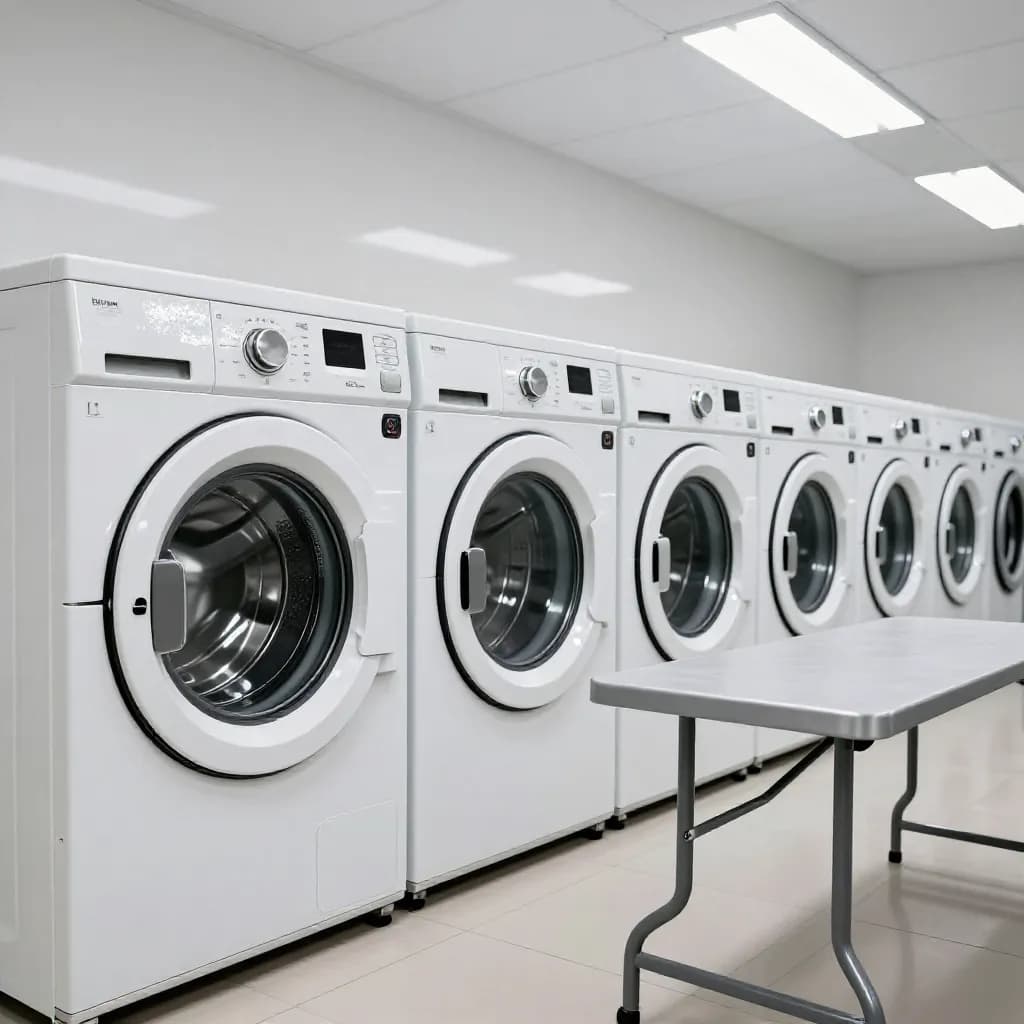
The equipment in a laundromat — commercial washers, dryers, folding tables, seating, vending machines, and change machines — represents a substantial capital investment that must deliver reliable service for 10-15 years to achieve acceptable return on investment. The finish on this equipment directly affects both its service life and the facility's customer appeal. Corroded, peeling, or discolored equipment drives customers to competing facilities, while well-maintained equipment communicates the cleanliness and care that laundromat customers value.
Ready to Start Your Project?
From one-off customs to 15,000-part production runs — get precise pricing in 24 hours.
On This Page
The Laundromat Environment: Moisture, Chemicals, and Heavy Use
Powder coating has become the standard finish for commercial laundry equipment because it provides the moisture barrier, chemical resistance, and mechanical durability that the laundromat environment demands. Major commercial laundry equipment manufacturers specify powder coating for their equipment housings, and the aftermarket refinishing of older equipment with powder coating extends the service life of existing machines at a fraction of replacement cost.
The laundromat industry is experiencing a renaissance as operators invest in modern, well-designed facilities that offer a premium customer experience. These upgraded laundromats feature designer color schemes, comfortable seating, entertainment options, and cafe-quality amenities. Powder coating supports this upgrade trend by enabling custom colors and finishes that transform utilitarian laundry equipment into design elements that contribute to the facility's aesthetic appeal.
Washer and Dryer Exterior Finishing
Commercial washer and dryer housings are the dominant visual elements in any laundromat, and their finish condition sets the tone for the entire facility. These housings are constructed from formed sheet steel and must withstand the vibration of machine operation, the humidity of the laundry environment, the chemical exposure from detergent and bleach splashes, and the mechanical abuse from customers loading and unloading laundry.
Powder coating on washer housings must resist the specific chemicals used in laundry operations. Laundry detergents are alkaline (pH 9-11) and contain surfactants that can penetrate porous coatings. Chlorine bleach is a strong oxidizer that attacks organic coatings. Fabric softeners contain cationic surfactants that can affect some coating systems. Polyester-epoxy hybrid powder coatings provide broad resistance to this range of laundry chemicals while maintaining the aesthetic quality needed for customer-facing equipment.
Vibration from machine operation creates fatigue stress in the coating system, particularly at corners, edges, and mounting points where stress concentrations occur. Commercial washers generate significant vibration during spin cycles, with unbalanced loads creating dynamic forces that flex the housing panels. Powder coating's inherent flexibility accommodates this vibration-induced flexing without the cracking that rigid coatings develop over time.
Dryer housings face the additional challenge of heat exposure. Commercial dryers operate at exhaust temperatures of 55-75°C, with housing surface temperatures reaching 40-60°C during operation. Standard polyester powder coatings handle these temperatures without difficulty, but the combination of heat and humidity accelerates coating degradation compared to either factor alone. Specifying coatings tested under combined heat-humidity conditions ensures adequate performance.
Top-loading washer lids and front-loading washer doors are the highest-contact surfaces on laundry equipment. These components are opened and closed hundreds of times per day, creating wear at hinge points and handle areas. The powder coating on these high-contact components should be specified with enhanced abrasion resistance and film thickness of 80-100 microns to provide additional wear margin.
Control panel areas on modern commercial laundry equipment incorporate digital displays, payment systems, and touch-screen interfaces. The powder coating surrounding these electronic components must provide electrical insulation and resist the moisture that is ever-present in the laundromat environment. Proper coating integrity around electronic interfaces prevents moisture-related electrical issues that could affect machine operation.
Folding Tables and Work Surfaces
Folding tables are essential laundromat fixtures that experience constant use throughout operating hours. Customers fold, sort, and stack laundry on these surfaces, creating wear from fabric abrasion, moisture from damp laundry, and chemical exposure from detergent and bleach residue on freshly washed items. The powder coating on folding table surfaces must provide a smooth, easy-to-clean surface that resists these combined exposures.
Table top surfaces require powder coating with a smooth finish that does not snag delicate fabrics. Surface roughness should be controlled to prevent pilling or snagging of knit fabrics and hosiery that are folded on the table. High-gloss or satin finishes provide the smoothest surface for fabric contact while also being the easiest to clean of detergent residue and lint accumulation.
Moisture resistance is critical for folding table surfaces because damp laundry is placed directly on the table during folding. The coating must resist prolonged moisture contact without blistering, softening, or allowing moisture to reach the substrate. Epoxy primer under the topcoat provides the moisture barrier needed for surfaces that experience continuous wet contact during operating hours.
Table legs and structural frames operate in the splash zone where water, detergent, and bleach accumulate on the floor and splash onto lower surfaces during machine loading and unloading. The coating on table legs must resist this concentrated chemical exposure, which is often more aggressive than the exposure on the table top because floor-level chemicals are more concentrated and contact times are longer between cleaning cycles.
Edge treatment on folding tables is important for both coating durability and customer safety. Sharp edges on table tops can snag fabric and create coating failure points where moisture penetrates. Radiusing all edges to a minimum of 1mm before coating ensures consistent film build on edges and eliminates fabric snagging. The powder coating's natural tendency to build thickness on radiused edges provides additional protection at these vulnerable points.
Antimicrobial powder coating on folding table surfaces provides hygiene benefits in a shared-use environment where multiple customers' laundry contacts the same surface throughout the day. While laundromat folding tables are not food contact surfaces, the antimicrobial properties reduce bacterial populations between cleaning cycles, supporting the clean environment that customers expect.
Seating, Carts, and Customer Amenities
Customer seating in laundromats must withstand heavy use in a humid, chemically active environment while providing the comfort that encourages customers to wait on-site rather than leaving during wash and dry cycles. Powder-coated metal seating — benches, chairs, and counter stools — provides the durability needed for this demanding application while enabling the design flexibility that modern laundromats use to differentiate their customer experience.
Bench seating along walls and between machine rows is the most common seating format in laundromats. These benches experience constant sitting, sliding, and the placement of laundry baskets and bags. The powder coating on bench surfaces must resist the abrasion from clothing and bags, the moisture from damp items placed on the bench, and the cleaning chemicals used to maintain hygiene. Textured powder coating on bench seats provides a non-slip surface that also masks the minor scratches from daily use.
Laundry carts with powder-coated steel frames are provided in many laundromats for customer convenience. These carts experience rough handling — overloading, collision with machines and walls, and the corrosive exposure from wet laundry and detergent residue. Heavy-duty powder coating at 100-125 microns on cart frames provides the impact and chemical resistance needed for this demanding application. Bright colors on laundry carts make them easy to locate in the facility and contribute to the laundromat's visual energy.
Vending machine housings and change machine enclosures are high-value targets for both corrosion and vandalism. Powder coating on these units provides corrosion protection in the humid laundromat environment while the hard, scratch-resistant surface resists the casual vandalism — scratching, sticker application, and marker graffiti — that vending equipment attracts. Anti-graffiti powder coating formulations allow graffiti to be removed without damaging the underlying finish.
Folding counter stools and standing-height work surfaces in premium laundromats provide comfortable work and waiting areas for customers who bring laptops or reading material. These amenity fixtures should be finished to a higher aesthetic standard than basic laundry equipment, with design-forward colors and finishes that communicate the premium positioning of the facility. Powder coating in contemporary colors with matte or satin finishes creates the modern, inviting atmosphere that premium laundromats cultivate.
Children's play area equipment in family-oriented laundromats requires powder coating that meets safety standards for children's furniture, including non-toxic formulations, rounded edges, and impact-resistant finishes. Bright, cheerful colors on play equipment create a welcoming environment for families while the durable powder coating withstands the energetic use that children's equipment receives.
Detergent and Bleach Chemical Resistance
The chemical resistance requirements for laundromat powder coating are defined by the specific products used in laundry operations. Understanding the chemistry of these products enables proper coating specification that ensures long-term performance in the laundromat environment.
Laundry detergents are alkaline formulations (pH 9-11) containing surfactants, builders, enzymes, and optical brighteners. The alkaline pH can hydrolyze ester bonds in some coating systems over time, while surfactants can penetrate micro-pores in the coating surface. Polyester powder coatings with good alkali resistance withstand detergent exposure without degradation, but the specific formulation should be tested with the detergents commonly used in the facility.
Chlorine bleach (sodium hypochlorite at 3-8% concentration) is the most aggressive chemical commonly encountered in laundromats. Hypochlorite is a strong oxidizer that can bleach pigments, degrade organic resins, and attack the coating-substrate interface. Epoxy-based powder coatings provide the best resistance to chlorine bleach, but even epoxy coatings can be affected by prolonged contact with concentrated bleach. Prompt cleaning of bleach splashes is the most effective protection strategy.
Oxygen bleach (sodium percarbonate) is less aggressive than chlorine bleach but still presents an oxidizing challenge to coating systems. The alkaline pH of dissolved oxygen bleach (pH 10-11) compounds the chemical stress. Polyester-epoxy hybrid coatings provide adequate resistance to oxygen bleach at normal use concentrations.
Fabric softeners contain cationic surfactants and silicone compounds that can affect some coating systems differently than anionic detergent surfactants. While fabric softener exposure is generally less aggressive than detergent or bleach exposure, the silicone content can leave residues on coated surfaces that affect appearance and cleanability. Regular cleaning removes fabric softener residue before it can build up.
Pre-treatment chemicals including stain removers, color-safe bleach alternatives, and enzyme-based pre-soak products add to the chemical diversity that laundromat coatings must resist. These products are typically used in small quantities but may be spilled or splashed on equipment surfaces during application. Broad-spectrum chemical resistance in the coating formulation provides protection against the full range of laundry chemicals that customers bring into the facility.
Facility Infrastructure and Utility Equipment
Beyond the customer-facing equipment, laundromat facilities contain infrastructure components that benefit from powder coating for protection and safety. Water heaters, plumbing manifolds, electrical panels, HVAC equipment, and structural steel all operate in the humid, chemically active laundromat environment and require appropriate corrosion protection.
Water supply and drain plumbing manifolds distribute water to multiple machines and collect wastewater for drainage. These plumbing components are exposed to the full humidity of the laundromat environment and may experience condensation on cold water lines. Powder coating on exposed plumbing provides corrosion protection while improving the visual appearance of utility infrastructure that may be visible to customers in open-plan laundromat designs.
Electrical panels and conduit in laundromat environments require powder coating that provides both corrosion protection and electrical insulation. The humidity levels in laundromats can cause condensation inside electrical enclosures, making moisture-resistant coating essential for electrical safety. Powder-coated electrical enclosures with proper sealing prevent moisture ingress while the coating's dielectric properties provide an additional insulation layer.
HVAC ductwork and ventilation equipment in laundromats handle air with elevated humidity and chemical content. The interior surfaces of ductwork benefit from powder coating that resists the corrosive atmosphere and provides a smooth surface that minimizes lint accumulation. Exterior ductwork surfaces visible to customers should be coated in colors that coordinate with the facility's design scheme.
Dryer exhaust ductwork operates at elevated temperatures and carries lint-laden air that creates both fire and corrosion hazards. Powder coating on dryer exhaust components must withstand the exhaust temperature (55-75°C) while providing a smooth interior surface that minimizes lint accumulation. Regular duct cleaning is essential regardless of the coating, but smooth powder-coated interiors facilitate more effective cleaning.
Structural steel columns, beams, and supports in the laundromat space require corrosion protection in the humid environment. Powder coating these structural elements in the facility's design colors transforms utilitarian structure into design elements while providing the corrosion protection needed for long-term structural integrity. This dual-purpose approach is particularly valuable in open-plan laundromat designs where structural elements are visible to customers.
Frequently Asked Questions
How does powder coating resist laundry detergent and bleach?
Polyester-epoxy hybrid powder coatings resist the alkaline pH (9-11) of laundry detergents and the surfactants they contain. Epoxy-based formulations provide the best resistance to chlorine bleach's oxidizing chemistry. Prompt cleaning of bleach splashes is recommended even on resistant coatings, as prolonged contact with concentrated bleach can affect any organic coating.
Can old laundromat equipment be refinished with powder coating?
Yes, existing washer and dryer housings can be stripped of their original finish and re-powder-coated to extend equipment life at a fraction of replacement cost. The process includes chemical or media stripping, surface preparation, pretreatment, and recoating. This is particularly cost-effective for commercial equipment with many years of mechanical life remaining.
What causes powder coating to fail in laundromat environments?
The most common failure causes are inadequate substrate preparation allowing moisture to undermine adhesion, insufficient film thickness that allows chemical penetration, and coating damage from impacts that is not repaired promptly. The combination of sustained humidity and alkaline chemical exposure accelerates any weakness in the coating system.
How should powder-coated laundromat equipment be maintained?
Clean all surfaces daily with pH-neutral cleaners to remove detergent and bleach residue. Wipe up chemical spills immediately, especially bleach. Inspect high-exposure areas weekly for coating damage and repair promptly. Avoid abrasive cleaning materials that scratch the coating surface. Annual professional inspection identifies early degradation.
What powder coating colors work best for laundromats?
Light colors like white and light gray communicate cleanliness but show every mark. Mid-tone colors in blues, greens, or warm grays balance cleanliness perception with practical maintenance. Bold accent colors on carts and seating add visual energy. Modern premium laundromats use contemporary color palettes that differentiate the facility from basic competitors.
Ready to Start Your Project?
From one-off customs to 15,000-part production runs — get precise pricing in 24 hours.