Intercooler piping is one of the most visible components on a turbocharged engine build. The charge pipes route from the turbo compressor outlet through the intercooler and into the intake manifold, often running across the front of the engine bay where they are immediately visible when the hood is opened. For builders who invest in quality intercooler kits and turbo systems, the finish on the piping is a significant part of the overall engine bay presentation.
Automotive
Powder Coating Intercooler Piping: Show-Quality Finishes for Turbocharged Vehicles
Sundial Powder Coating·April 23, 2026·9 min
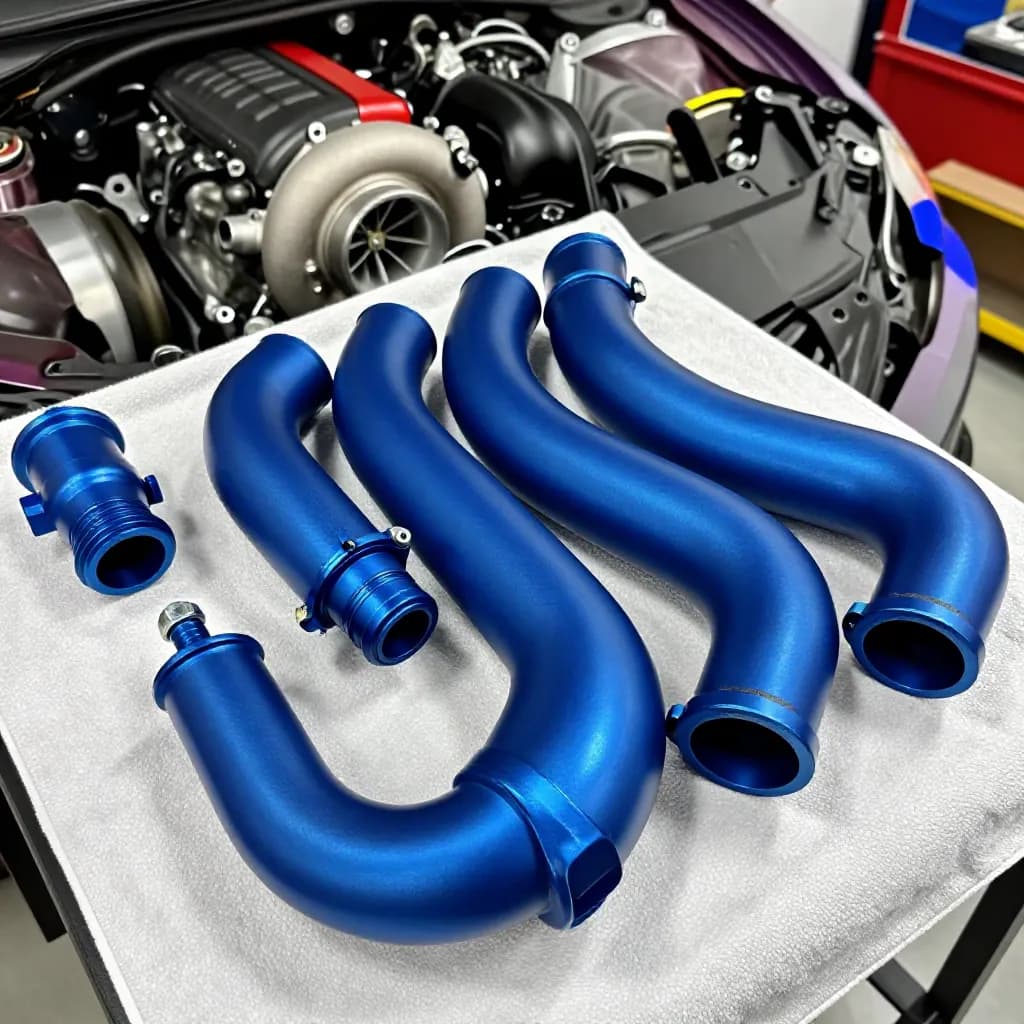
Beyond aesthetics, powder coating intercooler piping provides functional benefits. The coating protects aluminum pipes from oxidation and staining caused by heat cycling, oil vapors, and engine bay chemicals. Uncoated aluminum intercooler pipes develop a dull, blotchy appearance over time as the surface oxidizes unevenly, particularly in areas near heat sources. A powder-coated pipe maintains its appearance indefinitely with basic cleaning.
Ready to Start Your Project?
From one-off customs to 15,000-part production runs — get precise pricing in 24 hours.
On This Page
Why Powder Coat Intercooler Piping
The thermal properties of the coating also play a role. While the primary cooling function of the intercooler system occurs at the intercooler core itself, the charge pipes between the turbo and intercooler carry hot compressed air that can absorb additional heat from the engine bay. A light-colored powder coat on these hot-side pipes reflects radiant heat and provides a modest insulating effect, helping to keep charge air temperatures in check.
Aluminum Pipe Preparation
Intercooler piping is almost exclusively made from aluminum, typically 6061-T6 drawn tubing or mandrel-bent pipe. Aluminum is chosen for its light weight, good thermal conductivity, and ease of fabrication. Preparing aluminum intercooler pipes for powder coating requires attention to the specific characteristics of this material.
New aluminum pipes from aftermarket intercooler kits often arrive with a mill finish or light anodizing. The mill finish includes a thin oxide layer and may have drawing lubricants or protective oils on the surface. These must be completely removed through alkaline cleaning followed by a thorough rinse. The oxide layer should be removed or converted through chemical pretreatment rather than relied upon for adhesion, as the natural oxide is inconsistent and weakly bonded.
Abrasive blasting with fine aluminum oxide or glass bead at low to moderate pressure creates an ideal surface profile for powder adhesion. Aluminum intercooler pipes are typically thin-walled, ranging from 1.5 to 3 millimeters, so blast pressure must be controlled to avoid warping or distorting the pipe. Mandrel bends are particularly susceptible to distortion because the material is already work-hardened and stressed from the bending process.
A chromate-free conversion coating applied after blasting provides the chemical adhesion layer that is critical for long-term coating durability on aluminum. This step transforms the aluminum surface into a chemically bonded conversion layer that dramatically improves powder adhesion and corrosion resistance. Skipping this step is the most common cause of premature coating failure on aluminum intercooler pipes.
Welded joints on fabricated piping kits should be inspected for porosity and cleaned of any weld discoloration before coating. A light pre-bake at cure temperature drives out any trapped gases from weld areas.
Heat Cycling and Thermal Durability
Intercooler piping experiences significant thermal cycling during normal operation. The hot-side pipe between the turbo compressor and the intercooler can reach 100-200 degrees Celsius under boost, depending on the turbo size, boost pressure, and ambient temperature. The cold-side pipe between the intercooler and the throttle body runs cooler but still cycles between ambient temperature and 40-80 degrees Celsius during driving.
This thermal cycling subjects the coating to repeated expansion and contraction stress. Aluminum has a relatively high coefficient of thermal expansion, and the pipe diameter changes measurably between cold and hot conditions. The powder coating must be flexible enough to accommodate this movement without cracking or delaminating.
Standard polyester powder coatings handle the thermal range of intercooler piping without difficulty. Polyester powders are rated for continuous service at 150 degrees Celsius and can tolerate brief excursions to 180-200 degrees Celsius. For most turbocharged applications, the hot-side pipe temperatures fall within this range. Vehicles running very high boost levels or large turbos that generate extreme compressor outlet temperatures may benefit from a high-temperature powder formulation on the hot-side pipe.
The cold-side pipe operates well within the thermal comfort zone of any standard powder coating. Temperature cycling on the cold side is modest, and the coating experiences minimal thermal stress. Standard polyester in any color and finish is appropriate for cold-side piping.
Thermal cycling can also cause adhesion failure if the surface preparation was inadequate. The differential expansion between the aluminum substrate and the powder coat creates shear stress at the interface. A properly prepared surface with chemical conversion coating distributes this stress across a strong chemical bond. A poorly prepared surface with only mechanical adhesion may delaminate as the thermal cycles accumulate.
Boost Pressure and Coating Integrity
A common question from turbocharged vehicle owners is whether powder coating affects the pressure integrity of intercooler piping. The concern is that the coating process, specifically the cure temperature, might weaken the aluminum pipe or that the coating itself might fail under boost pressure and send debris into the engine.
The cure temperature concern is addressed by understanding aluminum metallurgy. The standard powder coating cure of 190-200 degrees Celsius for 10-15 minutes at metal temperature does not significantly affect the mechanical properties of 6061-T6 aluminum. The alloy retains over 95 percent of its yield strength after this brief thermal exposure. The pipe's pressure rating is determined by its wall thickness, diameter, and alloy properties, none of which are meaningfully changed by the coating process.
The coating itself does not contribute to or detract from the pipe's pressure capacity. At 60-80 microns thickness, the powder coat is far too thin to provide structural reinforcement, and it does not create any weakness in the pipe wall. The coating simply sits on the exterior surface as a protective and decorative layer.
Regarding debris concerns, a properly adhered powder coat does not flake or delaminate into the airstream. The coating is on the exterior of the pipe, not the interior, so even if the exterior coating were damaged, no material would enter the charge air path. The interior of the pipe should not be coated, both because it is unnecessary and because any interior coating could potentially flake and be ingested by the engine.
Coupler and clamp interfaces where silicone couplers connect pipe sections should be considered. The powder coat surface provides a slightly different grip characteristic than bare aluminum for silicone couplers. In practice, properly tightened T-bolt clamps seal effectively against powder-coated surfaces, but some builders prefer to leave the last 10-15 millimeters of each pipe end uncoated for maximum coupler grip.
Color Options and Show-Quality Finishing
Intercooler piping offers one of the best opportunities for color expression in a turbocharged engine bay. The pipes are prominently visible, have smooth cylindrical surfaces that showcase color and finish quality, and can be coated in virtually any color to complement the build theme.
The most popular colors for intercooler piping include wrinkle red, gloss blue, satin black, candy purple, and polished chrome-look silver. These colors create visual contrast against the engine and intercooler core, drawing the eye to the turbo system as a focal point of the build. Matching the pipe color to other engine bay accents like valve covers, intake manifolds, or strut tower braces creates a cohesive, intentional appearance.
Metallic and candy finishes are particularly striking on the smooth, cylindrical surface of intercooler pipes. The curved surface creates a natural gradient of light reflection that enhances the depth and complexity of metallic flake and translucent candy layers. A candy red or candy blue intercooler pipe catches light beautifully and is a guaranteed attention-getter at car shows and meets.
For a more subtle approach, satin black or gunmetal grey provides a clean, understated look that lets other engine bay components take center stage. These finishes are also more forgiving of minor surface imperfections and fingerprints than high-gloss colors.
Two-tone piping is achievable through masking. Coating the main pipe body in one color and the weld beads or bead-rolled sections in a contrasting color highlights the fabrication details. Some builders coat the hot-side and cold-side pipes in different colors to visually distinguish the two sides of the intercooler system.
Masking Couplers, Sensors, and BOV Flanges
Intercooler piping includes several interface points that require masking during the powder coating process. Blow-off valve flanges, boost pressure sensor bungs, intercooler inlet and outlet flanges, and coupler sealing surfaces all need protection to maintain proper function after coating.
Blow-off valve and bypass valve flanges must be masked to maintain the flat sealing surface and bolt hole dimensions. Powder buildup on the flange face can prevent proper gasket sealing, leading to boost leaks. Use high-temperature masking tape or a silicone gasket cut to match the flange pattern. After coating, verify that the flange surface is clean and flat, and chase bolt holes with the appropriate tap.
Boost pressure sensor bungs and MAP sensor fittings should be plugged with silicone plugs during coating. These threaded fittings require clean threads for proper sensor installation, and coating buildup can affect the sensor's ability to read accurate boost pressure. After coating, verify thread cleanliness and sensor fitment.
The pipe ends where silicone couplers attach can be masked or coated depending on preference. If coating the pipe ends, verify that the silicone couplers still seal properly with T-bolt clamps. Some builders apply a thin bead of silicone sealant inside the coupler for additional sealing assurance on coated pipe ends.
Weld-on bungs for water-methanol injection nozzles, boost gauges, and other accessories should be welded before coating so the entire assembly is coated as one piece. Welding after coating will burn the powder in the heat-affected zone and require touch-up or recoating of the damaged area.
Installation and Maintenance Tips
Installing powder-coated intercooler piping requires care to protect the fresh finish during assembly. The pipes should be handled with clean gloves, and silicone couplers should be slid on gently to avoid scratching the coating. T-bolt clamps should be tightened evenly and to the manufacturer's recommended torque to avoid crushing the pipe or cracking the coating under excessive clamping force.
During installation, avoid using metal tools directly against the coated surface. Pliers, wrenches, and pry bars will scratch and chip the powder coat. If leverage is needed to align pipes during assembly, use a rubber mallet or wrap the tool contact point with a cloth or rubber pad.
After installation, verify all connections for boost leaks. A boost leak test using a pressure tester connected to the intake system will reveal any leaks at coupler joints, BOV flanges, or sensor fittings. Address any leaks before driving the vehicle, as boost leaks reduce performance and can cause lean conditions that damage the engine.
Maintaining the finish is simple. Clean the pipes periodically with a mild automotive detailer or all-purpose cleaner to remove oil mist, dust, and fingerprints. Avoid abrasive cleaners and harsh solvents. For show vehicles, a light application of spray wax or ceramic coating enhances the gloss and provides a hydrophobic layer that repels water and oil.
Inspect the coating periodically for chips or scratches, particularly at clamp locations and where the pipes pass near other engine bay components. Touch up any damage with matching touch-up paint to maintain the appearance and prevent corrosion of the aluminum substrate. A well-maintained set of powder-coated intercooler pipes will remain a highlight of the engine bay for years.
Frequently Asked Questions
Does powder coating intercooler pipes affect boost pressure?
No. Powder coating is applied to the exterior of the pipe only and does not affect the internal diameter, wall strength, or pressure capacity. The cure temperature does not weaken 6061-T6 aluminum. Properly tightened T-bolt clamps seal effectively against powder-coated pipe surfaces.
Can the hot-side intercooler pipe handle powder coating temperatures?
Standard polyester powder coatings are rated for continuous service at 150 degrees Celsius, which covers most hot-side pipe temperatures. For vehicles running very high boost with compressor outlet temperatures above 150 degrees Celsius, a high-temperature powder formulation is recommended for the hot-side pipe.
Should I coat the inside of intercooler pipes?
No. The interior of intercooler pipes should not be coated. Interior coating is unnecessary for corrosion protection, could flake and be ingested by the engine, and would create a rougher surface that slightly increases airflow resistance. Coat the exterior only.
What is the best color for intercooler piping?
The best color depends on the build theme. Wrinkle red, gloss blue, and candy finishes are popular for show builds. Satin black and gunmetal grey provide a clean, understated look. Matching the pipe color to valve covers or intake manifold creates a cohesive engine bay appearance.
Will silicone couplers seal on powder-coated pipe ends?
Yes, with properly tightened T-bolt clamps. The powder coat surface provides adequate grip for silicone couplers. Some builders leave the last 10-15 millimeters of pipe ends uncoated for maximum coupler grip, or apply a thin bead of silicone sealant inside the coupler for extra assurance.
Ready to Start Your Project?
From one-off customs to 15,000-part production runs — get precise pricing in 24 hours.