Powder coating heat sinks and electronic components presents a fundamental engineering trade-off: the coating must provide corrosion protection, electrical insulation, and aesthetic appeal without significantly degrading the thermal performance that these components are designed to deliver. Understanding this trade-off — and the techniques available to manage it — is essential for engineers specifying coatings for thermal management hardware.
Technical
Powder Coating for Heat Sinks and Electronics: Balancing Thermal Performance with Protection
Sundial Powder Coating·April 23, 2026·12 min
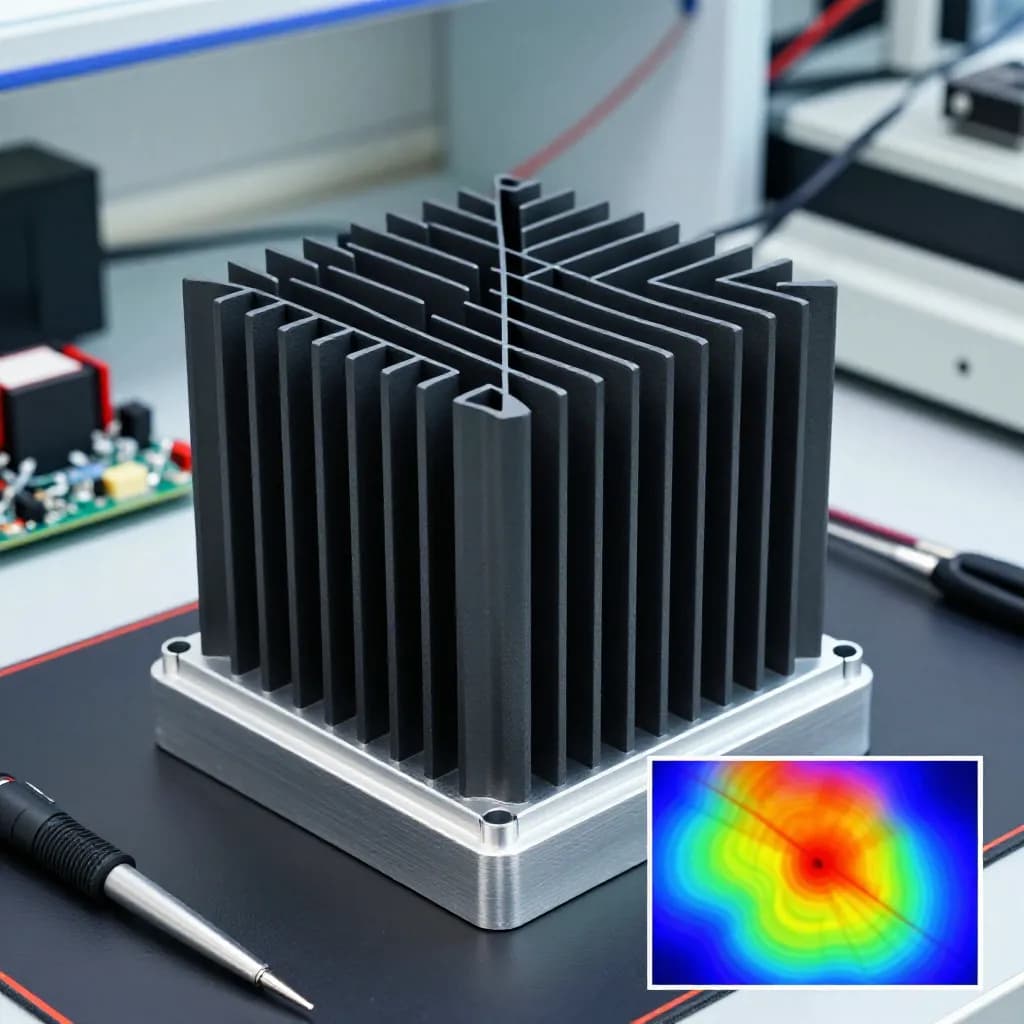
Heat sinks function by transferring thermal energy from electronic components to the surrounding air through conduction and convection. Any coating applied to a heat sink introduces an additional thermal resistance layer between the metal substrate and the cooling air. The magnitude of this thermal penalty depends on the coating's thermal conductivity, its thickness, and the specific heat sink geometry and airflow conditions.
Ready to Start Your Project?
From one-off customs to 15,000-part production runs — get precise pricing in 24 hours.
On This Page
The Thermal-Protection Trade-Off in Electronics Coating
Powder coatings are thermal insulators relative to the aluminum and copper substrates they cover. Typical powder coatings have thermal conductivity values of 0.2-0.5 W/m·K, compared to 205 W/m·K for aluminum and 385 W/m·K for copper. This three-orders-of-magnitude difference means that even thin coatings can measurably affect thermal performance if not properly engineered.
However, the relationship between coating and thermal performance is more nuanced than simple conduction resistance suggests. Coating color and surface emissivity significantly affect radiative heat transfer, and surface texture influences convective heat transfer coefficients. In many real-world applications, a properly selected powder coating can actually improve overall thermal performance compared to a bare, polished metal surface — a counterintuitive result that this article explores in detail.
Thermal Conductivity Impact: Quantifying the Coating Penalty
To make informed decisions about coating heat sinks, engineers need quantitative data on the thermal impact of powder coatings at various thicknesses. The thermal resistance added by a coating layer is calculated as R = t/k, where t is the coating thickness in meters and k is the thermal conductivity in W/m·K.
For a typical powder coating with k = 0.3 W/m·K applied at 50 microns (0.00005 m), the added thermal resistance is 0.000167 m²·K/W. For context, the convective thermal resistance at a heat sink surface in natural convection is typically 0.01-0.05 m²·K/W — roughly 60-300 times larger than the coating resistance. This means that in natural convection applications, a 50-micron powder coating adds less than 1% to the total thermal resistance of the system.
In forced convection applications with high airflow velocities, the convective resistance is lower (0.001-0.01 m²·K/W), and the relative impact of the coating increases. At 50 microns, the coating may add 2-15% to the total thermal resistance depending on airflow conditions. At 100 microns — a more typical powder coating thickness — the impact doubles.
These calculations explain why thin-film powder coating techniques are critical for heat sink applications. By controlling film thickness to 25-50 microns — roughly half the thickness of standard industrial powder coating — the thermal penalty is minimized to levels that are acceptable for most applications. Achieving these thin films consistently requires careful control of powder particle size distribution, application parameters, and curing conditions.
Thermally conductive powder coatings represent an emerging solution to the thermal penalty problem. These formulations incorporate thermally conductive fillers — aluminum oxide, boron nitride, or aluminum nitride particles — that increase the coating's thermal conductivity to 1-5 W/m·K, reducing the thermal resistance by a factor of 3-15 compared to standard formulations.
Color and Emissivity: How Coating Color Affects Thermal Performance
One of the most significant and often overlooked effects of powder coating on heat sink performance is the change in surface emissivity. Bare aluminum has a surface emissivity of only 0.04-0.09, meaning it radiates very little thermal energy. A powder-coated surface, regardless of color, has an emissivity of 0.85-0.95 — a dramatic increase that significantly enhances radiative heat transfer.
In natural convection environments where radiation can account for 25-50% of total heat dissipation, this emissivity increase can more than compensate for the conductive thermal penalty of the coating. Studies have demonstrated that black powder-coated heat sinks operating in natural convection can run 5-10°C cooler than identical bare aluminum heat sinks, despite the added thermal resistance of the coating layer.
The common assumption that black coatings perform significantly better than other colors is largely a myth in the context of thermal radiation at electronics operating temperatures. At temperatures below 200°C, the thermal radiation spectrum is entirely in the infrared range, and the emissivity of powder coatings in the infrared is nearly independent of visible color. A white powder-coated heat sink has virtually the same infrared emissivity as a black one, and both radiate heat far more effectively than bare aluminum.
There are measurable differences between colors in solar absorption, which matters for outdoor electronics exposed to direct sunlight. Dark colors absorb more solar radiation, increasing the thermal load on the heat sink. For outdoor LED luminaires, telecommunications equipment, and solar inverters, lighter colors reduce solar heat gain while maintaining the high infrared emissivity needed for effective radiative cooling.
Matte and textured finishes provide a slight additional benefit over high-gloss finishes. The increased surface area of a textured coating enhances both convective and radiative heat transfer, though the effect is modest — typically 2-5% improvement compared to a smooth gloss finish of the same color. For applications where every degree matters, specifying a matte or fine texture finish provides a small but meaningful thermal advantage.
Thin-Film Powder Coating Techniques for Electronics
Achieving consistent thin-film powder coatings in the 25-50 micron range required for heat sink applications demands specialized techniques that differ significantly from standard industrial powder coating practice. The challenge is that conventional powder coatings are formulated and applied to produce films of 60-120 microns, and simply reducing application parameters does not reliably produce thin, uniform films.
Powder particle size is the primary factor controlling minimum achievable film thickness. Standard powder coatings have a median particle size (D50) of 30-40 microns, making it physically difficult to produce uniform films below 50 microns. Thin-film powder coatings use finer particle size distributions with D50 values of 15-25 microns, enabling consistent films as thin as 25 microns. These fine powders require modified fluidization and transport systems, as their higher surface-area-to-volume ratio increases interparticle cohesion and makes them more difficult to fluidize and convey.
Application equipment must be optimized for thin-film work. Lower gun voltages (20-40 kV for corona guns) reduce the tendency for back-ionization — a phenomenon where excessive charge buildup on the substrate repels incoming powder particles, causing orange peel and uneven coverage. Tribo-charging guns are often preferred for thin-film applications because they deposit powder more uniformly without the strong edge-attraction effects of corona charging.
Curing parameters require adjustment for thin films. Thinner coatings reach curing temperature faster than standard-thickness films, and the reduced thermal mass means they are more susceptible to overcure if oven conditions are not precisely controlled. Infrared curing systems offer advantages for thin-film electronics coating, as they heat the coating directly rather than relying on convective heat transfer through the oven atmosphere, enabling faster cure cycles with less risk of substrate overheating.
For the most demanding thin-film applications, electrophoretic powder coating (powder-in-water suspension applied by electrodeposition) can achieve films as thin as 15-20 microns with excellent uniformity. This hybrid technology combines the environmental benefits of powder coating with the thin-film capability of electrocoating, though it requires specialized equipment and is currently limited to high-volume production applications.
LED Lighting and Power Electronics Applications
LED lighting fixtures and power electronics represent two of the fastest-growing application areas for powder-coated heat sinks, driven by the rapid expansion of solid-state lighting and the electrification of transportation and energy systems.
LED luminaires depend on effective thermal management to maintain light output, color consistency, and operating life. LED junction temperatures above 85-100°C accelerate lumen depreciation and color shift, making heat sink performance critical to luminaire longevity. Powder-coated aluminum heat sinks are the standard thermal solution for commercial and industrial LED fixtures, with the coating serving triple duty as corrosion protection, aesthetic finish, and thermal radiation enhancer.
For outdoor LED luminaires — street lights, area lights, and architectural fixtures — the coating must withstand UV exposure, rain, salt spray, and temperature cycling while maintaining thermal performance. Super-durable polyester powder coatings meeting AAMA 2604 or Qualicoat Class 2 specifications provide the weathering resistance needed for 20+ year outdoor service. White and light gray colors are preferred for their lower solar absorption, reducing the additional thermal load from sunlight on the heat sink.
Power electronics — inverters, converters, motor drives, and charging systems — generate concentrated heat loads that demand aggressive thermal management. The heat sinks in these systems often feature dense fin arrays with narrow channels that are challenging to coat uniformly. Electrostatic powder application struggles to penetrate between closely spaced fins due to the Faraday cage effect, and excessive coating in fin channels can restrict airflow and degrade thermal performance.
For power electronics heat sinks with fin spacing below 5 mm, selective coating strategies may be appropriate. The base plate and fin tips are coated for corrosion protection and emissivity enhancement, while the fin channels are left uncoated or receive only a minimal coating to maintain airflow. This selective approach requires careful masking or robotic application but optimizes the balance between protection and thermal performance.
EV battery thermal management systems represent an emerging application where powder-coated heat sinks and cold plates must meet automotive durability requirements including vibration resistance, thermal shock cycling (-40°C to +85°C), and resistance to automotive fluids.
Electrical Insulation and EMI Shielding Considerations
Beyond thermal management, powder coatings on electronic heat sinks and enclosures serve important electrical functions — providing insulation where isolation is needed and, in some configurations, contributing to electromagnetic interference (EMI) shielding.
Powder coatings are inherently electrically insulating, with dielectric strength values of 20-40 kV/mm for standard formulations. A 50-micron powder coating provides a dielectric withstand voltage of 1000-2000 volts — sufficient for electrical isolation in many low-voltage electronics applications. This insulating property is valuable for heat sinks that are electrically connected to semiconductor devices, as the coating can provide the creepage and clearance distances required by safety standards such as IEC 62368-1 and UL 60950-1.
However, the insulating nature of powder coatings can be problematic for EMI shielding applications where electrical continuity between enclosure components is required. EMI shielding effectiveness depends on the enclosure forming a continuous conductive shell (Faraday cage) around the electronics. Powder-coated joints and mating surfaces break this continuity, creating gaps in the shield that allow electromagnetic energy to leak.
Solutions for maintaining EMI shielding on powder-coated enclosures include masking mating surfaces to maintain bare metal contact, using conductive gaskets or finger stock at joints, and specifying electrically conductive powder coatings for applications where both coating protection and EMI shielding are required. Conductive powder coatings incorporate metallic or carbon-based fillers that reduce surface resistivity to levels compatible with EMI shielding, though their conductivity is lower than bare metal.
For grounding connections on powder-coated heat sinks and enclosures, designated grounding points must be masked during coating to provide bare metal contact for grounding lugs or screws. These grounding points should be clearly marked on engineering drawings and protected with corrosion-inhibiting compound after assembly to prevent galvanic corrosion at the bare metal interface.
The interaction between powder coating and thermal interface materials (TIMs) used between electronic components and heat sinks is another important consideration. The coating surface must be compatible with the TIM — thermal greases, phase-change materials, and thermal pads must wet and adhere to the coated surface to maintain low thermal resistance at the interface.
Design Guidelines for Coated Electronic Heat Sinks
Designing heat sinks for powder coating requires consideration of coating effects from the earliest stages of thermal and mechanical design. Retrofitting a coating onto a heat sink designed for bare metal operation often results in compromised thermal performance or coating quality issues.
Fin geometry should account for coating thickness. If the design calls for 2 mm fin spacing and the coating adds 50 microns to each fin surface, the effective air channel width is reduced to 1.9 mm — a 5% reduction that increases airflow resistance. For dense fin arrays, this reduction can meaningfully affect airflow and thermal performance. Designing with slightly wider fin spacing to accommodate the coating maintains the intended airflow characteristics.
Minimum fin thickness should be increased to account for the coating's thermal resistance. A 1 mm bare aluminum fin has a fin efficiency of approximately 95% for typical natural convection conditions. Adding 50 microns of powder coating to each side reduces effective fin efficiency by 1-3%, depending on fin height and airflow conditions. Increasing fin thickness by 0.1-0.2 mm compensates for this effect.
Sharp edges and corners on heat sink extrusions attract excessive powder buildup due to electrostatic edge effects. Radiusing edges to 0.5 mm minimum improves coating uniformity and reduces the risk of thin spots adjacent to heavy edge buildup. This radius also improves the mechanical durability of the coating, as sharp edges are stress concentration points where coatings are most vulnerable to chipping and cracking.
Mounting surfaces and thermal interface areas should be designed with masking in mind. Recessed mounting pads that are slightly below the surrounding surface simplify masking and protect the bare metal interface area from accidental coating during application. Alignment features such as dowel holes or registration marks help ensure consistent mask placement in production.
For heat sinks that will be powder coated, specify the coating requirements on the engineering drawing including: powder type, color, minimum and maximum film thickness, areas to be masked, and any special requirements for thermal interface surfaces. This information ensures that the coating applicator can plan the process correctly and that incoming inspection can verify compliance.
Frequently Asked Questions
Does powder coating reduce heat sink thermal performance?
It depends on the application. In natural convection, powder coating typically improves overall thermal performance because the high emissivity (0.85-0.95) of the coated surface dramatically increases radiative heat transfer, more than compensating for the coating's conductive resistance. In forced convection with high airflow, a thin 25-50 micron coating adds only 1-5% to total thermal resistance.
Does the color of powder coating affect heat sink performance?
At electronics operating temperatures, all powder coating colors have nearly identical infrared emissivity (0.85-0.95), so thermal radiation performance is essentially color-independent. However, for outdoor applications exposed to sunlight, lighter colors absorb less solar radiation, reducing additional heat gain by 10-30% compared to dark colors.
How thin can powder coating be applied on heat sinks?
Using fine-particle powder formulations (D50 of 15-25 microns) and optimized application parameters, consistent films of 25-50 microns are achievable. Electrophoretic powder coating can achieve films as thin as 15-20 microns. Standard powder coatings with typical particle sizes cannot reliably produce uniform films below 50 microns.
Can powder-coated heat sinks provide electrical insulation?
Yes. Standard powder coatings have dielectric strength of 20-40 kV/mm, so a 50-micron coating provides 1000-2000 volts of dielectric withstand. This is sufficient for electrical isolation in many low-voltage applications and can contribute to meeting creepage and clearance requirements per IEC 62368-1.
What about EMI shielding on powder-coated electronics enclosures?
Standard powder coatings are electrically insulating and break EMI shielding continuity at joints. Solutions include masking mating surfaces for bare metal contact, using conductive gaskets at joints, or specifying electrically conductive powder coatings with metallic or carbon fillers that maintain shielding effectiveness while providing corrosion protection.
Ready to Start Your Project?
From one-off customs to 15,000-part production runs — get precise pricing in 24 hours.