Hangar doors and large-format industrial doors represent the extreme end of powder coating applications — structures that can span 30-100 meters in width and 10-25 meters in height, with individual door panels weighing several tons. These massive structures must withstand decades of weather exposure, mechanical cycling, and operational stress while maintaining their appearance and protective function.
Industrial
Powder Coating for Hangar Doors and Large-Format Industrial Doors
Sundial Powder Coating·April 23, 2026·12 min
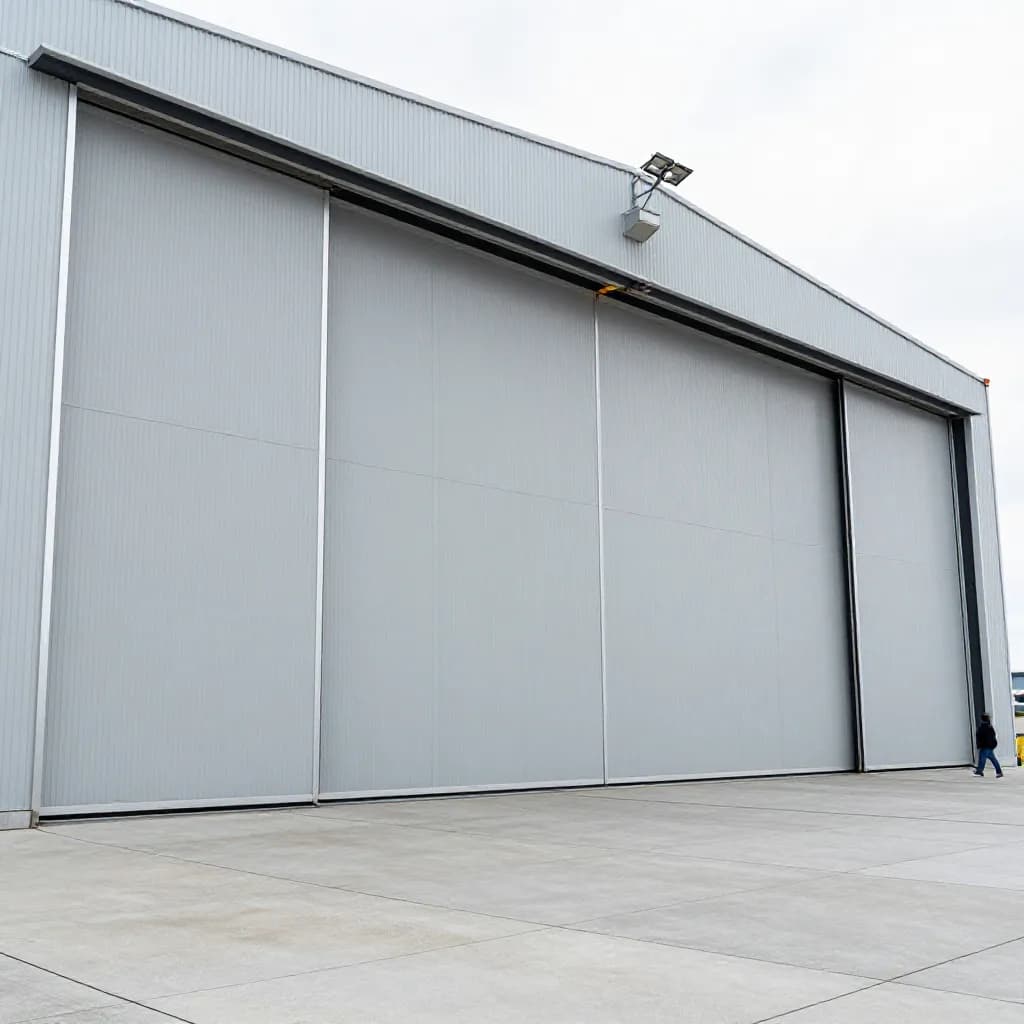
Aviation hangars house some of the world's most valuable assets — commercial aircraft worth hundreds of millions of dollars, military aircraft with classified technology, and maintenance equipment essential for aviation safety. The doors that protect these assets must operate reliably in all weather conditions, resist corrosion from jet fuel, deicing chemicals, and coastal atmospheres, and present a professional appearance that reflects the facility's operational standards.
Ready to Start Your Project?
From one-off customs to 15,000-part production runs — get precise pricing in 24 hours.
On This Page
Hangar Doors and Industrial Doors: Coating at Architectural Scale
Industrial doors for warehouses, distribution centers, manufacturing facilities, and agricultural buildings face similar demands at somewhat smaller scales. These doors cycle thousands of times per year, are exposed to wind, rain, snow, and UV radiation, and must maintain their structural integrity and weather sealing throughout a service life of 20-30 years.
Powder coating has become the preferred finishing technology for these large-format door systems, replacing liquid paint that required extensive scaffolding, long drying times, and generated significant VOC emissions. The challenge of powder coating at this scale — managing thermal mass, achieving uniform coverage on structures that may not fit in standard ovens, and maintaining quality across enormous surface areas — has driven innovation in application equipment, curing technology, and quality control methods.
This article examines the specific requirements and techniques for powder coating hangar doors and large industrial doors, from panel fabrication through field installation and long-term maintenance.
Large-Format Coating Challenges: Size, Weight, and Thermal Mass
The sheer size of hangar door and industrial door panels creates coating challenges that do not exist at conventional industrial scales. A single hangar door panel may measure 5-15 meters wide and 10-20 meters tall, with a weight of 2,000-10,000 kg. Processing components of this size requires specialized equipment, facilities, and techniques.
Oven size is often the limiting factor for powder coating large door panels. Standard industrial curing ovens accommodate parts up to 2-3 meters in their largest dimension, while hangar door panels can exceed 15 meters. Purpose-built ovens for large-format coating are expensive capital investments, and only a limited number of coating facilities worldwide can accommodate the largest door panels.
For panels that exceed oven capacity, several alternative curing approaches are used. Infrared curing systems — banks of IR emitters mounted on movable gantries — can cure powder coating on panels of virtually unlimited size by scanning the emitters across the panel surface. The IR energy heats the coating directly without needing to heat the entire panel mass, reducing energy consumption and enabling curing in open factory spaces rather than enclosed ovens.
Induction curing is another option for steel door panels. Induction coils positioned near the panel surface generate eddy currents in the steel substrate, heating the metal from within and curing the coating from the substrate outward. This approach is energy-efficient and can be applied to panels of any size, though it requires careful control to achieve uniform heating across the panel area.
Batch oven curing remains the preferred method when panel size permits, as it provides the most uniform and controllable cure conditions. Walk-in or drive-in ovens that accommodate panels up to 6-8 meters in their largest dimension serve the majority of industrial door panel coating requirements. For larger panels, the panel may be coated and cured in sections, with careful blending at the section boundaries to maintain uniform appearance.
The thermal mass of large steel panels affects both heating and cooling rates during curing. A panel fabricated from 3 mm steel plate weighing 2,000 kg requires significant energy input to reach curing temperature, and the oven must maintain temperature uniformity across the entire panel surface to prevent undercure in some areas and overcure in others. Temperature mapping using multiple thermocouples distributed across the panel surface verifies uniform cure conditions.
Aviation Hangar Door Requirements
Aviation hangar doors operate in a demanding environment that combines weather exposure, chemical contact, mechanical cycling, and the need for reliable operation in all conditions. The coating system must address all of these demands while meeting the aesthetic standards expected of aviation facilities.
Corrosion protection is the primary coating function for hangar doors. These structures are exposed to rain, snow, UV radiation, and wind-driven salt in coastal locations. Additionally, hangar doors are exposed to aviation-specific chemicals including jet fuel (Jet A-1), hydraulic fluid (Skydrol), deicing fluids (propylene glycol and ethylene glycol-based), and runway deicing chemicals (potassium acetate, sodium formate). The coating must resist all of these chemicals without softening, blistering, or losing adhesion.
Polyester powder coatings are the standard choice for hangar door exteriors, providing excellent UV resistance and weathering performance for the exposed face of the door. Super-durable polyester formulations meeting AAMA 2604 or Qualicoat Class 2 specifications provide the 20-25 year color retention and gloss retention needed for aviation facilities. For coastal airports, AAMA 2605 or Qualicoat Class 3 specifications may be required for maximum weathering resistance.
The interior face of hangar doors is exposed to a different environment — jet fuel vapors, hydraulic fluid mist, and cleaning chemicals used during aircraft maintenance. Epoxy or epoxy-polyester powder coatings provide better chemical resistance than polyester for interior surfaces, and the lack of UV exposure on the interior makes epoxy's poor UV resistance irrelevant.
For hangar doors with different coating requirements on interior and exterior faces, a dual-system approach is used. The exterior receives polyester for weathering resistance, while the interior receives epoxy for chemical resistance. This requires two separate coating operations with masking between them, adding complexity but optimizing performance for each exposure environment.
Mechanical durability is important for hangar doors that are subject to impacts from ground support equipment, aircraft tow bars, and maintenance vehicles. The coating must resist chipping and scratching from these impacts, and any damage must be easily repairable in the field. Epoxy-polyester hybrid coatings provide a good balance of chemical resistance and impact toughness for hangar door applications.
Color selection for aviation hangar doors often follows corporate branding requirements or airport authority standards. White and light gray are common choices for their solar reflectance properties (reducing thermal loading on the door structure) and their clean, professional appearance. Custom colors matching airline or airport branding are readily achievable with powder coating.
Weather Sealing and Coating Interface Design
The weather sealing system on hangar doors and industrial doors interfaces directly with the coating, and the design of this interface affects both sealing performance and coating durability. Proper coordination between the door manufacturer, the seal supplier, and the coating applicator ensures that the coating and sealing systems work together rather than against each other.
Bottom seals — the flexible elements that close the gap between the door bottom edge and the floor — slide across the coating surface every time the door operates. The friction between the seal and the coating can wear the coating over time, particularly at the bottom rail where the seal contact pressure is highest. Specifying a hard, abrasion-resistant powder coating (pencil hardness of 2H or harder) on the bottom rail area minimizes seal-induced wear.
Side and top seals compress against the coating surface when the door is closed, and the seal material must be compatible with the powder coating. Silicone rubber seals are generally compatible with all powder coating types, but EPDM and neoprene seals may contain plasticizers that can migrate into the coating surface, causing softening or discoloration. Compatibility testing between the specific seal material and powder coating should be performed during the door design phase.
The coating at seal contact areas must maintain its adhesion and integrity through thousands of compression-release cycles. Each door operation compresses the seal against the coating and then releases it, creating cyclic stress that can cause coating fatigue and delamination if adhesion is marginal. Thorough surface preparation and adequate film thickness (80-100 microns) at seal contact areas provide the durability needed for reliable long-term performance.
Drainage channels and weep holes in the door frame must remain clear of coating material to function properly. These features allow water that penetrates past the primary seals to drain away rather than accumulating in the door frame where it would cause corrosion. Masking drainage features during coating, or clearing them after coating, ensures proper water management.
Thermal movement of large door panels — expansion and contraction due to temperature changes — creates relative movement between the door panel and the sealing system. A hangar door panel 15 meters wide can expand by 3-4 mm between winter and summer temperatures, and this movement must be accommodated by the seal design without damaging the coating at the seal interface. Flexible seal designs that allow sliding movement rather than fixed compression accommodate thermal movement without coating damage.
For doors in cold climates, ice formation at the seal interface can bond the seal to the coating surface, and forcing the door open can tear the coating from the substrate. Anti-icing provisions — heated seal tracks, hydrophobic coating treatments, or mechanical ice-breaking systems — prevent ice bonding and protect the coating from ice-related damage.
Panel Fabrication and Coating Sequence
The fabrication sequence for hangar door and industrial door panels must integrate the coating process at the optimal point — after sufficient fabrication to minimize handling damage to the coating, but before final assembly operations that would prevent access to surfaces requiring coating.
The typical fabrication sequence begins with steel cutting and forming, followed by welding of the panel frame and skin. The welded panel assembly is then prepared for coating — weld spatter is removed, weld beads are ground to the specified profile, and sharp edges are rounded. Surface preparation (blasting and chemical pretreatment) follows, and the panel is powder coated and cured.
After coating, the panel receives its hardware — hinges, rollers, guide shoes, seal retainers, and operating mechanisms. These components are typically bolted to the coated panel through pre-drilled and masked mounting holes. The mounting holes are masked during coating to provide bare metal contact for structural bolting, and the bolt connections are sealed with compatible sealant to prevent moisture ingress at the fastener penetrations.
Insulated door panels — common for climate-controlled hangars and cold storage facilities — present a coating sequence decision. The outer and inner skins can be coated separately before insulation and assembly, or the assembled panel can be coated as a unit. Coating the skins separately provides better access and more uniform coverage, but requires careful handling of the coated skins during assembly to avoid damage. Coating the assembled panel is simpler logistically but may result in inadequate coverage in recessed areas and at skin-to-frame junctions.
For very large panels that are fabricated in sections and assembled on site, each section is coated in the factory and the field joints are coated after assembly using liquid touch-up systems. The field joint coating must match the factory powder coating in color and performance, and the joint area must be prepared (cleaned and primed) to the same standard as the factory-coated surfaces.
Quality control during fabrication includes verification of surface preparation quality (blast profile, cleanliness), coating thickness measurement at multiple points across the panel surface, adhesion testing, and visual inspection for defects. For large panels, a systematic inspection grid ensures that the entire surface area is evaluated rather than relying on spot checks that might miss localized defects.
Field Installation and Coating Protection
The installation of hangar doors and large industrial doors involves heavy lifting, precise alignment, and extensive on-site work that can damage the factory-applied coating if protective measures are not implemented. Protecting the coating during installation is essential for maintaining the warranty and ensuring long-term performance.
Transportation of coated door panels from the factory to the installation site requires careful packaging and handling. Panels are typically transported on custom cradles or A-frames with padded contact points that prevent metal-to-metal contact. Protective film or blankets cover the coated surfaces during transport to prevent scratching from straps, chains, and handling equipment.
Lifting and positioning large door panels during installation uses cranes, forklifts, and rigging equipment that can damage the coating if contact points are not padded. Nylon slings, padded spreader bars, and vacuum lifting systems minimize coating damage during handling. The installation contractor should be briefed on coating protection requirements before work begins, and the coating specification should include handling guidelines for the installation team.
Field welding during installation — for structural connections, seal track attachment, and hardware mounting — damages the coating in the weld zone and heat-affected area. These areas must be prepared and touched up after welding using compatible repair coating systems. The touch-up specification should define the preparation method (grinding and cleaning), the repair coating type (typically two-component epoxy or polyurethane), and the minimum film thickness for the repair.
Field drilling and cutting for hardware installation, electrical penetrations, and ductwork openings creates bare metal edges that require coating. All field-cut edges and drilled holes should be touched up with repair coating before the door is commissioned. The touch-up coating must be compatible with the factory powder coating and provide equivalent corrosion protection.
Sealant application at panel joints, hardware penetrations, and seal interfaces must use products compatible with the powder coating. Silicone sealants are generally compatible with all powder coating types, but some polyurethane and polysulfide sealants may contain solvents or plasticizers that can attack certain powder coatings. Compatibility testing or manufacturer confirmation should be obtained before sealant application.
Final inspection after installation verifies that the coating is intact, all field damage has been repaired, and the door operates without coating interference at seal contacts, guide tracks, and hardware interfaces. A photographic record of the installed coating condition provides a baseline for future maintenance inspections.
Maintenance, Repair, and Lifecycle Management
The long service life expected of hangar doors and industrial doors — typically 25-40 years — requires a planned maintenance program that preserves the coating's protective function and appearance throughout the door's operational life.
Routine cleaning is the most important maintenance activity for powder-coated doors. Accumulated dirt, salt deposits, bird droppings, and industrial fallout can degrade the coating if left in contact for extended periods. Cleaning with mild detergent (pH 6-8) and water using soft brushes or low-pressure washing (below 100 bar) removes surface contamination without damaging the coating. High-pressure washing above 150 bar can damage the coating at edges, joints, and any existing defects, and should be avoided.
For aviation hangar doors, cleaning frequency depends on the airport environment. Coastal airports with salt spray exposure should clean doors quarterly, while inland airports in temperate climates may clean annually. Deicing chemical residues should be washed off promptly after the winter season, as these chemicals can attack the coating if left in contact for extended periods.
Inspection for coating damage should be performed annually, with particular attention to high-wear areas (bottom rail seal contact, guide track interfaces, hardware mounting points), areas exposed to chemical contact (lower panels exposed to deicing runoff), and structural joints where differential movement may have stressed the coating.
Repair of coating damage should be performed promptly to prevent corrosion from initiating at the damage site and spreading beneath the adjacent intact coating. Small damage areas (less than 50 mm diameter) can be repaired with brush-applied two-component epoxy or polyurethane touch-up coating. Larger damage areas may require local surface preparation (sanding or blasting), primer application, and topcoat to restore full protection.
Recoating of the entire door may be necessary after 20-30 years of service, depending on the environment and maintenance history. Full recoating involves cleaning the existing coating, sanding to provide adhesion for the new coating, and applying a compatible liquid topcoat system. Complete removal of the existing powder coating and reapplication of powder is rarely practical for installed doors due to the size and the inability to oven-cure in the field.
Lifecycle cost analysis for hangar door coating systems should include the initial coating cost, annual cleaning costs, periodic repair costs, and the eventual recoating cost. Powder coating's superior durability compared to liquid paint systems typically results in lower lifecycle costs despite potentially higher initial coating costs, because the extended maintenance intervals and longer recoating cycle reduce the total number of maintenance interventions over the door's service life.
For facilities with multiple hangar doors, a coating condition database that tracks the age, condition, and maintenance history of each door enables proactive maintenance planning and budget forecasting. Doors approaching the end of their coating service life can be scheduled for recoating before significant corrosion develops, avoiding the higher cost of corrosion repair in addition to recoating.
Industrial Door Applications Beyond Aviation
While aviation hangars represent the most dramatic application of large-format powder-coated doors, the same technology serves a wide range of industrial and commercial door applications with similar coating requirements.
Warehouse and distribution center doors — typically 4-8 meters wide and 4-6 meters tall — are the highest-volume application for powder-coated industrial doors. These doors cycle frequently (10-50 times per day in busy facilities), are exposed to weather on the exterior face, and must maintain their appearance and function for 20+ years. Polyester powder coating at 60-80 microns provides adequate protection for most warehouse environments, with epoxy or duplex systems specified for coastal or industrial locations.
Agricultural buildings use large sliding and folding doors that are exposed to some of the most corrosive environments in the industrial door market. Animal housing generates ammonia, hydrogen sulfide, and high humidity that rapidly corrode unprotected steel. Fertilizer storage buildings expose doors to corrosive chemical dust and fumes. Epoxy powder coating at 80-120 microns provides the chemical resistance needed for agricultural door applications, and the smooth coating surface resists the accumulation of corrosive deposits.
Cold storage and freezer doors operate in environments where condensation and ice formation are constant concerns. The coating must resist moisture-induced adhesion loss at temperatures from -30°C to ambient, and the coating surface must not promote ice adhesion that could prevent door operation. Smooth, low-surface-energy powder coatings minimize ice adhesion, and the continuous barrier prevents condensation from reaching the steel substrate.
Fire station doors — typically 3-5 meters wide and 4-5 meters tall — must operate reliably in emergency conditions and present a professional appearance that reflects the fire service's public image. Powder-coated fire station doors in custom colors (often red, matching the fire service's branding) provide durable, attractive finishes that withstand the frequent washing and operational demands of fire station use.
Shipyard and marine facility doors face the most aggressive corrosion environment in the industrial door market. Salt spray, high humidity, and exposure to marine coatings and solvents demand maximum corrosion protection. Duplex systems (galvanizing plus epoxy powder coating) at combined thicknesses of 200+ microns provide the protection needed for 20-30 year service life in marine environments.
For all industrial door applications, the coating specification should be developed in consultation with the door manufacturer, considering the specific environmental exposure, operating frequency, maintenance access, and design life requirements of the installation.
Frequently Asked Questions
How are hangar door panels large enough to powder coat?
Panels up to 6-8 meters fit in purpose-built walk-in or drive-in ovens. Larger panels use alternative curing methods: infrared emitter gantries that scan across the panel surface, induction heating for steel panels, or section-by-section coating with blended boundaries. Some facilities have ovens exceeding 15 meters for the largest panels.
What powder coating resists jet fuel and deicing chemicals?
Epoxy and epoxy-polyester powder coatings provide good resistance to jet fuel (Jet A-1), hydraulic fluid (Skydrol), and glycol-based deicing fluids. For exterior surfaces, polyester topcoats provide UV resistance. A dual-system approach — polyester exterior, epoxy interior — optimizes performance for each exposure environment.
How long does powder coating last on hangar doors?
With proper specification and maintenance, powder coating on hangar doors provides 20-30 years of service before full recoating is needed. Super-durable polyester meeting AAMA 2604 or Qualicoat Class 2 provides the weathering resistance for this service life. Annual cleaning and prompt repair of damage are essential for achieving maximum coating life.
How is coating damage repaired on installed doors?
Small damage areas are repaired with brush-applied two-component epoxy or polyurethane touch-up coating after cleaning and light sanding. Larger areas require local surface preparation, primer, and topcoat. Field welding zones must be ground, cleaned, and touched up with compatible repair coating. Prompt repair prevents corrosion spread.
Does the coating affect door seal performance?
The coating and seal system must be designed together. Hard, abrasion-resistant coatings (2H+ pencil hardness) resist seal-induced wear at contact areas. Seal materials must be compatible with the powder coating — silicone seals are universally compatible, while EPDM and neoprene should be tested for plasticizer migration. Anti-icing provisions prevent ice bonding at seal interfaces.
What maintenance do powder-coated industrial doors require?
Routine cleaning with mild detergent and low-pressure water (quarterly for coastal, annually for inland), annual coating inspection focusing on high-wear and chemical-exposure areas, and prompt repair of any damage. Deicing chemical residues should be washed off promptly. A coating condition database enables proactive maintenance planning for multi-door facilities.
Ready to Start Your Project?
From one-off customs to 15,000-part production runs — get precise pricing in 24 hours.