Generator enclosures protect the engine, alternator, fuel system, and control electronics from environmental exposure while managing noise, heat, and exhaust. These enclosures operate in some of the most demanding outdoor environments imaginable — construction sites, remote telecommunications towers, hospital backup installations, offshore platforms, and disaster relief staging areas. The powder coating on a generator enclosure must perform reliably across this full spectrum of conditions, often with minimal maintenance access.
Industrial
Powder Coating for Generator Enclosures: Outdoor Durability, Heat Dissipation, and Noise Reduction
Sundial Powder Coating·April 23, 2026·12 min
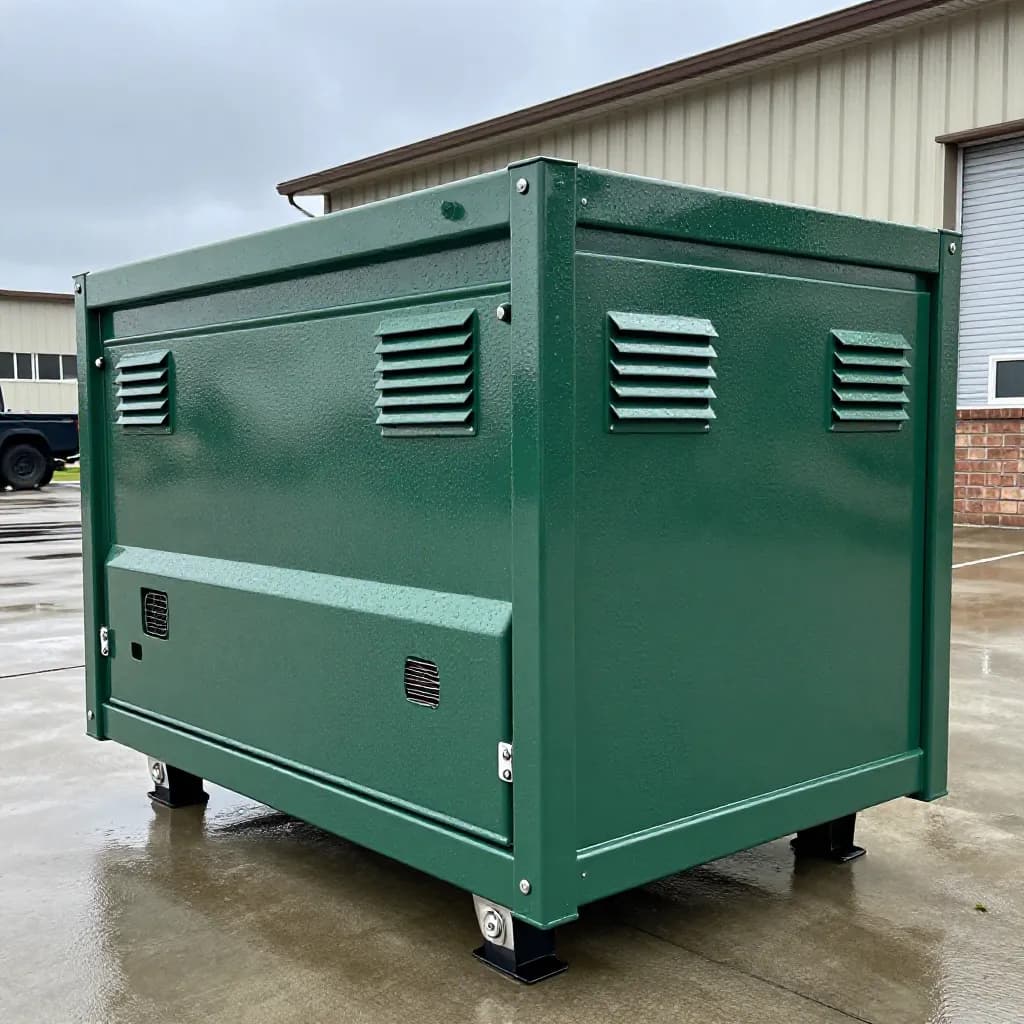
The generator market spans a wide range of products with different coating requirements. Portable generators rated at 2-15 kilowatts are consumer and light commercial products that face rough handling, outdoor storage, and intermittent use. Towable generators in the 15-100 kilowatt range serve construction sites and events, enduring road vibration, weather exposure, and jobsite abuse. Standby generators from 20 kilowatts to several megawatts are permanently installed at commercial and industrial facilities, requiring decades of outdoor durability with minimal maintenance. Each category demands a coating specification matched to its specific service profile.
Ready to Start Your Project?
From one-off customs to 15,000-part production runs — get precise pricing in 24 hours.
On This Page
Generator Enclosures: Where Coating Performance Is Critical
Powder coating dominates generator enclosure finishing because it delivers the thick, durable, chemically resistant film needed for outdoor equipment in a single application. The thermoset chemistry resists fuel and oil exposure, the dense film structure blocks moisture penetration, and the mechanical toughness withstands the handling abuse that generators routinely experience. Major generator manufacturers including Caterpillar, Cummins, Generac, Kohler, and Atlas Copco all specify powder coating for their enclosure products.
The coating specification must address multiple simultaneous requirements: UV resistance for outdoor exposure, corrosion protection for humid and coastal environments, heat resistance near engine and exhaust components, chemical resistance to fuel, oil, and coolant, impact resistance for handling and transport, and color accuracy for brand identity and safety marking. Balancing these requirements within a practical, cost-effective coating system is the central challenge of generator enclosure specification.
Outdoor Durability for Year-Round Exposure
Standby generators and permanently installed units face continuous outdoor exposure that tests every aspect of coating durability. The enclosure must maintain its protective and aesthetic properties through years of UV radiation, rain, snow, temperature cycling, and atmospheric pollution without the benefit of regular maintenance attention.
UV resistance is the primary durability concern for outdoor generator enclosures. Solar radiation degrades polymer coatings through photochemical chain scission, causing chalking, fading, gloss loss, and eventual embrittlement. Super-durable polyester powder coatings are the standard choice for outdoor generator enclosures, providing 7-10 years of color and gloss retention in full sun exposure. These formulations use modified polyester resins with enhanced UV stability, combined with UV absorber and hindered amine light stabilizer additives that extend the coating's resistance to photodegradation.
For generator enclosures in extreme UV environments — desert installations, tropical locations, and high-altitude sites where UV intensity is elevated — fluoropolymer-modified powder coatings provide the ultimate UV resistance, maintaining appearance for 15-20 years. The additional performance of fluoropolymer coatings is justified for large standby generators with expected service lives of 20-30 years, where the enclosure must maintain its appearance and protection throughout the generator's operational life.
Moisture resistance is equally important for outdoor enclosures. Rain, snow, condensation, and humidity all challenge the coating's barrier properties and adhesion. The coating must prevent moisture from reaching the steel substrate, where it would initiate corrosion that undermines both the coating and the structural integrity of the enclosure. A minimum of 1000 hours salt spray resistance per ASTM B117 is recommended for outdoor generator enclosures, with 1500 hours or more for coastal and tropical installations.
Temperature cycling creates thermal stress in the coating as the enclosure expands and contracts with daily and seasonal temperature changes. In continental climates, the enclosure surface temperature may range from minus 40 degrees Celsius in winter to plus 70 degrees Celsius in summer sun — a total range of 110 degrees. The coating must accommodate this thermal movement without cracking or losing adhesion, requiring good flexibility and a strong adhesion foundation from proper pretreatment.
Heat Dissipation and Thermal Zone Management
Generator enclosures must dissipate significant heat from the engine, alternator, and exhaust system while maintaining safe external surface temperatures. The powder coating affects heat transfer through both its thermal conductivity and its radiative emissivity, and these properties should be considered in the enclosure's thermal design.
Engine compartment surfaces can reach 80-120 degrees Celsius during generator operation, with localized hot spots near the exhaust manifold and turbocharger reaching 150-200 degrees Celsius. Standard polyester powder coatings are rated for continuous service at 120-150 degrees Celsius, which is adequate for most engine compartment surfaces but may be insufficient for exhaust-adjacent areas. High-temperature zones near the exhaust system should be coated with silicone-modified formulations rated for 250-350 degrees Celsius, or left uncoated with bare metal heat shields.
Radiative heat transfer from the enclosure surface to the surrounding air is an important cooling mechanism, particularly for enclosures without forced-air ventilation. The thermal emissivity of the coating surface determines how effectively it radiates heat. Dark-colored powder coatings have emissivity values of 0.85-0.95, while light colors range from 0.70-0.85. For generator enclosures where heat dissipation is a design concern, dark exterior colors improve radiative cooling by 10-20 percent compared to white or light gray.
However, dark colors also absorb more solar radiation, which can increase enclosure temperature during daytime operation in sunny conditions. The net thermal effect of color choice depends on the balance between internal heat generation and solar heat gain. For generators that operate primarily during daytime in sunny climates, light colors may provide a net thermal benefit by reducing solar heat gain. For generators that operate primarily at night or in cool climates, dark colors provide a net benefit through enhanced radiative cooling.
Ventilation louver and air intake areas require careful coating application to avoid restricting airflow. Powder coating can bridge narrow louver openings if film build is excessive, reducing the effective open area and increasing air resistance. Maximum film build on louver blades should be limited to 50-60 microns, and post-coating inspection should verify that all ventilation openings remain clear. Some manufacturers mask louver openings during coating and apply a separate thin-film coating to the louver blades.
Noise Reduction and Acoustic Considerations
Generator noise is a significant concern for residential standby installations, hospital backup systems, and event power applications where noise levels must comply with local ordinances and occupational exposure limits. While the primary noise reduction is achieved through enclosure design, acoustic insulation, and exhaust silencing, the powder coating can contribute to or detract from acoustic performance depending on its application.
The powder coating itself has negligible direct acoustic effect — the thin polymer film does not significantly absorb or reflect sound energy. However, the coating process and specification can affect the acoustic performance of the enclosure in indirect ways that are worth understanding.
Acoustic insulation materials — typically mineral wool, foam, or mass-loaded vinyl — are bonded to the interior surfaces of generator enclosures to absorb engine noise. The adhesion of these insulation materials to the coated surface depends on the coating's surface energy and texture. Standard powder coatings with moderate surface energy provide good adhesion for pressure-sensitive and contact adhesives used to bond insulation. However, silicone-modified coatings with low surface energy — which may be specified for heat resistance near the engine — can cause insulation adhesion failures. If silicone-modified coatings are used on interior surfaces, the insulation bonding system must be verified for compatibility.
Panel resonance is another acoustic consideration. Thin enclosure panels can vibrate at frequencies excited by engine operation, radiating noise from the panel surface. The powder coating adds a small amount of mass and damping to the panel, which can slightly shift resonant frequencies but does not provide significant vibration damping. For panels with resonance problems, constrained-layer damping treatments applied over the powder coating are more effective than relying on the coating itself for damping.
Exterior surface texture can affect the perception of enclosure quality, which indirectly relates to acoustic expectations. A smooth, high-quality powder coating finish communicates precision engineering and attention to detail, supporting the expectation that the enclosure will also perform well acoustically. Conversely, a rough or defective coating finish can undermine confidence in the overall product quality, including its noise performance.
Some generator manufacturers use textured powder coatings on exterior surfaces to create a premium appearance and hide minor surface imperfections in the sheet metal fabrication. These textures — typically fine wrinkle or sand textures — do not significantly affect acoustic performance but can complicate cleaning and may accumulate dirt more readily than smooth finishes in outdoor installations.
Portable vs. Standby: Different Coating Demands
The coating requirements for portable generators differ significantly from those for permanently installed standby units, reflecting the different handling, exposure, and service life expectations of each product category.
Portable generators face the most severe mechanical abuse of any generator type. They are lifted, carried, loaded into vehicles, set on rough ground, and operated in construction site conditions where impacts from tools, materials, and other equipment are routine. The coating must resist chipping and scratching from this rough handling while maintaining corrosion protection on exposed steel surfaces. Impact resistance of 100 inch-pounds or more and pencil hardness of 2H or higher are appropriate specifications for portable generator coatings.
Portable generators are also frequently stored outdoors or in unheated garages and sheds, where they experience temperature cycling and condensation. The coating must resist moisture-induced adhesion loss during extended storage periods. Proper pretreatment — zinc phosphate on steel — provides the adhesion foundation needed for reliable performance through storage and intermittent use cycles.
Standby generators face less mechanical abuse but more demanding long-term durability requirements. A residential standby generator may operate only a few hundred hours over its 15-20 year service life, but it is exposed to outdoor weather continuously. The coating must maintain its appearance and protection through years of UV exposure, rain, and temperature cycling with minimal maintenance. Super-durable polyester at 70-90 microns is the standard specification for residential standby enclosures.
Commercial and industrial standby generators have the most demanding coating requirements, combining long service life expectations with potentially aggressive installation environments. Hospital generators must maintain reliable operation and professional appearance for 20-30 years. Data center generators may be installed on rooftops with extreme UV and wind exposure. Telecommunications generators in remote locations receive minimal maintenance attention. For these applications, premium coating systems — fluoropolymer-modified polyester or dual-coat epoxy-polyester systems — provide the extended durability needed to match the generator's operational life.
Towable generators used on construction sites and for event power face a unique combination of road vibration, outdoor exposure, and jobsite abuse. The coating must resist stone chip damage during towing, maintain adhesion under road vibration, and withstand the chemical exposure of construction environments including concrete splash, fuel spills, and hydraulic fluid contact.
Fuel, Oil, and Chemical Resistance
Generator enclosures are exposed to a range of petroleum products and chemicals that can attack powder coatings if the formulation is not appropriate. Diesel fuel, gasoline, engine oil, coolant, battery acid, and exhaust condensate all contact enclosure surfaces during normal operation and maintenance, and the coating must resist these exposures without degradation.
Diesel fuel is the most common chemical exposure for industrial generator enclosures. Diesel fuel can soften and swell some polymer coatings through plasticization, particularly if the fuel contains biodiesel blends with higher solvent activity than petroleum diesel. Epoxy-polyester hybrid powder coatings provide good resistance to diesel fuel exposure, maintaining hardness and adhesion after prolonged contact. Pure polyester coatings offer moderate diesel resistance but may soften with extended immersion. For enclosures with integral fuel tanks or fuel system components, epoxy-based coatings provide the best fuel resistance.
Engine oil and hydraulic fluid exposure occurs during maintenance operations and from minor leaks. These petroleum-based fluids can penetrate and soften some coatings over time, particularly at elevated temperatures near the engine. The coating in the engine compartment should be tested for resistance to the specific oil types used in the generator, with a minimum of 168 hours immersion at 60 degrees Celsius without significant hardness loss or adhesion reduction.
Coolant — typically ethylene glycol or propylene glycol based — contacts enclosure surfaces during coolant system maintenance and from minor leaks. Coolant is mildly alkaline and can attack coating adhesion at the pretreatment interface. Standard polyester and epoxy-polyester coatings provide adequate coolant resistance for incidental exposure, but areas subject to frequent coolant contact should be specified with enhanced chemical resistance.
Battery acid — dilute sulfuric acid — is an aggressive chemical that can rapidly attack most powder coatings. The battery compartment area of the enclosure should be coated with acid-resistant epoxy formulation or protected with a supplementary acid-resistant barrier coating. Alternatively, the battery compartment can be fabricated as a separate, replaceable tray that is sacrificial and easily replaced if acid damage occurs.
Exhaust condensate is acidic due to dissolved combustion byproducts including sulfuric and nitric acids. Enclosure surfaces near the exhaust outlet and in the exhaust gas path should be coated with acid-resistant formulations or protected with stainless steel heat shields that prevent condensate contact with the coated steel surface.
Brand Identity and Market Differentiation
Generator manufacturers use enclosure color and finish as primary brand identity elements, and the powder coating must deliver consistent, recognizable brand colors across global production operations. In a competitive market where generators from different manufacturers may have similar specifications and performance, the visual identity of the enclosure influences purchasing decisions and brand loyalty.
Major generator brands have established distinctive color identities: Caterpillar's yellow, Cummins' white and red, Generac's orange, Kohler's gray, and Atlas Copco's yellow-green. These colors are specified with tight tolerances — typically Delta E less than 1.0 for critical brand colors — and must be consistent across production facilities worldwide. Powder coating's spectrophotometric color control capability supports this level of consistency, with incoming powder inspection and in-process color verification ensuring batch-to-batch accuracy.
Finish quality communicates product quality in the generator market. A smooth, uniform, defect-free powder coating finish signals precision manufacturing and attention to detail, supporting premium brand positioning. Conversely, visible coating defects — orange peel, runs, thin spots, or color variation — undermine the quality perception regardless of the generator's mechanical performance. For premium generator brands, coating quality standards include maximum orange peel ratings, minimum gloss uniformity, and zero tolerance for visible defects on customer-facing surfaces.
Custom color programs allow generator dealers and end users to specify enclosure colors that match facility color schemes, corporate branding, or architectural requirements. A hospital may require generators in a specific institutional color, a data center may specify colors that match the building exterior, or a rental company may want fleet colors for brand consistency. Powder coating's ability to match virtually any color reference and produce small custom batches economically supports these customization requirements.
Product line differentiation through color and finish helps manufacturers communicate the positioning of different generator series. Premium product lines may feature metallic or textured finishes that distinguish them from standard products. Compact residential units may use colors and finishes that blend with home exteriors, while industrial units use bold brand colors for maximum visibility on job sites.
Frequently Asked Questions
How long does powder coating last on an outdoor generator?
Super-durable polyester powder coating maintains color and gloss for 7-10 years on outdoor generator enclosures. Fluoropolymer-modified coatings extend this to 15-20 years. Corrosion protection typically outlasts cosmetic appearance, with properly pretreated and coated enclosures resisting substrate corrosion for 15-25 years depending on the installation environment.
Does enclosure color affect generator cooling?
Yes. Dark colors have higher thermal emissivity (0.85-0.95) and radiate internal heat more effectively, improving cooling by 10-20 percent compared to light colors. However, dark colors also absorb more solar radiation. The net effect depends on the balance between internal heat generation and solar exposure in the specific installation.
What powder coating resists diesel fuel?
Epoxy-polyester hybrid powder coatings provide good diesel fuel resistance, maintaining hardness and adhesion after prolonged contact. Pure epoxy coatings offer the best fuel resistance but lack UV stability for exterior surfaces. For enclosures with integral fuel systems, epoxy-based coatings on fuel-contact areas with polyester on exterior surfaces is the recommended approach.
Can powder coating help with generator noise?
The powder coating itself has negligible direct acoustic effect. However, the coating surface must be compatible with acoustic insulation adhesives bonded to interior surfaces. Silicone-modified coatings used for heat resistance can cause insulation adhesion failures, so adhesive compatibility should be verified when specifying interior coatings.
What coating is best for portable generator enclosures?
Portable generators need coatings with high impact resistance (100+ inch-pounds) and hardness (2H+ pencil) to survive rough handling. Standard polyester at 70-90 microns over zinc phosphate pretreatment provides good mechanical durability and corrosion protection for the intermittent outdoor exposure and storage conditions typical of portable generator use.
Ready to Start Your Project?
From one-off customs to 15,000-part production runs — get precise pricing in 24 hours.