Powder coating fuel tanks is a popular finishing option for motorcycle builders, classic car restorers, and custom vehicle fabricators who want a durable, high-quality exterior finish that outperforms paint. It is important to clarify upfront that powder coating is applied to the exterior surface of the fuel tank only. The interior of the tank, which contacts fuel directly, requires a separate fuel-compatible lining or sealer and is not suitable for standard powder coating.
Automotive
Powder Coating Fuel Tanks: External Protection for Motorcycle and Classic Car Tanks
Sundial Powder Coating·April 23, 2026·10 min
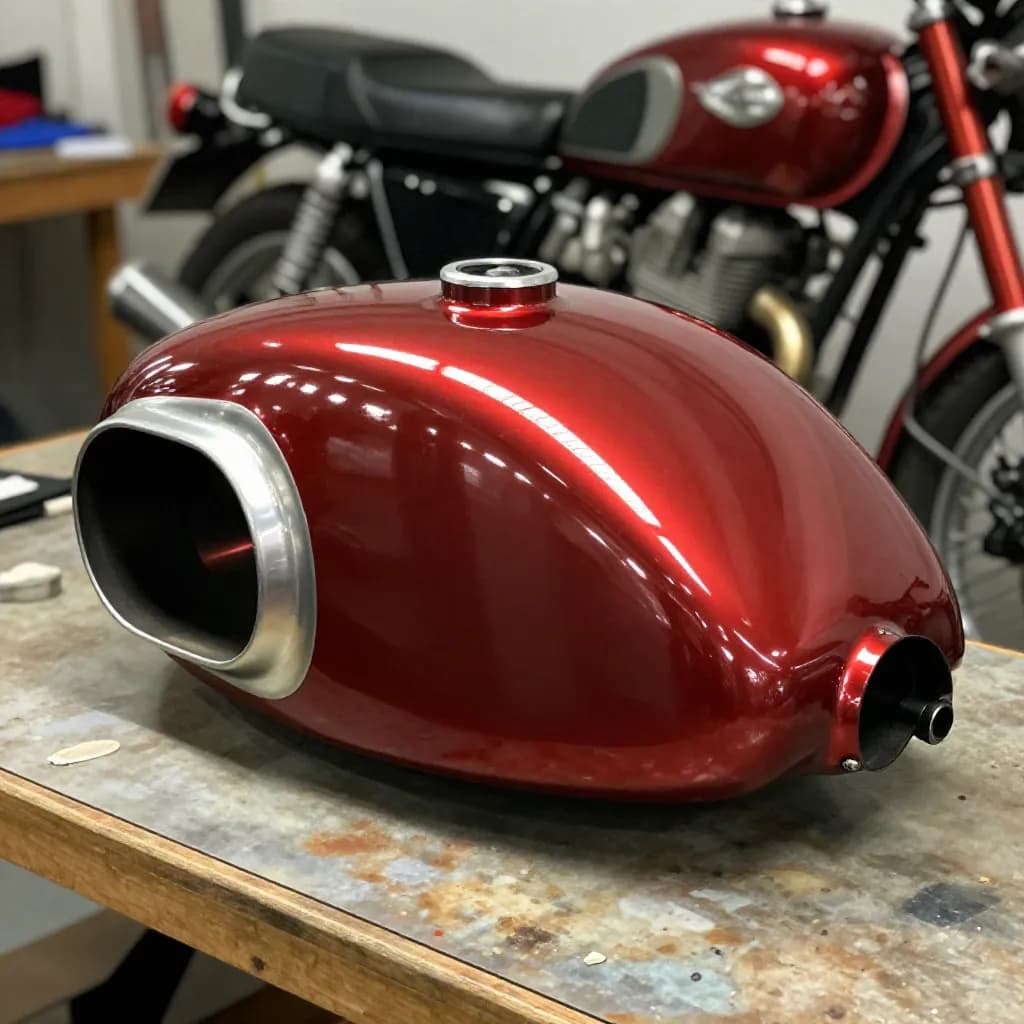
The exterior of a fuel tank faces a demanding set of environmental challenges. Motorcycle tanks are exposed to UV radiation, rain, road spray, fuel spills during filling, and physical contact from the rider's knees and gear. Classic car tanks, whether mounted in the trunk, under the body, or in the engine bay, face road debris, moisture, and chemical exposure from fuel vapors and underbody treatments.
Ready to Start Your Project?
From one-off customs to 15,000-part production runs — get precise pricing in 24 hours.
On This Page
Powder Coating Fuel Tanks: Scope and Safety
Powder coating addresses all of these challenges with a finish that is harder, thicker, and more chemically resistant than conventional automotive paint. A properly applied powder coat on a fuel tank exterior will resist fuel spills, UV degradation, stone chips, and corrosion for years, maintaining its appearance with minimal maintenance. For motorcycle builders in particular, powder coating eliminates the fragility of custom paint jobs that can be ruined by a single fuel spill or knee scuff.
Safety Considerations and Tank Preparation
Working with fuel tanks introduces safety considerations that do not apply to other powder coating projects. Residual fuel vapors inside the tank are explosive, and heating a tank that has not been properly purged can have catastrophic consequences. Every fuel tank must be thoroughly cleaned and purged of all fuel and vapors before any heat-related process.
The purging process begins with draining all fuel from the tank and removing the fuel sender, petcock, and any other fittings. The tank interior should be flushed multiple times with a solvent that displaces fuel, followed by a hot water rinse and extended air drying. Some shops fill the tank with an inert gas such as nitrogen or carbon dioxide during the coating process as an additional safety measure. The tank should be tested for residual vapors using a combustible gas detector before entering the blast booth or oven.
Exterior surface preparation follows standard procedures for the tank material. Steel tanks are blasted to bare metal with aluminum oxide or steel grit, then treated with a phosphate conversion coating. Aluminum tanks require softer blast media and a chromate-free conversion coating. Old paint, primer, body filler, and any previous coatings must be completely removed, as these materials can outgas during curing and create defects in the powder coat.
Dents, dings, and surface imperfections should be repaired before coating. Unlike liquid paint, powder coating cannot be built up to fill imperfections. Any dent or wave in the tank surface will be faithfully reproduced in the finished coating. Metal work, filling, and sanding must be completed before the final blast and coat.
Chemical Resistance: Fuel, Oil, and Road Treatments
The exterior of a fuel tank is routinely exposed to chemicals that can damage lesser coatings. Fuel spills during filling are the most common exposure, but oil drips, brake fluid, coolant, road salt solutions, and deicing chemicals also contact the tank surface depending on its mounting location.
Polyester powder coatings provide good resistance to brief fuel contact. Gasoline and diesel fuel will not damage a cured polyester powder coat during the short exposure times typical of a fuel spill, which is usually wiped away within minutes. However, prolonged soaking in fuel, such as a persistent leak that pools on the tank surface, can eventually soften the coating. For tanks in locations where prolonged fuel contact is possible, an epoxy primer beneath the polyester topcoat provides an additional chemical barrier.
Epoxy powder coatings offer superior chemical resistance compared to polyester but lack UV stability. For tanks that are not exposed to direct sunlight, such as those mounted under the vehicle body or in an enclosed trunk, a straight epoxy coating provides excellent chemical and corrosion resistance. For exposed tanks like motorcycle tanks, the polyester topcoat is necessary for UV protection, with the epoxy serving as a chemical-resistant primer layer.
Road salt and deicing chemicals are aggressive to most coatings over time. Tanks mounted beneath the vehicle in salt-belt regions benefit from the same multi-layer coating system recommended for other underbody components: zinc phosphate pretreatment, zinc-rich epoxy primer, and a super-durable polyester topcoat. This system provides both barrier and galvanic corrosion protection.
Motorcycle Tank Finishing: Show Quality and Durability
Motorcycle fuel tanks are the visual centerpiece of most builds, and the finish quality expectations are correspondingly high. Powder coating a motorcycle tank delivers a finish that rivals or exceeds the best custom paint work in terms of depth, uniformity, and durability, with the added benefit of superior resistance to the fuel spills and physical wear that motorcycle tanks endure.
Achieving show-quality results on a motorcycle tank requires meticulous surface preparation. The tank must be perfectly smooth, with all dents, waves, and surface imperfections corrected before coating. Any filler used must be compatible with the cure temperature of the powder, as standard automotive body filler can outgas or degrade at 200 degrees Celsius. High-temperature fillers and epoxy-based products are available for this purpose.
Color options for motorcycle tanks are virtually unlimited. Solid colors, metallics, candies, pearls, and color-shift powders are all available. Multi-color designs are achievable through masking and multiple coating cycles, allowing stripes, graphics, and two-tone schemes. Some builders combine powder coating with vinyl graphics or hydro-dipping for complex designs that would be difficult to achieve with powder alone.
Clear coat over a color base adds depth and provides a sacrificial layer that protects the color coat from minor scratches and fuel spills. A high-gloss clear powder coat over a metallic or candy base creates a deep, wet-look finish that is the hallmark of premium motorcycle builds. The clear coat can be wet-sanded and polished after curing for an even smoother, more reflective surface.
For vintage and cafe racer builds, matte and satin finishes are increasingly popular. These low-sheen finishes provide a period-correct or industrial aesthetic that suits the character of these builds. Matte finishes require less surface preparation than high-gloss finishes, as they do not highlight imperfections as aggressively.
Classic Car Tank Restoration
Classic car fuel tanks present unique challenges that differ from motorcycle tanks. Many classic car tanks are decades old, with extensive surface corrosion, pitting, and sometimes structural rust that must be assessed before any coating work begins. The first step is always a thorough evaluation of the tank's structural integrity.
If the tank has rust-through holes, pinhole leaks, or severely thinned walls, it should be repaired or replaced before coating. Powder coating is a surface finish, not a structural repair. Welding patches over rust holes, brazing pinhole leaks, and reinforcing thinned areas must be completed before the tank enters the coating process. All repairs should be pressure-tested for leaks before proceeding.
After structural repairs, the exterior is blasted to bare metal. Classic car tanks often have multiple layers of old paint, undercoating, and surface treatments that must be completely removed. Heavy pitting from decades of corrosion may remain after blasting, and the decision to fill these pits or leave them depends on the desired finish. For a concours restoration where the tank is visible, filling and smoothing is appropriate. For a driver-quality restoration where the tank is hidden, the pitting can be left as-is and the powder coat will follow the surface contour.
Color matching to the original vehicle color is important for concours restorations. Many classic car colors are available as powder coat formulations, and custom matching to original paint chips or color codes is straightforward for any experienced powder supplier. For tanks that are not visible when installed, satin black or semi-gloss black provides a clean, period-appropriate appearance.
The interior of a classic car tank should be treated separately with a fuel-compatible tank sealer or lining product after the exterior coating is complete. This two-step approach, powder coat exterior and sealed interior, provides comprehensive protection for a tank that may need to last another several decades.
Masking Fittings, Bungs, and Mounting Points
Fuel tanks have numerous fittings, threaded bungs, mounting brackets, and sealing surfaces that must be carefully masked during the powder coating process. Coating buildup on these features can prevent proper fitment of fuel senders, petcocks, filler necks, and mounting hardware.
Fuel sender openings and filler neck bungs should be plugged with silicone plugs or masked with high-temperature tape. The sealing surfaces where O-rings or gaskets sit must remain clean and dimensionally accurate. Even a thin layer of powder on a sealing surface can prevent proper O-ring compression and cause fuel leaks.
Threaded fittings for fuel lines, vent lines, and drain plugs should be protected with threaded silicone plugs or by threading sacrificial bolts into the fittings before coating. After coating, remove the plugs and chase the threads with the appropriate tap to ensure clean engagement. Fuel line fittings in particular must seal perfectly, as even a minor leak creates a fire hazard.
Mounting brackets and strap contact areas can be coated or left bare depending on the installation method. If the tank is held by metal straps, the strap contact area will be compressed and the coating may crack under clamping force. This is acceptable if a rubber or felt isolator is used between the strap and the tank, which is standard practice. If the tank mounts directly to metal brackets without isolators, leaving the contact area bare or applying a thin coat prevents cracking.
Vent tube connections and rollover valve fittings must be masked to maintain their function. These safety-critical components rely on precise dimensions and unobstructed passages. Verify all vent and safety fittings operate correctly after the tank is coated and reassembled.
Long-Term Care and Fuel Spill Management
Maintaining a powder-coated fuel tank is straightforward, but prompt attention to fuel spills is the single most important maintenance practice. While cured polyester powder coat resists brief fuel contact, allowing fuel to sit on the surface for extended periods can cause softening, staining, or dulling of the finish.
When fuel spills occur during filling, wipe the affected area immediately with a clean cloth. Follow up with a mild soap and water wash to remove any fuel residue. For stubborn fuel stains, a non-abrasive automotive cleaner or isopropyl alcohol will clean the surface without damaging the coating. Avoid using aggressive solvents like acetone, MEK, or lacquer thinner on powder-coated surfaces, as these can attack the polymer matrix.
For motorcycle tanks that are frequently exposed to fuel during filling, applying a sacrificial clear coat layer provides an additional buffer. The clear coat absorbs the chemical exposure and can be recoated if it becomes damaged, preserving the color coat underneath. Some builders also apply a ceramic coating or paint protection film over the powder coat for maximum chemical resistance.
UV protection is important for exposed tanks. Super-durable polyester powders with UV stabilizers maintain their color and gloss for years of outdoor exposure. Standard polyester powders will fade and chalk more quickly, particularly in dark colors. If the tank is on a motorcycle or a vehicle that is parked outdoors regularly, specifying a super-durable formulation is a worthwhile investment.
Periodic inspection of the coating around fittings, mounting points, and high-wear areas allows early detection of any coating damage. Touch up chips and scratches promptly with matching touch-up paint to prevent corrosion from gaining a foothold. A well-maintained powder-coated fuel tank will provide years of reliable service and maintain its visual appeal throughout.
Frequently Asked Questions
Can you powder coat the inside of a fuel tank?
No. Standard powder coatings are not fuel-compatible and should not be applied to the interior of fuel tanks. The tank interior should be treated with a dedicated fuel-compatible tank sealer or lining product. Powder coating is applied to the exterior surface only.
Will fuel spills damage a powder-coated tank?
Brief fuel contact during filling will not damage a cured polyester powder coat. However, prolonged soaking can soften the coating over time. Wipe fuel spills immediately and clean with mild soap and water. An epoxy primer beneath the polyester topcoat adds extra chemical resistance.
Is it safe to put a fuel tank in a powder coating oven?
Only after thorough purging of all fuel and vapors. The tank must be drained, flushed, rinsed with hot water, and air-dried completely. Testing with a combustible gas detector before heating is essential. Some shops also fill the tank with inert gas during the coating process as an additional safety measure.
What finish is best for a motorcycle fuel tank?
For show bikes, a high-gloss color coat with a clear powder coat topcoat provides maximum depth and protection. Metallic, candy, and pearl finishes create stunning visual effects. For daily riders, satin or matte finishes are practical and hide minor wear. All finishes should use UV-stable polyester chemistry.
Can you do custom graphics on a powder-coated fuel tank?
Yes. Multi-color designs are achieved through masking and multiple coating cycles. Stripes, logos, and two-tone schemes are all possible. Vinyl graphics and hydro-dipping can also be applied over a powder-coated base for complex designs. A clear coat over graphics protects them from wear and fuel exposure.
Ready to Start Your Project?
From one-off customs to 15,000-part production runs — get precise pricing in 24 hours.