Fast food restaurants operate at a pace and volume that tests every surface in the building. A single location may serve 500-1,500 customers per day, with each customer interacting with door handles, tray rails, seating, tables, condiment stations, and waste receptacles. This volume of human contact, combined with food spills, aggressive cleaning schedules, and the need for strict brand consistency across hundreds or thousands of locations, creates finishing requirements that exceed those of most other hospitality environments.
Hospitality
Powder Coating for Fast Food Restaurant Fixtures: High-Traffic Durability, Easy Cleaning, and Brand Compliance
Sundial Powder Coating·April 22, 2026·11 min
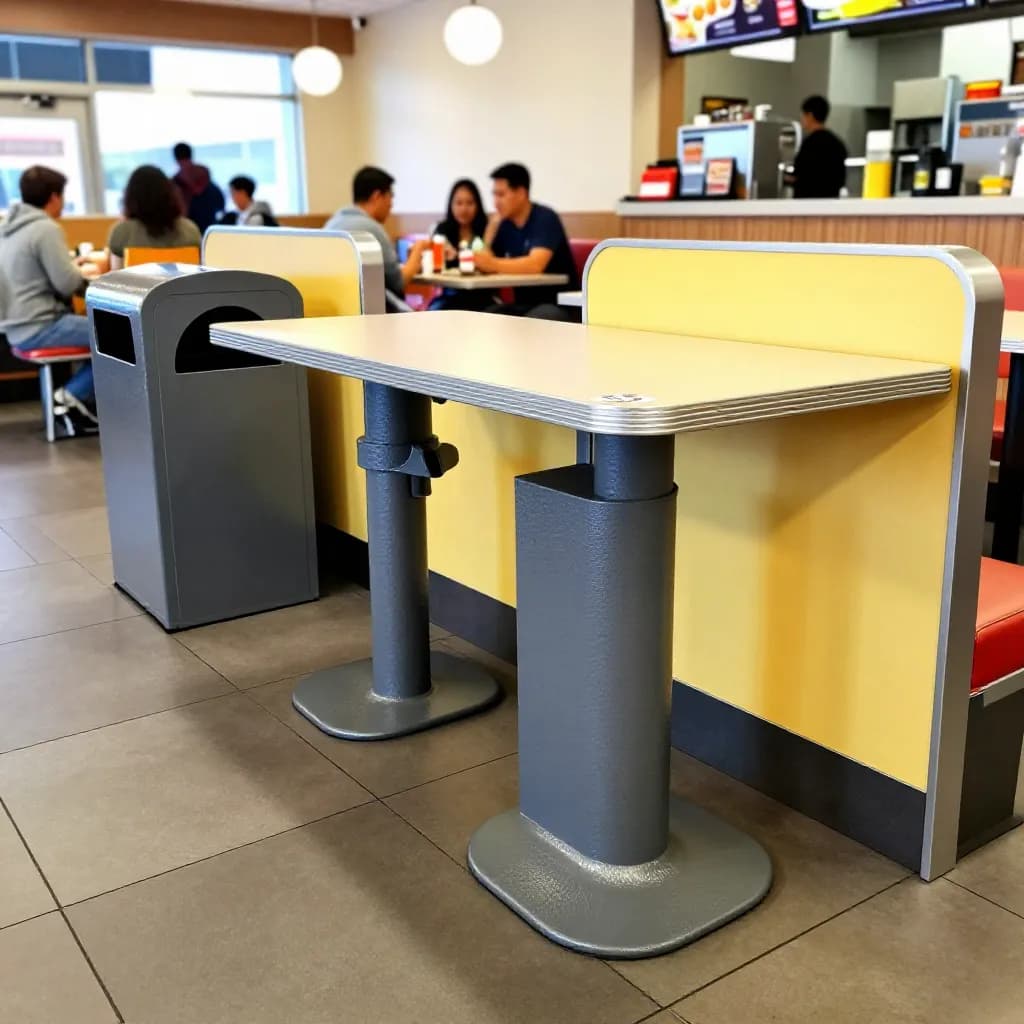
The fast food industry's emphasis on speed and efficiency extends to maintenance. Every minute spent on surface repair or refinishing is a minute of reduced operational capacity. Powder coating's exceptional durability reduces the frequency of maintenance interventions, keeping fixtures in service longer and reducing the lifecycle cost of restaurant furnishings. This durability advantage is multiplied across large franchise networks where even small per-unit savings translate to significant system-wide cost reductions.
Ready to Start Your Project?
From one-off customs to 15,000-part production runs — get precise pricing in 24 hours.
On This Page
The Fast Food Finishing Challenge
Brand compliance is a non-negotiable requirement in franchised fast food operations. Corporate brand standards specify exact colors, finishes, and materials for every visible element in the restaurant, and franchisees must maintain these standards to retain their franchise agreement. Powder coating's precise color matching capability and batch-to-batch consistency make it the preferred finishing technology for franchise fixture programs where thousands of identical components must match across locations nationwide.
This article examines the specific powder coating technologies and specifications that address the unique demands of fast food restaurant environments, from the drive-through window to the dining room to the outdoor patio.
High-Traffic Durability for Interior Fixtures
Interior fixtures in fast food restaurants experience wear rates that would be considered extreme in any other context. Tray rails along the service counter are touched by every customer who orders, accumulating thousands of hand contacts per day. Table edges are bumped by trays, bags, and elbows hundreds of times daily. Chair and booth frames endure constant sitting, shifting, and the occasional rough treatment from impatient or careless patrons.
Powder coating specifications for fast food interior fixtures should prioritize abrasion resistance and impact resistance above aesthetic considerations. Minimum film thickness of 80-100 microns provides the material depth needed to absorb daily wear without exposing the substrate. Impact resistance ratings of 80 inch-pounds direct impact per ASTM D2794 ensure that the coating survives the bumps and knocks that are inevitable in a high-volume dining environment.
Tray rails and counter fronts are the highest-wear surfaces in the dining area. These components benefit from powder coating formulations with enhanced abrasion resistance, achieved through harder resin systems or the addition of ceramic or PTFE additives that reduce surface friction and wear. Film thickness on tray rails should be specified at 100-125 microns to provide additional wear margin on these critical surfaces.
Booth and banquette frames experience concentrated wear at specific points — the seat edge where customers slide in and out, the back frame where shoulders and heads contact the surface, and the base where shoes and cleaning equipment make contact. Specifying reinforced coating thickness at these wear points extends the service life of booth fixtures and delays the point at which refinishing or replacement becomes necessary.
Door hardware including push plates, pull handles, and kick plates experiences the most concentrated wear of any fixture in the restaurant. These components are contacted by every customer entering and exiting the building, accumulating wear at a rate that can degrade liquid paint finishes within months. Powder coating on door hardware provides the thickness and hardness needed to maintain appearance through years of continuous use, with antimicrobial formulations adding hygiene value to these high-touch surfaces.
Easy-Clean Surfaces for Fast Food Operations
Cleaning efficiency is a critical operational metric in fast food restaurants where dining areas must be turned over rapidly during peak periods. Every surface must be cleanable in seconds, not minutes, to maintain the throughput that the business model requires. Powder coating's smooth, non-porous surface enables the rapid wipe-down cleaning that fast food operations demand.
The food residues encountered in fast food environments — ketchup, mustard, mayonnaise, cooking oil, soft drink syrup, and ice cream — each present different cleaning challenges. Acidic condiments like ketchup and mustard can stain porous surfaces. Cooking oils create greasy films that resist water-based cleaning. Soft drink syrups leave sticky residues that attract dirt. Powder coating resists penetration by all these substances, allowing them to be removed with a single wipe using standard food service sanitizing solution.
Gloss level selection affects both cleaning performance and appearance maintenance between cleaning cycles. High-gloss finishes clean most easily but show every fingerprint and smudge, requiring more frequent wiping to maintain a clean appearance. Matte finishes hide fingerprints effectively but can be slightly more difficult to clean because their micro-textured surface provides more points for residue adhesion. Satin finishes at 40-60 gloss units provide the optimal balance for fast food applications.
Sanitization requirements in fast food restaurants mandate the use of EPA-registered sanitizing solutions on all food contact and customer contact surfaces. The powder coating must resist these sanitizers without degradation over thousands of application cycles. Quaternary ammonium compounds are the most common sanitizers in fast food operations, and standard polyester powder coatings demonstrate excellent resistance to these chemicals. However, some operations use chlorine-based sanitizers that are more aggressive — verify chemical compatibility with the specific powder coating formulation before specifying.
Self-cleaning and easy-clean powder coating technologies represent the next generation of fast food surface finishes. These formulations incorporate hydrophobic or oleophobic surface modifications that cause liquids to bead and roll off the surface rather than spreading and adhering. While still emerging in commercial food service applications, these technologies promise to further reduce cleaning labor and improve hygiene performance in high-volume restaurants.
Brand Color Compliance Across Franchise Networks
Fast food franchise systems depend on brand consistency to deliver the uniform customer experience that drives brand loyalty and recognition. Every location must present the same colors, finishes, and visual identity, whether it is a company-owned flagship or a franchisee-operated unit in a remote market. Powder coating's precision color matching and manufacturing consistency make it the ideal finishing technology for franchise fixture programs.
Brand color specifications in franchise systems are typically defined using Pantone or proprietary color references with tight tolerances for acceptable variation. Powder coating manufacturers can match these references with Delta E color differences of 1.0 or less, which is within the threshold of perceptible difference for most observers. This precision ensures that fixtures produced by different manufacturers or at different times match visually when installed in the same restaurant.
Batch-to-batch consistency is equally important for franchise programs where fixtures are manufactured continuously over months or years. Powder coating manufacturers maintain master color standards and implement statistical process control to ensure that every production batch matches the approved reference. This consistency eliminates the color variation that can occur with liquid paint systems where solvent evaporation rates, application conditions, and mixing ratios introduce variability.
Multi-supplier fixture programs — where different manufacturers produce different fixture types for the same restaurant — require coordinated color management to ensure visual consistency across all components. Specifying the same powder coating manufacturer and product code for all suppliers eliminates the inter-supplier color variation that can occur when different powder manufacturers interpret the same color reference slightly differently.
Brand refresh programs that update restaurant colors and finishes across the franchise network benefit from powder coating's ability to deliver new colors quickly and consistently. When a brand updates its color palette, powder coating manufacturers can develop and qualify new formulations within weeks, enabling rapid rollout of the updated look across the franchise system. The durability of the new powder coating ensures that the refreshed appearance is maintained until the next brand update cycle.
Outdoor Seating and Drive-Through Equipment
Outdoor seating areas and drive-through installations extend the fast food restaurant's operational footprint into environments where weather exposure adds UV radiation, rain, temperature cycling, and wind-borne debris to the already demanding wear profile of fast food fixtures. Powder coating for these exterior applications must provide weathering resistance that maintains appearance and protection through years of outdoor exposure.
Outdoor dining furniture — tables, chairs, benches, and waste receptacles — requires super-durable polyester powder coating that meets Qualicoat Class 2 or AAMA 2604 weathering standards. These formulations resist UV-induced fading and chalking for 10-15 years in most climates, maintaining brand color accuracy throughout the furniture's service life. The mechanical durability of powder coating also resists the scratching and chipping from outdoor use, where furniture is exposed to sand, gravel, and debris that would quickly damage liquid paint.
Bolted-down outdoor furniture, common in fast food applications for security and wind resistance, requires powder coating that maintains its integrity around bolt holes and mounting hardware. These penetrations through the coating create potential corrosion initiation points where moisture can access the substrate. Proper detail design — including sealant application at bolt penetrations and the use of isolation washers to prevent galvanic corrosion between dissimilar metals — protects these vulnerable points.
Drive-through menu boards, speaker posts, and canopy structures are permanent outdoor installations that must maintain brand appearance for 10-20 years. These components are typically powder coated in brand colors with super-durable polyester formulations that provide the long-term weathering resistance needed for permanent outdoor installations. The structural steel of drive-through canopies benefits from zinc-rich epoxy primer under the polyester topcoat for maximum corrosion protection.
Playground equipment in fast food restaurant play areas requires powder coating that meets ASTM F1487 safety standards for public playground equipment. These standards address coating toxicity, surface temperature in direct sunlight, and durability under the intense use that children's play equipment experiences. Lead-free, cadmium-free powder coating formulations with UV-stable colors and high impact resistance satisfy these requirements while providing the bright, attractive colors that make play areas inviting.
Kitchen and Back-of-House Equipment
While the dining area receives the most attention for brand presentation, the kitchen and back-of-house areas of fast food restaurants contain numerous metal components that benefit from powder coating for protection, hygiene, and safety. Equipment frames, shelving systems, wall-mounted fixtures, and safety equipment all perform better and last longer with appropriate powder coating.
Kitchen shelving systems in fast food restaurants store ingredients, supplies, and equipment in a hot, humid, grease-laden environment. Powder-coated wire shelving with NSF-listed coatings has become the industry standard for fast food kitchen storage, replacing the chrome-plated wire shelving that was previously common. Powder coating provides better corrosion resistance than chrome plating in the aggressive kitchen environment and does not develop the rust spots that chrome plating exhibits when the plating is breached.
Equipment stands and work table frames operate in the splash zone where food preparation activities generate spills and splashes. Powder coating on these components must resist the specific food products handled in the restaurant — acidic tomato products, alkaline cleaning solutions, cooking oils, and salt — without degradation. Epoxy-polyester hybrid formulations provide the broad chemical resistance needed for kitchen splash zone applications.
Safety equipment including fire extinguisher cabinets, first aid stations, and emergency exit hardware requires powder coating in OSHA-mandated safety colors. Red for fire protection equipment, green for safety and first aid, and yellow for caution zones must be maintained in their specified colors to satisfy safety regulations. Powder coating's color stability ensures that safety colors remain recognizable throughout the equipment's service life.
Waste management equipment including trash compactors, recycling stations, and grease trap housings operates in the most aggressive environment in the restaurant. These components face constant exposure to food waste, cleaning chemicals, and mechanical abuse from waste handling operations. Heavy-duty epoxy powder coatings applied at 125-175 microns provide the chemical resistance and impact protection needed for waste management equipment, extending service life and reducing replacement frequency.
Renovation and Refresh Strategies
Fast food restaurants typically undergo interior refreshes every 7-10 years and major renovations every 15-20 years. Powder coating plays a central role in both refresh and renovation strategies, either through refinishing existing fixtures or replacing them with newly coated components that reflect updated brand standards.
Refresh programs that update the restaurant's appearance without full renovation often focus on recoating existing fixtures in new brand colors. Metal furniture, counter fronts, and decorative elements can be stripped of their existing powder coating and recoated with updated colors and finishes, extending the service life of the underlying metal components while delivering the visual update that the brand refresh requires. This approach is more cost-effective than full fixture replacement and reduces waste.
The stripping process for existing powder coating uses chemical strippers, thermal stripping in burn-off ovens, or media blasting depending on the substrate material and the condition of the existing coating. Chemical stripping is preferred for complex assemblies where heat could damage non-metal components. Thermal stripping is efficient for all-metal fixtures. Media blasting provides the cleanest substrate for recoating but requires careful control to avoid damaging thin-gauge metal components.
New fixture procurement for renovation projects should specify powder coating as part of the fixture design rather than as an afterthought. Designing fixtures with powder coating in mind — including appropriate edge radii, drainage provisions, and hanging points for the coating process — results in better coating quality and longer service life than retrofitting powder coating onto fixtures designed for other finishing methods.
Prototype approval processes for franchise fixture programs should include powder-coated samples evaluated under the restaurant's actual lighting conditions. Colors can appear significantly different under the fluorescent, LED, or natural lighting used in different restaurant zones. Approving colors based on samples viewed under the correct lighting prevents costly color mismatches that require recoating after installation.
Lifecycle planning for powder-coated fast food fixtures should account for the expected service life of the coating system in each application zone. High-wear areas like tray rails and door hardware may need recoating every 5-7 years, while lower-wear fixtures like wall-mounted decorative elements may last 15-20 years. Staggering recoating schedules across different fixture categories spreads the maintenance investment over time and avoids the disruption of refinishing everything simultaneously.
Frequently Asked Questions
How does powder coating maintain brand color consistency across franchise locations?
Powder coating manufacturers match brand colors with Delta E differences of 1.0 or less and maintain batch-to-batch consistency through statistical process control. Specifying the same powder manufacturer and product code for all fixture suppliers ensures visual consistency across locations, even when fixtures are produced by different manufacturers.
Can powder coating withstand the cleaning frequency of fast food restaurants?
Yes, polyester powder coatings resist thousands of cleaning cycles with quaternary ammonium sanitizers and standard food service cleaners without softening or discoloring. Satin finishes at 40-60 gloss units provide the best balance of cleanability and appearance maintenance for fast food dining areas.
What powder coating specification works for outdoor fast food seating?
Outdoor fast food furniture requires super-durable polyester powder coating meeting Qualicoat Class 2 or AAMA 2604 weathering standards. These formulations resist UV fading for 10-15 years. Specify minimum 80-100 micron film thickness and appropriate pretreatment for the substrate type, with zinc-rich primer for steel in corrosive environments.
How long do powder-coated fast food fixtures last before needing refinishing?
Service life varies by application zone. High-wear surfaces like tray rails and door hardware typically need recoating every 5-7 years. Standard dining furniture lasts 8-12 years. Low-wear decorative elements can last 15-20 years. Proper specification and maintenance maximize service life in each zone.
Is powder coating safe for fast food playground equipment?
Yes, when using lead-free, cadmium-free formulations that meet ASTM F1487 safety standards for public playground equipment. These standards address coating toxicity, surface temperature in sunlight, and durability under heavy use. Bright, UV-stable colors maintain their appearance through years of children's play.
Ready to Start Your Project?
From one-off customs to 15,000-part production runs — get precise pricing in 24 hours.