Electrical conduit is the protective raceway system that houses and routes electrical wiring throughout buildings, industrial facilities, and infrastructure installations. From the EMT (Electrical Metallic Tubing) running through commercial office ceilings to the rigid steel conduit protecting power feeds in chemical plants, these systems must provide mechanical protection for conductors, maintain electrical grounding continuity, and resist corrosion for the life of the installation.
Industrial
Powder Coating for Electrical Conduit: EMT, Rigid, and Color-Coded Raceway Systems
Sundial Powder Coating·April 23, 2026·11 min
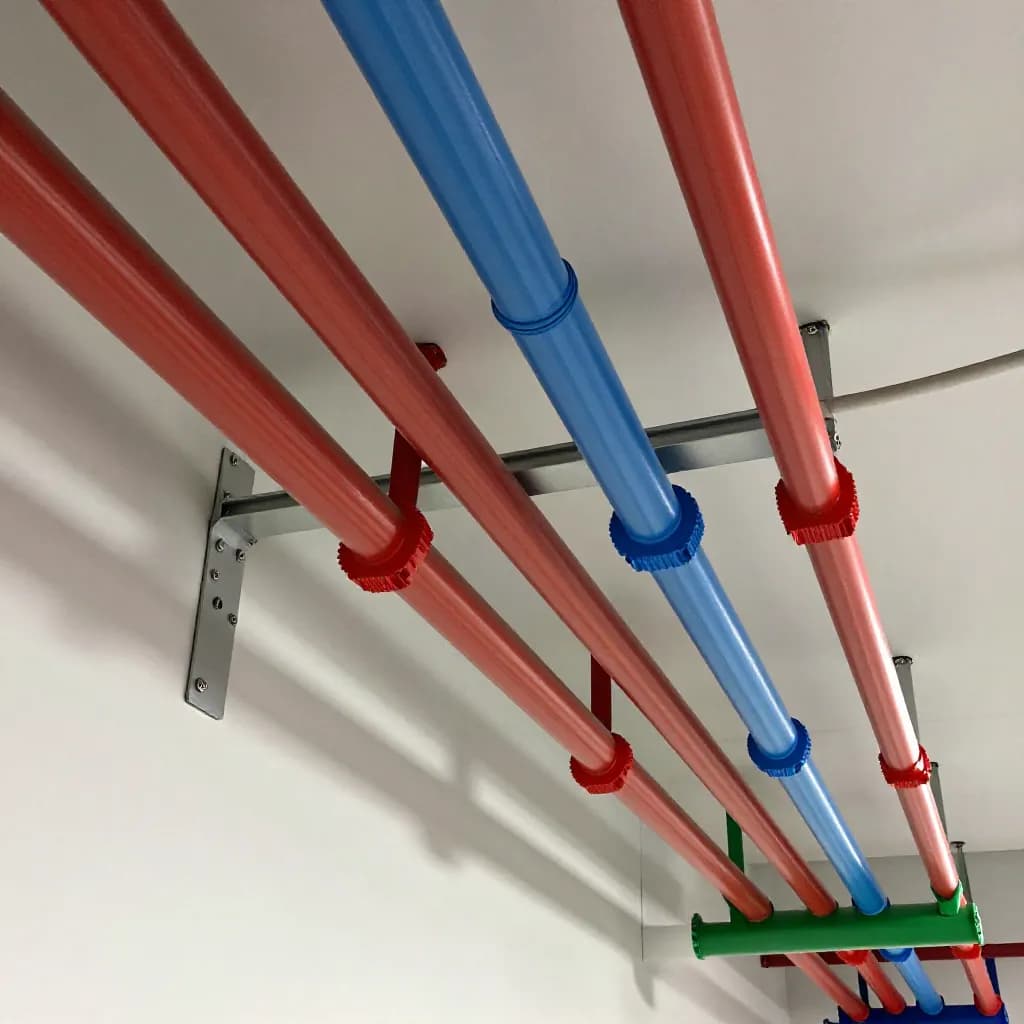
The conduit market has traditionally been divided between metallic conduit (steel and aluminum) with galvanized or bare finishes and non-metallic conduit (PVC and fiberglass). Powder coating is transforming this landscape by offering metallic conduit with enhanced corrosion protection, color coding capability, and improved appearance that competes with PVC on aesthetics while maintaining the mechanical strength, fire resistance, and grounding capability that only metal conduit provides.
Ready to Start Your Project?
From one-off customs to 15,000-part production runs — get precise pricing in 24 hours.
On This Page
Electrical Conduit: Protecting the Wires That Power Modern Infrastructure
Powder-coated conduit addresses several limitations of traditional finishes. Standard galvanized EMT provides adequate corrosion protection for dry indoor environments but can corrode in humid, coastal, or chemically aggressive conditions. PVC conduit offers corrosion resistance and color options but lacks the mechanical strength, fire resistance, and electromagnetic shielding of metal conduit. Powder-coated steel conduit combines the structural advantages of metal with the corrosion resistance and color flexibility of polymer coatings.
This article examines the technical requirements, application processes, and code compliance considerations for powder-coated electrical conduit across its range of applications, from commercial building wiring to heavy industrial power distribution.
EMT and Rigid Conduit: Substrate Differences and Coating Requirements
The two primary types of steel electrical conduit — EMT (Electrical Metallic Tubing) and rigid metal conduit (RMC) — have different wall thicknesses, manufacturing processes, and coating requirements that affect the powder coating approach.
EMT is thin-wall steel tubing (typically 1.0-1.5 mm wall thickness for trade sizes 1/2" to 4") manufactured by continuous roll forming and high-frequency welding of steel strip. Standard EMT is supplied with a zinc coating (either hot-dip galvanized or electroplated) that provides baseline corrosion protection. The thin wall and relatively light weight of EMT make it the most widely used conduit type for commercial and light industrial wiring.
Powder coating EMT requires careful control of film thickness to maintain the dimensional tolerances needed for conduit fittings. EMT connectors and couplings are designed to fit the outside diameter of standard conduit within tight tolerances — typically ±0.2 mm. A powder coating of 60-80 microns per side adds 120-160 microns to the outside diameter, which can interfere with connector fit if not accounted for in the conduit or fitting dimensions.
Rigid metal conduit (RMC) has thicker walls (2.0-4.0 mm depending on trade size) and is manufactured from hot-rolled steel with threaded ends. RMC is used in industrial, hazardous location, and outdoor applications where maximum mechanical protection is required. The thicker wall provides more tolerance for coating thickness, and the threaded connections are less sensitive to diameter changes than EMT push-on fittings.
Intermediate metal conduit (IMC) falls between EMT and RMC in wall thickness and is increasingly popular as a lighter-weight alternative to RMC. IMC uses the same threaded connections as RMC but with thinner walls, and powder coating requirements are similar to RMC.
For all conduit types, the interior surface coating is as important as the exterior. The interior coating protects against internal corrosion (which can damage conductor insulation) and provides a smooth surface that facilitates wire pulling. Standard galvanized conduit has a relatively rough interior surface that increases pulling friction, while a smooth powder coating can reduce pulling friction by 20-40%, allowing longer conduit runs between pull points.
Corrosion Protection: Environments Where Galvanizing Falls Short
Standard galvanized conduit provides adequate corrosion protection for dry indoor environments, but numerous installation conditions exceed the capability of zinc coatings alone. Powder coating addresses these limitations by providing a chemical-resistant barrier that protects the conduit in environments where galvanizing would fail.
Coastal and marine environments expose conduit to airborne chlorides that accelerate zinc corrosion. In severe coastal exposure (within 500 m of the surf zone), standard galvanized EMT may show visible corrosion within 5-10 years. Powder-coated conduit with epoxy or polyester coating provides 20-30 year protection in the same environment, and duplex systems (galvanizing plus powder coating) extend service life to 40+ years.
Concrete-embedded conduit faces a specific corrosion risk. While concrete's high alkalinity (pH 12-13) normally protects embedded steel, chloride contamination from deicing salts or seawater can penetrate the concrete and initiate corrosion of the conduit. Powder-coated conduit embedded in concrete provides a barrier against chloride attack, similar to the protection that epoxy-coated rebar provides for reinforcing steel.
Chemical processing environments expose conduit to acid fumes, caustic splashes, and solvent vapors that attack zinc coatings. Epoxy powder coating provides resistance to a wide range of industrial chemicals in the pH 2-13 range, making it the preferred finish for conduit in chemical plants, pulp mills, and wastewater treatment facilities.
Direct-buried conduit must resist soil moisture, soil chemistry, and the mechanical stresses of burial. While PVC conduit is commonly used for direct burial, powder-coated steel conduit provides superior mechanical protection against dig-ins and ground movement while matching PVC's corrosion resistance. Fusion-bonded epoxy at 300-500 microns — the same coating system used for buried pipelines — provides the barrier properties needed for direct-buried conduit in aggressive soil conditions.
High-humidity environments — swimming pool areas, commercial kitchens, laundries, and tropical climates — accelerate corrosion on standard galvanized conduit through continuous condensation cycling. Powder coating prevents condensation from contacting the metal surface, eliminating the white rust (zinc corrosion) and red rust (steel corrosion) that develop on galvanized conduit in persistently humid conditions.
The NEC (National Electrical Code) recognizes the need for enhanced corrosion protection in specific environments. NEC Article 300.6 requires conduit to be suitable for the environment in which it is installed, and supplementary corrosion protection (such as powder coating) may be required where standard galvanized conduit is inadequate.
Color Coding and Identification Systems
Color coding of electrical conduit is one of the most practical advantages of powder coating, enabling visual identification of different electrical systems, voltage levels, and circuit types throughout a facility. While not universally mandated by electrical codes, color-coded conduit is increasingly specified by facility owners, engineers, and data center operators for its operational benefits.
Common color coding schemes assign specific colors to different electrical systems: orange for fire alarm circuits, red for emergency power, blue for data and telecommunications, yellow for standby power, green for equipment grounding conductors, and gray or white for general power distribution. These color assignments vary by facility and jurisdiction, but the principle of visual differentiation is consistent.
In data centers, color-coded conduit is particularly valuable for managing the complex electrical infrastructure that supports IT equipment. Different colors identify utility power feeds, UPS-protected circuits, generator-backed circuits, and redundant power paths, enabling technicians to quickly identify circuit routing during maintenance and troubleshooting. The time savings and error reduction from visual identification can be significant in facilities with thousands of conduit runs.
Healthcare facilities use color-coded conduit to identify critical power systems — life safety circuits, critical care circuits, and equipment power — that must be maintained during power outages. The Joint Commission and other healthcare accreditation bodies recognize the value of visual identification systems for maintaining reliable power to patient care areas.
Industrial facilities use conduit color coding to identify voltage levels (120V, 208V, 480V, medium voltage), circuit types (lighting, power, control, instrumentation), and hazardous area classifications. This visual identification supports safe work practices by alerting electricians to the voltage and purpose of each conduit before they begin work.
Powder coating provides durable, consistent color that remains legible throughout the conduit's service life. Unlike adhesive labels that peel, fade, or become obscured by dirt, and unlike field-applied paint that chips and wears, factory-applied powder coating maintains its color and appearance for decades. The full RAL color range is available, and custom colors can be matched to facility-specific color coding standards.
For retrofit applications where existing galvanized conduit needs color identification, field-applied liquid paint is the practical option. However, for new construction, factory powder-coated conduit provides superior durability and appearance compared to field painting.
Powder Coating as a PVC Conduit Alternative
PVC (polyvinyl chloride) conduit has gained market share in recent decades due to its corrosion resistance, light weight, low cost, and ease of installation. However, PVC conduit has significant limitations that powder-coated steel conduit addresses while maintaining the corrosion resistance and appearance advantages that drive PVC specification.
Fire performance is PVC's most significant limitation. PVC conduit is combustible and generates dense, toxic smoke (including hydrogen chloride gas) when exposed to fire. Building codes restrict PVC conduit use in plenums, risers, and other locations where fire spread and smoke generation are concerns. NEC Article 352 limits PVC conduit to specific installation conditions and requires fire stopping at penetrations through fire-rated assemblies.
Powder-coated steel conduit is non-combustible and does not contribute to fire spread or smoke generation. The thin organic powder coating on a steel substrate achieves the same fire classification as bare steel conduit, making it suitable for all locations where metal conduit is permitted — including plenums, risers, and areas adjacent to fire-rated assemblies.
Mechanical strength is another area where steel conduit outperforms PVC. PVC conduit can be crushed, cracked, or deformed by impacts, construction traffic, and ground movement. Steel conduit provides superior mechanical protection for the conductors it contains, which is particularly important in industrial environments, parking structures, and direct-buried applications where physical damage risk is high.
Electromagnetic shielding is provided by steel conduit but not by PVC. In environments with electromagnetic interference (EMI) concerns — near heavy electrical equipment, radio transmitters, or sensitive electronic systems — steel conduit provides inherent shielding that protects the conductors from external interference and prevents the conductors from radiating interference to nearby equipment.
Temperature limitations affect PVC conduit performance. PVC becomes brittle at low temperatures (below -20°C) and softens at elevated temperatures (above 60°C), limiting its use in extreme environments. Steel conduit with powder coating maintains its structural properties across a much wider temperature range (-40°C to +200°C depending on the powder formulation), making it suitable for cold storage facilities, rooftop installations, and industrial environments with elevated ambient temperatures.
The environmental profile of PVC conduit has come under scrutiny due to concerns about chlorine chemistry, plasticizer leaching, and end-of-life disposal. Powder-coated steel conduit offers an environmentally preferable alternative — steel is infinitely recyclable, powder coating produces zero VOC emissions, and the finished product contains no chlorine or plasticizers.
Application Process for Conduit Coating
Powder coating electrical conduit is a high-speed, continuous process designed to coat straight lengths of tubing at production rates compatible with conduit manufacturing volumes. The process must achieve uniform coating on both interior and exterior surfaces while maintaining the dimensional tolerances required for conduit fittings.
The production line typically begins with surface preparation. For bare steel conduit, alkaline cleaning removes mill oils and forming lubricants, followed by iron phosphate or zinc phosphate conversion coating. For pre-galvanized conduit receiving a powder topcoat, the zinc surface is treated with a compatible conversion coating (zinc phosphate or zirconium-based) after alkaline cleaning.
Exterior coating is applied by electrostatic spray as the conduit passes through a spray booth on a continuous conveyor. Multiple guns arranged around the conduit circumference ensure 360-degree coverage. The round cross-section of conduit is well-suited to electrostatic application, as the uniform curvature provides consistent gun-to-surface distance and even powder deposition.
Interior coating presents a greater challenge. For small-diameter conduit (1/2" to 1"), the interior is difficult to reach with conventional spray guns. Several methods are used: internal lance guns that spray powder inside the conduit as it passes over the lance, airflow-assisted powder injection that uses air pressure to carry powder through the conduit bore, and pre-heating the conduit and passing it through a fluidized bed that coats both interior and exterior simultaneously.
For larger conduit sizes (2" and above), internal spray guns mounted on fixed lances can reach the interior surface effectively. The gun is positioned inside the conduit, and powder is sprayed outward against the interior wall as the conduit moves along the conveyor.
Threaded ends on rigid conduit and IMC require masking to prevent powder buildup in the threads that would interfere with coupling assembly. Silicone plugs or custom masking caps are applied to threaded ends before coating and removed after curing. The masking must seal tightly enough to prevent powder infiltration into the first few threads while being easily removable at production speed.
Curing is performed in a continuous oven matched to the conveyor speed. The thin wall of conduit reaches curing temperature quickly (typically within 2-3 minutes for EMT), allowing high conveyor speeds and short oven lengths. Temperature monitoring using non-contact infrared sensors verifies that the conduit reaches the required cure temperature throughout the oven.
Post-cure quality checks include film thickness measurement (exterior and interior), adhesion testing, and dimensional verification to confirm that the coated conduit meets fitting compatibility requirements.
Code Compliance, Testing, and Installation
Powder-coated electrical conduit must comply with the same electrical codes and product safety standards as conventional galvanized conduit, with additional considerations for the coating's effect on electrical properties and corrosion performance.
UL 797 (Electrical Metallic Tubing — Steel) and UL 6 (Rigid Metal Conduit — Steel) are the primary product safety standards for steel conduit in North America. Powder-coated conduit must be tested and listed under these standards with the specific coating system applied. The UL listing verifies that the coating does not adversely affect the conduit's mechanical properties, electrical continuity, or fire performance.
Electrical continuity through powder-coated conduit systems is maintained through the metallic contact between the conduit and its fittings. Set-screw and compression-type EMT connectors make metal-to-metal contact with the conduit exterior, and the coating at the connection point is displaced or penetrated by the connector's set screws or compression ring. For threaded rigid conduit, the bare metal threads provide electrical continuity at each coupling.
The NEC requires that conduit systems provide an effective ground-fault current path (NEC 250.4). Testing per UL standards verifies that powder-coated conduit systems maintain adequate electrical continuity for ground-fault protection when installed with listed fittings. The coating's dielectric properties do not interfere with grounding because the fittings are designed to make direct metal contact.
Corrosion testing for powder-coated conduit follows ASTM B117 (salt spray) with duration requirements based on the intended installation environment. Standard requirements range from 500 hours for indoor commercial use to 2000+ hours for severe industrial or coastal environments. The test evaluates both exterior and interior coating performance, as internal corrosion can damage conductor insulation and create safety hazards.
Installation of powder-coated conduit follows the same practices as galvanized conduit, with a few additional considerations. Field cutting should use methods that minimize coating damage — tube cutters and hacksaws are preferred over abrasive cut-off wheels. Cut ends should be reamed to remove burrs (which can damage conductor insulation) and touched up with compatible repair coating to maintain corrosion protection.
Bending powder-coated EMT requires a standard conduit bender, and the coating must withstand the bending strain without cracking or delaminating. Flexibility testing per the applicable UL standard verifies that the coating maintains integrity through the minimum bend radius specified for each conduit size. For tight bends, the coating on the outside of the bend is stretched and may thin slightly, but properly formulated conduit coatings accommodate this strain without failure.
Storage and handling of powder-coated conduit should avoid dragging, dropping, or stacking without protective separation. While the powder coating is more scratch-resistant than galvanizing, it can be damaged by rough handling, and damaged areas should be touched up before installation.
Frequently Asked Questions
Does powder coating interfere with conduit fitting connections?
Powder coating adds 60-80 microns per side to the conduit diameter, which must be accounted for in conduit or fitting dimensions. Set-screw and compression EMT fittings displace or penetrate the coating to make metal contact. Threaded rigid conduit connections use bare metal threads that are masked during coating.
Is powder-coated conduit better than PVC for corrosion resistance?
Powder-coated steel conduit matches PVC's corrosion resistance while providing superior fire performance (non-combustible vs. combustible), mechanical strength, electromagnetic shielding, and temperature range. PVC generates toxic smoke in fires and becomes brittle below -20°C, limitations that powder-coated steel avoids.
Can powder-coated conduit be used in hazardous locations?
Yes, provided it is listed for the specific hazardous location classification. Rigid metal conduit (RMC) and intermediate metal conduit (IMC) are permitted in Class I, II, and III hazardous locations per NEC Articles 501-503. The powder coating must be included in the UL listing for the conduit to be used in these locations.
What are the benefits of color-coded conduit?
Color-coded conduit enables visual identification of different electrical systems (fire alarm, emergency power, data, general power) without opening the raceway. This reduces installation errors, speeds troubleshooting, and supports safe work practices. Factory powder coating provides durable color that lasts decades, unlike labels or field paint.
Does powder coating affect conduit grounding capability?
No. Electrical continuity is maintained through metal-to-metal contact at fittings — set screws and compression rings penetrate the coating on EMT, and bare threads provide contact on rigid conduit. UL testing verifies that powder-coated conduit systems provide an effective ground-fault current path per NEC requirements.
Ready to Start Your Project?
From one-off customs to 15,000-part production runs — get precise pricing in 24 hours.