Commercial kitchens are among the most demanding environments for any surface finish. The combination of extreme heat from ovens and grills, airborne grease, acidic food splashes, aggressive cleaning chemicals, and high-pressure washdown cycles creates conditions that destroy conventional paint within months. Powder coating has emerged as the finish of choice for kitchen shelving, hood systems, equipment housings, and structural metalwork because it withstands these combined stresses far better than liquid paint or bare metal alternatives.
Hospitality
Powder Coating for Commercial Kitchens: NSF Compliance, Heat Resistance, and Washdown Durability
Sundial Powder Coating·April 22, 2026·12 min
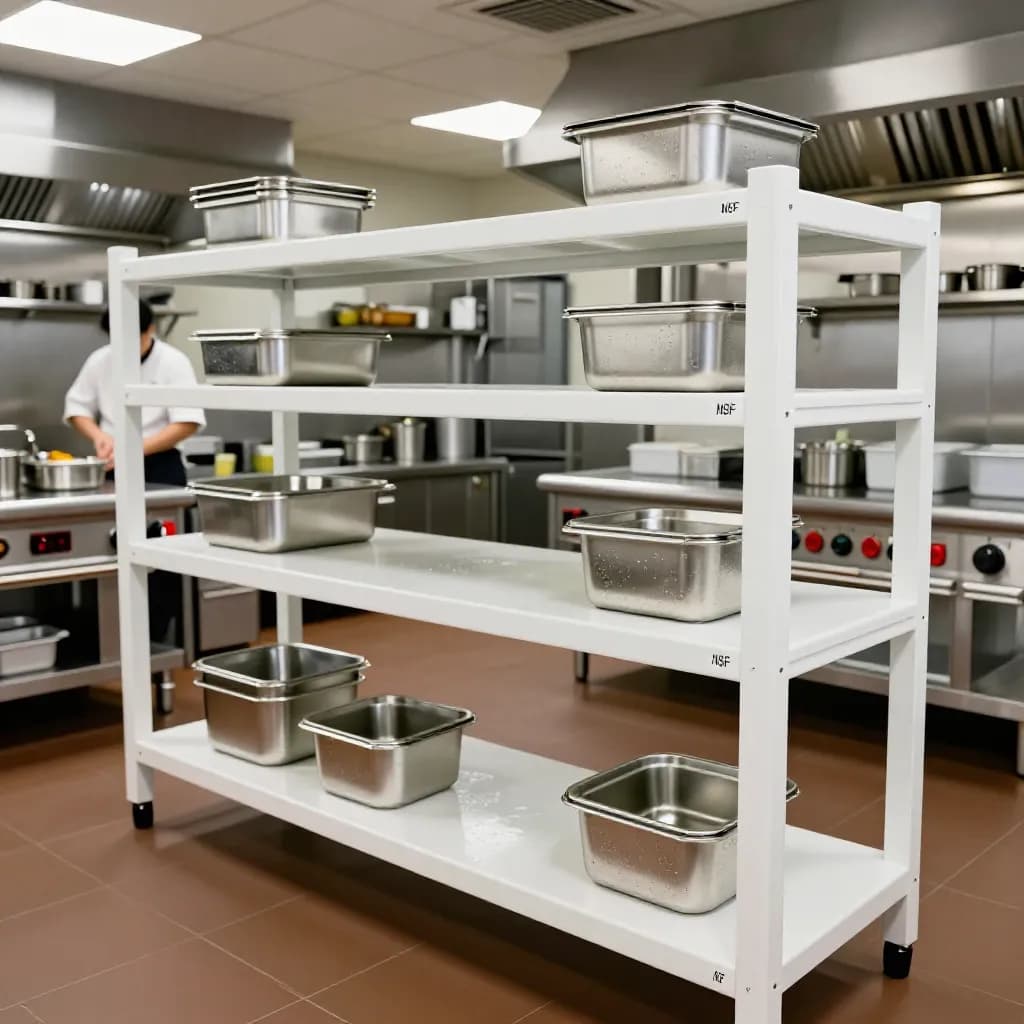
The food service industry operates under strict regulatory oversight from agencies including the FDA, USDA, and NSF International. Any coating applied to surfaces in food preparation or storage zones must meet specific requirements for chemical inertness, cleanability, and resistance to microbial harboring. Powder coatings formulated for food service environments are engineered to satisfy these requirements while delivering the mechanical toughness needed to survive daily kitchen operations.
Ready to Start Your Project?
From one-off customs to 15,000-part production runs — get precise pricing in 24 hours.
On This Page
Why Commercial Kitchens Demand Specialized Powder Coating
Beyond regulatory compliance, commercial kitchen operators increasingly recognize that powder coating offers a cost-effective alternative to stainless steel for many applications. While stainless steel remains essential for direct food contact surfaces like prep tables and sinks, powder-coated carbon steel or aluminum can replace stainless on shelving units, wall panels, equipment housings, and structural supports at significantly lower material cost without sacrificing hygiene or durability.
This article examines the specific powder coating technologies, standards, and application strategies that make the finish viable for commercial kitchen environments, from fast-casual restaurants to institutional food service operations.
NSF International Compliance and Food Safety Standards
NSF International certification is the benchmark for materials and equipment used in commercial food service. NSF/ANSI Standard 2 covers food equipment materials, requiring that coatings applied to food zone and splash zone surfaces be smooth, non-absorbent, corrosion-resistant, and free from toxic substances that could migrate into food. Powder coatings seeking NSF listing must pass extraction testing to confirm that no harmful chemicals leach from the cured film under conditions simulating food contact.
For food zone applications where the coating directly contacts food, NSF requires compliance with FDA 21 CFR 175.300, which governs coatings for food contact surfaces. Powder coatings meeting this standard use resin systems and pigments that have been evaluated for extractable substances and found safe for repeated food contact. These formulations typically use specific epoxy, polyester, or hybrid chemistries that have established safety profiles.
Splash zone and non-food zone applications have less stringent extraction requirements but still demand coatings that resist microbial growth, clean easily, and do not chip or peel in ways that could contaminate food. The smooth, non-porous surface of a properly cured powder coating inherently resists bacterial adhesion more effectively than rough or textured finishes, making it well-suited for splash zone shelving, equipment exteriors, and wall-mounted fixtures.
Kitchen operators should verify that their powder coating applicator uses NSF-listed powder formulations and can provide documentation of compliance. Simply applying any powder coating to kitchen equipment does not guarantee food safety compliance — the specific formulation matters, and traceability from powder manufacturer through applicator to installed equipment is essential for regulatory audits.
Heat Resistance for Kitchen Environments
Commercial kitchens routinely expose surfaces to temperatures that challenge conventional coatings. Oven exteriors can reach 150-200°C during operation, exhaust hoods experience sustained heat from cooking equipment below, and radiant heat from grills and broilers affects nearby shelving and wall surfaces. Standard decorative powder coatings rated for 80-100°C continuous exposure are inadequate for these conditions and will yellow, chalk, or lose adhesion within weeks.
High-temperature powder coatings formulated with silicone-modified polyester or silicone-based resin systems can withstand continuous operating temperatures of 200-350°C depending on the specific formulation. These coatings maintain their color stability, gloss retention, and adhesion at temperatures that would destroy standard polyester or epoxy powders. For exhaust hood interiors and oven surrounds, silicone-based powders rated to 500°C or higher are available, though color options become more limited at extreme temperature ratings.
Thermal cycling is another critical consideration. Kitchen equipment heats and cools repeatedly throughout each service period, and the differential expansion between the metal substrate and the coating film creates stress that can cause cracking or delamination in rigid coating systems. High-temperature powder coatings are formulated with controlled flexibility to accommodate thermal cycling without film failure, maintaining their integrity through thousands of heat-cool cycles over the equipment's service life.
Proper substrate preparation is especially important for high-temperature applications. The pretreatment system must itself be heat-stable — standard chromate or iron phosphate pretreatments may degrade at elevated temperatures, so zirconium-based or silane pretreatments are often preferred for equipment that will operate above 150°C continuously.
Grease Resistance and Chemical Durability
Airborne grease is the defining environmental challenge in commercial kitchens. Cooking oils become aerosolized during frying, grilling, and sautéing, depositing a fine film on every surface in the kitchen. Over time, this grease film polymerizes under heat exposure, creating a tenacious residue that bonds to surfaces and becomes increasingly difficult to remove. Powder coatings for kitchen environments must resist grease penetration and allow accumulated grease to be removed without damaging the coating surface.
The dense, cross-linked molecular structure of thermoset powder coatings provides inherent resistance to grease absorption. Unlike porous or micro-cracked liquid paint films, a properly cured powder coating presents a continuous, non-porous barrier that prevents grease molecules from penetrating into the film. This means that grease deposits remain on the surface where they can be cleaned rather than becoming embedded in the coating.
Chemical resistance extends beyond grease to the aggressive cleaning agents used in commercial kitchens. Quaternary ammonium compounds, chlorinated alkaline cleaners, and degreasing solvents are standard cleaning chemicals in food service, and all can attack poorly formulated coatings. Powder coatings designed for kitchen use are tested against these specific chemical families to ensure that repeated cleaning cycles do not cause softening, discoloration, blistering, or adhesion loss.
Acidic food products including tomato sauce, citrus juice, vinegar, and fermented ingredients also contact kitchen surfaces regularly. Epoxy-polyester hybrid powder coatings offer excellent acid resistance for splash zone applications, while pure polyester formulations provide better UV stability for equipment near windows or in open kitchen designs where natural light exposure is a factor.
Washdown Compatibility and Pressure Cleaning
Health department regulations require commercial kitchens to undergo thorough cleaning and sanitization, often including high-pressure washdown procedures. These washdown cycles use water pressures of 500-1,200 PSI combined with hot water at 60-80°C and chemical sanitizers. The combination of mechanical force from the water jet, thermal shock from hot water, and chemical exposure from sanitizers creates a uniquely aggressive cleaning environment that tests coating adhesion and integrity.
Powder coatings engineered for washdown environments achieve adhesion ratings that exceed the forces generated by standard pressure washing equipment. The key to washdown durability lies in substrate preparation — blast cleaning to SA 2.5 or better followed by appropriate chemical pretreatment creates a surface profile and conversion coating that anchors the powder film against hydraulic forces. Inadequate preparation is the primary cause of coating failure in washdown environments, not the powder coating itself.
Edge coverage is a critical detail in washdown applications. Water jets naturally find and exploit any weakness in a coating system, and sharp edges where film thickness is reduced are the most vulnerable points. Powder coating's natural tendency to build thickness on edges — the opposite of liquid paint's tendency to thin on edges — provides an inherent advantage in washdown environments. However, best practice still calls for radiusing all sharp edges to a minimum of 0.5mm before coating to ensure consistent film build.
Drain holes, weld seams, and fastener penetrations require special attention in washdown-rated powder coating applications. These features create potential entry points for water behind the coating film, which can cause blistering and underfilm corrosion. Proper design eliminates standing water traps, seals weld seams before coating, and uses appropriate fastener details to maintain the coating envelope's integrity.
Stainless Steel Alternatives: Where Powder Coating Excels
Stainless steel has long been the default material for commercial kitchen construction, but its high material cost drives kitchen designers to seek alternatives wherever direct food contact is not required. Powder-coated carbon steel and aluminum offer compelling alternatives for shelving systems, wall cladding, equipment housings, hood exteriors, and structural framing at material costs 40-60% lower than equivalent stainless steel components.
The performance comparison between powder-coated carbon steel and stainless steel depends heavily on the specific application. For shelving units that hold packaged goods, dry storage items, or equipment, powder-coated carbon steel provides equivalent hygiene performance at lower cost. The smooth powder coating surface cleans as easily as stainless steel and resists the same cleaning chemicals. For walk-in cooler shelving, powder-coated wire shelving with antimicrobial powder formulations has become an industry standard.
Powder-coated aluminum is particularly attractive for hood systems, decorative panels, and equipment housings where weight reduction is beneficial. Aluminum's natural corrosion resistance supplements the powder coating's barrier protection, creating a dual-defense system that performs well even if the coating is locally damaged. The weight savings also simplify installation and reduce structural support requirements.
The aesthetic advantage of powder coating over stainless steel is significant for open kitchen designs where the kitchen is visible to diners. While stainless steel offers only its characteristic metallic appearance, powder coating provides unlimited color options that allow kitchen metalwork to coordinate with the restaurant's interior design scheme. Custom brand colors, textured finishes, and matte effects are all achievable with powder coating, enabling kitchen designs that are both functional and visually integrated with the dining space.
Antimicrobial Powder Coatings for Enhanced Hygiene
Antimicrobial powder coatings represent the latest advancement in food service surface technology. These formulations incorporate antimicrobial agents — typically silver ion or zinc-based compounds — directly into the powder coating matrix. The antimicrobial agents migrate to the coating surface over time, creating a persistent zone of microbial inhibition that reduces bacterial populations on the coated surface between cleaning cycles.
The antimicrobial function supplements rather than replaces standard cleaning protocols. Health regulations still require regular cleaning and sanitization regardless of the coating's antimicrobial properties. However, antimicrobial coatings provide an additional layer of protection during the intervals between cleaning cycles, reducing the risk of cross-contamination from surfaces that have been touched or splashed since the last cleaning.
Several antimicrobial powder coating systems have achieved EPA registration and NSF certification for food service applications. These registrations require manufacturers to demonstrate both antimicrobial efficacy and safety for food contact or splash zone use. The testing protocols evaluate the coating's ability to reduce populations of specific organisms including Staphylococcus aureus, Escherichia coli, and MRSA on the coated surface over defined time periods.
For commercial kitchen applications, antimicrobial powder coatings are most valuable on high-touch surfaces such as door handles, push plates, equipment controls, and shelving that is frequently accessed by kitchen staff. These surfaces accumulate microbial contamination rapidly during busy service periods and benefit most from the continuous antimicrobial activity that the coating provides between scheduled cleaning cycles.
Specification and Maintenance Best Practices
Specifying powder coating for commercial kitchen applications requires attention to several details that differ from standard architectural or industrial specifications. The specification should identify the specific NSF-listed powder formulation by manufacturer and product code, the required pretreatment system, minimum film thickness, cure schedule verification method, and any antimicrobial performance requirements. Generic specifications that simply call for powder coating without these details leave too much room for substitution of inappropriate products.
Film thickness for kitchen applications should be specified at 75-100 microns minimum for general surfaces and 100-150 microns for high-wear areas such as shelving rails, cart bumper zones, and equipment bases that experience frequent contact. Thicker films provide greater barrier protection and longer service life in aggressive kitchen environments, though excessively thick films above 200 microns can become brittle and prone to impact chipping.
Maintenance protocols for powder-coated kitchen surfaces should be integrated into the facility's standard cleaning schedule. Daily cleaning with approved kitchen degreasers maintains the coating's appearance and hygiene performance. Weekly inspection of high-wear areas identifies any coating damage early, allowing touch-up before corrosion develops. Annual deep cleaning with non-abrasive methods removes any accumulated residue that daily cleaning may miss.
When coating damage does occur, prompt repair prevents corrosion from spreading beneath the intact coating. Small chips and scratches can be repaired with touch-up paint matched to the original powder coating color, while larger damaged areas may require professional repair or component replacement. Establishing a relationship with the original powder coating applicator ensures that repair materials and color matches are readily available when needed.
Frequently Asked Questions
Is powder coating food-safe for commercial kitchen equipment?
Yes, when using NSF-listed powder coating formulations that comply with FDA 21 CFR 175.300 for food contact surfaces. These specific formulations have been tested for chemical extraction and found safe for repeated food contact. Standard decorative powder coatings are not automatically food-safe — the specific formulation must be verified.
Can powder coating withstand commercial kitchen temperatures?
High-temperature powder coatings formulated with silicone-modified polyester or silicone resins can withstand continuous temperatures of 200-350°C, with some formulations rated to 500°C or higher. Standard powder coatings rated for 80-100°C are not suitable for surfaces near ovens, grills, or exhaust hoods.
How does powder coating compare to stainless steel in kitchens?
Powder-coated carbon steel or aluminum costs 40-60% less than stainless steel and provides equivalent hygiene performance for non-food-contact applications like shelving, equipment housings, and wall panels. Stainless steel remains necessary for direct food contact surfaces such as prep tables and sinks.
Will powder coating survive high-pressure washdown cleaning?
Yes, properly applied powder coating on blast-cleaned and pretreated substrates withstands washdown pressures of 500-1,200 PSI with hot water and chemical sanitizers. The key is thorough substrate preparation to SA 2.5 standard and proper edge treatment to prevent water intrusion at vulnerable points.
What is antimicrobial powder coating and is it worth using in kitchens?
Antimicrobial powder coatings contain silver ion or zinc-based agents that continuously reduce bacterial populations on the surface between cleaning cycles. They supplement but do not replace standard cleaning protocols. EPA-registered and NSF-certified antimicrobial coatings are most valuable on high-touch surfaces like door handles and equipment controls.
Ready to Start Your Project?
From one-off customs to 15,000-part production runs — get precise pricing in 24 hours.