Bus shelters are among the most visible and heavily used elements of urban public infrastructure. Positioned at street level in high-traffic locations, they serve thousands of transit riders daily while enduring continuous exposure to weather, pollution, vandalism, and the general wear of public use. The powder coating on a bus shelter must maintain both its protective function and its visual appearance under these demanding conditions, as a deteriorated shelter undermines public confidence in the transit system and the quality of the urban environment.
Architecture
Powder Coating for Bus Shelters: Vandal Resistance, Anti-Graffiti, UV Protection, and Public Infrastructure
Sundial Powder Coating·April 23, 2026·12 min
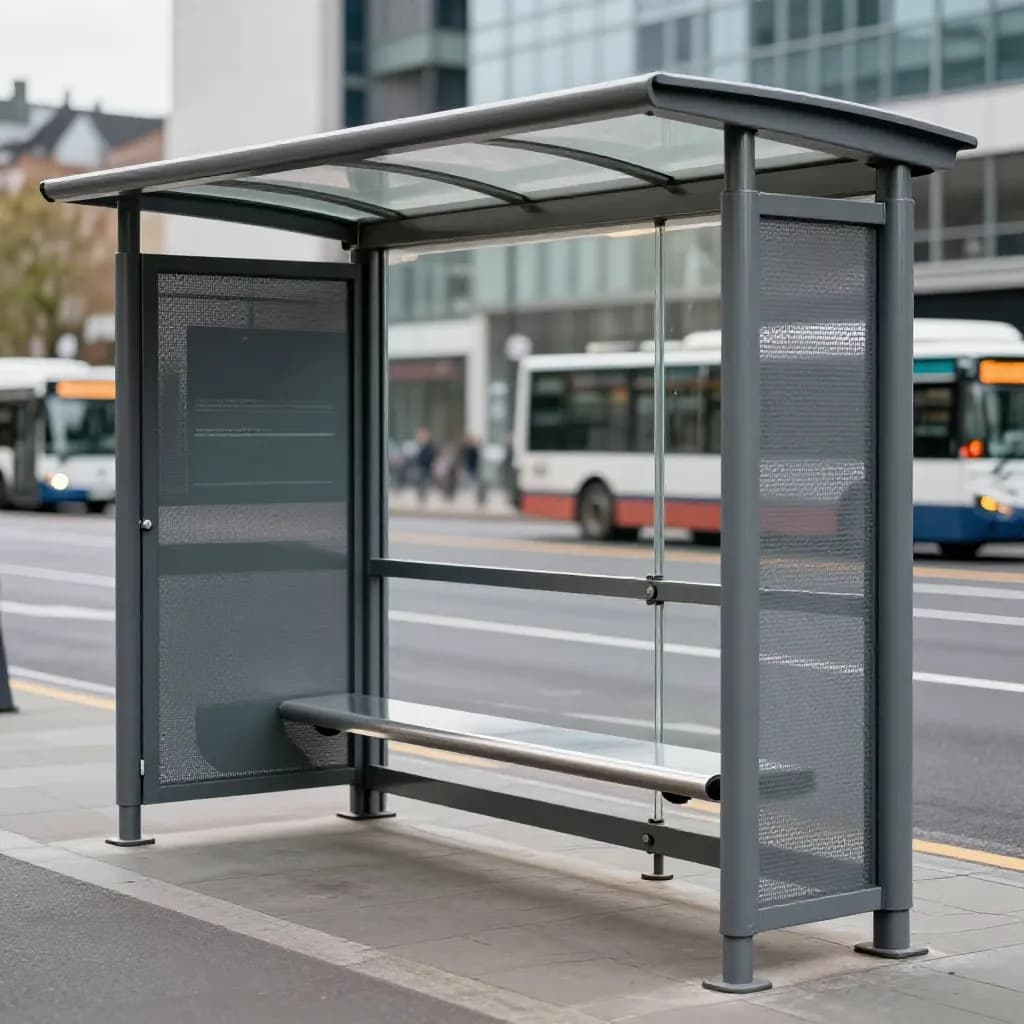
Modern bus shelters are sophisticated structures that integrate seating, lighting, digital information displays, advertising panels, and sometimes heating or cooling systems. The structural framework is typically fabricated from steel tube or aluminum extrusion, with glass or polycarbonate panels for weather protection. The metal framework receives powder coating as its primary finish, and the coating specification must address the full range of environmental and human-induced stresses that the shelter will face.
Ready to Start Your Project?
From one-off customs to 15,000-part production runs — get precise pricing in 24 hours.
On This Page
Bus Shelters: High-Visibility Public Infrastructure
Transit agencies and municipal governments specify bus shelters through procurement processes that include detailed coating requirements. These specifications typically reference national or international standards for outdoor coating durability, vandal resistance, and color consistency, and may include agency-specific requirements for brand colors, anti-graffiti properties, and maintenance procedures. The coating specification is a significant factor in shelter procurement evaluation because coating durability directly affects lifecycle maintenance requirements.
The bus shelter market includes both custom-designed shelters specified by transit agencies and standardized shelter products offered by street furniture manufacturers. In both cases, powder coating is the dominant finishing technology, chosen for its combination of durability, color range, vandal resistance, and environmental compliance. Major street furniture manufacturers including JCDecaux, Clear Channel, and Trueform all use powder coating as their primary finishing technology for bus shelter frameworks.
Anti-Graffiti Coatings for Transit Infrastructure
Graffiti is the most persistent vandalism challenge facing bus shelters, and anti-graffiti powder coatings have become a standard specification for transit infrastructure in urban areas. The coating must prevent permanent adhesion of spray paint, marker ink, and adhesive stickers while maintaining its anti-graffiti effectiveness through years of outdoor exposure and repeated cleaning cycles.
Permanent anti-graffiti powder coatings are the preferred technology for bus shelters because they do not require reapplication after each graffiti removal event. These coatings achieve their graffiti-release properties through surface chemistry modifications — typically fluoropolymer or silicone-based additives — that create a low surface energy surface resistant to wetting by paint and adhesive. Surface energy values below 25 millinewtons per meter provide effective graffiti release for most common graffiti materials.
Graffiti removal from anti-graffiti powder coatings is performed using proprietary cleaning solutions matched to the specific coating formulation. The cleaning solution softens or dissolves the graffiti material without attacking the underlying coating, allowing removal by wiping or low-pressure washing. The cleaning process should be validated for each graffiti type — spray paint, permanent marker, lipstick, and adhesive residue — to ensure effective removal without coating damage.
The durability of anti-graffiti properties over time is a critical specification parameter. Some anti-graffiti coatings lose their graffiti-release effectiveness after repeated cleaning cycles as the surface chemistry is gradually depleted. High-quality permanent anti-graffiti formulations maintain their effectiveness through 50 or more cleaning cycles, which is adequate for the typical graffiti frequency on urban bus shelters. The specification should include a minimum number of cleaning cycles with verified graffiti release performance.
Sticker and poster removal is as important as paint graffiti removal for bus shelter maintenance. Unauthorized stickers, posters, and adhesive labels are applied to shelter surfaces daily in urban areas, and the anti-graffiti coating must facilitate their removal without leaving adhesive residue. The low surface energy that resists paint adhesion also reduces sticker bond strength, allowing most stickers to be peeled off cleanly. Residual adhesive can be removed with the same cleaning solutions used for paint graffiti.
The anti-graffiti coating must be compatible with the shelter's other surface treatments and components. Advertising panel frames, digital display bezels, and lighting fixtures may be bonded or mechanically attached to the coated surface, and the low surface energy of anti-graffiti coatings can affect adhesive bond strength at these interfaces. Assembly adhesive selection must account for the coating's surface properties to ensure reliable component attachment.
UV Protection for Continuous Outdoor Exposure
Bus shelters are installed in open street environments with no shade protection, subjecting the powder coating to continuous UV radiation that degrades polymer coatings through photochemical chain scission. The coating must maintain its color, gloss, and protective properties for the shelter's design service life — typically 15-25 years — without scheduled recoating.
Super-durable polyester powder coatings are the standard specification for bus shelter frameworks, providing 7-10 years of color and gloss retention in full outdoor exposure. For shelters with longer design lives or in high-UV environments, fluoropolymer-modified powder coatings extend UV resistance to 15-20 years. The choice between these options depends on the transit agency's lifecycle maintenance strategy — agencies that plan for mid-life refurbishment may accept super-durable polyester, while agencies seeking minimal maintenance over the full shelter life should specify fluoropolymer-modified formulations.
Color stability under UV exposure is particularly important for bus shelters because they serve as brand identity elements for the transit system. Transit agencies invest in distinctive shelter designs and colors that build system recognition and rider confidence. A shelter that fades from its specified brand color to a washed-out approximation undermines this brand investment. UV-stable pigments with Blue Wool Scale ratings of 7 or higher should be specified for all brand-critical colors.
Chalking — the formation of a loose, powdery surface layer from UV degradation — is objectionable on bus shelters because it transfers to riders' clothing when they lean against or brush past the shelter framework. Even moderate chalking that would be acceptable on industrial equipment is unacceptable on transit furniture that contacts the public. The specification should require a maximum chalking rating of 8 or higher per ASTM D4214 after the specified accelerated weathering exposure.
Gloss retention affects the shelter's perceived quality and cleanliness. A high-gloss finish that becomes matte after a few years of exposure looks aged and poorly maintained, even if the coating is still providing adequate protection. Specifying initial gloss levels in the satin range of 30-50 gloss units at 60 degrees makes UV-related gloss changes less visually apparent than starting with a high-gloss finish. Satin finishes also show less dirt accumulation and fingerprinting than high-gloss surfaces.
South-facing shelter surfaces receive significantly more UV exposure than north-facing surfaces in the northern hemisphere, creating differential fading that can be visually apparent on shelters with multiple exposed faces. Specifying UV-resistant formulations for all surfaces — not just the most exposed — ensures uniform appearance over time.
Structural Durability and Impact Resistance
Bus shelters face a wide range of mechanical stresses from both intentional vandalism and accidental damage. The powder coating must absorb these impacts without cracking or delaminating, maintaining the corrosion barrier that protects the structural framework from degradation.
Deliberate vandalism — kicking, striking with objects, and attempted structural damage — is a persistent threat to bus shelters in urban areas. While the coating cannot prevent structural damage from determined vandalism, it must resist the more common low-to-moderate impact events without chipping or cracking. A minimum of 120 inch-pounds direct impact resistance per ASTM D2794 is recommended for bus shelter frameworks, with 160 inch-pounds preferred for shelters in high-vandalism locations.
Vehicle contact is a significant damage source for bus shelters positioned close to roadways. Buses, trucks, and cars can strike shelter components during parking, turning, or accident events. The lower sections of shelter posts and the roof edge facing the roadway are most vulnerable. Enhanced impact resistance in these zones — through increased film thickness, impact-resistant primer systems, or structural design features that absorb impact — reduces coating damage from vehicle contact.
Abrasion from daily use accumulates over the shelter's service life. Riders lean against posts, drag bags across surfaces, and handle framework components during boarding and alighting. Maintenance activities including cleaning, poster removal, and component replacement also create abrasion. The coating must resist this chronic low-level abrasion without wearing through to the substrate. Pencil hardness of 2H or higher and Taber abrasion loss below 80 milligrams per 1000 cycles with CS-17 wheels provide adequate abrasion resistance for transit furniture applications.
Fastener and connection point protection is critical for bus shelter durability. Bolted connections between posts, roof beams, and panel frames create stress concentration points where the coating is most likely to crack under mechanical loading. The coating at these connections must accommodate the slight movement that occurs as the shelter flexes under wind loads and thermal expansion without cracking or losing adhesion. Flexible polyester formulations with good elongation properties perform better at connection points than rigid, brittle coatings.
Seating surfaces on bus shelters experience concentrated wear from rider contact. The coating on bench seats and leaning rails must resist the abrasion of clothing, bags, and direct skin contact for thousands of use cycles per day. Smooth, hard coatings with enhanced abrasion resistance are specified for seating surfaces, and some shelter designs use separate materials — stainless steel, hardwood, or recycled plastic — for seating to avoid coating wear issues entirely.
Color Standards and Transit Brand Identity
Bus shelter color is a significant element of transit system brand identity, and the powder coating must deliver precise, consistent colors that reinforce system recognition across hundreds or thousands of shelter installations. Transit agencies invest in brand development programs that specify exact colors, finishes, and application standards for all system elements including shelters.
Transit brand colors are typically specified using standard color systems — RAL, Pantone, NCS, or custom spectrophotometric coordinates — with tight tolerances that ensure visual consistency across the system. Delta E tolerances of 1.0 or less are common for primary brand colors, requiring careful powder formulation control and batch-to-batch verification. Physical color reference panels maintained by the transit agency provide the ultimate color standard against which production coating is measured.
Multi-color shelter designs use different colors for structural framework, roof elements, seating, and accent features to create visual hierarchy and brand distinction. These multi-color schemes require sequential coating with intermediate masking, or separate coating of individual components before assembly. Color consistency between components coated in different batches or by different applicators must be verified before assembly to prevent visible color mismatches on the installed shelter.
Color durability over the shelter's service life is essential for brand consistency across the system. Shelters installed years apart must appear the same color when viewed side by side, which requires both UV-stable coating formulations and consistent color specification over time. Transit agencies should maintain archived powder samples and spectrophotometric data for each color specification, enabling accurate color reproduction for replacement shelters and refurbishment projects decades after the original installation.
Contrast between shelter colors and the surrounding urban environment affects shelter visibility and wayfinding effectiveness. Shelters should be visually distinct from their background to help riders locate stops from a distance. Dark shelters against light building facades, or light shelters against dark backgrounds, provide the visual contrast needed for effective wayfinding. The color specification should consider the typical background context of shelter installations across the system.
Accessibility considerations influence color selection for specific shelter elements. Contrast between structural posts and glass panels helps visually impaired riders identify shelter boundaries. Contrasting color on bench edges and leaning rail ends improves visibility of these features. These accessibility color requirements should be integrated into the overall shelter color specification.
Pretreatment and Application for Shelter Components
Bus shelter components are fabricated from a variety of materials — steel tube, aluminum extrusion, cast aluminum, and stainless steel — each requiring appropriate pretreatment for optimal powder coating adhesion and durability. The pretreatment specification must address the specific substrate materials used in the shelter design and the aggressive outdoor environment the coating will face.
Steel tube framework — the most common structural material for bus shelters — requires thorough pretreatment for long-term outdoor durability. The standard sequence includes abrasive blasting or acid pickling to remove mill scale and surface contamination, followed by zinc phosphate conversion coating for maximum adhesion and corrosion resistance. For shelters in aggressive environments, a zinc-rich epoxy primer applied over the conversion coating before the powder topcoat provides additional cathodic protection at any coating defect.
Aluminum extrusion components require alkaline cleaning, acid etching, and chromate-free conversion coating. The conversion coating — typically zirconium-based — must provide adhesion that withstands decades of outdoor exposure including UV, moisture, and thermal cycling. Conversion coating weight should be verified at 30-50 milligrams per square meter on production parts.
Cast aluminum decorative elements — ornamental brackets, finials, and base covers — may have surface porosity from the casting process that causes outgassing defects during powder curing. Pre-baking cast components at 200-220 degrees Celsius for 15-20 minutes before powder application drives out trapped gases and prevents pinholes in the cured film. The casting surface should also be inspected for porosity, shrinkage defects, and cold shuts that could affect coating appearance or adhesion.
Mixed-material assemblies — such as steel posts with aluminum roof structures — require pretreatment systems compatible with both substrates. Multi-metal pretreatment chemistries based on zirconium or titanium provide acceptable performance on both steel and aluminum, though they may not achieve the peak performance of dedicated single-metal treatments. For critical applications, separate pretreatment of steel and aluminum components before assembly ensures optimal treatment for each substrate.
Weld preparation on fabricated steel shelter components follows standard practice: grinding weld spatter, blending weld beads, and ensuring smooth transitions between welds and parent metal. For shelters where surface quality expectations are high — particularly on visible structural members — weld seams should be ground to a surface finish that matches the surrounding metal, with no visible weld line after coating.
Maintenance Programs and Lifecycle Management
Bus shelter coating maintenance is an ongoing operational requirement that transit agencies must plan and budget for throughout the shelter's service life. A proactive maintenance program extends coating life, maintains brand appearance, and prevents structural corrosion that could compromise shelter safety.
Routine cleaning is the most frequent maintenance activity, typically performed on a monthly to quarterly cycle depending on the shelter's location and vandalism frequency. Cleaning removes dirt, pollution deposits, bird droppings, and graffiti that degrade the coating's appearance and can accelerate UV degradation by trapping moisture against the surface. The cleaning method and chemicals must be compatible with the powder coating — particularly anti-graffiti formulations that can be damaged by aggressive solvents or abrasive cleaning methods.
Graffiti removal should be performed within 24-48 hours of discovery to discourage repeat vandalism. Rapid graffiti removal has been shown to reduce the frequency of subsequent graffiti attacks, making prompt response a cost-effective vandalism management strategy. Maintenance crews should be equipped with the specific cleaning solutions recommended for the shelter's anti-graffiti coating and trained in proper application technique to avoid coating damage.
Coating condition inspection should be performed at least annually, with more frequent inspection for shelters in aggressive environments or high-vandalism locations. The inspection should evaluate coating adhesion, chalking, fading, impact damage, and corrosion at vulnerable points including base plates, fastener connections, and weld seams. Inspection data should be recorded in the transit agency's asset management system to track coating condition trends and predict maintenance needs.
Touch-up repair of localized coating damage prevents corrosion progression between major maintenance intervals. Touch-up kits matched to the shelter's powder coating color should be stocked by the maintenance department. The repair process involves cleaning the damaged area, applying corrosion-inhibiting primer if bare metal is exposed, and topcoating with color-matched repair paint. While touch-up repair does not match factory powder coating quality, it maintains the corrosion barrier and extends the time between major refurbishment.
Major refurbishment — stripping and recoating the entire shelter framework — is typically performed at 15-20 year intervals depending on coating condition and the transit agency's appearance standards. Refurbishment can be performed in the field by removing the shelter to a workshop, or in some cases by on-site coating using portable equipment. The refurbishment specification should match or exceed the original coating specification to ensure equivalent performance in the second service period.
Frequently Asked Questions
How does anti-graffiti powder coating work on bus shelters?
Permanent anti-graffiti powder coatings use fluoropolymer or silicone-based additives to create a low surface energy surface (below 25 mN/m) that prevents paint and adhesive from bonding permanently. Graffiti is removed with proprietary cleaning solutions that dissolve the graffiti without damaging the coating. High-quality formulations maintain effectiveness through 50 or more cleaning cycles.
How long does powder coating last on bus shelters?
Super-durable polyester provides 7-10 years of color and gloss retention. Fluoropolymer-modified coatings extend this to 15-20 years. Corrosion protection from the duplex galvanizing-plus-powder-coating system lasts 30-40 years in moderate environments. Regular maintenance including cleaning and touch-up repair extends the overall coating service life.
What impact resistance is needed for bus shelter coatings?
A minimum of 120 inch-pounds direct impact resistance per ASTM D2794 is recommended, with 160 inch-pounds preferred for high-vandalism locations. The lower sections of shelter posts and roadway-facing edges need the highest impact resistance due to vehicle contact risk. Flexible polyester formulations perform better at connection points than rigid coatings.
Does bus shelter powder coating transfer to clothing?
Properly maintained powder coating does not transfer to clothing. However, UV-degraded coatings that have developed chalking can leave a powdery residue on dark clothing. Specifying super-durable or fluoropolymer-modified coatings with maximum chalking ratings of 8 or higher prevents this issue throughout the shelter's service life.
Can bus shelter colors be matched to transit brand standards?
Yes. Powder coating can match any color specified by RAL, Pantone, NCS, or custom spectrophotometric coordinates with Delta E tolerances below 1.0. Batch-to-batch color verification ensures consistency across shelter installations. Archived powder samples and spectrophotometric data enable accurate color reproduction for replacement shelters decades later.
Ready to Start Your Project?
From one-off customs to 15,000-part production runs — get precise pricing in 24 hours.