Powder coating is a method of applying a protective and decorative finish to metal objects using a dry powder rather than liquid paint. The powder — a finely ground mixture of resin, pigment, and performance additives — is sprayed onto the metal surface using a specialized gun that gives the powder particles an electrical charge. The charged particles are attracted to the grounded metal part and cling to its surface. The coated part is then placed in an oven where heat melts the powder, causes it to flow into a smooth film, and triggers a chemical reaction that hardens the coating into a tough, durable finish.
Guides
Powder Coating for Beginners: What It Is, How It Differs from Paint, and When to Choose It
Sundial Powder Coating·April 22, 2026·13 min
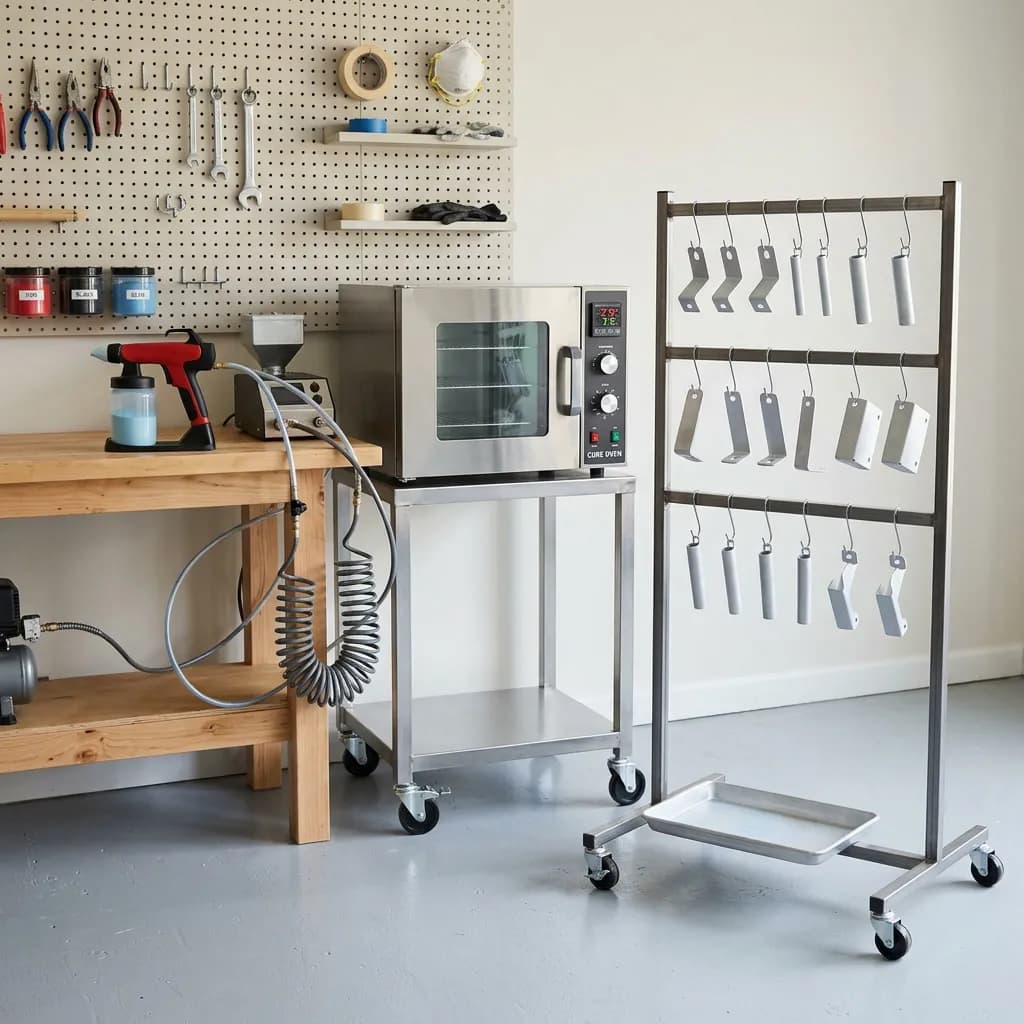
The result is a coating that is typically thicker, more uniform, and more durable than conventional liquid paint. Powder coatings resist chipping, scratching, fading, and corrosion better than most paint systems, and they do so without the volatile organic compound (VOC) emissions that make liquid painting an environmental and health concern. This combination of performance and environmental responsibility has made powder coating the dominant finishing technology for metal products across industries from architecture and automotive to furniture, appliances, and industrial equipment.
Ready to Start Your Project?
From one-off customs to 15,000-part production runs — get precise pricing in 24 hours.
On This Page
What Is Powder Coating?
If you have ever looked at a metal railing, a bicycle frame, a patio chair, a car wheel, or an electrical enclosure and noticed a smooth, consistent, durable finish, there is a good chance you were looking at powder coating. It is one of those technologies that is everywhere once you know what to look for, yet most people outside the manufacturing world have never heard of it. This guide introduces the basics for anyone encountering powder coating for the first time.
How Powder Coating Differs from Liquid Paint
The fundamental difference between powder coating and liquid paint is the absence of solvents. Liquid paint consists of pigment and resin dissolved or suspended in a liquid solvent — water for water-based paints, or organic chemicals like xylene, toluene, or acetone for solvent-based paints. The solvent keeps the paint in liquid form for application, then evaporates during drying, leaving the solid pigment and resin behind as the coating film. This evaporation releases volatile organic compounds into the atmosphere, contributing to air pollution and posing health risks to workers.
Powder coating eliminates the solvent entirely. The resin and pigment are combined in solid form, ground into a fine powder, and applied as a dry material. There is nothing to evaporate, so there are zero VOC emissions during application and curing. This is not a minor difference — it fundamentally changes the environmental profile, workplace safety requirements, and regulatory compliance burden of the finishing operation.
The application method also differs significantly. Liquid paint can be applied by brush, roller, dip, or spray to virtually any surface. Powder coating requires electrostatic spray equipment and a conductive substrate (typically metal), and the coated part must be oven-cured at temperatures of 160 to 200°C. This means powder coating is not suitable for heat-sensitive materials like wood or most plastics (though specialized low-temperature powders are expanding the range). The trade-off is that powder coating achieves a thicker, more uniform film in a single application — typically 60 to 80 microns compared to 25 to 50 microns for a single coat of liquid paint — providing superior protection and appearance.
Basic Powder Coating Terminology
Understanding a few key terms will help you communicate effectively with powder coaters and make informed decisions about your coating requirements.
Resin system refers to the base chemistry of the powder. The most common types are polyester (good all-around performance, excellent UV resistance for outdoor use), epoxy (excellent chemical and corrosion resistance but poor UV resistance — interior use only), hybrid or polyester-epoxy (a blend offering moderate chemical resistance and moderate UV resistance — suitable for interior and light exterior use), and polyurethane (excellent smoothness and chemical resistance, used for premium applications). The resin system determines the fundamental performance characteristics of the coating.
Film thickness is the thickness of the cured coating, measured in microns (thousandths of a millimeter) or mils (thousandths of an inch). One mil equals approximately 25 microns. Standard powder coating thickness is 60 to 80 microns (2.4 to 3.2 mils). Thicker films provide more protection but cost more in material and may affect dimensional tolerances on precision parts.
Pretreatment is the surface preparation process applied to the metal before powder coating. It includes cleaning (removing oil, grease, and dirt) and conversion coating (creating a chemical layer that improves adhesion and corrosion resistance). Pretreatment quality is the single most important factor in coating longevity.
Cure schedule is the combination of temperature and time required to fully harden the powder coating. A typical cure schedule might be 200°C for 10 minutes at metal temperature. Under-curing produces a soft, poorly performing coating; over-curing can cause discoloration and brittleness.
When to Choose Powder Coating
Powder coating is the right choice in many situations, but it is not the answer to every finishing need. Understanding when powder coating excels — and when alternatives might be better — helps you make the right decision for your project.
Choose powder coating when durability is a priority. If the finished product will be exposed to weather, UV radiation, mechanical wear, chemical exposure, or frequent handling, powder coating's thick, hard, crosslinked film provides superior protection compared to most liquid paint systems. Outdoor furniture, architectural metalwork, automotive parts, industrial equipment, and playground structures are all excellent candidates.
Choose powder coating when environmental responsibility matters. The zero-VOC, near-zero-waste characteristics of powder coating make it the most environmentally friendly metal finishing option available. If your project requires green building certification credits, environmental product declarations, or compliance with strict air quality regulations, powder coating simplifies compliance.
Choose powder coating when you need consistency across large quantities. The automated nature of powder coating lines — consistent electrostatic application, precise oven temperature control, and standardized powder formulations — produces highly repeatable results from the first part to the last. This consistency is valuable for architectural projects with hundreds of matching panels, automotive production runs, and any application where color and finish uniformity across parts is critical.
Consider alternatives when the substrate cannot withstand heat (most plastics, wood, assembled electronics), when the part is too large for available ovens, when touch-up of small damaged areas is needed in the field (powder coating requires oven curing and cannot be touch-up brushed like paint), or when very thin films are required for dimensional precision.
Colors, Finishes, and Design Options
One of the most pleasant surprises for people new to powder coating is the enormous range of colors and finishes available. Powder coating is not limited to the industrial greys and blacks that many people associate with metal finishing. The full RAL Classic color range — over 200 standardized colors — is available as standard from most powder manufacturers, along with RAL Design, NCS, Pantone, and custom color matching to virtually any reference sample.
Beyond solid colors, powder coatings are available in a wide variety of finishes and effects. Metallic finishes incorporate aluminum flake or mica pigments to create sparkle and shimmer. Textured finishes — wrinkle, hammer-tone, sand, and leather textures — add tactile and visual interest while hiding surface imperfections. Matte, satin, semi-gloss, and high-gloss sheens are available in most colors, allowing you to control the reflectivity of the surface. Wood-grain finishes use sublimation transfer technology to replicate the appearance of natural timber on aluminum profiles.
Special effects include candy coat transparents over metallic bases, color-shift chameleon finishes, glow-in-the-dark formulations, and anti-graffiti coatings that allow spray paint to be wiped off without damaging the underlying finish. Antimicrobial powder coatings incorporating silver ion or copper-based additives are available for healthcare, food service, and public transit applications.
The design flexibility of powder coating means that virtually any aesthetic vision can be realized on metal substrates. The key is to communicate your requirements clearly to the powder coater and request physical samples — sprayed on the actual substrate material — before committing to production. Digital color representations and small color chips do not adequately represent how a finish will look on a full-size part.
Finding and Evaluating a Powder Coater
Finding the right powder coating service provider is as important as choosing the right color and finish. The quality of the finished product depends heavily on the coater's equipment, process control, experience, and quality management practices. Here is how to find and evaluate a powder coater for your project.
Start by identifying coaters in your region through industry directories, manufacturer referral programs, and online searches. Major powder manufacturers like AkzoNobel, Axalta, Tiger Coatings, and Sherwin-Williams maintain networks of approved applicators and can recommend coaters qualified to apply their products. Industry associations such as the Powder Coating Institute (PCI) in North America and the European Powder Coating Association (EPCA) maintain member directories.
When evaluating a coater, ask about their certifications and quality systems. For architectural work, look for Qualicoat, GSB, or AAMA certification, which require regular audits of the coater's equipment, processes, and quality control procedures. For general industrial work, ISO 9001 certification indicates a structured quality management system. Ask to see their pretreatment process — a coater who invests in multi-stage pretreatment with conversion coating is more likely to produce durable results than one who relies on simple cleaning alone.
Request references from customers with similar projects and ask to see examples of their work. A reputable coater will be happy to show you their facility, explain their process, and provide sample panels in your specified color and finish. Pay attention to the cleanliness and organization of the facility — a well-maintained coating operation is more likely to produce consistent, high-quality results than a disorganized one.
What to Expect: Lead Times, Quantities, and Communication
Understanding the practical aspects of working with a powder coater helps set realistic expectations and ensures a smooth project experience. Lead times for powder coating vary depending on the coater's workload, the complexity of the job, and whether custom colors or special finishes are required. Standard colors on simple parts might be turned around in 3 to 5 business days. Custom colors requiring powder manufacturing may add 2 to 4 weeks. Large architectural projects with multiple colors and quality documentation requirements may require 4 to 8 weeks or more.
Minimum order quantities vary by coater. Some job shops accept single parts for custom or prototype work, while production-oriented coaters may require minimum batch sizes to justify the setup time for color changes and equipment cleaning. If you have a small quantity of parts in a custom color, expect to pay a premium for the setup and color change time, or consider choosing a standard catalog color that the coater runs regularly.
Communication is critical to a successful powder coating project. Provide the coater with clear specifications including: the substrate material and condition, the desired color (RAL number, color chip, or reference sample), the finish type and gloss level, the film thickness requirement, any masking requirements (areas that must remain uncoated), the quantity and delivery schedule, and any applicable quality standards or testing requirements. The more clearly you communicate your expectations upfront, the less likely you are to encounter surprises when the finished parts arrive.
Ask for a sample or first-article approval before full production begins. This gives you the opportunity to evaluate the color, finish, and quality on an actual part and request adjustments before the entire batch is coated. Most professional coaters offer first-article approval as a standard part of their process for new jobs.
Frequently Asked Questions
Is powder coating better than paint?
For metal substrates, powder coating generally outperforms liquid paint in durability, thickness, consistency, and environmental impact. It produces a thicker film in one coat, emits zero VOCs, and achieves 95-98% material utilization. However, liquid paint is more versatile for non-metal substrates, field touch-ups, and very thin film requirements.
What materials can be powder coated?
Powder coating works best on metals — steel, aluminum, stainless steel, brass, copper, and zinc die-cast. The substrate must be electrically conductive for electrostatic application and able to withstand cure temperatures of 160-200°C. Specialized low-temperature powders are expanding the range to some plastics and composites.
How long does powder coating last?
Properly applied powder coating on well-prepared metal substrates lasts 15-25 years in exterior applications, depending on the resin system, pretreatment quality, and environmental exposure. Interior applications can last the lifetime of the product. Architectural powder coatings certified to Qualicoat or AAMA 2605 standards are warranted for up to 25 years.
Can powder coating be repaired if damaged?
Small chips and scratches can be touched up with color-matched liquid touch-up paint for cosmetic repair, but this does not replicate the full performance of the original powder coating. For significant damage, the affected area or entire part should be stripped and recoated. Powder coating cannot be touch-up applied in the field like liquid paint.
How do I choose the right color for powder coating?
Start with standardized color systems like RAL Classic, which offers over 200 colors available from most powder manufacturers. Request physical sprayed samples on your actual substrate material — digital images and small color chips do not accurately represent the final appearance. Evaluate samples under the lighting conditions where the finished product will be used.
Ready to Start Your Project?
From one-off customs to 15,000-part production runs — get precise pricing in 24 hours.