Automotive wheels occupy a unique position in the powder coating world — they combine the aesthetic demands of a show-quality finish with the functional demands of one of the harshest operating environments on a vehicle. A wheel must look flawless from a distance of a few feet while enduring road salt, brake dust, curb impacts, stone chips, extreme temperature cycling, and aggressive cleaning chemicals. This combination of requirements makes wheel coating one of the most technically demanding applications in the powder coating industry.
Automotive
Powder Coating for Automotive Wheels: Preparation, Outgassing, Clear Coats, and Brake Dust Resistance
Sundial Powder Coating·April 22, 2026·14 min
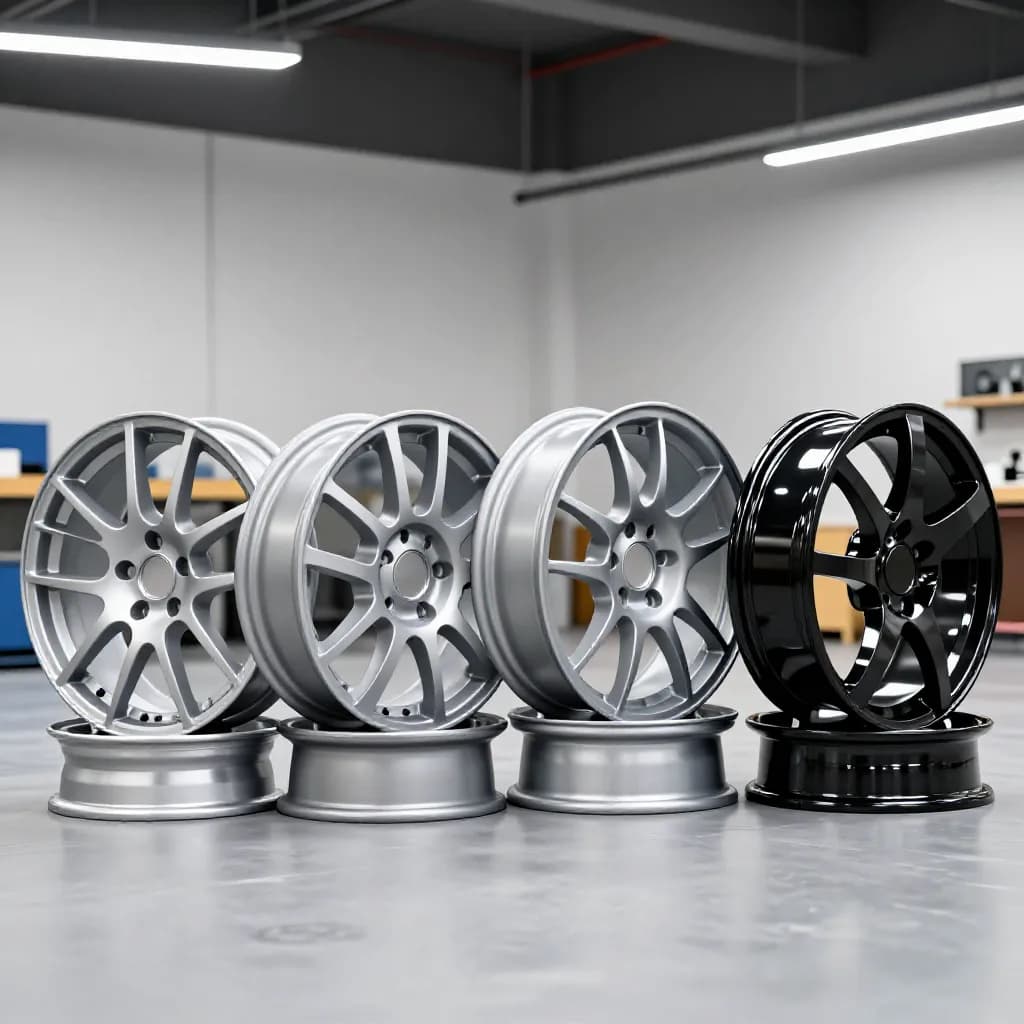
The challenges begin with the substrate. Cast aluminum alloy wheels — the most common type — are produced by pouring molten aluminum into molds, a process that traps gas within the casting. This trapped gas becomes a major problem during powder coating because the cure oven temperature causes the gas to expand and escape through the coating, creating pinholes, bubbles, and craters that ruin the finish. This phenomenon, called outgassing, is the single most common cause of wheel coating defects and requires specific process steps to manage.
Ready to Start Your Project?
From one-off customs to 15,000-part production runs — get precise pricing in 24 hours.
On This Page
Why Wheels Are One of the Toughest Powder Coating Jobs
Beyond outgassing, wheels present geometric challenges. The complex shape — with spokes, barrel, hub face, lug holes, and valve stem hole — creates Faraday cage areas where electrostatic powder has difficulty reaching. The back side of the wheel, the inner barrel, and the areas between spokes require careful gun technique or specialized equipment to coat uniformly. And the finished wheel must withstand brake temperatures that can exceed 300°C at the hub area during aggressive driving, testing the thermal stability of the coating system.
Alloy Wheel Preparation and Outgassing Management
Proper preparation of cast aluminum wheels is the foundation of a successful coating job, and outgassing management is the most critical element of that preparation. Skipping or shortcutting the outgassing step is the most common mistake made by inexperienced wheel coaters, and it invariably results in a defective finish that must be stripped and redone.
Outgassing occurs because cast aluminum contains microscopic porosity — tiny voids and channels within the metal that trap air, moisture, and mold release agents during the casting process. At room temperature, these trapped substances are stable. But when the wheel is heated to powder coating cure temperature (typically 190 to 200°C), the trapped gases expand and migrate to the surface. If a powder coating is already on the surface, the escaping gas pushes through the molten coating, creating pinholes and craters.
The solution is to bake the wheel at or above the cure temperature before applying any powder. This degassing bake — typically 200 to 220°C for 30 to 60 minutes — drives out the trapped gases while the surface is bare, allowing them to escape freely. After the degassing bake, the wheel is cooled, and the powder coating is applied and cured normally. During the cure cycle, most of the gas has already been expelled, and the remaining outgassing is minimal — not enough to cause visible defects in the coating.
Some coaters perform the degassing bake as a separate step, while others combine it with the pretreatment process. Chemical pretreatment — alkaline cleaning followed by a chrome-free conversion coating — should be performed after the degassing bake, as the bake can burn organic contaminants onto the surface that the pretreatment chemicals then remove. The sequence is: degrease, degassing bake, chemical pretreatment, dry, powder application, cure.
Coating Systems for Wheels: Single Coat vs Multi-Layer
Wheel coating systems range from simple single-coat applications to complex multi-layer systems, with the choice depending on the desired appearance, performance requirements, and budget.
Single-coat systems apply one layer of colored powder directly to the pretreated wheel surface. This is the simplest and most economical approach, suitable for solid-color wheels in standard finishes. A single coat of polyester powder at 60 to 80 microns provides good appearance and adequate protection for normal street use. The limitation is that single-coat systems offer less depth and richness than multi-layer systems, and they provide less protection against stone chips and chemical attack.
Two-coat systems — base coat plus clear coat — are the standard for premium wheel finishing. The base coat provides the color and any special effects (metallic, candy, textured), while the clear topcoat adds depth, gloss, and a sacrificial protective layer that absorbs UV radiation, chemical attack, and minor abrasion before the color coat is affected. The clear coat also makes the wheel easier to clean because its smooth, hard surface resists brake dust adhesion and chemical staining.
Three-coat systems add a primer layer between the substrate and the base coat. The primer — typically an epoxy or epoxy-polyester formulation — provides enhanced adhesion to the aluminum substrate and superior corrosion protection. Three-coat systems are specified for wheels that will see aggressive environments (coastal areas, heavy winter salt use) or demanding use (track driving, commercial vehicles). The total film build of a three-coat system — 40 to 60 microns primer, 50 to 70 microns base coat, 40 to 60 microns clear coat — provides a robust 130 to 190 micron barrier that offers maximum protection.
Clear Coat Systems and Their Importance
The clear topcoat is arguably the most important layer in a wheel coating system. It is the first line of defense against every environmental and chemical assault the wheel faces, and its quality determines how long the wheel maintains its appearance.
Powder clear coats for wheels are typically based on polyester, acrylic, or polyester-urethane resin systems. Polyester clears offer good UV resistance and chemical resistance at moderate cost — they are the standard choice for most wheel applications. Acrylic clears provide superior clarity and depth, producing a glass-like finish that enhances metallic and candy base coats, but they can be more brittle and less chemical-resistant than polyester. Polyester-urethane clears combine the UV resistance of polyester with the hardness and chemical resistance of urethane, offering the best overall performance for demanding wheel applications.
Brake dust resistance is a critical performance attribute for wheel clear coats. Brake dust — a mixture of iron particles from the brake rotor and friction material from the brake pads — is highly corrosive and chemically aggressive. Hot brake dust particles land on the wheel surface and, if not removed promptly, can etch into the clear coat, leaving permanent stains and pitting. High-quality wheel clear coats are formulated with enhanced chemical resistance to withstand brake dust exposure, but even the best clear coat will eventually be damaged by prolonged brake dust contact. Regular cleaning is essential.
The clear coat also provides UV protection for the base coat beneath it. UV absorbers and HALS stabilizers in the clear coat formulation absorb UV radiation before it reaches the color coat, preventing fading and chalking of the base color. This is particularly important for metallic and candy base coats, where the effect pigments can be sensitive to UV degradation. A well-formulated clear coat with robust UV protection can extend the life of the base coat by several years compared to an unprotected base coat.
Track Wheels vs Street Wheels: Different Requirements
Wheels used for track driving face significantly more demanding conditions than street wheels, and the coating system must be selected accordingly. Track driving generates extreme brake temperatures — sustained braking from high speeds can heat the brake rotor to 600°C or more, and this heat conducts through the hub and into the wheel. The area around the lug holes and the hub face can reach temperatures well above the cure temperature of the powder coating, potentially causing discoloration, softening, or even coating failure.
For track-dedicated wheels, the coating options are more limited. Standard polyester powder coatings begin to soften and discolor above 200°C, making them unsuitable for the hub area of track wheels. High-temperature powder coatings — typically silicone-modified or ceramic-filled formulations — can withstand temperatures of 300 to 500°C but are available in a limited color range (usually black, silver, and a few other colors) and do not offer the same appearance quality as standard polyester powders.
A practical approach for dual-use wheels (street and occasional track) is to accept that some discoloration may occur in the hub area during track use and to focus the coating specification on protecting the visible spoke and barrel surfaces. The hub area can be coated with a high-temperature primer or left with a simpler finish that is expected to show heat effects. Some track enthusiasts choose to leave the hub area uncoated or coated with a sacrificial high-temperature paint that can be easily refreshed.
For street-only wheels, standard polyester powder coating with a quality clear coat provides excellent performance. The brake temperatures generated during normal street driving — even spirited driving — rarely exceed the coating's thermal limits. The primary threats to street wheel coatings are brake dust accumulation, road salt, curb damage, and aggressive wheel cleaning chemicals rather than extreme heat.
Common Wheel Coating Defects and Prevention
Understanding the most common wheel coating defects helps both coaters and wheel owners identify problems and their causes.
Outgassing pinholes are the most frequent defect on cast wheels. They appear as tiny holes or craters scattered across the coating surface, often concentrated in areas of the casting with higher porosity. Prevention: thorough degassing bake before coating. If pinholes appear after coating, the wheel must be stripped and recoated with a proper degassing bake.
Orange peel — a bumpy texture resembling orange skin — results from insufficient flow during the cure cycle. On wheels, it is often caused by applying the powder too thick, curing at too low a temperature, or using a powder formulation with poor flow characteristics. Prevention: apply powder at the recommended thickness, verify oven temperature with a data logger attached to the wheel, and use powder formulations designed for good flow on complex geometries.
Edge pull-back occurs when the coating retracts from sharp edges during the melt phase, leaving the edge exposed. On wheels, this commonly occurs at the edges of spoke cutouts and at the lip of the barrel. Prevention: ensure adequate powder build-up on edges during application (edges naturally attract more powder due to electrostatic field concentration, but the coating can still pull back during flow), and consider using powders formulated for good edge coverage.
Clear coat peeling — delamination of the clear topcoat from the base coat — is a serious defect that usually indicates an inter-coat adhesion problem. Common causes include contamination of the base coat surface before clear coat application, incompatible base and clear coat chemistries, or insufficient cure of the base coat before clear coat application. Prevention: keep the base coat surface clean between application steps, use compatible products from the same manufacturer, and verify base coat cure before applying the clear coat.
Wheel Refinishing: Restoring Damaged Wheels
Wheel refinishing — stripping and recoating damaged or worn wheels — is a thriving segment of the powder coating industry. Curb rash, stone chips, brake dust staining, and general weathering eventually degrade even the best wheel finish, and refinishing restores the wheel to like-new appearance at a fraction of the replacement cost.
The refinishing process begins with tire removal (the tire must come off the wheel for proper coating) and thorough inspection of the wheel for structural damage — cracks, bends, or severe curb damage that affects the wheel's structural integrity. Structural damage must be repaired by a qualified wheel repair specialist before refinishing, as coating over a structurally compromised wheel creates a safety hazard.
After inspection, the old coating is removed by chemical stripping, media blasting, or a combination. Chemical stripping is preferred for wheels with machined faces because it does not alter the surface profile. Media blasting with plastic or glass bead media is effective for wheels that will receive a full powder coat finish. Aggressive media like aluminum oxide should be avoided on wheel faces because it creates a rough surface profile that shows through the coating.
Curb damage is repaired by welding (for deep gouges), filling with aluminum-compatible filler, and sanding smooth. The repaired areas must be feathered into the surrounding surface to create an invisible transition under the new coating. After repair, the wheel goes through the standard coating process: degassing bake, pretreatment, powder application, and cure.
Wheel refinishing is also an opportunity to change the wheel's appearance — a different color, a different finish (matte instead of gloss, metallic instead of solid), or a custom effect like candy coat or two-tone. Many wheel owners use refinishing as a chance to personalize their wheels and create a unique look that sets their vehicle apart.
Choosing a Wheel Coating Specialist
Not all powder coaters are equally equipped or experienced for wheel work. The outgassing challenge, the complex geometry, the multi-layer coating systems, and the high appearance standards make wheel coating a specialty that benefits from dedicated experience and equipment.
When selecting a coater for wheel work, look for demonstrated experience with wheels specifically. Ask to see examples of their wheel work — both freshly coated and wheels that have been in service for a year or more. A coater who regularly does wheels will have a portfolio of work and satisfied customers who can provide references.
Ask about their outgassing management process. A coater who understands wheel coating will immediately discuss their degassing bake procedure — temperature, time, and how they verify that outgassing has been adequately addressed. A coater who does not mention outgassing or dismisses it as unnecessary is likely to produce wheels with pinhole defects.
Ask about their pretreatment process. Wheels benefit from multi-stage chemical pretreatment with conversion coating for maximum adhesion and corrosion resistance. A coater who relies on sandblasting alone for surface preparation may produce acceptable short-term results but inferior long-term durability.
Ask about their clear coat system. A quality wheel coater will use a dedicated wheel clear coat formulated for brake dust and chemical resistance, not a general-purpose clear coat. They should be able to tell you the specific product they use and its performance characteristics.
Finally, ask about turnaround time and tire handling. A professional wheel coating operation will have tire mounting and balancing capability or a partnership with a tire shop, and they will provide a realistic turnaround time that accounts for proper degassing, multi-coat application, and adequate cure time between coats.
Frequently Asked Questions
What is outgassing and why does it matter for wheel coating?
Outgassing is the release of trapped gases from cast aluminum when heated to powder coating cure temperature. These gases push through the molten coating, creating pinholes and craters. It is the most common cause of wheel coating defects. A degassing bake at 200-220°C for 30-60 minutes before coating drives out the gases and prevents this problem.
Do powder coated wheels need a clear coat?
A clear coat is not strictly required but is strongly recommended. The clear topcoat provides a sacrificial protective layer against brake dust, UV radiation, road chemicals, and minor abrasion. It also adds depth and gloss to the finish and makes the wheel easier to clean. Two-coat systems (color + clear) are the standard for quality wheel finishing.
Can powder coated wheels handle track driving?
Standard polyester powder coatings can soften and discolor at the extreme temperatures generated during track driving, particularly around the hub area. For track use, consider high-temperature coatings for the hub area or accept some heat discoloration. Street driving temperatures rarely exceed the coating's thermal limits.
How do I protect powder coated wheels from brake dust?
Regular cleaning is the most effective protection — wash wheels weekly or biweekly with a pH-neutral wheel cleaner to prevent brake dust from etching into the clear coat. Avoid acidic wheel cleaners that can attack the coating. Applying a ceramic coating or wheel sealant creates an additional barrier that makes brake dust easier to remove.
Can curb-damaged wheels be refinished with powder coating?
Yes. Curb damage can be repaired by welding and filling, then the wheel is stripped, pretreated, and recoated. This restores the wheel to like-new appearance at a fraction of replacement cost. Ensure the wheel is inspected for structural damage before refinishing — cracks or bends must be repaired by a qualified specialist first.
Ready to Start Your Project?
From one-off customs to 15,000-part production runs — get precise pricing in 24 hours.