Powder coatings are finely divided organic materials that, when dispersed in air at sufficient concentration, can form explosive dust clouds. This fundamental characteristic places powder coating operations in the category of combustible dust hazards, requiring specific fire and explosion prevention measures. The dust explosion pentagon — fuel (powder particles), oxygen (air), ignition source, dispersion (dust cloud), and confinement — defines the five conditions that must be present simultaneously for a dust explosion to occur. Effective prevention strategies aim to eliminate or control one or more of these conditions.
Technical
Fire Prevention and Safety in Powder Coating: Dust Explosion Risk, NFPA 33, ATEX Zones, and Suppression
Sundial Powder Coating·April 22, 2026·12 min
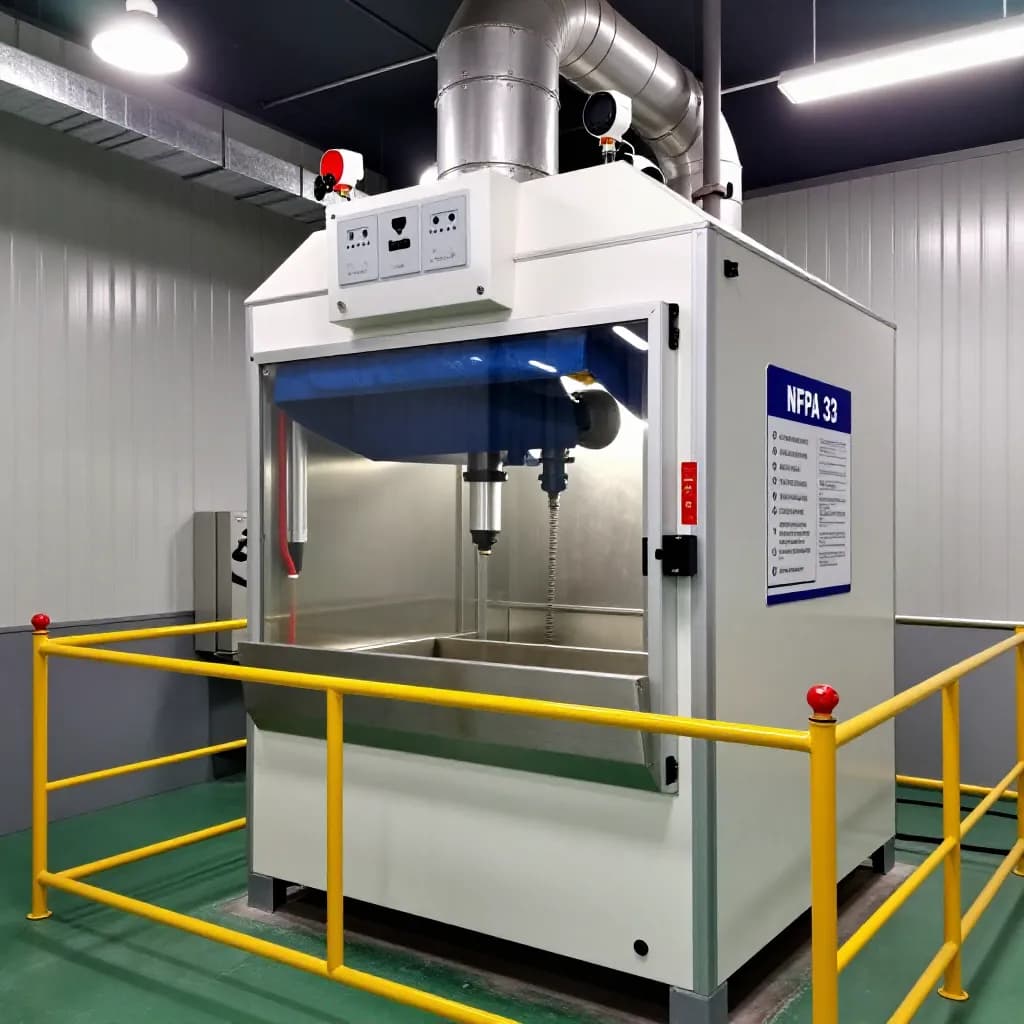
The explosion characteristics of powder coatings are defined by several measurable parameters. The minimum explosible concentration (MEC) is the lowest dust concentration in air that can propagate an explosion, typically 20-60 g/m³ for most powder coatings. The minimum ignition energy (MIE) is the smallest electrical spark energy that can ignite a dust cloud, typically 1-30 millijoules for powder coatings — low enough that electrostatic discharges can serve as ignition sources. The maximum explosion pressure (Pmax) and the rate of pressure rise (KSt) characterize the severity of an explosion, with most powder coatings classified as St1 (KSt ≤ 200 bar·m/s), indicating a moderate explosion severity.
Ready to Start Your Project?
From one-off customs to 15,000-part production runs — get precise pricing in 24 hours.
On This Page
Understanding Dust Explosion Risks in Powder Coating
The consequences of a powder coating dust explosion can be catastrophic, including structural damage to buildings and equipment, severe burn injuries and fatalities, and secondary explosions triggered by the disturbance of accumulated dust layers. Historical incidents in the powder coating industry, while relatively rare, underscore the importance of rigorous prevention and protection measures. Every powder coating facility must conduct a dust hazard analysis (DHA) to identify explosion risks and implement appropriate safeguards.
NFPA 33: Standard for Spray Application Using Flammable or Combustible Materials
In the United States, NFPA 33 (Standard for Spray Application Using Flammable or Combustible Materials) is the primary fire safety standard governing powder coating operations. This standard establishes requirements for spray booth construction, ventilation, electrical classification, fire protection, and housekeeping that are essential for safe powder coating operations. Compliance with NFPA 33 is typically required by local fire codes and insurance carriers.
NFPA 33 classifies the interior of powder coating spray booths as Class II, Division 2 (or Zone 22 under the alternative classification system) hazardous locations, where combustible dust may be present under abnormal conditions. This classification requires that all electrical equipment within the booth — including lighting, spray guns, reciprocators, and sensors — be rated for use in Class II, Division 2 locations. Equipment that is not properly rated for the hazardous classification represents an ignition source that could trigger a dust explosion.
The standard also addresses spray booth construction requirements, specifying that booths must be constructed of noncombustible materials or limited-combustible materials, with smooth interior surfaces that facilitate cleaning. Ventilation requirements mandate sufficient airflow to maintain dust concentrations below 50% of the MEC throughout the booth interior. NFPA 33 requires automatic fire suppression systems in spray booths, with dry chemical or clean agent systems being the most common choices for powder coating applications. The standard is updated on a regular cycle, and powder coating facility operators should ensure they are working with the current edition and have implemented all applicable requirements.
ATEX Directive and European Zone Classification
In the European Union, the ATEX Directives provide the regulatory framework for explosion protection in powder coating facilities. ATEX Directive 2014/34/EU (Equipment Directive) governs equipment and protective systems intended for use in potentially explosive atmospheres, while ATEX Directive 1999/92/EC (Workplace Directive) establishes requirements for protecting workers from explosion risks. Together, these directives require employers to assess explosion risks, classify hazardous areas into zones, and implement appropriate prevention and protection measures.
ATEX zone classification for powder coating operations typically results in the following designations: Zone 20 (continuous or frequent explosive atmosphere) may apply inside powder feed equipment and reclaim systems where dust clouds are present during normal operation. Zone 21 (occasional explosive atmosphere during normal operation) typically applies inside spray booths during powder application. Zone 22 (explosive atmosphere not likely during normal operation, but possible for short periods) may apply to areas adjacent to booths, powder storage areas, and other locations where dust accumulation could be disturbed.
Equipment used within each zone must meet the corresponding ATEX equipment category. Zone 20 requires Category 1D equipment (highest protection level), Zone 21 requires Category 2D, and Zone 22 requires Category 3D. The ATEX Equipment Directive requires that equipment placed on the EU market for use in explosive atmospheres bears the CE marking and ATEX marking, with an EU Declaration of Conformity and supporting technical documentation. Powder coating facility operators must ensure that all equipment within classified zones meets the appropriate ATEX category and maintain documentation demonstrating compliance.
Housekeeping and Dust Accumulation Control
Rigorous housekeeping is one of the most effective and most frequently neglected fire and explosion prevention measures in powder coating facilities. Accumulated powder on surfaces — floors, ledges, equipment tops, ductwork, and structural members — represents a secondary explosion hazard. A primary explosion within a booth or equipment enclosure can generate a pressure wave that disperses accumulated dust into the air, creating a much larger and more destructive secondary explosion in the general facility space.
NFPA 652 (Standard on the Fundamentals of Combustible Dust) and NFPA 33 both address housekeeping requirements for combustible dust environments. The general principle is that dust accumulations should not be allowed to exceed 1/32 inch (0.8 mm) thickness over 5% or more of the floor area, as this quantity of dust, if dispersed, could create an explosive concentration. In practice, this means that powder coating facilities should implement cleaning schedules that prevent any visible dust accumulation on horizontal surfaces.
Cleaning methods must be appropriate for combustible dust environments. Compressed air blow-down — a common but dangerous practice — must be prohibited because it disperses accumulated dust into explosive clouds. Approved cleaning methods include HEPA-filtered industrial vacuum cleaners rated for combustible dust collection, wet mopping or wet wiping of surfaces, and dust-rated central vacuum systems. Vacuum cleaners used in powder coating facilities should be certified to NFPA 652 requirements, with conductive hoses, grounded construction, and appropriate filtration to prevent the vacuum itself from becoming an ignition source. Regular housekeeping audits, documented with photographs and checklists, verify compliance and maintain awareness of the importance of dust control.
Ignition Source Control and Electrostatic Safety
Controlling ignition sources is a fundamental element of explosion prevention in powder coating operations. The low minimum ignition energy of powder coatings means that relatively weak energy sources — including electrostatic discharges, friction sparks, hot surfaces, and electrical equipment faults — can potentially ignite a dust cloud. A systematic ignition source assessment should identify all potential sources and implement controls for each.
Electrostatic hazards are particularly relevant in powder coating because the application process itself relies on electrostatic charging of powder particles. The high-voltage charging systems in electrostatic spray guns are designed with current-limiting features that prevent incendive discharges under normal operating conditions. However, electrostatic hazards can arise from other sources: ungrounded workpieces, conductive objects isolated from ground within the booth, and the buildup of static charge on non-conductive materials such as plastic components or ungrounded operators. All conductive objects within the spray booth must be grounded, and operators should wear conductive or static-dissipative footwear on conductive flooring.
Hot surface ignition is a concern near curing ovens and pretreatment dryers, where surface temperatures may exceed the minimum ignition temperature of powder coatings (typically 400-500°C for cloud ignition and 300-400°C for layer ignition). While normal oven operating temperatures are below these thresholds, localized hot spots from malfunctioning burners or blocked airflow can create ignition risks. Mechanical sparks from metal-to-metal contact, friction from conveyor systems, and electrical faults in motors and wiring represent additional ignition sources that must be controlled through proper equipment maintenance, electrical installation standards, and hot work permit systems for maintenance activities in hazardous areas.
Explosion Protection Systems
When prevention measures cannot eliminate explosion risk entirely, explosion protection systems provide the final layer of defense. These systems are designed to either prevent an explosion from developing (suppression) or to manage the consequences of an explosion to prevent injury and limit damage (venting and isolation). The selection of protection systems depends on the equipment type, location, and the consequences of an uncontrolled explosion.
Explosion suppression systems detect an incipient explosion in its earliest stages — typically within 5-15 milliseconds of ignition — and discharge a suppressant agent (usually sodium bicarbonate or monoammonium phosphate) into the protected volume to quench the flame before destructive pressures develop. Suppression systems are commonly installed on powder feed equipment, reclaim systems, and filter housings where explosion venting to the outside is not practical. The systems consist of pressure detectors, a control panel, and suppressant canisters, and must be designed and installed by qualified specialists.
Explosion venting uses rupture panels (explosion relief vents) to release explosion pressure safely to the outside of the building before structural damage occurs. Vent panels are sized based on the protected volume, the KSt value of the powder, and the structural strength of the equipment, following calculation methods in NFPA 68 (Standard on Explosion Protection by Deflagration Venting) or EN 14491. Explosion isolation systems — including chemical barriers, fast-acting valves, and rotary airlocks — prevent explosion propagation through interconnected ductwork and piping, containing the event within the protected equipment. A comprehensive explosion protection strategy typically combines suppression or venting on individual equipment items with isolation on interconnecting ducts to prevent cascading explosions.
Emergency Planning and Regulatory Compliance
A comprehensive emergency plan for powder coating facilities should address fire response, explosion response, medical emergencies, and evacuation procedures. The plan should be developed in consultation with the local fire department, which should be familiar with the facility layout, hazardous materials present, and the location of fire protection systems. Regular emergency drills — at least annually — ensure that all workers know their roles and responsibilities during an emergency and that evacuation routes are clear and functional.
Regulatory compliance for fire and explosion safety in powder coating operations involves multiple standards and authorities. In the United States, OSHA's Combustible Dust National Emphasis Program (NEP) targets facilities with combustible dust hazards for inspection, using the General Duty Clause (Section 5(a)(1) of the OSH Act) and specific standards including NFPA 33, NFPA 652, and NFPA 654 as enforcement references. Insurance carriers, particularly FM Global and similar industrial insurers, have their own loss prevention standards (FM Data Sheets) that may impose requirements beyond regulatory minimums.
In the EU, compliance with the ATEX Workplace Directive requires employers to prepare an Explosion Protection Document (EPD) that documents the explosion risk assessment, zone classification, equipment selection, and organizational measures implemented. This document must be maintained current and reviewed whenever significant changes occur to processes, equipment, or materials. Regular third-party audits of fire and explosion safety systems — including inspection and testing of suppression systems, vent panels, detection equipment, and electrical installations — provide independent verification of compliance and identify areas for improvement. Documentation of all inspections, tests, maintenance activities, and training should be maintained as evidence of due diligence in managing fire and explosion risks.
Frequently Asked Questions
Can powder coatings explode?
Yes. Powder coatings are finely divided organic materials that can form explosive dust clouds when dispersed in air at concentrations above the minimum explosible concentration (typically 20-60 g/m³). The minimum ignition energy is low enough that electrostatic discharges can serve as ignition sources. Proper prevention and protection measures are essential.
What is the ATEX zone classification for a powder coating booth?
Powder coating spray booths are typically classified as Zone 21 (occasional explosive atmosphere during normal operation) under the ATEX Directive. Areas inside powder feed and reclaim equipment may be Zone 20, while adjacent areas may be Zone 22. All equipment within classified zones must meet the corresponding ATEX equipment category.
Why is compressed air cleaning prohibited in powder coating facilities?
Compressed air blow-down disperses accumulated powder into the air, potentially creating explosive dust clouds. This practice is prohibited by NFPA 652 and equivalent standards. Approved cleaning methods include HEPA-filtered industrial vacuum cleaners rated for combustible dust, wet mopping, and dust-rated central vacuum systems.
What fire suppression systems are used in powder coating booths?
Powder coating booths typically use dry chemical or clean agent automatic fire suppression systems as required by NFPA 33. Explosion suppression systems using sodium bicarbonate or monoammonium phosphate are installed on enclosed equipment like reclaim systems and filter housings. Explosion venting panels provide pressure relief on equipment near exterior walls.
How often should dust hazard analysis be conducted?
NFPA 652 requires an initial dust hazard analysis (DHA) and review whenever significant changes occur to processes, equipment, or materials. Best practice is to review the DHA at least every five years or more frequently if operations change. The ATEX Explosion Protection Document has similar review requirements in the EU.
Ready to Start Your Project?
From one-off customs to 15,000-part production runs — get precise pricing in 24 hours.