Fire extinguishers are among the most ubiquitous safety devices in the built environment, with hundreds of millions of units in service worldwide across commercial buildings, industrial facilities, vehicles, aircraft, and homes. The coating on a fire extinguisher cylinder serves multiple critical functions: it provides corrosion protection that maintains the pressure vessel's structural integrity, delivers the color coding that enables rapid identification of the extinguisher type in an emergency, and presents the professional appearance that encourages confidence in the device's reliability.
Industrial
Powder Coating for Fire Extinguisher Cylinders: High-Volume Production and Color Coding Standards
Sundial Powder Coating·April 22, 2026·11 min
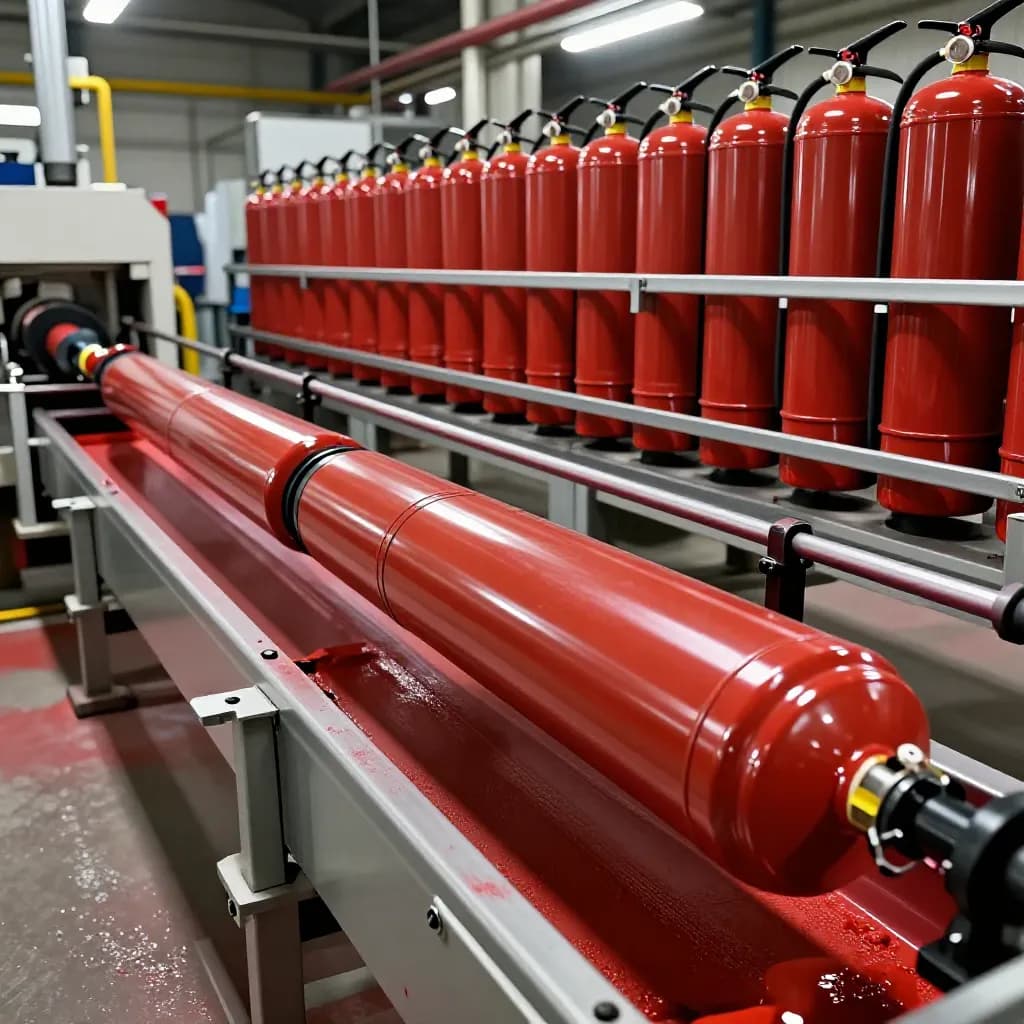
Powder coating has become the dominant finishing technology for fire extinguisher cylinders, displacing the liquid paint systems that were standard until the 1990s. The transition was driven by powder coating's superior production efficiency (single-coat application with no drying time between coats), environmental compliance (zero VOC emissions), and coating performance (thicker, more uniform films with better corrosion protection and mechanical durability).
Ready to Start Your Project?
From one-off customs to 15,000-part production runs — get precise pricing in 24 hours.
On This Page
Fire Extinguisher Coating: Where Safety Meets Production Efficiency
The fire extinguisher industry is characterized by high production volumes and intense cost pressure. Major manufacturers produce millions of cylinders per year on automated production lines where coating speed, consistency, and material efficiency directly impact profitability. Powder coating's compatibility with high-speed automated application, combined with 95-98% material utilization through overspray reclaim, makes it the most cost-effective finishing technology for this high-volume application.
This article examines the specific requirements for powder coating fire extinguisher cylinders, covering color coding standards, pressure vessel considerations, production processes, and the performance standards that ensure these critical safety devices remain functional throughout their service life.
Color Coding Standards and Regulatory Requirements
The color of a fire extinguisher is not merely decorative — it is a safety-critical identification system that enables users to quickly select the correct extinguisher type for the fire they are facing. Using the wrong extinguisher type can be ineffective or dangerous (for example, using a water extinguisher on an electrical fire), making accurate and durable color coding essential.
Color coding standards vary by region, creating a complex landscape for manufacturers serving international markets. In the United Kingdom and many Commonwealth countries, BS EN 3 specifies that all extinguisher bodies are signal red (RAL 3000) with a color-coded band or zone identifying the extinguishing agent: red for water, cream for foam, blue for dry powder, black for CO2, and yellow for wet chemical. This system was adopted in 1997, replacing the previous full-body color coding system.
In the United States, NFPA 10 (Standard for Portable Fire Extinguishers) does not mandate specific body colors, but industry convention and UL listing requirements have established that most extinguishers are red (similar to RAL 3000 or Federal Standard 595 color 11105). Chrome or polished stainless steel finishes are used for decorative applications in hospitality and high-end commercial environments.
Australian Standard AS 1841 specifies color coding similar to the UK system, with red bodies and colored bands. European markets generally follow EN 3, while Asian markets have varying national standards that may specify different color schemes.
The powder coating must achieve precise color matching to the specified standard, with color tolerances typically defined as delta E ≤ 1.5 from the reference standard. For signal red (the most common extinguisher color), the powder must match the specific shade defined by the applicable standard — RAL 3000, BS 381C 537, or the relevant national color reference. Batch-to-batch color consistency is critical because extinguishers from different production runs may be installed side by side in the same building.
Color durability is equally important. The extinguisher's color coding must remain legible throughout its service life (typically 5-12 years between major services, with a total life of 20+ years for steel cylinders). Powder coating's UV resistance ensures that the color coding remains accurate even for extinguishers installed in locations with significant light exposure.
Pressure Vessel Considerations and Coating Integrity
Fire extinguisher cylinders are pressure vessels that operate at internal pressures of 12-25 bar (depending on the extinguishing agent and propellant system), with test pressures of 25-40 bar applied during manufacture and periodic inspection. The coating on a pressure vessel must not compromise the vessel's structural integrity, and conversely, the vessel's operating conditions must not compromise the coating's protective function.
The relationship between coating and pressure vessel integrity operates in both directions. The coating protects the steel cylinder from external corrosion that would reduce wall thickness and weaken the vessel. Simultaneously, the coating must not mask internal corrosion or structural defects that could lead to vessel failure. For this reason, fire extinguisher inspection procedures include assessment of the coating condition as an indicator of overall cylinder condition — extensive coating damage or corrosion suggests that the cylinder may have experienced conditions that could also affect its internal condition.
Hydrostatic testing of fire extinguisher cylinders (required at manufacture and at periodic intervals during service) subjects the cylinder to pressures 50-100% above the working pressure. During hydrostatic testing, the cylinder expands elastically by a small amount (typically 0.1-0.3% volumetric expansion), and the coating must accommodate this expansion without cracking or delaminating. Polyester powder coatings with elongation values exceeding 3% at break readily accommodate the elastic deformation of hydrostatic testing.
The curing temperature of the powder coating (typically 180-200°C for 10-15 minutes) must not adversely affect the mechanical properties of the steel cylinder. For standard carbon steel cylinders (typically manufactured from seamless or welded steel tube to EN 3-8 or DOT specifications), the curing temperature is well below the tempering temperature of the steel and has no effect on mechanical properties. However, for cylinders manufactured from heat-treated aluminum alloys, the curing temperature must be verified against the alloy's aging response to ensure that the heat treatment is not degraded.
Thread protection during coating is essential. The valve connection thread at the top of the cylinder must remain uncoated to ensure proper valve seating and seal integrity. Silicone plugs or caps rated for the curing temperature protect the thread during the coating process.
High-Volume Production Processes and Line Design
Fire extinguisher coating lines are among the most highly automated powder coating operations in any industry, designed to process thousands of cylinders per shift with minimal manual intervention. The cylindrical geometry of extinguisher bodies is well-suited to automated coating, and the high production volumes justify the capital investment in specialized handling and application equipment.
The production sequence begins with surface preparation. New steel cylinders arrive from the forming operation with residual drawing oils, mill scale, and surface contamination that must be removed before coating. The standard preparation process is a multi-stage spray wash system: alkaline degreasing at 50-60°C, water rinse, iron phosphate or zinc phosphate conversion coating, and deionized water final rinse. The entire pretreatment sequence takes 3-5 minutes, with cylinders traveling through the wash tunnel on a continuous overhead conveyor.
Some manufacturers use abrasive blasting (shot blasting with steel shot) instead of or in addition to chemical pretreatment, particularly for cylinders that will operate in aggressive environments. Shot blasting removes mill scale more effectively than chemical cleaning and creates a surface profile that enhances mechanical adhesion. Automated shot blast machines process cylinders at rates of 200-400 per hour.
Powder application uses automatic electrostatic spray guns arranged around the conveyor path. For cylindrical bodies, a typical configuration uses 4-8 guns positioned at different angles to ensure complete coverage of the curved surface, including the domed top and bottom of the cylinder. The cylinders rotate on the conveyor hooks as they pass through the spray zone, ensuring uniform coverage around the full circumference.
Film thickness control is critical for both performance and economics. Too thin a coating compromises corrosion protection, while too thick a coating wastes material and can cause defects such as sagging and orange peel. The target film thickness for fire extinguisher cylinders is typically 60-80 microns, controlled within ±10 microns by precise adjustment of powder flow rate, gun voltage, and conveyor speed.
Curing takes place in a convection oven at 180-200°C for 10-15 minutes at metal temperature. The cylindrical geometry of extinguisher bodies promotes uniform heating, and the relatively thin wall thickness (1.5-3.0 mm) ensures rapid heat-up to cure temperature. Oven residence times of 15-25 minutes (including heat-up) are typical at conveyor speeds matched to the spray booth throughput.
Production rates of 500-2,000 cylinders per hour are achievable on modern automated lines, depending on cylinder size and the number of spray guns and oven capacity.
Corrosion Protection and Service Life Performance
Fire extinguisher cylinders must maintain their structural integrity and functional readiness for extended periods — often 20 years or more — in environments ranging from climate-controlled offices to unheated warehouses, outdoor installations, and vehicle-mounted applications. The powder coating is the primary defense against external corrosion that could weaken the pressure vessel and compromise safety.
The corrosion protection provided by powder coating on fire extinguisher cylinders is validated through salt spray testing per ASTM B117 or ISO 9227. Standard specifications require 500-1,000 hours of neutral salt spray resistance without significant corrosion or coating degradation. Premium specifications for extinguishers intended for outdoor or marine environments may require 1,500 hours or more.
The most vulnerable areas for corrosion on fire extinguisher cylinders are the bottom dome (which may sit in accumulated water on floors or in cabinets), the valve connection area (where moisture can be trapped by the valve assembly), and any areas where the coating has been damaged by handling, installation, or accidental impact. Adequate film thickness at the bottom dome — where gravity causes powder to thin during application — requires specific attention during the coating process, often addressed by additional gun passes or manual touch-up of the bottom area.
Vehicle-mounted fire extinguishers experience particularly aggressive conditions. Vibration from vehicle operation can cause fretting wear at mounting bracket contact points, exposing bare steel to corrosion. Road salt, stone chips, and engine compartment heat add to the corrosion challenge. Heavy-duty polyester powder coatings at 80-100 microns, combined with rubber-lined mounting brackets that prevent metal-to-metal contact, provide adequate protection for vehicle-mounted applications.
Marine fire extinguishers face the most demanding corrosion environment. Salt air, high humidity, and occasional salt water splash create conditions that can initiate corrosion at any coating defect within weeks. Marine-grade fire extinguishers typically use enhanced coating systems — either increased film thickness (100-120 microns), duplex systems (zinc-rich primer plus polyester topcoat), or specialized marine-grade powder formulations with enhanced salt spray resistance.
Periodic inspection of fire extinguisher coating condition is part of the maintenance regime defined by NFPA 10, BS 5306, and equivalent national standards. Inspectors assess the coating for damage, corrosion, and degradation as indicators of the cylinder's overall condition. Extinguishers with significant coating damage or visible corrosion are typically condemned or sent for refurbishment, which includes stripping, re-preparation, and re-coating.
Specialty Extinguisher Types and Coating Variations
Beyond standard portable fire extinguishers, the broader fire suppression market includes wheeled extinguishers, fixed system cylinders, and specialty units that each present distinct coating requirements.
Wheeled fire extinguishers (50-150 kg capacity) use larger cylinders mounted on wheeled carriages for mobility. The cylinders are powder coated using the same processes as portable units but require larger spray booths and ovens to accommodate their size. The wheeled carriage — typically fabricated from steel tube and sheet — is powder coated separately, often in a contrasting color (black or grey) to the red cylinder body.
Clean agent fire suppression cylinders (containing FM-200, Novec 1230, or similar halogenated agents) are high-pressure vessels operating at 25-42 bar, significantly higher than standard extinguisher pressures. These cylinders are typically manufactured from seamless steel tube and powder coated in the agent-specific color (commonly red or green depending on the jurisdiction and agent type). The higher operating pressure demands more rigorous coating inspection, as any coating defect that could mask a surface flaw in the high-pressure vessel is a safety concern.
CO2 fire extinguisher cylinders operate at very high pressures (up to 60 bar at 20°C) and are manufactured from thick-walled seamless steel. The powder coating on CO2 cylinders must withstand the extreme cold that occurs during discharge — the rapid expansion of CO2 from liquid to gas causes the cylinder surface temperature to drop to -40°C or below within seconds. The coating must resist thermal shock cracking at these extreme temperatures. Polyester powder coatings with good low-temperature flexibility (tested per ASTM D522 at -30°C) are specified for CO2 cylinders.
Stainless steel and aluminum fire extinguishers for decorative applications in hotels, restaurants, and premium commercial spaces are powder coated in metallic silver, brushed steel effect, or custom colors that complement the interior design. These decorative units must meet the same functional and safety standards as standard red extinguishers, with the coating providing both the desired aesthetic and the required corrosion protection.
Kitchen fire suppression system cylinders (containing wet chemical agents for commercial kitchen hood systems) are typically powder coated in stainless steel effect or polished chrome effect finishes for installation in visible locations within commercial kitchens. The coating must resist the heat, grease, and cleaning chemicals present in kitchen environments.
Quality Control, Testing, and Regulatory Compliance
Quality control for fire extinguisher coatings operates within the broader regulatory framework governing pressure vessel manufacture and fire safety equipment certification. The coating is one element of a comprehensive quality system that ensures each extinguisher meets the applicable safety standards.
Manufacturing quality control includes incoming powder inspection (color, particle size, gel time, specific gravity), in-process monitoring (film thickness, cure temperature, visual inspection), and finished product testing (adhesion, impact resistance, salt spray resistance). Statistical process control methods are used to monitor coating quality trends and identify process drift before it results in non-conforming product.
Film thickness measurement is performed on a sampling basis — typically 5-10% of production — using magnetic induction gauges calibrated to the curved surface of the cylinder. Measurements are taken at defined locations (top dome, mid-body, bottom dome) to verify that all areas meet the minimum thickness specification. The bottom dome, where gravity causes powder to thin, receives particular attention.
Adhesion testing per ISO 2409 (cross-cut) or ASTM D3359 (tape test) verifies that the coating is properly bonded to the substrate. A rating of 4B or 5B (less than 5% or 0% coating removal) is the standard acceptance criterion. Adhesion testing is performed on sample cylinders from each production batch and on any cylinders where process deviations have occurred.
Impact resistance testing per ASTM D2794 verifies that the coating withstands the handling impacts that extinguishers experience during transport, installation, and service. A minimum impact resistance of 40-60 inch-pounds (direct) is typical for fire extinguisher coatings.
Regulatory compliance for fire extinguisher manufacture is governed by national and international standards including EN 3 (Europe), UL 299 and UL 154 (North America), AS 1841 (Australia), and IS 15683 (India). These standards define requirements for the complete extinguisher, including the cylinder, valve, agent, and coating. Certification by approved testing laboratories (BSI, UL, SAI Global, etc.) requires demonstration that the coating meets the specified performance requirements as part of the overall product certification.
Traceability systems link each coated cylinder to its powder batch, coating date, application parameters, and inspection results. This traceability is essential for investigating any quality issues and for supporting the product liability documentation that fire safety equipment manufacturers must maintain.
Frequently Asked Questions
Why are fire extinguishers red?
Signal red (RAL 3000 or equivalent) is specified by safety standards including BS EN 3 and NFPA 10 for high visibility in emergencies. In the UK and Europe, all extinguisher bodies are red with colored bands identifying the agent type. In the US, red is industry convention. The powder coating must match the specified red within delta E ≤ 1.5 tolerance.
Does the powder coating cure temperature affect the steel cylinder?
No, for standard carbon steel cylinders. The 180-200°C curing temperature is well below the steel's tempering temperature and has no effect on mechanical properties. For heat-treated aluminum alloy cylinders, the curing temperature must be verified against the alloy's aging response to ensure the heat treatment is not degraded.
How long does powder coating protect a fire extinguisher?
Powder coating provides 20+ years of corrosion protection on fire extinguisher cylinders in indoor environments. Vehicle-mounted and outdoor extinguishers may need re-coating after 10-15 years. Marine applications are the most demanding, potentially requiring enhanced coating systems or more frequent inspection and maintenance.
What happens to the coating during hydrostatic testing?
During hydrostatic testing at 150-200% of working pressure, the cylinder expands elastically by 0.1-0.3%. Polyester powder coatings with elongation exceeding 3% accommodate this expansion without cracking or delaminating. The coating is inspected after hydrostatic testing for any signs of damage.
How many fire extinguishers can be powder coated per hour?
Modern automated coating lines process 500-2,000 cylinders per hour depending on size. The cylindrical geometry is well-suited to automated spray application with 4-8 guns, and the thin wall thickness ensures rapid heat-up during curing. High material utilization (95-98%) through overspray reclaim keeps per-unit coating costs low.
Ready to Start Your Project?
From one-off customs to 15,000-part production runs — get precise pricing in 24 hours.