Dry film thickness (DFT) is arguably the single most important measurable parameter in powder coating quality control. It directly influences every performance characteristic of the finished coating: corrosion resistance, UV durability, mechanical properties, appearance, adhesion, and chemical resistance. Too thin, and the coating fails to provide adequate protection and coverage. Too thick, and the coating becomes prone to cracking, orange peel, sagging, poor adhesion, and wasted material. Controlling film thickness within a specified range is the foundation of consistent coating quality.
Technical
Powder Coating Film Thickness Control: Measurement, Specification, and Process Management
Sundial Powder Coating·April 22, 2026·13 min
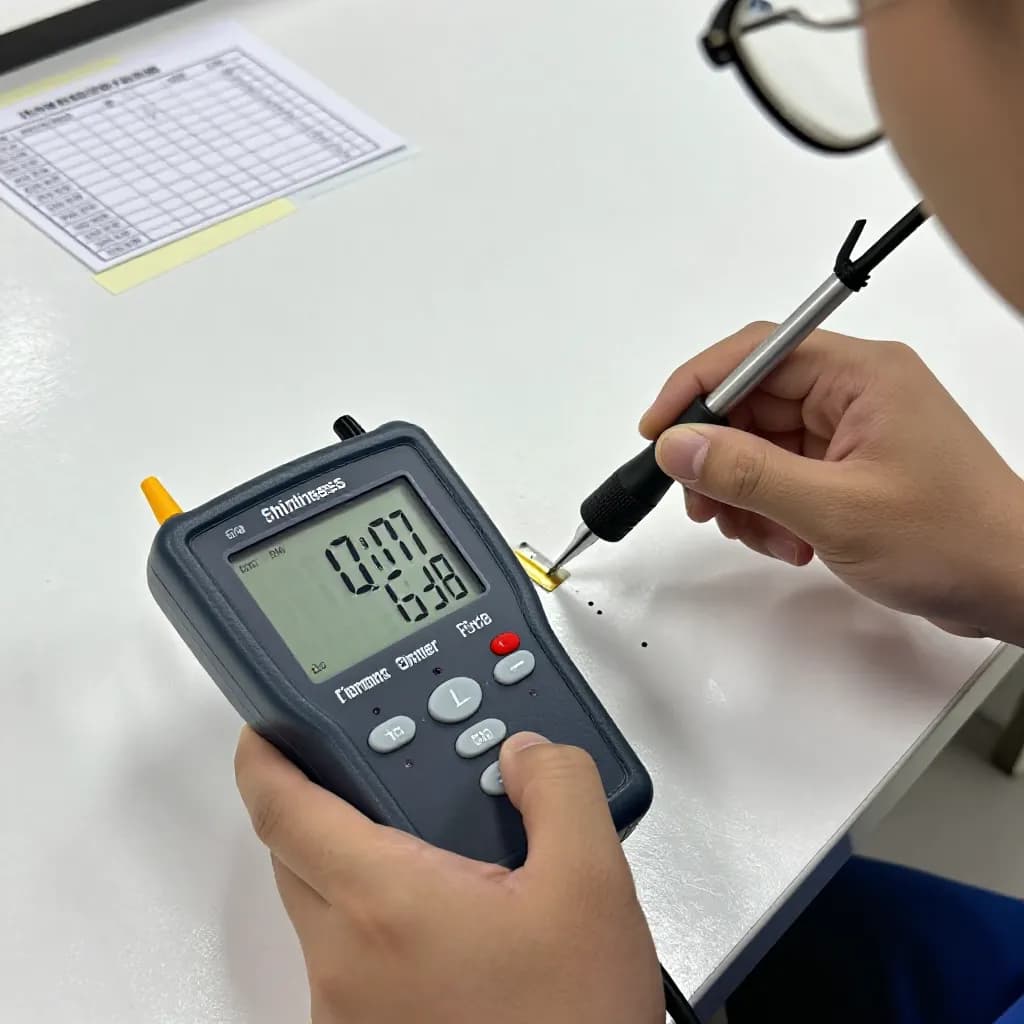
Most powder coating specifications define a target DFT range rather than a single value. Typical ranges for common applications include: 60-80 μm for general industrial finishing, 60-120 μm for architectural aluminum per Qualicoat specifications, 75-125 μm for automotive components, and 200-350 μm for functional coatings such as pipeline or rebar applications. These ranges represent the balance between adequate protection and the practical and economic limits of the coating process.
Ready to Start Your Project?
From one-off customs to 15,000-part production runs — get precise pricing in 24 hours.
On This Page
Why Film Thickness Is the Most Critical Process Variable
Film thickness variation across a production batch is inevitable due to the nature of electrostatic powder application — edges and corners attract more powder than flat surfaces, areas facing the gun receive more than shadowed areas, and part-to-part variation occurs due to changes in gun-to-part distance, powder output, and electrostatic conditions. The goal of process control is not to eliminate variation but to keep it within the specified range across all measurement points on all parts. This requires understanding the measurement methods, the sources of variation, and the process adjustments available to the coating operator.
Measurement Methods: Magnetic Induction and Eddy Current
Two non-destructive measurement principles dominate powder coating film thickness measurement: magnetic induction for coatings on ferrous (magnetic) substrates, and eddy current for coatings on non-ferrous substrates such as aluminum, copper, and zinc. Most modern coating thickness gauges are dual-mode instruments that automatically detect the substrate type and select the appropriate measurement principle.
Magnetic induction gauges measure the change in magnetic flux between a permanent magnet or electromagnet in the probe and the ferrous substrate. The non-magnetic powder coating layer increases the distance between the probe and the substrate, reducing the magnetic coupling in proportion to the coating thickness. These gauges are highly accurate on steel substrates, with typical accuracy of ±1-3% of reading or ±1-2.5 μm, whichever is greater. They are insensitive to the coating material — the same gauge reads correctly on polyester, epoxy, hybrid, or any other non-magnetic powder coating on steel.
Eddy current gauges work by inducing high-frequency alternating currents (eddy currents) in the non-ferrous substrate and measuring the impedance change caused by the coating layer separating the probe from the substrate. Accuracy on aluminum is typically ±1-3% of reading or ±1-2.5 μm. Eddy current measurements are more sensitive to substrate conductivity variations, surface roughness, and edge effects than magnetic measurements, requiring more careful calibration and measurement technique. Both methods require calibration on uncoated substrate samples of the same material and geometry as the production parts, using certified calibration foils to verify accuracy at the expected film thickness range.
Calibration, Substrate Effects, and Measurement Accuracy
Accurate film thickness measurement depends on proper calibration and understanding of the factors that influence measurement accuracy. Calibration should be performed on uncoated samples of the actual production substrate — not on generic calibration plates — because substrate properties such as magnetic permeability (for steel), electrical conductivity (for aluminum), surface roughness, and curvature all affect the measurement. A gauge calibrated on flat cold-rolled steel will not read accurately on cast iron, galvanized steel, or stainless steel without recalibration.
Surface roughness of the substrate creates a systematic measurement bias. When powder coating fills the valleys of a rough surface, the gauge measures the total distance from the probe to the substrate peaks, which includes both the coating thickness above the peaks and the coating that filled the valleys. This results in a reading that is higher than the actual coating thickness above the surface profile. The correction factor is approximately equal to the peak-to-valley roughness (Rz) of the substrate surface. For a substrate with Rz = 15 μm, the gauge will read approximately 15 μm higher than the true coating thickness above the peaks. For precision work, this offset should be determined by measuring the apparent thickness of a calibration foil placed on the rough substrate.
Edge effects cause measurement errors near part edges, corners, and holes. Both magnetic and eddy current gauges are affected by proximity to edges because the magnetic or electromagnetic field extends laterally from the probe tip. Measurements taken within 10-15 mm of an edge or corner will read higher than the actual thickness. For this reason, specifications typically exclude measurements within a defined edge zone — commonly 10-20 mm from any edge. Curved surfaces also affect accuracy: convex surfaces cause the probe to sit slightly above the surface, reading high, while concave surfaces allow the probe to contact more intimately, potentially reading low. Gauges with small-diameter probes (2-5 mm contact area) minimize curvature effects.
Specification Ranges: Too Thin vs Too Thick
Understanding the consequences of film thickness outside the specified range is essential for making informed process decisions. Coatings that are too thin fail to provide adequate barrier protection against corrosion, UV radiation, and chemical exposure. At thicknesses below 40-50 μm, most powder coatings have insufficient film build to fully cover the substrate surface profile, leaving micro-areas of thin or absent coating that become initiation points for corrosion. Thin coatings also show more color variation, reduced hiding power (especially with lighter colors), and increased sensitivity to substrate imperfections.
Coatings that are too thick introduce a different set of problems. Mechanical properties degrade at excessive thickness — impact resistance and flexibility decrease because the thicker film generates higher internal stresses during curing and thermal cycling. Orange peel worsens because the thicker powder layer requires more flow energy to level. Sagging and runs occur on vertical surfaces when the molten powder film is too heavy to resist gravity. Edge coverage paradoxically worsens at very high thicknesses because the electrostatic field concentrates even more powder on edges and corners, creating extremely thick edge buildup while flat areas may still be within range.
Back-ionization becomes increasingly problematic above 100-120 μm with corona charging. The accumulated charge on the thick deposited powder layer creates a repulsive field that disrupts further deposition, causing craters, starring patterns, and uneven texture. This is often the practical upper limit for single-coat corona application. For applications requiring thicker films, tribo charging (which produces lower charge levels), multiple application passes with intermediate grounding, or fluidized bed coating may be necessary. The economic impact of excessive thickness is also significant — powder coating material represents 40-60% of the total coating cost, and every 10 μm of unnecessary thickness wastes 10-15% more material than necessary.
Process Variables That Control Film Thickness
Film thickness in electrostatic spray application is controlled by the interaction of several process variables, each of which can be adjusted to increase or decrease deposition. Understanding these variables and their interactions is essential for maintaining thickness within specification.
Powder output rate — the mass of powder delivered per unit time, typically measured in grams per minute — is the most direct control. Increasing output deposits more powder per unit area, increasing thickness. Output is controlled by the powder pump settings (venturi air pressure or dense phase pump speed) and the fluidization air in the hopper. Typical output rates range from 100-400 g/min per gun for production applications.
Gun-to-part distance affects both the powder pattern width and the deposition efficiency. At closer distances, the pattern is narrower and the deposition rate per unit area is higher, producing thicker films. At greater distances, the pattern spreads and the deposition rate decreases. The optimal distance for most applications is 200-300 mm, balancing coverage uniformity with deposition efficiency.
Line speed (for conveyor systems) or dwell time (for manual or robotic application) determines how long each area of the part is exposed to the powder cloud. Slower line speeds or longer dwell times increase thickness. Electrostatic voltage and current affect transfer efficiency — higher settings deposit a greater percentage of the sprayed powder on the part, increasing thickness for a given output rate and distance. However, excessively high settings cause back-ionization that actually reduces effective thickness.
The number of gun passes and the overlap between passes determine the uniformity of the deposited layer. Reciprocating automatic guns typically make 2-4 passes over each area of the part, with 30-50% overlap between adjacent passes. Increasing the number of passes or the overlap increases both the average thickness and the uniformity.
Statistical Process Control for Film Thickness
Statistical process control (SPC) provides a systematic framework for monitoring and controlling film thickness variation over time. The foundation of SPC is regular measurement of film thickness at defined locations on production parts, recording the data, and analyzing it using control charts to detect trends, shifts, and out-of-control conditions before they result in non-conforming product.
A typical SPC program for film thickness involves measuring 3-5 points on each of 3-5 parts per production run or per hour of continuous production. The measurement points should include the thinnest expected area (typically a flat surface facing away from the guns), the thickest expected area (typically an edge or corner facing the guns), and 1-3 intermediate points. The data is plotted on X-bar and R charts (for averages and ranges) or individual and moving range charts, with control limits calculated from the process data.
Control limits are not the same as specification limits. Control limits represent the natural variation of the process — typically set at ±3 standard deviations from the process mean — and are used to detect changes in the process. Specification limits represent the customer or standard requirements for acceptable film thickness. A capable process has control limits that fall well within the specification limits, providing margin for normal variation without producing non-conforming parts. Process capability indices Cp and Cpk quantify this relationship: a Cpk of 1.33 or higher indicates that the process can consistently produce parts within specification with minimal risk of non-conformance.
When SPC charts indicate an out-of-control condition — such as a point beyond the control limits, a run of 7 or more points on one side of the mean, or a trend of 6 or more consecutive increasing or decreasing points — the process should be investigated and corrected before continuing production. Common assignable causes include powder output drift, gun distance changes, voltage or current changes, powder batch changes, and reclaim ratio shifts.
Automatic Film Thickness Control Systems
Modern powder coating lines increasingly use automatic film thickness control systems that measure the deposited powder layer in real time and adjust application parameters to maintain target thickness. These systems use non-contact sensors — typically based on infrared absorption, laser triangulation, or capacitive measurement — positioned between the spray booth and the cure oven to measure the uncured powder layer thickness on each part as it exits the booth.
Infrared-based systems measure the absorption of specific IR wavelengths by the powder layer, which is proportional to the layer thickness. These systems can measure thickness on moving parts at conveyor speeds up to 10-15 m/min with accuracy of ±5-10 μm. Laser triangulation systems measure the surface profile of the powder layer and compare it to a reference profile of the uncoated part to determine thickness. Capacitive systems measure the dielectric properties of the powder layer between the sensor and the grounded substrate.
The measurement data is fed back to the gun controller, which adjusts powder output, voltage, or gun position to correct any deviation from the target thickness. Closed-loop control can reduce film thickness variation by 30-50% compared to open-loop operation, resulting in more consistent quality and reduced powder consumption. The material savings alone — typically 10-20% reduction in average film thickness while maintaining minimum specification compliance — can provide a return on investment within 12-24 months for high-volume operations.
These systems also provide continuous documentation of film thickness for every part produced, supporting traceability requirements and eliminating the sampling limitations of manual gauge measurements. The data can be integrated with the plant's quality management system and used for SPC analysis, trend monitoring, and customer reporting.
Troubleshooting Common Film Thickness Problems
Film thickness problems in production typically manifest as either the average thickness drifting outside the target range, or the variation (range between thinnest and thickest points) exceeding acceptable limits. Each pattern has different root causes and corrective actions.
Average thickness too low across all parts usually indicates reduced powder output — check the pump settings, hopper fluidization, and powder feed hose for blockages or wear. Verify that the powder level in the hopper is adequate and that the fluidization bed is uniform. If output appears normal, check the transfer efficiency — reduced electrostatic charge (from a dirty or worn charging electrode), increased gun distance, or faster line speed all reduce the amount of powder that actually deposits on the part.
Average thickness too high suggests increased output or reduced line speed. Check for pump setting drift, particularly with venturi pumps where throat wear gradually increases output over time. Verify line speed against the production standard. If the thickness increase is accompanied by back-ionization defects (craters, starring), the root cause may be excessive voltage or current rather than excessive output.
Excessive variation between measurement points on the same part indicates non-uniform application. Check gun reciprocation speed and stroke length — if the guns are not covering the full part height uniformly, horizontal bands of thick and thin coating result. Verify gun-to-part distance at all points in the reciprocation cycle. Check for blocked or worn nozzles that produce asymmetric spray patterns. For parts with complex geometry, variation between Faraday cage areas and exposed surfaces is inherent and may require separate specification limits for different zones.
Part-to-part variation within a batch suggests inconsistent process conditions. Check for powder output pulsation (common with worn venturi pumps), conveyor speed variation, inconsistent part spacing on the conveyor, or electrostatic grounding problems. Poor grounding — from dirty hooks, worn contact points, or paint buildup on the conveyor — reduces transfer efficiency unpredictably and is one of the most common causes of part-to-part thickness variation.
Frequently Asked Questions
What is the typical film thickness range for powder coating?
Typical ranges vary by application: 60-80 μm for general industrial, 60-120 μm for architectural aluminum (Qualicoat), 75-125 μm for automotive components, and 200-350 μm for functional coatings like pipeline protection. The specification balances adequate protection against the problems caused by excessive thickness including orange peel, cracking, and material waste.
What type of gauge should I use to measure powder coating thickness?
Use a magnetic induction gauge for coatings on steel (ferrous substrates) and an eddy current gauge for coatings on aluminum, copper, or zinc (non-ferrous substrates). Most modern gauges are dual-mode and automatically detect the substrate type. Calibrate on uncoated samples of the actual production substrate using certified calibration foils.
Why does my coating thickness vary so much across the part?
Variation is inherent in electrostatic application — edges and corners attract more powder than flat surfaces, areas facing the gun receive more than shadowed areas, and Faraday cage effects cause thin coating in recessed areas. Reducing variation requires optimizing gun distance, voltage, reciprocation pattern, and potentially using tribo charging for complex geometries.
What happens if powder coating is applied too thick?
Excessive thickness causes reduced impact resistance and flexibility, increased orange peel, sagging on vertical surfaces, back-ionization defects (craters and starring) above 100-120 μm with corona charging, and significant material waste. Every 10 μm of unnecessary thickness wastes approximately 10-15% more powder material.
How does surface roughness affect film thickness measurement?
Surface roughness causes gauges to read higher than the actual coating thickness above the surface peaks because the measurement includes coating that filled the surface valleys. The error is approximately equal to the peak-to-valley roughness (Rz) of the substrate. For a substrate with Rz = 15 μm, readings will be approximately 15 μm higher than true thickness above the peaks.
Ready to Start Your Project?
From one-off customs to 15,000-part production runs — get precise pricing in 24 hours.