Purchasing powder coating equipment is a significant investment that will determine the quality, efficiency, and profitability of your coating operation for years to come. The equipment market offers options ranging from basic entry-level systems suitable for small job shops to fully automated production lines capable of coating thousands of parts per hour. Making the right choice requires a clear understanding of your production requirements, quality targets, and growth plans.
Guides
Powder Coating Equipment Buyer's Guide: Guns, Booths, Ovens, and Systems
Sundial Powder Coating·April 22, 2026·13 min
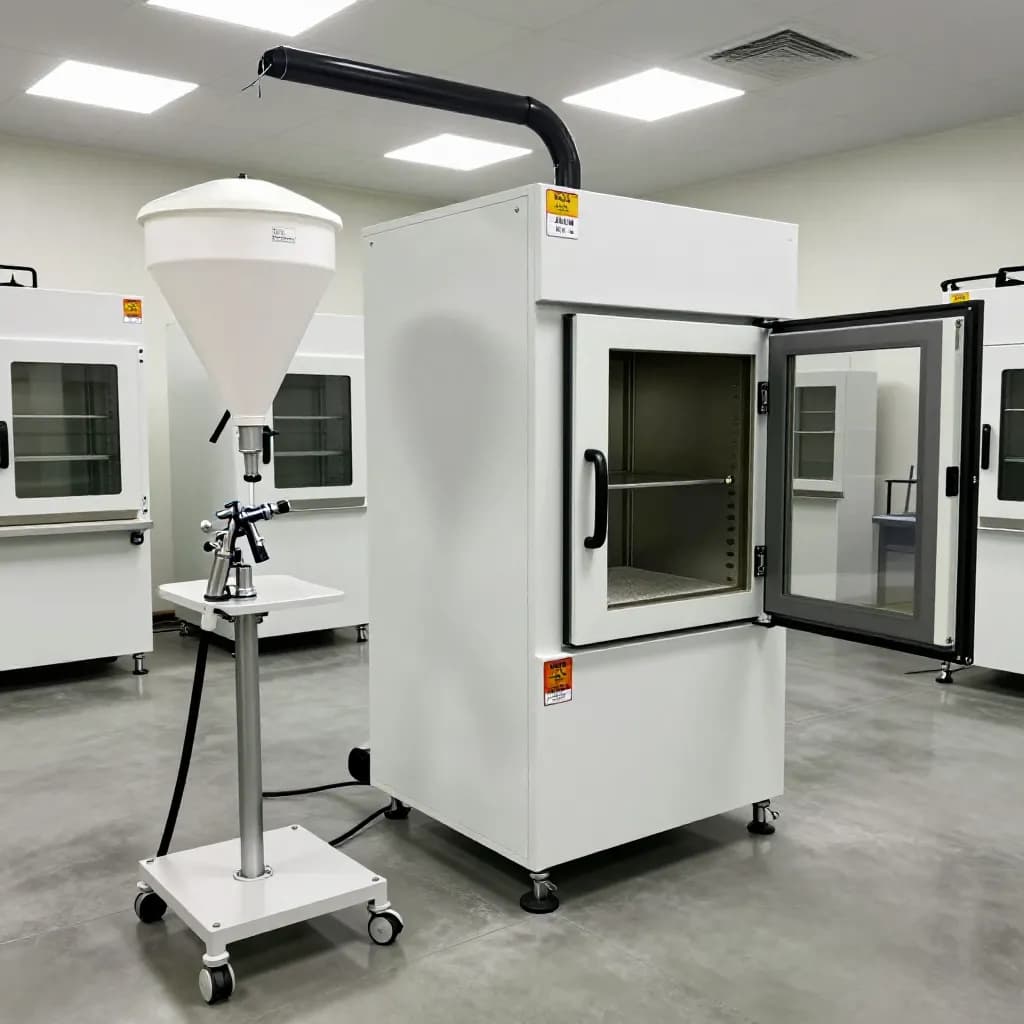
The major equipment categories in a powder coating system are the pretreatment system, the spray booth with powder recovery, the powder application equipment (guns and controllers), the curing oven, and the conveyor or handling system. Each category offers multiple technology options at different performance and price levels, and the components must be matched to each other and to the overall system requirements for optimal performance.
Ready to Start Your Project?
From one-off customs to 15,000-part production runs — get precise pricing in 24 hours.
On This Page
Navigating the Powder Coating Equipment Market
This buyer's guide covers each equipment category in detail, explaining the technology options available, the key selection criteria, and the practical considerations that should inform your purchasing decision. Whether you are setting up a new coating operation, upgrading existing equipment, or adding capacity to an established line, this guide will help you evaluate options systematically and make informed investment decisions.
Powder Application Guns and Controllers
The powder application gun is the tool that delivers powder to the part surface, and its performance directly affects coating quality, consistency, and material efficiency. Modern powder guns use one of two charging technologies: corona charging, which applies a high-voltage charge to the powder as it exits the gun, or tribo (triboelectric) charging, which generates charge through friction as powder passes through a PTFE-lined barrel.
Corona guns are the most widely used type and offer reliable performance across a broad range of powder types and applications. They provide strong electrostatic wrap-around for coating complex geometries and are available in both manual and automatic configurations. The main limitation of corona charging is the Faraday cage effect — the strong electric field can prevent powder from penetrating into deep recesses and internal corners. Adjustable voltage and current controls on modern corona guns help manage this effect.
Tribo guns generate a softer, more uniform charge that produces excellent penetration into recesses and a smoother finish with less orange peel. They are particularly effective for coating complex parts and for achieving thin, uniform films. However, tribo guns are more sensitive to powder formulation — not all powders charge effectively in tribo systems — and they require more maintenance due to wear on the PTFE charging surfaces.
The gun controller manages the electrostatic charging parameters, powder flow rate, and air pressure settings. Advanced controllers offer programmable recipes that store optimal settings for different parts and powders, allowing quick changeover between jobs with consistent results. Look for controllers with intuitive interfaces, reliable recipe storage, and diagnostic capabilities that alert operators to charging or flow problems.
Spray Booths and Powder Recovery Systems
The spray booth contains the powder application process, captures overspray, and manages airflow to maintain a clean working environment. Booth design significantly affects coating quality, color change speed, and powder recovery efficiency — making it one of the most important equipment decisions in the system.
Booth construction options include steel (painted or stainless), plastic (polypropylene or PVC), and composite materials. Non-conductive booth walls (plastic or composite) reduce powder adhesion to booth surfaces, making cleaning faster and more thorough during color changes. Steel booths are more durable but require more cleaning effort. Booth size must accommodate your largest parts with adequate clearance for gun movement and airflow.
Powder recovery systems fall into two main categories: cyclone separators and cartridge filter modules. Cyclone systems use centrifugal force to separate powder from the air stream and are effective for high-volume, single-color operations where maximum powder recovery is important. Cartridge filter systems capture powder on filter elements and are preferred for operations with frequent color changes because the filters can be cleaned quickly. Some modern systems combine both technologies — a cyclone for primary separation followed by cartridge filters for final cleanup.
Quick color change capability is essential for job shops and any operation handling diverse color requirements. Look for booths designed for rapid cleaning — smooth interior surfaces, accessible corners, integrated blow-off systems, and modular components that can be swapped between colors. The best quick-change booths can complete a full color change in fifteen to thirty minutes, compared to an hour or more for conventional designs.
Curing Ovens: Types and Selection Criteria
The curing oven provides the heat energy needed to melt, flow, and cross-link the powder coating into a durable, fully cured film. Oven selection affects cure quality, energy consumption, throughput, and the range of parts and powders you can process. The two main oven types are batch ovens and conveyorized (continuous) ovens.
Batch ovens are loaded with a rack or cart of parts, sealed, and cycled through the cure profile. They offer maximum flexibility — any part that fits through the door can be cured, and different cure schedules can be programmed for different powders. Batch ovens are ideal for job shops, low-to-medium volume operations, and applications requiring diverse cure profiles. Their main limitation is throughput — the load/unload cycle and heat-up time between batches reduce productive capacity compared to continuous ovens.
Conveyorized ovens move parts continuously through a heated tunnel on an overhead or floor conveyor. Parts enter at one end, travel through the oven at a controlled speed that provides the required time at temperature, and exit fully cured at the other end. Conveyorized ovens offer higher throughput, more consistent cure (because every part receives the same thermal profile), and better energy efficiency for high-volume operations. However, they require more floor space, higher capital investment, and less flexibility for varying part sizes and cure schedules.
Regardless of oven type, key selection criteria include temperature capability (most powders cure at 160-200°C, but some specialty powders require higher or lower temperatures), temperature uniformity across the load (±5°C is a typical requirement for consistent cure), heat-up time, energy source (gas or electric), insulation quality, and control system sophistication. Invest in an oven with good temperature uniformity and a reliable control system — inconsistent cure is one of the most common causes of coating quality problems.
Pretreatment Systems and Chemical Management
The pretreatment system cleans and chemically prepares the substrate surface for powder coating. It is arguably the most critical component in the entire coating system because pretreatment quality directly determines coating adhesion and corrosion resistance. A beautiful powder coating applied over a poorly pretreated surface will fail — sometimes immediately, sometimes months later in service.
Pretreatment system options range from simple manual wash stations for very low volumes to multi-stage automated spray wash tunnels for production operations. A typical multi-stage system includes alkaline cleaning (to remove oils and greases), rinse stages (to remove cleaning chemistry residues), conversion coating (iron phosphate, zinc phosphate, or chrome-free alternatives), a final rinse (often with deionized water to prevent water spotting), and a drying stage.
The number of stages and the chemistry type depend on the substrates you process and the performance requirements of the finished coating. Iron phosphate systems are simpler and less expensive but provide moderate corrosion resistance. Zinc phosphate systems offer superior corrosion protection but are more complex to operate and generate more waste. Chrome-free conversion coatings are increasingly specified for environmental reasons and can provide performance comparable to traditional chromate systems.
Chemical management is an ongoing operational requirement. Pretreatment chemistry concentrations, temperatures, and pH levels must be monitored and maintained within specified ranges for consistent results. Budget for chemical testing equipment, ongoing chemical supply costs, and waste treatment and disposal. Many pretreatment chemical suppliers offer technical support and monitoring services that can help maintain optimal chemistry performance.
Conveyor and Handling Systems
The conveyor or handling system moves parts through the coating process — from loading through pretreatment, coating, curing, cooling, and unloading. The handling system design affects throughput, labor requirements, part quality (by minimizing handling damage), and the overall efficiency of the operation.
Overhead conveyor systems are the most common choice for conveyorized coating lines. Parts are hung from hooks or fixtures attached to the conveyor chain and travel through each process stage in sequence. Overhead conveyors keep the floor clear for operator access and maintenance, and the hanging orientation allows powder to coat all surfaces of the part. Conveyor speed, chain pitch, and load capacity must be matched to the throughput requirement and the weight and size of the parts being processed.
For batch operations, handling systems typically involve rolling carts or racks that are loaded with parts, wheeled into the pretreatment system, transferred to the spray booth, and then rolled into the curing oven. This approach is more labor-intensive than a conveyorized system but offers greater flexibility for varying part sizes and batch quantities. Invest in well-designed racks and fixtures that hold parts securely, present them at optimal angles for coating, and minimize contact marks.
Part fixturing deserves careful attention regardless of the handling system. Every part must be held securely during coating and curing, and the fixture contact points will leave small uncoated marks on the finished part. Design fixtures that contact parts in non-critical locations, provide good electrical grounding for electrostatic charging, and allow easy loading and unloading. Custom fixtures for high-volume parts can significantly improve coating consistency and reduce labor time.
Capacity Planning and System Sizing
Proper capacity planning ensures that your equipment investment matches your production requirements — neither undersized (creating a bottleneck) nor oversized (wasting capital on unused capacity). Start by defining your throughput requirement in terms of parts per hour, square meters per hour, or linear meters per hour, depending on your product mix.
Calculate the required throughput for each process stage — pretreatment, coating, and curing — and size each component to meet or exceed the requirement. The slowest stage determines the overall system throughput, so balance the capacity across all stages to avoid bottlenecks. Include a capacity margin of 20-30% above current requirements to accommodate demand growth, production variability, and downtime for maintenance and color changes.
Consider the range of parts you will process, not just the average. Your system must accommodate the largest parts (determining booth and oven dimensions), the heaviest parts (determining conveyor load capacity), and the most complex parts (determining pretreatment capability and coating application flexibility). If your product mix includes both small, simple parts and large, complex assemblies, you may need to design the system for the most demanding case while maintaining efficiency for the routine work.
Develop a phased investment plan if your current volume does not justify a full production system. Start with equipment that handles your near-term requirements efficiently, and plan for expansion as the business grows. Modular equipment designs that allow capacity additions — such as additional spray guns, extended oven length, or faster conveyor speeds — provide a cost-effective growth path without requiring complete system replacement.
Frequently Asked Questions
Should I choose corona or tribo powder guns?
Corona guns are the most versatile choice for general-purpose coating and work well with virtually all powder types. Tribo guns excel at coating complex geometries and producing smooth finishes but are more sensitive to powder formulation. Most operations start with corona guns and add tribo capability for specific applications if needed.
What size curing oven do I need?
Size the oven to accommodate your largest parts with adequate clearance for air circulation. For batch ovens, consider the number of parts per load and the load/unload cycle time. For conveyorized ovens, calculate the oven length based on conveyor speed and required cure time. Include a capacity margin for growth.
How important is powder recovery efficiency?
Very important for cost and environmental reasons. A good recovery system reclaims 95-98% of overspray powder for reuse, dramatically reducing material waste and cost. Cyclone systems offer the highest recovery rates for single-color operations, while cartridge filter systems balance good recovery with fast color change capability.
What is the most common equipment mistake new coaters make?
Underinvesting in pretreatment is the most common and most costly mistake. Many new operations spend heavily on spray booths and ovens while installing minimal pretreatment, then struggle with adhesion failures and corrosion problems. The pretreatment system is the foundation of coating quality and should receive proportionate investment.
Should I buy new or used powder coating equipment?
Used equipment can reduce startup costs significantly. Ovens and booths are generally safe to buy used if structurally sound and well-maintained. Spray guns and controllers should be current-generation for best performance and support. Have pretreatment systems inspected by a specialist. Always verify that used equipment meets current safety and environmental standards.
Ready to Start Your Project?
From one-off customs to 15,000-part production runs — get precise pricing in 24 hours.