Elevator components occupy a unique position in architectural finishing — they are among the most heavily used and closely scrutinized surfaces in any building. A busy commercial elevator may carry 2,000-5,000 passengers per day, each spending 30-90 seconds in close proximity to the cab interior surfaces. This intensive use, combined with the confined space that makes every surface defect visible, demands coating performance that exceeds typical architectural specifications for durability, appearance, and maintenance.
Architecture
Powder Coating Elevator Components: Cab Interiors, Door Panels, Frames, and Fire-Rated Finishes
Sundial Powder Coating·April 22, 2026·11 min
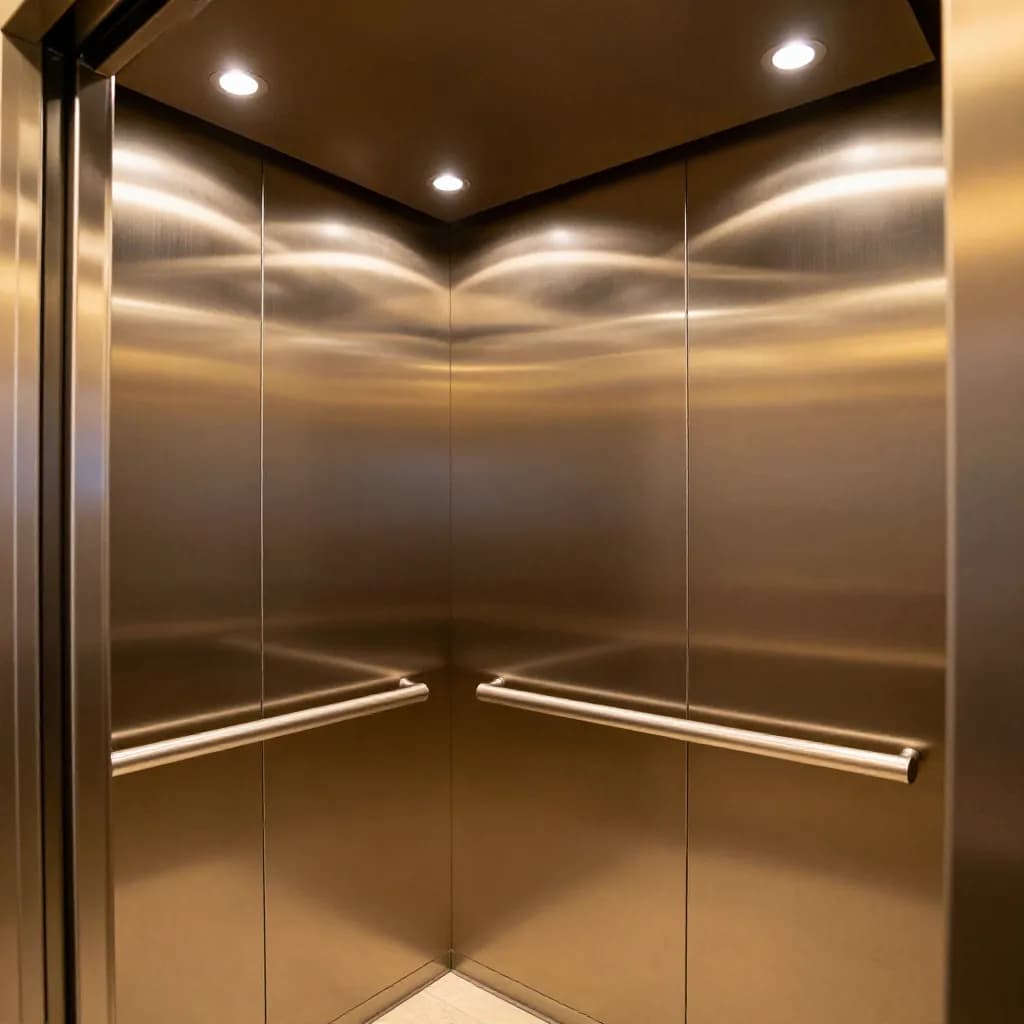
Powder coating has emerged as a leading finish for elevator cab interiors, landing door panels, door frames, and structural components, challenging the traditional dominance of stainless steel, laminate, and liquid paint finishes. The technology offers elevator manufacturers and building owners a compelling combination of design flexibility (unlimited colors, textures, and effects), durability (superior scratch and impact resistance compared to liquid paint and laminate), fire safety (non-combustible on steel substrates), and lifecycle economy (lower maintenance cost than stainless steel, longer service life than laminate).
Ready to Start Your Project?
From one-off customs to 15,000-part production runs — get precise pricing in 24 hours.
On This Page
Elevator Finishing: High Traffic, High Visibility, High Standards
The elevator industry's adoption of powder coating has been accelerated by advances in sublimation transfer technology, which enables photorealistic wood grain, stone, and metallic effects on powder-coated steel panels. These decorative effects allow elevator designers to achieve the warm, luxurious aesthetics of natural materials with the practical advantages of powder-coated steel — fire resistance, vandal resistance, and ease of maintenance that natural materials cannot match.
Cab Interior Panels: Design Flexibility and Durability
Elevator cab interior panels are the primary design surface of the elevator, defining the aesthetic experience for every passenger. These panels are typically fabricated from 1.0-1.5 mm steel sheet, formed to fit the cab's interior dimensions, and finished with a coating or cladding that provides the desired appearance and durability. Powder coating offers the widest range of design options for cab interior panels, from solid colors and metallics to wood grain, stone, and custom graphic effects.
Solid color powder coatings for elevator cab panels are available in the full RAL, NCS, and Pantone color ranges, with gloss levels from dead matte (2-5 GU) to high gloss (85+ GU). Matte and satin finishes are currently preferred for elevator interiors because they minimize fingerprint visibility, reduce glare from cab lighting, and create a sophisticated aesthetic that complements contemporary architectural design. Anti-fingerprint powder coating formulations are particularly valuable for elevator panels, as the confined space and high traffic ensure that every panel surface is frequently touched.
Sublimation transfer finishes on powder-coated elevator panels have revolutionized elevator interior design. The process applies a photorealistic printed pattern — oak, walnut, marble, brushed metal, or custom graphics — to the cured powder coat surface using heat and vacuum. The result is a durable, fire-resistant panel that is visually indistinguishable from the natural material it replicates. Wood grain sublimation finishes are particularly popular, allowing elevator designers to achieve the warmth of timber paneling without the fire risk, maintenance requirements, and cost of real wood.
The durability requirements for cab interior panels reflect the intensive use environment. Specifications typically require pencil hardness of 2H or greater, Taber abrasion resistance below 80 mg loss per 1,000 cycles, impact resistance of 60+ inch-pounds, and chemical resistance to common contaminants including hand sanitizer, cleaning solutions, coffee, and soft drinks. These requirements ensure that the panel finish maintains its appearance through years of daily passenger contact and regular cleaning.
Landing Door Panels and Door Frames
Elevator landing doors and frames are the building-side interface of the elevator system, visible on every floor and subject to the full range of building environmental conditions — from climate-controlled office lobbies to unconditioned parking garages. The coating on landing doors must provide corrosion protection appropriate to the installation environment, aesthetic consistency with the building's interior design, and resistance to the mechanical stresses of daily door operation.
Landing door panels are fabricated from 1.2-2.0 mm galvanized steel and operate on tracks that guide the doors through thousands of opening and closing cycles daily. The powder coating must withstand the mechanical wear at track contact points, the impact of passengers and cargo contacting the door surfaces, and the cleaning chemicals used to maintain the door appearance. Polyester powder at 60-80 microns over the galvanized substrate provides adequate protection for climate-controlled interior environments, while epoxy primer plus polyester topcoat at 100-120 microns total is specified for parking garage and exterior-exposed landing doors.
Door frames (entrances) are the architectural trim that surrounds the elevator opening on each floor. These frames are visible at all times (unlike the doors, which are only visible when closed) and must maintain their appearance for the building's lifetime — typically 30-50 years. The coating specification for door frames is therefore more demanding than for door panels, with super-durable polyester or fluoropolymer-modified powder coatings specified for maximum UV and wear resistance. Frame finishes must match the building's interior design scheme, with brushed stainless steel effect, anodized aluminum effect, and architectural colors being the most common specifications.
The gap between landing door panels and door frames is a critical detail for elevator coating. This gap (typically 5-8 mm) is visible to passengers and must present a clean, consistent appearance. Coating must extend fully into the door panel edges and frame returns, with no bare metal visible at any viewing angle. Powder coating's electrostatic wrap-around effect provides better edge coverage than liquid paint, but careful attention to application parameters and part orientation is still required to achieve full coverage on these critical edge details.
Fire Safety Ratings and Smoke Performance
Fire safety is a non-negotiable requirement for elevator components. Elevators are vertical transportation systems that connect multiple floors of a building, and in a fire scenario, the elevator shaft can act as a chimney, channeling smoke and flames between floors. The coating on elevator components must not contribute to fire spread or generate toxic smoke that could endanger building occupants during evacuation.
EN 81-20 and EN 81-50 (Safety Rules for the Construction and Installation of Lifts) are the primary European standards for elevator safety, including requirements for fire performance of cab interior materials. These standards reference EN 13501-1 for reaction to fire classification, requiring that cab interior surface materials achieve a minimum Euroclass rating that varies by building type and local fire regulations. Powder-coated steel panels typically achieve Euroclass A2-s1,d0 (limited combustibility, negligible smoke production, no flaming droplets), which satisfies the most stringent fire requirements for elevator interiors.
ASME A17.1 / CSA B44 (Safety Code for Elevators and Escalators) is the North American elevator safety standard. It requires that elevator cab interior finishes comply with ASTM E84 (Standard Test Method for Surface Burning Characteristics of Building Materials) or equivalent, with flame spread index and smoke developed index within specified limits. Powder-coated steel panels achieve flame spread index of 0 and smoke developed index below 25, placing them in the most favorable Class A (Class 1) fire rating category.
The fire performance advantage of powder-coated steel over alternative elevator interior materials is significant. Wood paneling, plastic laminates, and fabric wall coverings all contribute combustible fuel load to the elevator cab, potentially accelerating fire development and generating toxic smoke. Powder-coated steel panels, by contrast, are essentially non-combustible — the thin organic powder film (60-100 microns) on a non-combustible steel substrate contributes negligible fuel load. This inherent fire safety is a primary driver of the shift from laminate and wood to powder-coated steel in elevator interior design.
Vandal Resistance for Public and High-Traffic Elevators
Elevators in public buildings, social housing, transit stations, hospitals, and educational facilities face significant vandalism risk. Graffiti, scratching, kicking, and deliberate damage to cab interiors are persistent problems that degrade the user experience and impose ongoing maintenance costs. Powder coating provides inherent vandal resistance through its hard, dense film structure, and specialized anti-vandal formulations extend this protection further.
Scratch resistance is the most important vandal resistance property for elevator interiors. Keys, coins, belt buckles, and sharp objects are commonly used to scratch elevator panels, and the resulting marks are highly visible in the confined, well-lit cab environment. Standard polyester powder coatings achieve pencil hardness of 2H-3H, which resists casual scratching but can be marked by determined vandalism. Ceramic-reinforced powder coatings incorporating alumina or silica nanoparticles achieve hardness values of 5H-9H, providing exceptional scratch resistance that deters all but the most aggressive vandalism attempts.
Anti-graffiti powder coatings with low surface energy chemistry prevent spray paint, marker ink, and adhesive stickers from bonding to the elevator panel surface. Graffiti can be removed with mild solvents or cleaning solutions without damaging the underlying coating. For elevator applications, permanent anti-graffiti formulations (rather than sacrificial systems) are preferred because they provide ongoing protection without the need for reapplication after each cleaning event.
Textured powder coatings provide a practical approach to vandal resistance in high-risk elevator installations. Medium to heavy textures (leather grain, sand texture, or hammertone) hide minor scratches and scuff marks that would be prominently visible on smooth, glossy surfaces. The texture also increases the effective film thickness at texture peaks, providing additional protection against through-coating damage. Many public housing and transit authorities specify textured powder coatings for elevator interiors specifically for their vandal-concealing properties.
Structural Components: Sills, Car Frames, and Guide Rails
Beyond the visible interior and door surfaces, elevator systems contain numerous structural and mechanical components that require powder coating for corrosion protection and identification. Car frames, counterweight frames, guide rails, sill plates, and machine room equipment are all candidates for powder coating, with specifications driven by functional performance rather than aesthetic considerations.
Elevator sill plates — the threshold surfaces at each landing and in the cab — experience the most concentrated wear of any elevator component. Every passenger steps on the sill when entering and exiting the elevator, and wheeled carts, dollies, and wheelchairs create additional abrasion. Sill plates are typically fabricated from extruded aluminum or cast iron and require coatings with exceptional abrasion resistance. Powder coating sill plates with a high-hardness formulation (3H+ pencil hardness) at 80-100 microns provides effective wear protection, though the highest-traffic sills may require periodic recoating as part of the elevator's maintenance program.
Car frames and counterweight frames are structural steel assemblies that support the elevator cab and counterweight within the hoistway. These components operate in the hoistway environment — a vertical shaft that can experience temperature extremes, humidity, and in some buildings, water infiltration. Epoxy or epoxy-polyester hybrid powder coatings at 60-100 microns provide adequate corrosion protection for hoistway components, with the coating also serving as a visual indicator of component condition during maintenance inspections.
Guide rails — the T-section steel rails that guide the elevator cab and counterweight through the hoistway — present a specific coating challenge. The running surfaces of the guide rails (where the guide shoes or rollers contact the rail) must remain uncoated to provide the smooth, lubricated surface required for quiet, efficient elevator operation. The non-running surfaces of the guide rails can be powder coated for corrosion protection, but careful masking of the running surfaces is essential to prevent coating interference with guide shoe operation.
Modernization and Retrofit: Updating Existing Elevator Finishes
Elevator modernization — updating the cab interior, doors, and controls of existing elevators — is a significant market for powder-coated elevator components. Building owners modernize elevators to improve aesthetics, comply with updated accessibility requirements, enhance energy efficiency, and extend the service life of the elevator system. The cab interior finish is typically the most visible element of an elevator modernization, and powder-coated panels offer a cost-effective, durable, and design-flexible solution.
Retrofit cab interior panels are manufactured to fit the existing cab shell dimensions, replacing the original interior finish (which may be laminate, stainless steel, liquid paint, or an earlier generation of powder coating). Accurate field measurement of the existing cab is critical because elevator cabs are rarely perfectly square or plumb after years of service. Powder-coated panels can be fabricated to accommodate the dimensional variations of existing cabs, with adjustable mounting systems that allow fine-tuning during installation.
The modernization timeline is a critical consideration for elevator coating projects. Elevator downtime during modernization directly affects building operations, and building owners typically require that modernization be completed within 2-4 weeks per elevator. Powder coating's rapid production cycle — panels can be fabricated, coated, and shipped within 1-2 weeks of order — supports the compressed timelines of elevator modernization projects.
Accessibility upgrades during modernization may require specific coating considerations. Tactile indicators, Braille signage, and contrasting color bands for visually impaired passengers must be integrated into the powder-coated panel design. Raised tactile elements can be incorporated into the panel fabrication before coating, with the powder coat providing a uniform finish over both the flat panel surface and the raised tactile features. Color contrast between operating panels and surrounding surfaces (minimum 70% luminance contrast per EN 81-70) ensures that elevator controls are identifiable by passengers with visual impairments.
Maintenance and Lifecycle Cost Advantages
The lifecycle cost advantage of powder-coated elevator components over alternative finishes is a compelling factor in specification decisions. While the initial cost of powder-coated panels may be comparable to or slightly higher than laminate alternatives, the reduced maintenance cost and extended service life of powder coating deliver significant savings over the elevator's 25-30 year service life.
Daily maintenance of powder-coated elevator interiors is straightforward — wiping with a damp cloth or mild detergent solution removes fingerprints, smudges, and most contaminants. Unlike stainless steel, which requires specialized stainless steel cleaners and directional wiping to avoid visible streaking, powder-coated surfaces can be cleaned with standard cleaning products and techniques. This simplicity reduces cleaning time and training requirements for building maintenance staff.
Stain resistance is an important maintenance consideration. Powder-coated surfaces resist staining from common elevator contaminants — coffee, soft drinks, food, cosmetics, and hand sanitizer — that can permanently stain laminate and some liquid paint finishes. The dense, non-porous thermoset film prevents contaminant penetration, allowing stains to be removed with standard cleaning even after extended contact time.
The expected service life of powder-coated elevator interior panels is 15-20 years before aesthetic refreshment is needed, compared to 8-12 years for laminate panels (which can delaminate, chip, and show edge wear) and 10-15 years for liquid-painted panels (which can chip, scratch, and show wear patterns). Stainless steel panels have the longest service life but at significantly higher initial cost and ongoing maintenance expense. When total lifecycle cost is calculated — including initial cost, cleaning labor, repair frequency, and replacement interval — powder coating typically delivers the lowest cost per year of service for elevator interior finishes.
Frequently Asked Questions
What fire rating do powder-coated elevator panels achieve?
Powder-coated steel panels achieve Euroclass A2-s1,d0 (limited combustibility, negligible smoke, no flaming droplets) per EN 13501-1, and Class A (flame spread 0, smoke developed below 25) per ASTM E84. This is the highest fire performance category, significantly better than laminate or wood alternatives.
Can powder coating replicate wood and stone finishes in elevators?
Yes. Sublimation transfer technology applies photorealistic wood grain, marble, stone, and custom graphic patterns to cured powder coat surfaces. The result is visually indistinguishable from natural materials but provides the fire resistance, vandal resistance, and easy maintenance of powder-coated steel.
How does powder coating resist elevator vandalism?
Standard powder coatings achieve 2H-3H pencil hardness for basic scratch resistance. Ceramic-reinforced formulations reach 5H-9H for exceptional scratch resistance. Anti-graffiti formulations prevent paint and marker adhesion. Textured finishes hide minor damage. This multi-layered approach deters and conceals vandalism in high-risk installations.
How long do powder-coated elevator interiors last?
Powder-coated elevator interior panels typically maintain acceptable appearance for 15-20 years, compared to 8-12 years for laminate and 10-15 years for liquid paint. Daily maintenance requires only damp cloth wiping. The lifecycle cost is typically the lowest of any elevator interior finish option.
Can existing elevators be retrofitted with powder-coated panels?
Yes. Retrofit panels are manufactured to fit existing cab dimensions, with adjustable mounting systems for dimensional variations. Powder coating's rapid production cycle (1-2 weeks) supports the compressed modernization timelines that building owners require. Accessibility features including tactile indicators and contrast bands are integrated into the panel design.
Ready to Start Your Project?
From one-off customs to 15,000-part production runs — get precise pricing in 24 hours.