Electrostatic powder coating relies on one of the most fundamental forces in physics — the attraction between opposite electrical charges — to deposit dry powder particles onto metal substrates. Understanding the electrostatic principles that govern this process is essential for optimizing coating quality, troubleshooting application problems, and appreciating why powder coating works as well as it does.
Technical
Powder Coating Electrostatics Explained: The Science Behind Charged Particle Deposition
Sundial Powder Coating·April 23, 2026·12 min
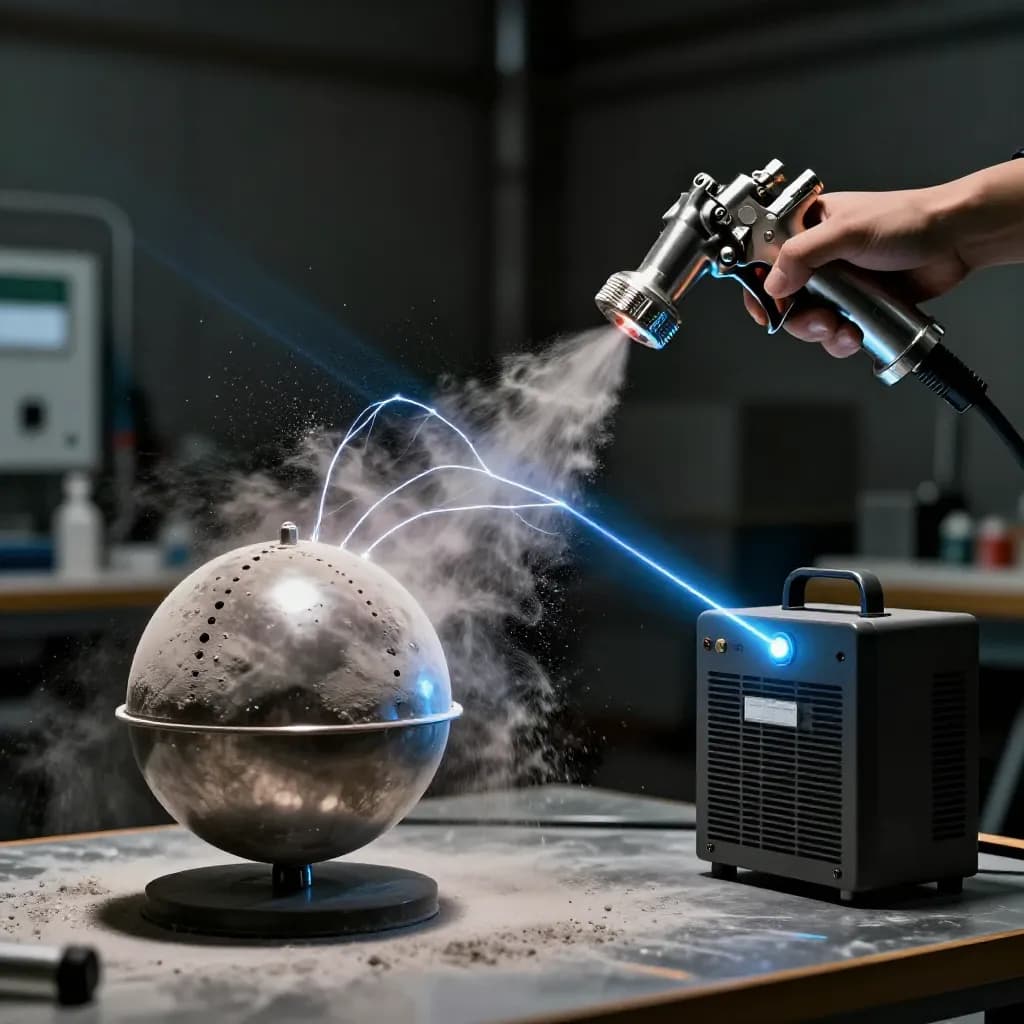
The basic principle is straightforward: powder particles are given an electrical charge (typically negative) as they leave the spray gun, while the workpiece to be coated is electrically grounded (zero charge). The charged particles are attracted to the grounded surface by electrostatic force, adhering to it in a uniform layer. The coated part is then transferred to a curing oven where the powder melts and fuses into a continuous film.
Ready to Start Your Project?
From one-off customs to 15,000-part production runs — get precise pricing in 24 hours.
On This Page
Fundamentals of Electrostatic Powder Deposition
However, the apparent simplicity of this description masks considerable complexity. The behavior of charged powder particles in an electric field is governed by multiple interacting physical phenomena — Coulomb's law, electric field geometry, aerodynamic forces, gravity, particle-to-particle interactions, and the buildup of charge on the deposited powder layer itself. These interactions determine coating thickness, uniformity, penetration into recesses, edge coverage, and transfer efficiency.
Two primary charging methods are used in powder coating: corona charging and triboelectric (tribo) charging. Each method imparts charge to powder particles through a different physical mechanism, and each produces distinct electric field characteristics that affect how the powder deposits on the workpiece. Understanding the differences between these methods is crucial for selecting the right equipment and optimizing application parameters for specific part geometries and coating requirements.
Coulomb's Law and Electrostatic Force
Coulomb's law, formulated by French physicist Charles-Augustin de Coulomb in 1785, describes the force between two electrically charged objects. The law states that the electrostatic force between two point charges is directly proportional to the product of their charges and inversely proportional to the square of the distance between them. Mathematically, F = k × (q₁ × q₂) / r², where F is the force, k is Coulomb's constant, q₁ and q₂ are the charges, and r is the distance between them.
In powder coating, Coulomb's law governs the attractive force between a charged powder particle and the grounded workpiece. The force increases with the charge on the particle and decreases rapidly with distance from the workpiece surface. This distance dependence has important practical implications: particles close to the workpiece experience strong attraction and deposit readily, while particles farther away experience weaker forces and are more influenced by competing aerodynamic forces and gravity.
The inverse-square relationship also means that the electrostatic force changes dramatically over short distances. A particle at 1 centimeter from the workpiece experiences four times the electrostatic force of an identical particle at 2 centimeters. This steep force gradient helps explain why powder coating achieves good adhesion — once a particle approaches the surface, the rapidly increasing force pulls it firmly into contact.
However, Coulomb's law also explains a phenomenon that limits coating thickness: back-ionization. As charged powder accumulates on the workpiece surface, the deposited layer itself becomes a charged insulator. The electric field created by this charged layer opposes the deposition of additional particles, effectively creating a self-limiting mechanism. When the repulsive force from the deposited layer equals the attractive force from the grounded substrate, no additional powder can deposit — establishing the maximum achievable film thickness for a given set of application parameters.
This self-limiting behavior is both a blessing and a challenge. It helps prevent excessive film build in areas of high powder flux, promoting uniformity. But it also limits the ability to build thick coatings in a single pass and can cause defects such as orange peel or back-ionization craters if the charge density in the deposited layer becomes too high.
Charge-to-Mass Ratio: The Critical Parameter
The charge-to-mass ratio (q/m) of powder particles is arguably the single most important parameter in electrostatic powder coating. It represents the amount of electrical charge carried per unit mass of powder and directly determines how strongly particles respond to electric fields relative to other forces such as gravity and aerodynamic drag.
Typical charge-to-mass ratios for corona-charged powder particles range from 1 to 5 microcoulombs per gram (μC/g), while tribo-charged particles typically carry 0.5 to 3 μC/g. These values may seem small, but they are sufficient to create electrostatic forces that dominate particle behavior in the spray booth environment.
The optimal charge-to-mass ratio depends on the specific application. Higher q/m values produce stronger electrostatic attraction, resulting in better wrap-around coverage on complex geometries and higher first-pass transfer efficiency. However, excessively high q/m values cause problems. Heavily charged particles create strong electric field lines that concentrate deposition on edges, corners, and protruding features — a phenomenon known as the Faraday cage effect in reverse — while starving recessed areas of powder. High charge levels also increase the risk of back-ionization, where the accumulated charge in the deposited layer causes electrical breakdown and creates crater-like defects in the coating.
Lower q/m values produce softer deposition with better penetration into recesses and more uniform coverage on complex parts. The reduced electrostatic force allows aerodynamic forces to play a larger role in directing particles into cavities and recessed areas. However, too-low charge levels result in poor adhesion of the uncured powder to the workpiece, leading to powder fall-off during handling and transfer to the curing oven.
The charge-to-mass ratio is influenced by multiple factors: the voltage and current settings of the spray gun, the powder flow rate, the particle size distribution, the chemical composition of the powder, ambient humidity, and the distance between the gun and the workpiece. Skilled operators and automated systems adjust these parameters to achieve the optimal q/m for each specific application, balancing coverage uniformity against transfer efficiency and defect risk.
Corona Charging: Principles and Field Geometry
Corona charging is the most widely used method for imparting electrical charge to powder particles in industrial powder coating operations. In a corona charging gun, a high-voltage electrode (typically a sharp needle or ring) at the gun tip is energized to a negative potential of 60,000 to 100,000 volts. This extreme voltage creates a corona discharge — a localized electrical breakdown of the air surrounding the electrode — that generates a dense cloud of free ions (primarily negative oxygen ions).
As powder particles pass through or near this ion cloud on their way from the gun to the workpiece, they collide with and capture free ions, acquiring a negative electrical charge. The charging process is essentially a bombardment — ions are driven onto the particle surfaces by the strong electric field near the electrode, and the particles accumulate charge until they reach a saturation level determined by their size, shape, and dielectric properties.
The electric field created by a corona charging gun has a characteristic geometry that significantly influences powder deposition patterns. The field lines emanate from the charged electrode and terminate on the grounded workpiece, creating a roughly conical deposition pattern. The field is strongest along the direct line between the gun and the nearest point on the workpiece, and it wraps around edges and into recesses to varying degrees depending on the part geometry and the gun-to-part distance.
One important characteristic of corona charging is that it creates free ions in addition to charged powder particles. These free ions travel to the workpiece surface and deposit on the growing powder layer, contributing to the charge buildup that causes back-ionization at high film thicknesses. This free ion current is the primary cause of back-ionization defects and is the main disadvantage of corona charging compared to triboelectric charging.
Modern corona guns offer adjustable voltage and current settings that allow operators to control the intensity of the corona discharge and the resulting charge-to-mass ratio. Low-voltage, low-current settings produce softer charging with less free ion generation, reducing back-ionization risk at the expense of some transfer efficiency. This flexibility makes corona charging adaptable to a wide range of part geometries and coating requirements.
Triboelectric Charging: Friction-Based Alternative
Triboelectric charging, commonly called tribo charging, uses a fundamentally different physical mechanism to charge powder particles. Instead of bombarding particles with ions from a corona discharge, tribo guns charge particles through frictional contact with the internal surfaces of the gun body. As powder particles flow through a PTFE (polytetrafluoroethylene) or similar material-lined barrel, they repeatedly collide with and slide against the barrel walls, transferring electrons from the powder to the barrel material and acquiring a positive electrical charge.
The triboelectric effect — the generation of electrical charge through friction between dissimilar materials — is the same phenomenon that causes static cling in clothing and sparks when touching a metal doorknob after walking across a carpet. In a tribo gun, the effect is engineered and controlled by selecting barrel materials with appropriate positions in the triboelectric series relative to the powder coating material.
Tribo charging produces a distinctly different electric field geometry compared to corona charging. Because there is no high-voltage electrode generating a strong external field, the electric field between a tribo gun and the workpiece is created solely by the charged powder particles themselves. This results in a softer, more diffuse field pattern with less tendency to concentrate deposition on edges and protruding features.
The absence of free ions is the most significant advantage of tribo charging. Without the free ion current that accompanies corona charging, tribo-charged powder can be built to greater thicknesses without back-ionization defects. This makes tribo charging particularly well-suited to applications requiring thick coatings or coating of complex geometries with deep recesses where back-ionization is problematic with corona guns.
However, tribo charging has its own limitations. The charge level achieved depends on the chemical compatibility between the powder formulation and the gun barrel material, meaning that not all powder formulations charge equally well in tribo guns. Charging efficiency can also be affected by humidity, powder flow rate, and barrel wear. And because the charging mechanism relies on physical contact, tribo guns typically have lower powder throughput rates than corona guns, making them less suitable for high-speed production lines.
The choice between corona and tribo charging — or the use of both in combination — depends on the specific requirements of each application, including part geometry, coating thickness, production speed, and powder formulation.
Electric Field Lines and Faraday Cage Effects
The behavior of electric field lines around complex workpiece geometries is one of the most important and challenging aspects of electrostatic powder coating. Electric field lines represent the paths along which charged particles are driven by electrostatic force, and their distribution around a workpiece determines where powder deposits and where it does not.
On flat or gently curved surfaces, electric field lines are relatively uniform, producing even powder deposition. However, on complex geometries with sharp edges, corners, recesses, and cavities, the field lines concentrate on protruding features and are excluded from recessed areas. This concentration effect causes excessive powder buildup on edges and corners while leaving recesses and interior surfaces with insufficient coating — a phenomenon known as the Faraday cage effect.
The Faraday cage effect is named after Michael Faraday's observation that the interior of a conductive enclosure is shielded from external electric fields. In powder coating, the effect occurs when the electric field lines preferentially terminate on the outer edges of a recessed feature rather than penetrating into the interior. Charged powder particles follow these field lines and deposit on the outer surfaces, leaving the interior under-coated or uncoated.
The severity of the Faraday cage effect depends on several factors: the depth and aspect ratio of the recess, the charge-to-mass ratio of the powder, the gun-to-part distance, and the type of charging method used. Deep, narrow recesses with high-aspect ratios are the most challenging geometries. Higher charge-to-mass ratios exacerbate the effect because the stronger electrostatic force more rigidly constrains particles to follow field lines rather than penetrating into recesses via aerodynamic momentum.
Several strategies are used to mitigate the Faraday cage effect. Reducing the charging voltage decreases the q/m ratio, allowing aerodynamic forces to carry particles into recesses. Using tribo charging instead of corona charging eliminates the external electric field that drives the concentration effect. Adjusting gun position and angle to direct powder flow into recesses can improve penetration. And specialized gun tips that produce a more diffuse spray pattern can reduce field line concentration on protruding features.
Understanding electric field behavior is essential for optimizing powder coating of complex parts such as automotive wheels, heat exchangers, electrical enclosures, and architectural extrusions with multiple chambers and recesses.
Practical Implications for Application Quality
The electrostatic principles described in this article have direct, practical implications for the quality and efficiency of powder coating operations. Translating theoretical understanding into application practice is what separates good powder coating from great powder coating.
Film thickness uniformity is fundamentally governed by the interaction between electrostatic forces, aerodynamic forces, and gravity. On vertical surfaces, gravity pulls uncured powder downward, potentially causing thickness variation from top to bottom. Electrostatic attraction counteracts this tendency, but only up to the point where the powder layer's own charge creates sufficient repulsion. Optimizing the balance between these forces — through gun settings, powder flow rate, and application distance — is key to achieving uniform thickness on large vertical panels.
Transfer efficiency — the percentage of sprayed powder that actually deposits on the workpiece — is directly related to the electrostatic charging parameters. Higher charging levels generally improve transfer efficiency by increasing the attractive force between powder and workpiece. However, the relationship is not linear; beyond an optimal point, excessive charging causes back-ionization, powder rejection, and reduced efficiency. Most well-optimized powder coating operations achieve first-pass transfer efficiencies of 60-80%, with reclaimed overspray bringing total material utilization to 95-98%.
Edge coverage is enhanced by electrostatic wrap — the tendency of charged particles to follow electric field lines around edges and onto adjacent surfaces. This wrap-around effect is one of powder coating's significant advantages over liquid paint, which tends to thin at edges due to surface tension effects. However, excessive wrap can cause thick buildup on sharp edges, requiring careful parameter optimization.
The grounding of the workpiece is a frequently overlooked but critical factor in electrostatic deposition. Poor grounding — caused by dirty hooks, oxidized contact points, or non-conductive masking materials — reduces the electrostatic force driving powder deposition and can cause dramatic reductions in transfer efficiency and coating uniformity. Regular maintenance of grounding connections is one of the simplest and most effective quality improvement measures in any powder coating operation.
Ambient conditions, particularly humidity, affect electrostatic charging and powder behavior. High humidity reduces the resistivity of the air and the powder particles, allowing charge to dissipate more rapidly and reducing the effective charge-to-mass ratio. Most powder coating facilities control humidity to maintain consistent application quality.
Frequently Asked Questions
What is the charge-to-mass ratio in powder coating?
The charge-to-mass ratio (q/m) measures the electrical charge per unit mass of powder particles. Typical values are 1-5 μC/g for corona charging and 0.5-3 μC/g for tribo charging. This ratio determines how strongly particles respond to electric fields and directly affects coating uniformity, transfer efficiency, and penetration into recesses.
What is the Faraday cage effect in powder coating?
The Faraday cage effect occurs when electric field lines concentrate on the outer edges of recessed features rather than penetrating into the interior. This causes excessive powder buildup on edges while leaving recesses under-coated. It can be mitigated by reducing charging voltage, using tribo charging, or adjusting gun position and spray pattern.
What is the difference between corona and tribo charging?
Corona charging uses a high-voltage electrode (60,000-100,000V) to create ions that charge powder particles negatively. Tribo charging uses friction between powder and a PTFE gun barrel to charge particles positively. Corona offers higher throughput but generates free ions that cause back-ionization. Tribo produces softer deposition with better recess penetration but lower throughput.
What causes back-ionization in powder coating?
Back-ionization occurs when the accumulated charge in the deposited powder layer becomes so high that it causes localized electrical breakdown, creating crater-like defects. It is primarily caused by free ions from corona charging that deposit on the powder layer. Reducing voltage, using tribo charging, or limiting film thickness per pass can prevent it.
How does humidity affect electrostatic powder coating?
High humidity reduces air and powder resistivity, allowing electrical charge to dissipate more rapidly and reducing the effective charge-to-mass ratio. This can decrease transfer efficiency and coating uniformity. Most powder coating facilities control humidity levels to maintain consistent electrostatic charging and application quality.
Ready to Start Your Project?
From one-off customs to 15,000-part production runs — get precise pricing in 24 hours.