Electrostatic powder coating relies on the fundamental principle that oppositely charged objects attract each other. Powder particles are given an electrical charge — typically negative — and are directed toward a grounded (electrically neutral) metal workpiece. The electrostatic attraction between the charged particles and the grounded part causes the powder to adhere to the metal surface, forming a uniform layer that is subsequently melted and cured in an oven to form a continuous coating film.
Technical
Powder Coating Electrostatic Application Physics: Corona, Tribo, Voltage, and Powder Cloud Dynamics
Sundial Powder Coating·April 22, 2026·14 min
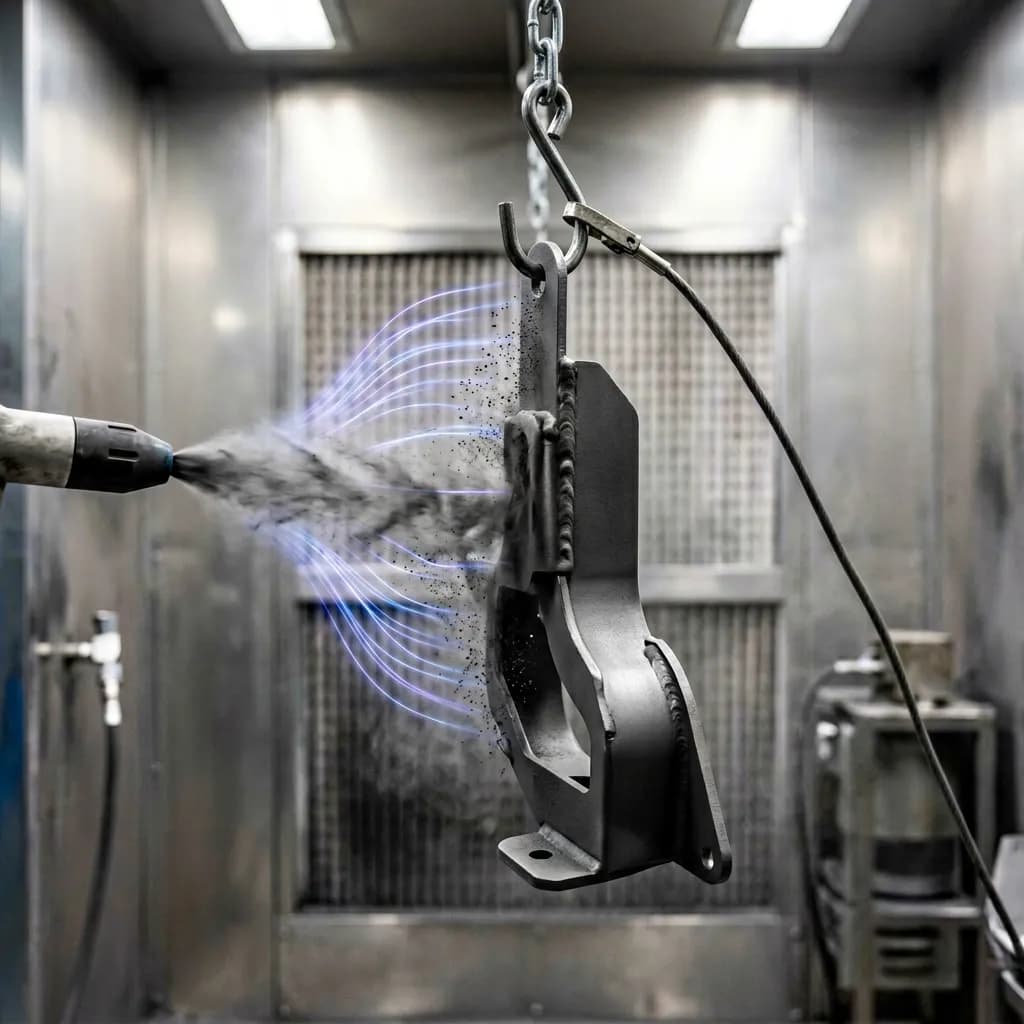
The electrostatic deposition process involves three simultaneous physical mechanisms: electrostatic attraction, aerodynamic transport, and gravitational settling. The charged powder particles are carried from the gun to the part by a stream of compressed air (aerodynamic transport), attracted to the grounded part by the electrostatic field (electrostatic attraction), and pulled downward by gravity (gravitational settling). The relative importance of these three mechanisms determines the deposition pattern, transfer efficiency, and coating uniformity.
Ready to Start Your Project?
From one-off customs to 15,000-part production runs — get precise pricing in 24 hours.
On This Page
Electrostatic Fundamentals: How Charged Powder Reaches the Part
For particles in the typical powder coating size range (20-60 μm), electrostatic forces dominate over gravitational forces at gun-to-part distances up to approximately 300 mm. Beyond this distance, the electrostatic field weakens and aerodynamic forces become more important for directing particles to the part. At very close distances (below 100 mm), the electrostatic field is extremely strong and can cause back-ionization and uneven deposition. The optimal gun-to-part distance of 200-300 mm represents the range where electrostatic attraction is strong enough for efficient deposition but not so strong that it causes field-related defects.
Corona Charging: The Dominant Technology
Corona charging uses a high-voltage electrode at the gun tip to ionize the surrounding air, creating a corona discharge that charges powder particles as they pass through the ionized zone. The electrode is typically a sharp tungsten needle or a thin wire ring, connected to a high-voltage power supply that generates 30-100 kV DC (negative polarity in most applications). The intense electric field at the electrode tip (exceeding 3 × 10⁶ V/m) strips electrons from air molecules, creating a cascade of free electrons and positive ions — the corona discharge.
Powder particles passing through the corona zone acquire negative charge through two mechanisms: field charging and diffusion charging. Field charging occurs when free electrons and negative ions are driven onto the particle surface by the electric field — this is the dominant mechanism for particles larger than approximately 2 μm. Diffusion charging occurs when ions collide with particles through random thermal motion — this mechanism is more important for sub-micron particles. For typical powder coating particles (20-60 μm), field charging dominates, and the charge acquired is approximately proportional to the particle surface area and the electric field strength.
The saturation charge — the maximum charge a particle can acquire — is reached when the electric field created by the charge already on the particle repels further ion deposition. For a 40 μm powder particle in a typical corona field, the saturation charge is approximately 10⁻¹³ to 10⁻¹² coulombs, corresponding to a charge-to-mass ratio of 2-10 μC/g. The time to reach saturation charge is very short — typically less than 1 millisecond — so all particles passing through the corona zone are fully charged regardless of their velocity.
The corona discharge also produces a large number of free ions that are not captured by powder particles. These free ions travel to the grounded workpiece and deposit on the coating surface, contributing to back-ionization at high film thicknesses. The ratio of free ions to charged powder particles depends on the powder concentration in the spray cloud — at low powder concentrations, most ions reach the part as free ions; at high concentrations, more ions are captured by powder particles.
Tribo Charging: Friction-Based Electrostatics
Triboelectric charging generates charge through friction between powder particles and a contact surface inside the gun body, typically a PTFE (polytetrafluoroethylene) tube or channel. As powder particles flow through the tube, repeated collisions between the particles and the tube wall transfer electrons from one material to the other according to their positions in the triboelectric series. PTFE is strongly electronegative — it tends to acquire electrons from most powder coating resins — so the powder particles lose electrons and become positively charged.
The charge level achieved by tribo charging is typically 1-5 μC/g, significantly lower than the 5-20 μC/g achieved by corona charging. This lower charge level is actually advantageous for many applications because it reduces the Faraday cage effect, eliminates back-ionization, and produces more uniform deposition across complex part geometries. The absence of free ions — because there is no corona discharge — means that the only charge on the part surface comes from the deposited powder particles themselves, resulting in a more gradual and uniform charge buildup.
The charging efficiency of a tribo gun depends on the triboelectric compatibility between the powder resin and the gun's contact material. Polyester and polyester-TGIC resins charge well against PTFE, typically achieving 3-5 μC/g. Epoxy resins charge poorly against PTFE because epoxy is closer to PTFE in the triboelectric series, often achieving only 0.5-2 μC/g. Hybrid (epoxy-polyester) resins fall between these extremes. Some tribo guns use nylon contact surfaces instead of PTFE, which provides better charging for epoxy-based powders but poorer charging for polyester.
Tribo gun maintenance is more demanding than corona gun maintenance because the charging surfaces wear over time and accumulate powder buildup that reduces charging efficiency. The PTFE tubes should be inspected regularly for wear and replaced when the inner surface becomes smooth or scored. Cleaning the charging surfaces with compressed air or a soft brush between color changes is essential for maintaining consistent charge levels. Charge monitoring — measuring the current flowing from the gun to ground, which is proportional to the charge being deposited on the powder — provides a real-time indicator of charging efficiency and can detect degradation before it affects coating quality.
Voltage, Current, and Their Effects on Deposition
In corona charging systems, voltage and current are the two primary electrical parameters that control the charging and deposition process. Voltage determines the strength of the electric field between the gun and the part, which drives the charged particles toward the grounded surface. Current determines the rate of ion generation at the corona electrode, which controls the charge level on the powder particles and the free ion flux to the part.
Increasing voltage from 30 kV to 100 kV increases the electrostatic field strength proportionally, improving the attractive force on charged particles and increasing the wrap — the ability of powder to deposit on surfaces that are not directly facing the gun. Higher voltage also increases the corona current, generating more ions and charging particles to higher levels. However, the relationship between voltage and deposition quality is not linear — above approximately 60-80 kV, the benefits of increased field strength are offset by increased back-ionization, reduced penetration into recessed areas, and increased orange peel from electrostatic disruption of the deposited powder layer.
Current limiting is a critical control feature on modern corona guns. By restricting the maximum current output of the charging electrode (typically adjustable from 10-80 μA), the operator can control the free ion flux independently of the voltage. Low current settings (10-30 μA) reduce free ion generation while maintaining the electrostatic field strength, improving penetration into Faraday cage areas and reducing back-ionization. High current settings (50-80 μA) maximize charging efficiency and deposition rate on flat surfaces but increase the risk of back-ionization on thick films.
The optimal voltage and current settings depend on the part geometry, the target film thickness, and the powder formulation. Flat panels can be coated efficiently at 60-80 kV and 40-60 μA. Complex parts with recessed areas benefit from reduced settings of 40-60 kV and 15-30 μA. Very thick films (above 80 μm) require lower settings to avoid back-ionization. Many modern gun controllers offer pre-programmed settings for different application scenarios, and some use automatic feedback control that adjusts voltage and current based on the measured deposition current to maintain optimal charging conditions.
Powder Cloud Dynamics and Spray Pattern Control
The powder cloud — the stream of charged particles traveling from the gun to the part — is a complex aerodynamic and electrostatic system whose behavior determines the deposition pattern, transfer efficiency, and coating uniformity. Understanding and controlling the powder cloud is essential for optimizing the coating process.
The powder cloud is shaped by the gun nozzle or deflector, which determines the initial spray pattern geometry. Flat spray nozzles produce a fan-shaped pattern suitable for coating flat panels and wide surfaces. Round spray nozzles produce a conical pattern suitable for general-purpose coating. Deflector plates redirect the powder stream into a wide, diffuse cloud that provides soft, uniform deposition with reduced impact velocity — useful for achieving smooth finishes and reducing back-ionization.
Air velocity in the powder cloud is a critical but often overlooked parameter. The transport air that carries powder from the hopper to the gun also determines the velocity of the powder cloud at the gun exit. Higher air velocities (3-5 m/s at the nozzle) produce a focused, high-momentum cloud that penetrates well into recessed areas but can cause powder to bounce off flat surfaces, reducing transfer efficiency. Lower air velocities (1-2 m/s) produce a softer, more diffuse cloud that deposits gently on surfaces with less bounce-back but has less penetration into recesses.
Dense phase delivery systems provide a significant advantage in powder cloud control because they decouple the powder transport function from the atomization function. In a venturi system, the same air stream that transports the powder also determines the cloud velocity and pattern. In a dense phase system, the powder is transported at low velocity by a positive-pressure pump, and a separate atomizing air supply at the gun controls the cloud characteristics independently. This allows the operator to optimize the cloud velocity and pattern for the specific application without affecting the powder delivery rate.
The electrostatic field also shapes the powder cloud. Charged particles repel each other, causing the cloud to expand as it travels from the gun to the part. This electrostatic expansion increases the effective spray pattern width but reduces the powder concentration at the center of the pattern. At higher charge levels (higher voltage), the expansion is greater, producing a wider but thinner cloud. At lower charge levels, the cloud remains more concentrated. The interaction between aerodynamic and electrostatic forces creates a complex three-dimensional powder distribution that varies with distance from the gun, charge level, air velocity, and powder output rate.
Transfer Efficiency and Wrap: Maximizing Powder Utilization
Transfer efficiency (TE) — the percentage of sprayed powder that deposits on the part — is a key economic and environmental metric for powder coating operations. First-pass TE for electrostatic spray application typically ranges from 40-70%, depending on part geometry, gun settings, and powder properties. With reclaim systems that collect and reuse overspray, the overall material utilization can reach 95-98%, but maximizing first-pass TE reduces the load on the reclaim system and improves coating consistency.
Wrap — the ability of charged powder to deposit on surfaces that are not directly facing the gun — is a direct consequence of the electrostatic field geometry. The electric field lines between the charged powder cloud and the grounded part curve around the part edges, carrying charged particles to side surfaces and even to the back of the part. The degree of wrap depends on the field strength (higher voltage = more wrap), the charge level on the particles (higher charge = more wrap), and the part geometry (smaller parts with more edges have better wrap than large flat panels).
Several factors reduce transfer efficiency: excessive air velocity that causes powder to bounce off the part surface; back-ionization that repels incoming particles from areas with high surface charge; poor grounding that reduces the electrostatic attraction; and excessive gun-to-part distance that weakens the electrostatic field. Optimizing TE requires balancing these factors — reducing air velocity improves deposition on flat surfaces but reduces penetration into recesses; reducing voltage reduces back-ionization but also reduces wrap.
Part grounding is often the most overlooked factor affecting transfer efficiency. The electrostatic attraction between charged powder and the part depends on the part being at ground potential (0 V). If the grounding path has high resistance — due to dirty hooks, paint buildup on contact points, or corroded conveyor connections — the part floats above ground potential and the electrostatic attraction is reduced. Grounding resistance should be measured regularly and maintained below 1 megohm (preferably below 100 kilohms) for consistent transfer efficiency. A simple test is to measure the resistance between the part and the conveyor ground bus using a megohmmeter.
Back-Ionization: The Limiting Factor in Electrostatic Deposition
Back-ionization is the most significant limitation of corona electrostatic application, setting an effective upper limit on the film thickness achievable in a single application pass. It occurs when the accumulated charge on the deposited powder layer creates an electric field strong enough to cause electrical breakdown of the air trapped between powder particles, generating localized micro-discharges that disrupt the powder layer and create visible defects.
The mechanism begins as charged powder particles deposit on the grounded part surface. Each particle carries its charge, and as the layer builds up, the total surface charge increases. The electric field within the powder layer — between the charged surface and the grounded substrate — increases proportionally. When this field exceeds approximately 3 × 10⁶ V/m (the dielectric breakdown strength of air), micro-discharges occur within the powder layer, creating small craters, pits, and a characteristic 'starring' or 'orange peel' pattern in the deposited powder.
Back-ionization typically becomes visible at film thicknesses above 80-120 μm with standard corona settings (60-80 kV, 40-60 μA). The threshold depends on the powder's dielectric properties, the charge level, and the humidity (higher humidity increases air conductivity and raises the breakdown threshold slightly). Once back-ionization begins, additional powder application makes the problem worse rather than better — the additional charge increases the field strength and intensifies the micro-discharges.
Countermeasures for back-ionization include: reducing voltage and current to lower the charge level on deposited particles; using tribo charging, which produces lower charge levels and no free ions; applying powder in multiple passes with a brief pause between passes to allow charge dissipation; increasing gun-to-part distance to reduce the local field strength; and using powders formulated with conductive additives that help dissipate surface charge. For applications requiring thick films (above 100 μm), tribo charging or a combination of corona first pass (for coverage) followed by tribo second pass (for thickness buildup) is often the most effective approach.
Automatic Gun Systems: Reciprocators, Robots, and Control
Automatic gun systems provide consistent, repeatable application that is essential for high-volume production and demanding quality requirements. The two main types of automatic systems are reciprocating gun banks and robotic applicators, each with distinct advantages for different production scenarios.
Reciprocating systems mount multiple guns (typically 6-16 per side) on a vertical carriage that moves up and down as parts travel horizontally on a conveyor. The reciprocation speed, stroke length, and gun spacing are set to provide uniform coverage across the full height of the part. Typical reciprocation speeds are 15-30 m/min with stroke lengths of 0.5-2.0 m. The guns fire continuously as the carriage reciprocates, and the combination of vertical gun movement and horizontal part movement creates a crosshatch deposition pattern that builds up a uniform film.
Key parameters for reciprocating systems include: stroke length (must exceed the part height by at least 100 mm on each end to avoid thick bands at the stroke reversal points); reciprocation speed (faster speeds produce thinner individual passes and more uniform coverage); gun spacing (closer spacing provides more overlap between adjacent guns but requires more guns); and trigger timing (guns can be programmed to turn on and off based on part position to avoid spraying between parts and wasting powder).
Robotic applicators use 6-axis industrial robots to move one or more guns along a programmed path that follows the contours of the part. Robots provide the ultimate flexibility for complex part geometries because the gun path, speed, distance, and angle can be optimized for each surface of the part independently. A robot can spray the inside of a channel at close range with reduced voltage, then move to the flat exterior surface and spray at standard distance and voltage — adjustments that are impossible with a fixed reciprocating system.
Modern automatic systems integrate gun control, powder delivery, and part detection into a unified control platform. Part detection sensors (photoelectric or vision-based) identify the part geometry as it enters the booth and select the appropriate spray program. The controller adjusts gun positions, output rates, voltage, and current settings automatically for each part type, enabling mixed-model production without manual intervention.
Frequently Asked Questions
What is the difference between corona and tribo charging?
Corona charging uses a high-voltage electrode to ionize air and charge powder particles, producing charge levels of 5-20 μC/g with free ions. Tribo charging uses friction between powder and a PTFE tube, producing lower charge levels of 1-5 μC/g with no free ions. Corona provides faster deposition on flat surfaces; tribo provides better penetration into recessed areas and eliminates back-ionization.
What causes back-ionization in powder coating?
Back-ionization occurs when accumulated charge on the deposited powder layer creates an electric field exceeding the dielectric breakdown strength of air (~3 × 10⁶ V/m), causing micro-discharges that disrupt the powder layer. It typically appears above 80-120 μm film thickness with standard corona settings. Countermeasures include reducing voltage/current, using tribo charging, or applying in multiple passes.
What is the optimal gun-to-part distance for powder coating?
The optimal distance is typically 200-300 mm for most applications. At this range, the electrostatic field provides good attraction and wrap without causing back-ionization. Closer distances (150-200 mm) improve penetration into recesses but increase back-ionization risk. Greater distances (above 300 mm) reduce transfer efficiency and electrostatic attraction.
How does grounding affect powder coating quality?
Poor grounding reduces the electrostatic attraction between charged powder and the part, lowering transfer efficiency and causing inconsistent film thickness. Grounding resistance should be maintained below 1 megohm (preferably below 100 kilohms). Common causes of poor grounding include dirty hooks, paint buildup on contact points, and corroded conveyor connections.
What transfer efficiency should I expect from electrostatic powder coating?
First-pass transfer efficiency typically ranges from 40-70% depending on part geometry, gun settings, and powder properties. Simple flat parts achieve 60-70%, while complex geometries with recessed areas may achieve only 40-50%. With reclaim systems collecting and reusing overspray, overall material utilization reaches 95-98%.
Ready to Start Your Project?
From one-off customs to 15,000-part production runs — get precise pricing in 24 hours.