Electrical enclosures — cabinets, panels, junction boxes, control stations, and distribution boards that house electrical and electronic equipment — represent one of the most technically demanding applications for powder coating. The coating must simultaneously provide corrosion protection, aesthetic finishing, electrical insulation (or controlled conductivity for grounding), electromagnetic interference (EMI) shielding compatibility, and compliance with safety standards from organizations including UL (Underwriters Laboratories), CSA (Canadian Standards Association), IEC (International Electrotechnical Commission), and NEMA (National Electrical Manufacturers Association).
Technical
Powder Coating Electrical Enclosures: EMI Shielding, Grounding, UL Requirements, and NEMA Ratings
Sundial Powder Coating·April 22, 2026·14 min
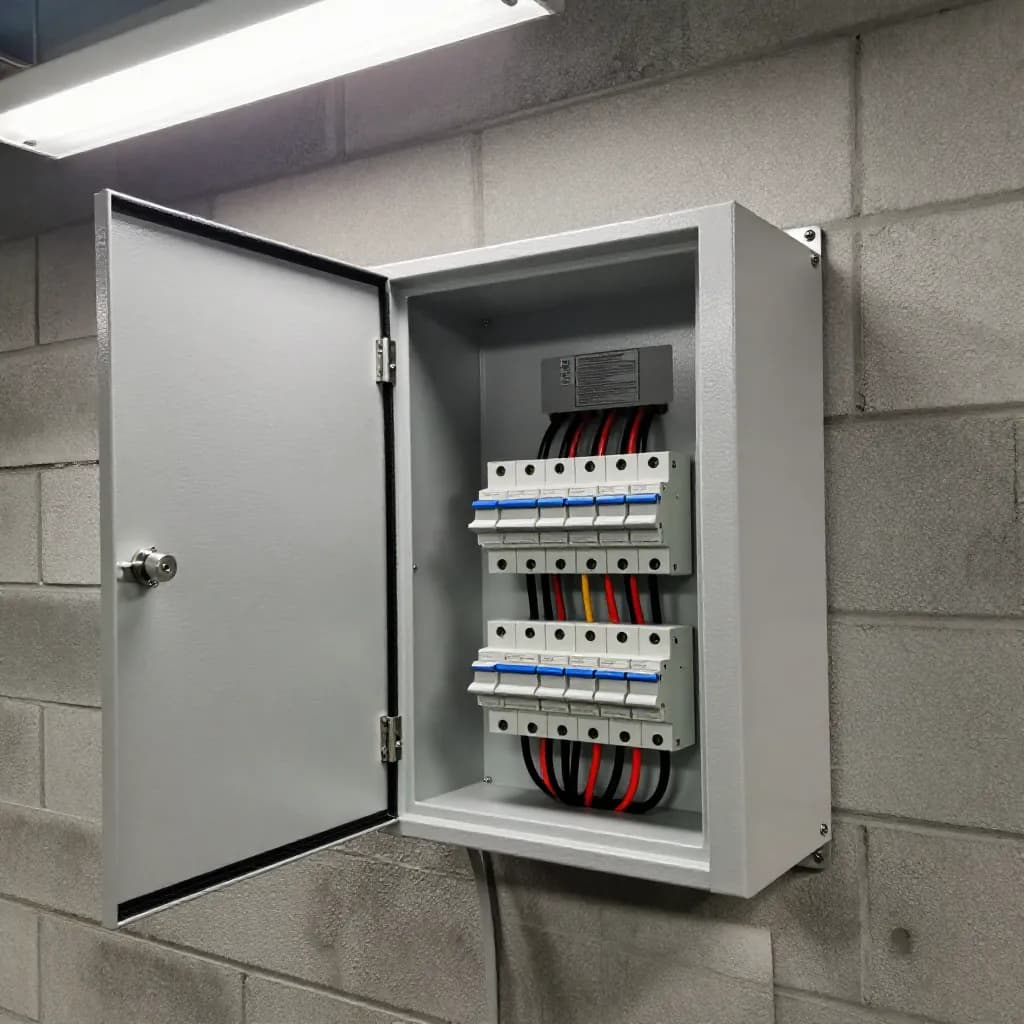
The global electrical enclosure market is dominated by powder-coated steel and aluminum construction, with powder coating accounting for the vast majority of enclosure finishing. The reasons are compelling: powder coating provides a durable, consistent finish in a single coat with zero VOC emissions, excellent edge coverage for corrosion protection of sheet metal fabrications, and the ability to achieve the specific colors (RAL 7035 light grey is the industry standard) and textures (fine texture is preferred for hiding minor surface imperfections) that the enclosure industry demands.
Ready to Start Your Project?
From one-off customs to 15,000-part production runs — get precise pricing in 24 hours.
On This Page
Electrical Enclosures: Where Coating Meets Compliance
However, the intersection of coating performance with electrical safety requirements creates unique challenges. The coating must not interfere with grounding connections, must maintain or provide EMI shielding effectiveness, must meet flammability requirements for electrical equipment, and must withstand the specific environmental conditions defined by the enclosure's NEMA or IP (Ingress Protection) rating. Understanding these requirements and how they interact with the powder coating process is essential for enclosure manufacturers and their coating suppliers.
EMI Shielding and Coating Conductivity
Electromagnetic interference (EMI) shielding is a critical function of metal electrical enclosures, protecting sensitive electronic equipment inside the enclosure from external electromagnetic fields and preventing electromagnetic emissions from the equipment inside from interfering with nearby devices. The shielding effectiveness of a metal enclosure depends on the electrical conductivity of the enclosure walls and the quality of electrical contact at joints, seams, and access openings.
Standard powder coatings are electrical insulators with surface resistivity of 10¹⁰-10¹⁴ ohm/square, which means that a powder-coated enclosure surface does not conduct electricity and cannot provide EMI shielding through surface conductivity. However, the shielding effectiveness of a metal enclosure is primarily determined by the bulk conductivity of the metal wall (which is unaffected by a thin surface coating) and the quality of electrical contact at joints and seams. A powder-coated steel enclosure with properly designed and maintained metal-to-metal contact at all joints retains excellent shielding effectiveness because the electromagnetic fields interact with the metal wall, not the thin surface coating.
The critical areas for EMI shielding on powder-coated enclosures are the joints between panels, the door-to-frame interface, and cable entry points. At these locations, the powder coating must be removed or prevented (by masking) to ensure metal-to-metal contact for electrical continuity. EMI gaskets — conductive elastomer strips or spring fingers — are installed at door frames and panel joints to maintain electrical contact while allowing the enclosure to be opened and closed. The gasket contact surfaces must be bare metal (uncoated) or coated with a conductive finish to ensure low-impedance electrical contact. Some enclosure manufacturers use conductive powder coatings containing metallic or carbon fillers for EMI-critical surfaces, providing both corrosion protection and electrical conductivity, though these specialty coatings are more expensive than standard formulations.
Grounding Requirements and Coating Design
Electrical grounding (earthing) of metal enclosures is a fundamental safety requirement that ensures fault currents are safely conducted to ground, preventing electric shock hazards. Every metal enclosure must provide a reliable, low-impedance ground path from all accessible metal surfaces to the grounding conductor. Powder coating, as an electrical insulator, can interfere with grounding if not properly managed in the enclosure design.
Grounding connections on powder-coated enclosures require bare metal contact points where the grounding conductor (wire, strap, or bus bar) connects to the enclosure. These contact points must be masked during the coating process to prevent powder from covering them, or the coating must be removed after cure by grinding, scraping, or using a star washer that cuts through the coating during assembly. Star washers (also called serrated lock washers) with sharp teeth that penetrate the coating to make metal-to-metal contact are the most common solution in production, as they eliminate the need for masking or post-coating grinding.
The grounding design must account for all removable panels, doors, and covers that are part of the enclosure. Each removable component must have its own grounding connection to the main enclosure body, typically through a bonding jumper (flexible braided wire) or through the hinge mechanism for doors. The resistance of each grounding connection should not exceed 0.1 ohm per IEC 61439 or equivalent standards. Testing of grounding continuity is a mandatory quality check for every enclosure, performed using a low-resistance ohmmeter or a dedicated ground bond tester that applies a test current (typically 25-30 amperes) and measures the voltage drop across the connection.
UL and Safety Standard Compliance
UL (Underwriters Laboratories) certification is required for electrical enclosures sold in North America, and the powder coating must meet specific UL requirements for flammability, dielectric strength, and durability. UL 508A (Industrial Control Panels) and UL 50/50E (Enclosures for Electrical Equipment) are the primary standards governing enclosure construction and finishing. These standards require that the coating material be UL-recognized (listed in the UL Recognized Component Directory) and that the finished enclosure pass specific performance tests.
Flammability is the most critical UL requirement for enclosure coatings. UL 94 defines flammability classifications for plastic materials, and while powder coatings on metal substrates are not directly classified under UL 94 (because the metal substrate is non-combustible), the coating material itself must demonstrate acceptable flame resistance. UL-recognized powder coatings have been tested and found to self-extinguish when the ignition source is removed, without producing flaming drips that could ignite materials below the enclosure. The UL recognition is specific to the powder formulation — changing powder suppliers or formulations requires verification that the new material is also UL-recognized.
Dielectric strength testing verifies that the coating provides adequate electrical insulation between live components inside the enclosure and the accessible metal exterior. The test applies a high voltage (typically 1000-2500 VAC depending on the equipment voltage rating) between the internal conductors and the enclosure body for one minute, with no breakdown or flashover permitted. The powder coating's dielectric strength (typically 20-40 kV/mm for standard formulations) provides substantial insulation at the 60-100 micrometer film thicknesses used on enclosures, but any pinholes, thin spots, or coating damage that reduces the effective insulation thickness could compromise dielectric performance. This is why uniform film thickness and defect-free coating are particularly important for electrical enclosures.
NEMA and IP Ratings: Environmental Protection
NEMA (National Electrical Manufacturers Association) ratings and IP (Ingress Protection) ratings per IEC 60529 define the environmental protection level that an enclosure provides against dust, water, ice, oil, and corrosive agents. The powder coating contributes to the enclosure's environmental protection by providing corrosion resistance on the metal surfaces and by maintaining the integrity of the enclosure's sealing system over the product's service life.
NEMA 1 enclosures (indoor, general purpose) require only basic corrosion protection — iron phosphate pretreatment with a single coat of polyester or epoxy-polyester powder at 60-80 micrometers is standard. NEMA 3R (outdoor, rain-tight) and NEMA 4 (outdoor, watertight) enclosures require enhanced corrosion protection — zinc phosphate pretreatment with polyester powder at 80-100 micrometers, or a primer-plus-topcoat system for extended outdoor service. NEMA 4X (outdoor, watertight, corrosion-resistant) enclosures, typically constructed from stainless steel or fiberglass, require coatings that withstand aggressive chemical and marine environments.
The coating's role in maintaining the enclosure's IP rating extends beyond corrosion protection. The gasket sealing surfaces on the door frame and panel joints must be smooth, uniform, and free of defects that could create leak paths. Powder coating provides an excellent sealing surface — the smooth, continuous film fills minor surface irregularities in the sheet metal and creates a uniform surface for gasket compression. However, excessive coating thickness on gasket surfaces can alter the compression characteristics of the gasket, potentially reducing the seal effectiveness. Gasket groove dimensions should account for the coating thickness, and gasket compression testing should be performed on coated enclosures to verify that the IP rating is maintained.
Interior vs. Exterior Finish Considerations
Many electrical enclosures require different coating specifications for interior and exterior surfaces, reflecting the different functional requirements and environmental exposures of each surface. The exterior surface is exposed to the installation environment — UV radiation, moisture, temperature cycling, mechanical damage, and chemical exposure — and must provide long-term corrosion protection and aesthetic durability. The interior surface houses electrical components and wiring, and must provide electrical insulation, light reflectance for visibility during maintenance, and resistance to the thermal environment created by heat-generating equipment inside the enclosure.
Exterior coatings for outdoor enclosures are typically polyester or super-durable polyester powders with UV stabilizers, applied at 80-100 micrometers for maximum weathering resistance. RAL 7035 (light grey) is the dominant color for industrial enclosures, chosen for its neutral appearance, good heat reflectance, and ability to show dirt and contamination that might indicate seal failure. Fine texture finishes are preferred because they hide minor surface imperfections, reduce fingerprint visibility, and provide a professional appearance without the maintenance demands of high-gloss finishes.
Interior coatings may use epoxy-polyester hybrid powders that provide superior chemical resistance and hardness for interior environments where UV resistance is not required. White or light grey interior colors maximize light reflectance, improving visibility for installation and maintenance of electrical components. Some enclosure specifications require the interior coating to have specific electrical properties — high dielectric strength for insulation, or controlled surface resistivity for electrostatic discharge (ESD) protection of sensitive electronic components. Anti-static powder coatings with surface resistivity of 10⁶-10⁹ ohm/square dissipate static charges safely without the risk of electrostatic discharge that could damage electronic components or ignite flammable atmospheres in hazardous location enclosures.
Production Considerations and Quality Control
Electrical enclosure manufacturing is characterized by high product variety (hundreds of enclosure sizes and configurations), moderate to high production volumes, and stringent quality requirements driven by safety certification. The powder coating process must be flexible enough to handle frequent color and size changes while maintaining the consistency required for UL, CSA, and NEMA compliance.
Color change efficiency is a key production consideration because enclosure manufacturers typically offer products in multiple standard colors (RAL 7035, RAL 7032, RAL 7021, RAL 9005, and custom colors) and must change colors frequently during production. Quick-color-change powder booths with smooth, non-stick interior surfaces and efficient powder recovery systems can complete a color change in 10-15 minutes, minimizing production downtime. Dedicated powder feed systems for high-volume colors (RAL 7035 typically accounts for 60-70% of production) further improve efficiency.
Quality control for electrical enclosures must verify both coating performance and safety compliance. Film thickness measurement at multiple points (including edges, corners, and internal surfaces), adhesion testing, and visual inspection are standard coating quality checks. Additionally, grounding continuity testing of every enclosure verifies that all grounding connections meet the 0.1 ohm maximum resistance requirement. Dielectric strength testing is performed on a sample basis per the UL certification requirements. Salt spray testing per ISO 9227 is performed on test panels at regular intervals to verify ongoing corrosion resistance — typical requirements are 500-1000 hours for NEMA 3R/4 enclosures. Documentation of all quality test results is maintained for traceability and regulatory compliance, with records retained for the product's expected service life.
Frequently Asked Questions
Does powder coating affect EMI shielding of electrical enclosures?
Standard powder coatings are insulators and do not conduct electricity, but the shielding effectiveness of a metal enclosure depends primarily on the bulk conductivity of the metal wall, which is unaffected by a thin surface coating. The critical requirement is maintaining metal-to-metal contact at joints, door frames, and panel seams through masking, grinding, star washers, or conductive EMI gaskets.
How do you maintain grounding on powder-coated enclosures?
Grounding contact points must have bare metal for low-impedance connections. Methods include masking grounding areas during coating, post-coating grinding to expose metal, or using star washers with sharp teeth that penetrate the coating during assembly. Each grounding connection must not exceed 0.1 ohm resistance per IEC 61439, verified by testing every enclosure.
What UL requirements apply to powder-coated enclosures?
The powder coating must be UL-recognized for flammability (self-extinguishing, no flaming drips). The coated enclosure must pass dielectric strength testing (1000-2500 VAC for one minute without breakdown). UL 508A and UL 50/50E are the primary standards. Changing powder formulations requires verification that the new material is UL-recognized.
What coating thickness is needed for different NEMA ratings?
NEMA 1 (indoor): 60-80 micrometers with iron phosphate pretreatment. NEMA 3R/4 (outdoor): 80-100 micrometers with zinc phosphate pretreatment or primer-plus-topcoat system. NEMA 4X (corrosion-resistant): enhanced systems on stainless steel or fiberglass substrates. Higher NEMA ratings require progressively more robust coating systems for environmental protection.
Why is RAL 7035 the standard color for electrical enclosures?
RAL 7035 (light grey) is the industry standard because it provides a neutral, professional appearance, good heat reflectance (reducing solar heat gain on outdoor enclosures), visibility of dirt and contamination that might indicate seal failure, and compatibility with most industrial and commercial environments. It accounts for 60-70% of enclosure production volume.
Ready to Start Your Project?
From one-off customs to 15,000-part production runs — get precise pricing in 24 hours.