Defense organizations worldwide are increasingly turning to powder coating technology as a preferred finishing method for military equipment, driven by a compelling combination of performance, environmental, and economic advantages. The traditional liquid CARC coating system, while proven in service, carries significant operational burdens including high VOC emissions requiring expensive air pollution control, isocyanate health hazards requiring supplied-air respiratory protection, limited pot life creating material waste and scheduling constraints, and relatively low material utilization rates. Powder coating addresses all of these concerns while delivering coating performance that meets or exceeds military specification requirements.
Technical
Powder Coating for Defense Equipment: Applications and Advantages
Sundial Powder Coating·April 20, 2026·11 min
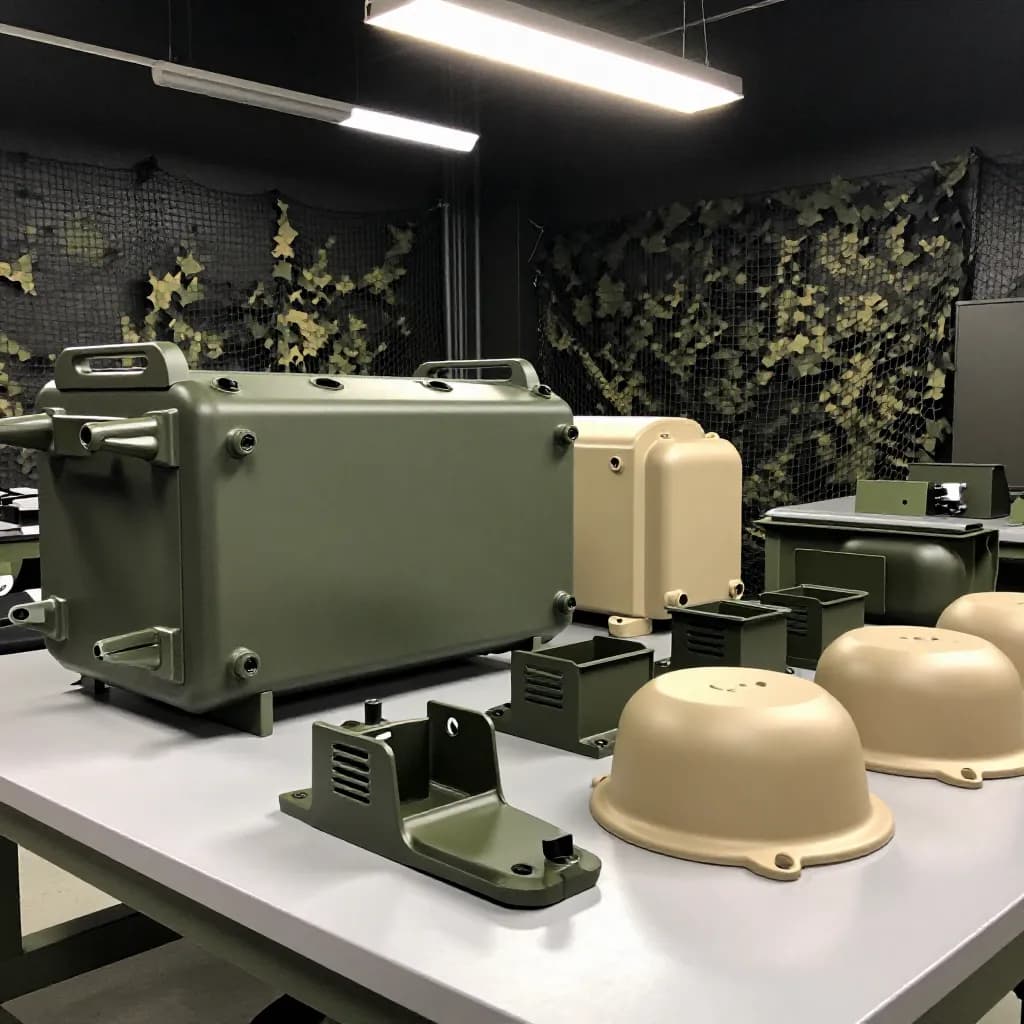
The durability advantage of powder coating is particularly relevant for defense applications where equipment is subjected to extreme mechanical stress, chemical exposure, and environmental conditions. Powder coatings typically achieve higher film builds in a single coat than liquid coatings, providing a thicker, more robust protective barrier. The thermoset curing process creates a highly cross-linked polymer network that resists chipping, scratching, abrasion, and chemical attack more effectively than many liquid coating systems. Edge coverage — a critical factor for corrosion protection on the complex fabricated geometries typical of military equipment — is inherently superior with powder coatings because the electrostatic application process deposits material uniformly, including on edges where liquid coatings tend to thin.
Ready to Start Your Project?
From one-off customs to 15,000-part production runs — get precise pricing in 24 hours.
On This Page
Why Defense Organizations Are Adopting Powder Coating
The economic case for powder coating in defense applications strengthens as facility volume increases. While the capital investment for powder coating equipment (spray booths, reclaim systems, curing ovens) is significant, the operating cost advantages are substantial. Material utilization rates of 95% or higher reduce raw material costs. Elimination of solvents removes a major consumable expense. Reduced hazardous waste generation lowers disposal costs. Simplified environmental compliance reduces permitting and monitoring expenses. And faster throughput — powder coatings can be cured in 15-30 minutes versus days for liquid CARC — increases facility capacity without additional floor space.
Tactical Vehicle Applications
Tactical vehicles represent one of the largest and most visible applications for powder coating in defense. The US military's fleet of tactical vehicles — including the Joint Light Tactical Vehicle (JLTV), High Mobility Multipurpose Wheeled Vehicle (HMMWV/Humvee), Family of Medium Tactical Vehicles (FMTV), Heavy Expanded Mobility Tactical Truck (HEMTT), and various trailers and specialized vehicles — requires continuous coating maintenance throughout their service life. Powder coating is increasingly used for vehicle components during both original manufacture and depot-level overhaul.
Components well-suited for powder coating include vehicle frames and chassis members, suspension components, wheel rims, bumpers and brush guards, tool box bodies and lids, storage compartments, fuel tank skid plates, trailer bodies and running gear, and armored panel assemblies that can be coated before installation. These components can be individually processed through a powder coating line — blasted, pretreated, powder coated, and cured — before assembly into the complete vehicle. The resulting finish provides superior corrosion protection and mechanical durability compared to liquid CARC on these high-wear components.
MIL-PRF-32348 qualified powder coatings in standard military colors (FS 34094 green, FS 33446 desert sand, FS 30051 brown, FS 37030 black) are available for tactical vehicle applications. These coatings meet the same chemical agent resistance, NIR reflectance, and durability requirements as liquid CARC, ensuring that powder-coated components are fully compatible with the vehicle's overall CARC coating system. For components that will be visible on the assembled vehicle, color matching between powder-coated components and liquid CARC-coated body panels is carefully controlled to ensure a uniform appearance.
Weapons Systems and Small Arms
Powder coating and related thermal-cure coating technologies have found extensive application on weapons systems and small arms, where the combination of durability, chemical resistance, and thin-film capability provides significant advantages over traditional bluing, parkerizing, and liquid paint finishes. Military and law enforcement weapons are subjected to extreme conditions including exposure to cleaning solvents, lubricants, propellant residue, salt spray, sand abrasion, and repeated mechanical impact, demanding a coating that can withstand this abuse while maintaining a functional and professional appearance.
Cerakote, a polymer-ceramic composite coating applied in thin films and oven-cured, has become one of the most widely used coatings for weapons systems and small arms components. While technically a thin-film thermal-cure coating rather than a traditional powder coating, Cerakote shares many characteristics with powder coatings including oven curing, zero-VOC application, and exceptional durability. Cerakote H-Series (oven cure at 250°F) and C-Series (air cure) coatings are used on rifle and pistol receivers, handguards, optics housings, magazines, and accessories. The thin film build (0.5-1.0 mil) is critical for weapons applications where dimensional tolerances are tight and excess coating thickness can interfere with function.
Traditional powder coatings are used on larger weapons system components where thicker film builds are acceptable, including ammunition containers, weapons storage racks, tripod mounts, mortar base plates, and vehicle-mounted weapon system housings. These components benefit from the superior corrosion protection and impact resistance of powder coatings compared to liquid paint. For ammunition containers and storage systems, powder coating provides a durable, chemical-resistant finish that withstands the rough handling inherent in military logistics operations. The ability to produce powder coatings in standard military colors ensures visual compatibility with the overall equipment camouflage scheme.
Field and Support Equipment
Military field and support equipment encompasses a vast range of items that are ideal candidates for powder coating, from large systems like generators and communications shelters to small items like tool boxes and storage containers. This equipment category represents a significant portion of the military's total coating requirement and is often the easiest application area for transitioning from liquid to powder coating, as the components are typically of manageable size and can be processed through standard powder coating equipment.
Generators and power distribution equipment are excellent powder coating candidates. Military generators such as the Tactical Quiet Generator (TQG) family include numerous sheet metal enclosure panels, frames, fuel tanks, and structural components that can be individually powder coated before assembly. The powder coating provides superior protection against the fuel, oil, and exhaust exposure inherent in generator operations, while the zero-VOC application process eliminates the environmental compliance burden associated with painting these components with liquid CARC. Communications shelters (S-788, S-250, and similar) are essentially metal enclosures that can be powder coated as complete assemblies or as individual panels, providing a durable, uniform finish that resists the mechanical damage from repeated transport and field deployment.
Water purification units, field kitchen equipment, medical equipment shelters, and maintenance tool sets all include metal components that benefit from powder coating's durability and corrosion resistance. Storage containers, shipping cases, and logistics packaging are high-volume items where powder coating's efficiency and consistency provide both quality and cost advantages. The military's extensive inventory of hand tools, maintenance equipment, and test sets includes countless metal components — from wrench sets to multimeter housings — where powder coating provides a professional, durable finish that withstands years of field use.
Aviation Ground Support Equipment
Aviation ground support equipment (AGSE) represents a growing application area for powder coating in defense. AGSE includes the diverse range of equipment used to support military aircraft operations on the ground: maintenance stands and platforms, aircraft tow bars and tow tractors, cargo loaders and conveyor systems, fuel servicing carts and hydrant systems, hydraulic test stands, pneumatic servicing carts, air conditioning units, and electrical power units. This equipment operates in demanding environments — exposed to weather, jet exhaust, fuel and hydraulic fluid spills, and constant mechanical wear from daily use.
Powder coating is particularly well-suited for AGSE because most items are of a size that can be processed through standard industrial powder coating ovens, and the components can be coated before assembly. Maintenance stands and platforms, for example, consist of welded steel tube frames and aluminum deck panels that can be individually powder coated for maximum corrosion protection. The superior edge coverage of powder coating is especially valuable on the welded joints and cut edges common in AGSE fabrication, where liquid coatings tend to thin and allow early corrosion initiation.
The US Air Force and Navy have both adopted powder coating for AGSE applications at maintenance and overhaul facilities. The durability of powder coatings reduces the frequency of AGSE repainting, which is significant given the large inventories of ground support equipment at military air bases. Color coding of AGSE — different colors identify different equipment functions (yellow for flight line equipment, red for fire and rescue, etc.) — is easily achieved with powder coating's wide color range. The zero-VOC characteristic of powder coating is particularly valuable at air bases where multiple coating operations may be conducted in proximity to aircraft maintenance activities, reducing the risk of coating solvent contamination of aircraft surfaces or systems.
Challenges and Limitations of Powder Coating for Defense
Despite its many advantages, powder coating for defense applications faces several challenges and limitations that must be understood and managed. The most fundamental limitation is the requirement for oven curing at temperatures typically ranging from 350°F to 400°F (177°C to 204°C). This means that powder coating can only be applied to components that can physically fit in a curing oven and that can withstand the curing temperature without damage. Fully assembled vehicles, large structures, and assemblies containing heat-sensitive components (electronics, rubber seals, lubricants) cannot be powder coated as complete units.
Field repairability is a significant concern for powder-coated military equipment. When powder-coated surfaces are damaged in the field — from combat damage, mechanical impact, or normal wear — they cannot be repaired with powder coating because no field-portable curing oven exists. Field touch-up must be performed with compatible liquid coatings, typically MIL-DTL-53039 single-component CARC or similar products. The compatibility between the liquid touch-up coating and the powder coating substrate must be verified to ensure adequate adhesion and appearance matching. This dual-coating approach adds complexity to maintenance procedures and supply chain management.
Color matching between powder-coated components and liquid CARC-coated surfaces on the same piece of equipment can be challenging. Differences in resin chemistry, pigment dispersion, and film formation between powder and liquid coatings can result in subtle color differences that are noticeable when the two coating types are adjacent. NIR reflectance matching is equally important — both the powder and liquid coatings must meet the same NIR specification to ensure consistent camouflage performance. Achieving consistent color and NIR matching requires close coordination between powder and liquid coating suppliers and careful quality control during production. Despite these challenges, the benefits of powder coating for defense applications continue to drive adoption, and the industry is actively working to address each limitation through improved formulations, lower-cure-temperature technologies, and better field repair solutions.
Frequently Asked Questions
Is powder coating approved for use on US military equipment?
Yes, powder coatings qualified under MIL-PRF-32348 are approved for use on US military tactical equipment as an alternative to liquid CARC. Products must pass rigorous testing for chemical agent resistance, NIR reflectance, corrosion resistance, and durability, and must be listed on the Qualified Products List (QPL) before they can be used on military equipment.
Can powder-coated military equipment be repaired in the field?
Powder coating itself cannot be applied in the field because it requires oven curing. Field repairs to powder-coated surfaces are performed using compatible liquid coatings, typically MIL-DTL-53039 single-component CARC for touch-up. The liquid touch-up coating must be compatible with the powder coating substrate and match both the visible color and NIR reflectance requirements.
What military colors are available in powder coating?
MIL-PRF-32348 qualified powder coatings are available in standard military camouflage colors including FS 34094 (green), FS 33446 (desert sand), FS 30051 (brown), and FS 37030 (black). Additional colors may be available from qualified manufacturers. All colors must meet both visible color and near-infrared reflectance specifications for camouflage effectiveness.
How does powder coating compare to liquid CARC in durability?
Powder coating generally provides equal or superior durability compared to liquid CARC in terms of chip resistance, abrasion resistance, and edge coverage. The thermoset curing process creates a highly cross-linked film that resists mechanical damage effectively. Salt spray and humidity resistance of qualified powder CARC meets the same 1,000+ hour requirements as liquid CARC.
What size components can be powder coated for military use?
Component size is limited by the dimensions of the curing oven. Industrial powder coating ovens range from small batch ovens suitable for small parts to large conveyorized ovens that can accommodate vehicle frames, trailer bodies, and shelter panels. The largest military powder coating facilities can process components up to 20-30 feet in length, though most operations focus on components in the 1-10 foot range.
Ready to Start Your Project?
From one-off customs to 15,000-part production runs — get precise pricing in 24 hours.