Data centers are among the most technically demanding building types in modern construction. Housing the digital infrastructure that supports global commerce, communications, and cloud computing, these facilities must deliver uninterrupted operation under all conditions. Every element of the building envelope — from cladding panels and louvre systems to security barriers and equipment enclosures — must meet exacting standards for fire safety, thermal performance, physical security, and long-term durability.
Architecture
Powder Coating for Data Center Building Envelopes: Security, Thermal Performance, and Fire Safety
Sundial Powder Coating·April 22, 2026·11 min
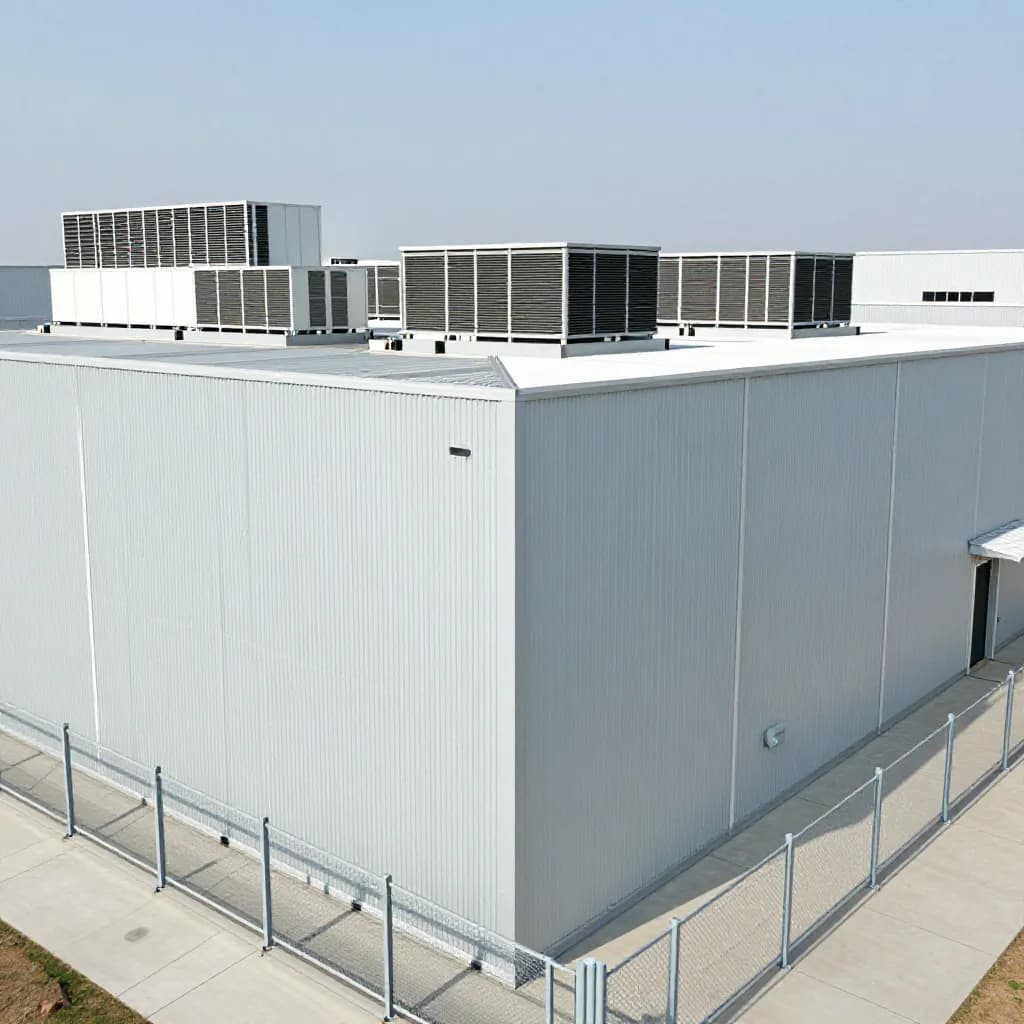
Powder coating has become the dominant finishing technology for data center metalwork because it aligns precisely with these requirements. The 60-120 micron film thickness provides superior corrosion and mechanical protection compared to the 25-50 microns achievable with liquid paint, while the A1/A2 Euroclass fire rating on aluminum substrates meets the non-combustible requirements of data center fire safety standards. Zero VOC emissions during application support the environmental management systems that major data center operators maintain as part of their corporate sustainability commitments.
Ready to Start Your Project?
From one-off customs to 15,000-part production runs — get precise pricing in 24 hours.
On This Page
Data Centers: Mission-Critical Architecture Demands Mission-Critical Finishes
The rapid growth of the data center sector — driven by artificial intelligence, cloud computing, and edge computing demand — has also created pressure for faster construction timelines. Powder coating's single-coat application process and rapid curing cycle support the prefabricated and modular construction methods increasingly used for data center delivery, enabling factory-finished components to be assembled on site with minimal finishing work.
Fire Safety: Protecting Irreplaceable Digital Assets
Fire is the most catastrophic risk facing data center operations. A fire event can destroy irreplaceable data, interrupt critical services, and generate losses measured in millions per hour of downtime. Data center fire safety standards — including EN 1047-2, NFPA 75, and NFPA 76 — impose stringent requirements on all building materials, with particular attention to the building envelope and internal partitions.
Powder-coated aluminum cladding achieves A1 or A2 Euroclass fire ratings under EN 13501-1, classifying it as non-combustible. This performance is critical for data center envelopes, where combustible cladding materials have been identified as a significant fire risk by insurers and regulators. The thin organic powder film on a non-combustible aluminum substrate contributes negligible fuel load and does not produce toxic smoke or flaming droplets — properties that are essential for protecting both the facility and its occupants.
For internal applications, powder-coated steel server rack enclosures, cable tray systems, and partition walls similarly achieve excellent fire ratings. The powder coating does not contribute to flame spread along cable routes — a critical consideration given the high density of cabling in data center environments. Fire-resistant powder coatings can also be specified for structural steel elements, providing both decorative finish and supplementary fire protection.
Data center insurers increasingly scrutinize the fire performance of building envelope materials as part of their risk assessment process. Specifying powder-coated aluminum or steel with documented Euroclass ratings provides clear evidence of compliance, simplifying the insurance underwriting process and potentially reducing premiums for facility operators.
Thermal Performance and Energy Efficiency
Data centers consume enormous quantities of energy, with cooling systems typically accounting for 30-40% of total facility power consumption. The thermal performance of the building envelope directly influences cooling energy demand, making the specification of cladding and insulation systems a critical design decision.
Powder coating contributes to thermal performance in several ways. Solar-reflective powder coating formulations, available in a range of colors including dark shades, reduce solar heat gain through the building envelope by reflecting a higher proportion of incident solar radiation. Cool-roof and cool-wall powder coatings can achieve solar reflectance index (SRI) values significantly higher than conventional coatings of the same color, reducing the cooling load on the facility's HVAC systems.
The dimensional stability of powder coatings under thermal cycling is also important for data center envelopes. These buildings experience significant temperature differentials between interior and exterior surfaces, and the cladding system must accommodate thermal movement without compromising weathertightness. Powder coating's elastic properties allow it to flex with the substrate through thermal cycles without cracking, delaminating, or losing adhesion — a performance advantage over more rigid liquid paint films that can develop micro-cracks under repeated thermal stress.
For data centers in extreme climates — from desert locations with surface temperatures exceeding 70°C to Nordic sites with winter temperatures below -40°C — powder coating formulations can be tailored to the specific thermal environment. High-temperature resistant formulations maintain their properties at sustained elevated temperatures, while flexible formulations designed for cold climates resist embrittlement and cracking at sub-zero temperatures.
Physical Security and Blast Resistance
Data centers housing critical infrastructure are classified as high-security facilities, and the building envelope must resist unauthorized access, forced entry, and in some cases, blast events. The surface finish on security-rated elements — including perimeter fencing, anti-ram barriers, blast-resistant walls, and security-rated doors — must maintain its integrity under extreme mechanical stress without compromising the structural performance of the underlying component.
Powder coating's combination of hardness and flexibility makes it well-suited to security applications. The thermoset polymer film absorbs impact energy without shattering or delaminating, maintaining both its protective and aesthetic function after mechanical events that would destroy a liquid paint finish. For blast-resistant facades tested to standards such as ISO 16933 and GSA TS01, powder coating has been demonstrated to maintain adhesion and integrity through blast loading events, avoiding the generation of secondary projectiles from coating fragments.
The corrosion protection provided by powder coating is also critical for security infrastructure. Perimeter fencing, bollards, and barrier systems are fully exposed to weather and must maintain their structural integrity over service lives of 20-25 years. The 60-120 micron powder coating film, combined with appropriate pretreatment systems such as chromate-free conversion coatings or anodic oxidation, provides the long-term corrosion barrier needed to ensure that security elements remain structurally sound throughout their intended service life.
Color and finish selection for security elements must balance visibility requirements with aesthetic integration. Powder coating's extensive color range allows security infrastructure to be finished in colors that either blend with the surrounding architecture or provide high-visibility deterrent marking, depending on the security strategy.
Modular Construction and Prefabricated Data Center Components
The data center industry has embraced modular and prefabricated construction methods to accelerate delivery timelines and improve quality control. Modular data centers — assembled from factory-built units that are transported to site and connected — require surface finishes that can be applied in controlled factory conditions and withstand the rigors of transport, handling, and on-site assembly without damage.
Powder coating is ideally suited to modular construction. The factory application process ensures consistent quality across all components, with film thickness, adhesion, and appearance controlled to tight tolerances that are impossible to achieve with on-site liquid painting. The cured powder film is harder and more scratch-resistant than liquid paint, reducing the risk of damage during transport and handling — a significant practical advantage when modules may travel hundreds of kilometers by road before assembly.
The rapid curing cycle of powder coating — typically 10-20 minutes at 180-200°C — supports the fast production rates required for modular data center manufacturing. Components can be coated, cured, and moved to assembly within hours, compared to the multi-day drying and curing times required for some liquid paint systems. This speed advantage translates directly into shorter manufacturing lead times and faster project delivery.
For modular data center operators who deploy standardized designs across multiple sites, powder coating provides the color consistency needed to maintain brand identity and corporate standards. Batch-to-batch color variation in powder coating is tightly controlled through spectrophotometric quality assurance, ensuring that modules manufactured months apart and assembled at different locations present a uniform appearance. The 95-98% material efficiency of powder application also reduces waste generation in the manufacturing facility, supporting the environmental management systems that major data center operators require of their supply chain partners.
Louvre Systems, Ventilation Grilles, and Air Handling Components
Data centers require massive volumes of air for cooling, and the louvre systems, ventilation grilles, and air handling components that manage this airflow represent a significant proportion of the building envelope. These elements must balance aerodynamic performance with weather protection, acoustic attenuation, security screening, and aesthetic integration — all while maintaining their surface finish under continuous airflow and weather exposure.
Powder-coated aluminum louvres are the standard specification for data center ventilation openings. The smooth, dense powder film does not impede airflow or create turbulence at the blade surface, maintaining the aerodynamic efficiency of the louvre design. The coating's resistance to moisture, UV radiation, and atmospheric pollutants ensures that louvre blades maintain their profile and surface quality over the 20-25 year service life expected of data center envelope components.
For data centers in coastal or industrial locations, the corrosion resistance of powder-coated louvres is particularly critical. Salt spray, industrial pollutants, and high humidity can rapidly degrade unprotected or poorly protected aluminum, leading to surface pitting that disrupts airflow patterns and reduces louvre efficiency. Powder coatings certified to Qualicoat Seaside or equivalent marine-grade standards provide the enhanced corrosion protection needed for these aggressive environments.
Acoustic louvres — which incorporate sound-attenuating elements to reduce noise breakout from cooling equipment — present additional coating challenges. The complex geometry of acoustic louvre blades, with their perforated faces and internal absorptive media, requires a coating process that can achieve uniform coverage on intricate shapes. Electrostatic powder application excels in this regard, with the charged powder particles wrapping around edges and penetrating recesses to achieve consistent film build on complex geometries that would be difficult to coat uniformly with liquid spray systems.
Sustainability and Corporate Environmental Responsibility
Major data center operators — including hyperscale cloud providers and colocation companies — have made ambitious sustainability commitments covering carbon neutrality, renewable energy procurement, water stewardship, and circular economy principles. The specification of building materials, including surface finishes, is increasingly scrutinized as part of these commitments.
Powder coating's environmental credentials align directly with data center sustainability objectives. Zero VOC emissions eliminate a significant source of air pollution associated with building construction and maintenance. The 95-98% material utilization efficiency minimizes waste generation, with reclaimed overspray powder reused in the application process rather than disposed of as hazardous waste. The absence of solvents eliminates the need for solvent storage, handling, and disposal infrastructure, reducing both environmental risk and operational complexity.
Lifecycle carbon analysis further strengthens the case for powder coating in data center construction. The combination of lower material consumption per unit area, elimination of solvent production emissions, reduced transport weight (dry powder versus liquid paint with solvent carrier), and extended service life between recoating cycles results in a significantly lower carbon footprint per square meter of coated surface over the building's operational life.
For data center operators pursuing LEED, BREEAM, or other green building certifications, powder coating contributes to credits across multiple categories including materials and resources, indoor environmental quality, and innovation. The full recyclability of powder-coated aluminum at end of life — with the aluminum recovered through standard smelting processes and the organic coating consumed as fuel — supports circular economy objectives and contributes to end-of-life material recovery credits.
Frequently Asked Questions
What fire rating does powder coating achieve for data center cladding?
Powder-coated aluminum achieves A1 or A2 Euroclass fire ratings under EN 13501-1, classifying it as non-combustible. This meets the stringent fire safety requirements of data center standards including NFPA 75 and NFPA 76, and satisfies insurer requirements for non-combustible building envelopes.
Can powder coating improve data center energy efficiency?
Yes. Solar-reflective powder coating formulations reduce solar heat gain through the building envelope, lowering cooling energy demand. These coatings achieve higher solar reflectance index values than conventional coatings of the same color, directly reducing the 30-40% of facility power typically consumed by cooling systems.
Is powder coating suitable for modular data center construction?
Powder coating is ideal for modular construction. Factory application ensures consistent quality, the hard cured film resists transport damage, and rapid 10-20 minute curing cycles support fast production rates. Spectrophotometric quality control ensures color consistency across modules manufactured at different times.
How does powder coating perform on data center security infrastructure?
Powder coating maintains adhesion and integrity under extreme mechanical stress, including blast loading events tested to ISO 16933. The 60-120 micron film provides long-term corrosion protection for perimeter fencing, bollards, and barriers, ensuring structural integrity over 20-25 year service lives.
Does powder coating support data center sustainability certifications?
Yes. Powder coating contributes to LEED and BREEAM credits through zero VOC emissions, 95-98% material efficiency, and lower lifecycle carbon footprint. The full recyclability of powder-coated aluminum supports circular economy objectives required by major data center operators.
Ready to Start Your Project?
From one-off customs to 15,000-part production runs — get precise pricing in 24 hours.