Custom color matching in powder coating is the process of formulating a unique powder coating to replicate a specific color reference that is not available as a standard product. While the RAL Classic system and manufacturers' standard color ranges cover a broad spectrum, many projects require colors that fall outside these standard offerings, making custom matching an essential capability in the powder coating industry.
Guides
Powder Coating Custom Color Matching Process: Sample Submission, Spectrophotometer Matching, and Batch Consistency
Sundial Powder Coating·April 22, 2026·12 min
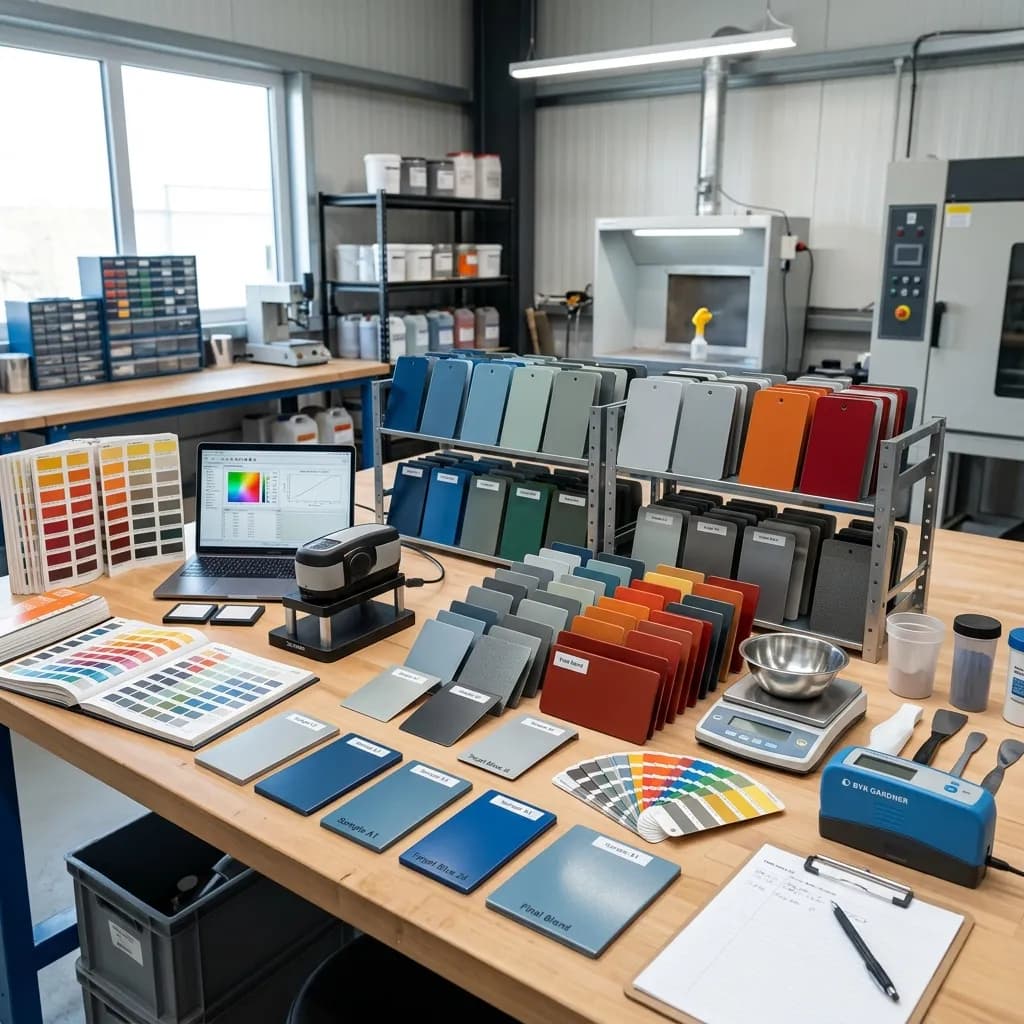
The most common reasons for custom color matching include brand color reproduction, where corporate identity colors must be precisely replicated on powder-coated surfaces; architectural color coordination, where powder-coated elements must match specific paint colors, natural materials, or other finishes used on the same project; heritage restoration, where existing historic colors must be replicated for conservation work; and design-driven specification, where architects or designers have selected specific colors from paint ranges, fabric samples, or other references that do not correspond to standard powder coating colors.
Ready to Start Your Project?
From one-off customs to 15,000-part production runs — get precise pricing in 24 hours.
On This Page
When and Why Custom Color Matching Is Needed
Custom color matching is also necessary when a project requires a color from a non-standard color system such as NCS, Pantone, or a manufacturer-specific reference. While these colors can often be approximated by standard RAL colors, an exact match requires custom formulation based on spectrophotometer measurement of the original reference.
The custom color matching process involves several stages: sample submission, spectrophotometer analysis, formulation development, sample production and approval, production batch manufacture, and ongoing quality control. Understanding each stage helps specifiers manage the process effectively and set realistic expectations for lead times, costs, and achievable accuracy.
Submitting Color Samples for Matching
The quality of the custom color match depends fundamentally on the quality of the color reference submitted to the powder manufacturer. A clear, accurate, and well-preserved color reference enables precise spectrophotometer measurement and efficient formulation development. A poor-quality reference leads to inaccurate matching, extended development time, and potential disputes about whether the delivered color meets the specification.
The ideal color reference for powder coating matching is a flat, smooth, opaque surface of at least 50mm by 50mm, in good condition without fading, scratching, or contamination. Painted metal panels, Pantone color chips, and existing powder-coated components all make excellent references. The reference should represent the exact color desired, not an approximation that requires verbal adjustment such as like this but slightly darker.
When submitting a paint color reference, provide the actual paint manufacturer's color chip or a freshly painted sample panel rather than a printed color card. Printed reproductions of paint colors are often inaccurate due to the limitations of the printing process. If the reference is a paint color, specify the paint manufacturer, product line, and color code so the powder manufacturer can cross-reference if needed.
For brand color matching, submit the official Pantone chip or an approved physical brand color standard. Include the Pantone number, the brand's color specification document if available, and any specific requirements for the acceptable color tolerance. If the brand color has been previously matched in powder coating by another manufacturer, providing a sample of that existing match can accelerate the process.
For heritage and restoration projects, submit a sample of the original finish in the best available condition. If the original finish has faded or deteriorated, indicate whether the match should replicate the current aged appearance or the estimated original color. Provide photographs and context about the original finish to help the powder manufacturer understand the target.
Avoid submitting color references that are textured, curved, translucent, or very small, as these characteristics make accurate spectrophotometer measurement difficult. If the only available reference has these limitations, discuss the constraints with the powder manufacturer before proceeding so that expectations for matching accuracy can be set appropriately.
Spectrophotometer Analysis and Color Measurement
Spectrophotometer analysis is the foundation of accurate custom color matching. A spectrophotometer measures the precise spectral reflectance of the color reference, quantifying the color in objective, mathematical terms that eliminate the subjectivity and variability of visual color assessment.
The spectrophotometer illuminates the sample surface with a controlled light source and measures the intensity of reflected light at each wavelength across the visible spectrum, typically from 400 to 700 nanometers. This spectral reflectance data is then converted into color coordinates in the CIE Lab* color space, where L* represents lightness, a* represents the red-green axis, and b* represents the yellow-blue axis. These three coordinates precisely define the color's position in color space.
The CIE Lab* color coordinates serve as the target for the powder formulation. The powder manufacturer's color matching software uses the target coordinates, along with a database of available pigments and their spectral properties, to calculate a pigment combination that will produce a powder coating matching the target color. This computational approach is far more efficient and accurate than the trial-and-error mixing that characterized color matching before spectrophotometer technology.
Multiple measurements are typically taken across the reference sample surface to assess color uniformity. If the reference shows significant color variation, the powder manufacturer will discuss with the specifier which area or average value should serve as the matching target. For references with intentional variation, such as natural materials or aged finishes, the specifier must define which specific tone within the variation range the powder coating should match.
The spectrophotometer also measures the gloss level of the reference, providing data that informs the gloss specification for the custom powder. However, the gloss of the reference and the gloss of the powder coating are specified independently, as the specifier may want a different gloss level on the powder-coated surface than exists on the reference sample.
Metamerism assessment is an important part of the spectrophotometer analysis. By measuring the reference under multiple illuminants, such as D65 daylight, illuminant A for incandescent light, and TL84 for fluorescent light, the spectrophotometer can predict whether the custom powder formulation will match the reference under all lighting conditions or only under specific illuminants. This information helps the powder manufacturer select pigments that minimize metamerism.
Formulation Development and Sample Production
Once the spectrophotometer analysis is complete, the powder manufacturer's color matching laboratory develops a custom formulation designed to achieve the target color within the specified tolerance. This process combines computational color matching with the practical expertise of experienced color technicians.
The color matching software proposes initial pigment combinations based on the target color coordinates and the available pigment database. The software considers not only the color properties of each pigment but also their compatibility with the resin system, their lightfastness and weathering stability, their heat stability during curing, and their cost. The software may propose several alternative formulations that achieve the same target color using different pigment combinations, allowing the manufacturer to select the formulation that best balances color accuracy, durability, and cost.
The proposed formulation is then produced as a small laboratory batch and applied to test panels for evaluation. The test panels are measured with a spectrophotometer to verify that the formulation achieves the target color within the specified tolerance. If the initial formulation does not meet the target, the color technician adjusts the pigment ratios and produces revised test panels. This iterative refinement process typically requires one to three rounds of adjustment to achieve an acceptable match.
Once the laboratory formulation meets the target color, sample panels are produced for the specifier's approval. These approval samples should be produced on the same substrate material as the production components, at the specified film thickness and gloss level, and cured under production-representative conditions. Samples produced under laboratory conditions may not exactly replicate production results, so it is important that the approval samples are as representative of production conditions as possible.
The approval samples are typically provided as flat panels of at least 100mm by 150mm, allowing evaluation under various lighting conditions and viewing angles. For metallic or textured formulations, larger samples and samples on representative component geometries may be necessary to evaluate the finish accurately.
The lead time for custom color development varies depending on the complexity of the color, the availability of suitable pigments, and the manufacturer's workload. Simple solid colors in standard resin systems can typically be developed within one to two weeks. Complex colors, metallics, and formulations requiring specialized pigments may require three to four weeks or longer.
The Approval Process: Evaluating and Accepting Custom Colors
The sample approval process is the critical quality gate that determines whether the custom color formulation meets the specifier's requirements. A rigorous, well-structured approval process prevents costly disputes and recoating later in the project.
Evaluate approval samples under the lighting conditions that will be present in the final installation. Colors can appear significantly different under daylight, warm LED, cool LED, fluorescent, and incandescent lighting due to metamerism. If the installation environment includes multiple light sources, evaluate the samples under each source to verify acceptable appearance across all conditions.
Compare the approval sample directly against the original color reference, placing them adjacent to each other on a neutral grey background. Evaluate the comparison at the viewing distance representative of the final installation. Colors that appear to match at arm's length may show visible differences at close range, and vice versa.
Use spectrophotometer measurements to supplement visual evaluation. Request the Delta E value between the approval sample and the original reference, calculated using the agreed method, either CIE76 or CIEDE2000. Verify that the Delta E value falls within the specified tolerance. For critical applications, also review the individual L*, a*, and b* differences to understand the nature of any color deviation, whether it is a lightness difference, a hue shift, or a saturation difference.
If the approval sample does not meet requirements, provide specific, objective feedback to the powder manufacturer. Rather than saying it is too dark or not quite right, describe the deviation in measurable terms: the L* value is 1.5 units too low, or the b* value needs to shift 0.8 units toward yellow. This objective feedback enables the manufacturer to make precise adjustments rather than guessing at the specifier's subjective impression.
Once approved, retain the approval sample panel as the project reference standard. This panel becomes the benchmark against which all production batches are measured. Store the reference panel in a dark, climate-controlled environment to prevent fading or degradation that would compromise its accuracy as a reference. Some specifiers request duplicate reference panels, retaining one and providing one to the powder manufacturer.
Batch Consistency and Production Quality Control
Maintaining color consistency across production batches is one of the most important aspects of custom color management. Even small variations between powder batches can produce visible color differences when components from different batches are installed adjacent to each other.
Powder manufacturers control batch consistency through rigorous raw material management, precise weighing and mixing procedures, and spectrophotometer verification of every production batch. Each batch of custom powder is measured against the approved reference standard, and only batches that fall within the specified Delta E tolerance are released for use.
The acceptable batch-to-batch tolerance should be defined in the specification. For standard commercial applications, Delta E less than 1.5 between any production batch and the approved reference is typical. For architectural applications where components will be viewed together, Delta E less than 1.0 is recommended. For critical brand color applications, Delta E less than 0.5 may be specified, though this tighter tolerance increases the risk of batch rejection and may affect lead times and costs.
For large projects that will consume multiple powder batches, consider specifying that all powder for the project is manufactured in a single production run. This eliminates batch-to-batch variation entirely, as all components receive powder from the same batch. The powder manufacturer can produce the required quantity in one run and store it for delivery as needed throughout the project duration.
If single-batch production is not practical, specify that the powder manufacturer must verify inter-batch consistency by measuring each new batch against both the approved reference standard and the previous production batch. This dual verification ensures that any color drift between batches is detected and corrected before the powder is shipped.
Retain samples from each production batch, labeled with the batch number and production date, as a project archive. These retained samples provide a traceable record of the color delivered at each stage of the project and can be used to investigate any color consistency concerns that arise during or after installation.
Delta E: Understanding Color Difference Measurement
Delta E is the standard metric for quantifying the difference between two colors, and understanding how to interpret and specify Delta E values is essential for effective custom color management in powder coating.
Delta E represents the Euclidean distance between two colors in the CIE Lab* color space. A Delta E of 0 means the two colors are identical. As the Delta E value increases, the perceived color difference increases. The relationship between Delta E values and visual perception provides a practical framework for setting color tolerances.
A Delta E of 0 to 0.5 is generally imperceptible to the human eye under normal viewing conditions. This level of precision is achievable but demanding, typically specified only for critical brand color applications. A Delta E of 0.5 to 1.0 is perceptible to a trained observer under controlled conditions but is generally acceptable for architectural applications where components are viewed together. A Delta E of 1.0 to 2.0 is noticeable to most observers under direct comparison but may be acceptable for components not viewed adjacent to each other. A Delta E above 2.0 is clearly visible and generally considered unacceptable for quality-controlled powder coating.
Two Delta E calculation methods are commonly used: CIE76 and CIEDE2000. CIE76 is the original and simpler calculation, computing the straight-line distance in Lab* space. CIEDE2000 incorporates corrections for the non-uniformity of human color perception, producing values that correlate more closely with visual assessment. CIEDE2000 values are typically lower than CIE76 values for the same color pair, so specifying which method is used is essential to avoid confusion.
When specifying Delta E tolerances, consider the viewing conditions and criticality of the color match. Components viewed side by side under bright lighting require tighter tolerances than those separated by distance. Always specify the illuminant and observer angle for calculations, with D65 illuminant and 10-degree observer being the standard for daylight viewing conditions.
Managing Custom Colors Across Multi-Site and Long-Duration Projects
Large-scale projects that span multiple manufacturing sites, multiple coating facilities, or extended time periods present additional challenges for custom color consistency. Managing these challenges requires a structured approach to color control that extends beyond the basic matching and approval process.
For multi-site projects where components are coated at different facilities, establish a single approved powder formulation that is supplied to all coating sites from the same powder manufacturer. This ensures that all sites receive identical powder, eliminating the variation that would result from independent color matching at each location. Provide each coating site with an approved reference panel from the same production batch for local quality verification.
For projects with extended durations, where powder may be manufactured in multiple batches over months or years, establish a formal color management protocol. This protocol should define the batch verification procedure, the acceptable Delta E tolerance, the reference panel storage and replacement schedule, and the escalation process for batches that fall outside tolerance. Assign a single point of responsibility for color quality management across the project duration.
Pigment availability can affect long-duration projects. Some pigments used in custom formulations may be discontinued, reformulated, or subject to supply disruptions over the course of a multi-year project. Discuss pigment stability and availability with the powder manufacturer at the outset, and consider specifying alternative pigment combinations that can be used if the primary pigments become unavailable.
Document the complete custom color specification in a color management plan that accompanies the project specification. This plan should include the approved color reference, the spectrophotometer measurement data, the Delta E tolerance, the approved powder formulation code, the reference panel identification, the batch verification procedure, and the contact details for the powder manufacturer's color laboratory. This documentation ensures that the color management process can be maintained consistently even if project personnel change during the course of the work.
For franchise and brand rollout projects where the same custom color will be used across dozens or hundreds of locations over many years, consider establishing a formal color standard with the powder manufacturer. This involves creating a permanent product code, maintaining a master reference standard, and implementing ongoing quality monitoring to ensure that the color remains consistent as raw materials and production conditions evolve over time.
Frequently Asked Questions
What should I submit for custom color matching?
Submit a flat, smooth, opaque color sample of at least 50mm by 50mm in good condition. Pantone chips, painted metal panels, and existing powder-coated components make excellent references. Avoid textured, curved, or very small samples. Include any relevant color codes and specify the desired gloss level separately.
How long does custom color matching take?
Simple solid colors in standard resin systems typically take one to two weeks for development and sample production. Complex colors, metallics, and formulations requiring specialized pigments may require three to four weeks or longer. Allow additional time for sample approval and production batch manufacture.
What Delta E tolerance should I specify?
For standard commercial work, Delta E less than 1.5 is typical. For architectural applications with adjacent components, Delta E less than 1.0 is recommended. For critical brand colors, Delta E less than 0.5 may be specified. Always state the calculation method, either CIE76 or CIEDE2000, as values differ between methods.
How is batch-to-batch color consistency maintained?
Powder manufacturers verify each production batch against the approved reference using spectrophotometer measurement. Only batches within the specified Delta E tolerance are released. For maximum consistency, specify that all powder for a project is manufactured in a single production run.
Can any color be matched in powder coating?
Most colors can be closely matched, but some limitations exist. Very vivid, highly saturated colors may not be achievable with available powder coating pigments. Metallic and pearlescent effects from other media may not translate exactly. The powder manufacturer will advise on achievable accuracy during the matching process.
What is metamerism and why does it matter for custom colors?
Metamerism occurs when two colors appear to match under one light source but differ under another. It happens because different pigment combinations can produce the same color coordinates under specific lighting but diverge under different illumination. Evaluate custom color matches under all lighting conditions present in the installation environment.
Ready to Start Your Project?
From one-off customs to 15,000-part production runs — get precise pricing in 24 hours.