Curing is the transformative step in the powder coating process — the moment when a loose layer of dry powder particles becomes a continuous, durable, chemically resistant film permanently bonded to the substrate. Understanding the chemistry of curing is essential for achieving optimal coating performance and troubleshooting cure-related defects.
Technical
Powder Coating Curing Chemistry Explained: Crosslinking, Thermoset Networks, and Degree of Cure
Sundial Powder Coating·April 23, 2026·12 min
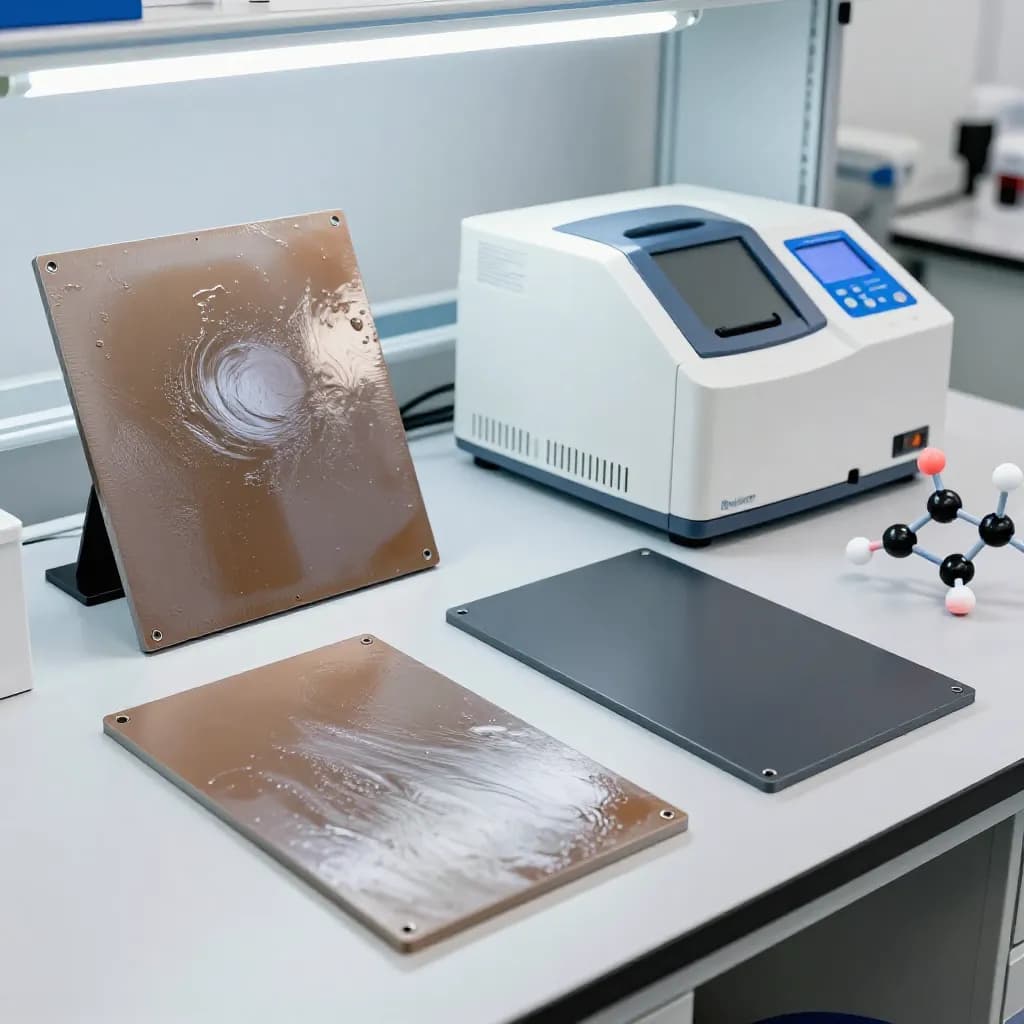
When a powder-coated part enters the curing oven, the powder particles first undergo a physical transformation: they melt. As the temperature rises above the powder's glass transition temperature (Tg) and melting point, the individual particles soften, flow together, and coalesce into a continuous liquid film. This melt-flow phase is critical for achieving a smooth, uniform coating surface. The viscosity of the molten powder decreases as temperature increases, allowing the material to level and eliminate the boundaries between individual particles.
Ready to Start Your Project?
From one-off customs to 15,000-part production runs — get precise pricing in 24 hours.
On This Page
What Happens When Powder Coating Cures
Simultaneously with or shortly after the melt-flow phase, the chemical curing reaction begins. In thermoset powder coatings — which account for the vast majority of commercial powder coatings — the resin and crosslinking agent undergo irreversible chemical reactions that create covalent bonds between polymer chains. These crosslinks connect the linear or branched polymer molecules into a three-dimensional network structure that cannot be re-melted or dissolved.
The competition between melt-flow and crosslinking is a fundamental aspect of powder coating cure. The powder must achieve sufficient flow and leveling before the crosslinking reaction advances far enough to increase viscosity and freeze the film surface. If crosslinking begins too early or proceeds too rapidly, the coating may have poor flow, orange peel texture, or visible particle boundaries. If crosslinking is too slow, the coating may sag on vertical surfaces before it gels. Powder coating formulators carefully balance resin reactivity, crosslinker type, and catalyst levels to optimize this flow-then-cure sequence.
Crosslinking Reactions in Common Powder Systems
Different powder coating resin systems use different crosslinking chemistries, each with distinct reaction mechanisms, temperature requirements, and performance characteristics. Understanding these reactions helps explain why different powder types behave differently during cure and in service.
Polyester-TGIC systems use the reaction between carboxyl groups on the polyester resin and the epoxy groups of triglycidylisocyanurate (TGIC). This reaction proceeds through nucleophilic ring-opening of the epoxy groups by the carboxyl groups, forming ester linkages and hydroxyl groups. The reaction typically requires temperatures of 180-200°C and produces coatings with excellent weathering resistance, making polyester-TGIC the workhorse chemistry for architectural and exterior applications.
Polyester-HAA systems replace TGIC with hydroxyalkylamide (HAA) crosslinkers, which react with the carboxyl groups of the polyester resin through a condensation reaction that releases water as a byproduct. This water release can cause pinholing defects if the coating is cured too rapidly, as water vapor trapped in the film creates bubbles. HAA-crosslinked polyesters offer similar weathering performance to TGIC systems and are preferred in regions where TGIC is restricted due to its classification as a mutagen.
Epoxy systems use dicyandiamide (DICY) or phenolic crosslinkers that react with the epoxy groups of bisphenol-A based epoxy resins. The DICY-epoxy reaction produces coatings with outstanding chemical resistance, adhesion, and mechanical properties, but poor UV resistance that limits them to interior or under-body applications. Phenolic-crosslinked epoxies offer improved flexibility and are used in functional protective coatings.
Polyester-epoxy hybrid systems combine polyester and epoxy resins that crosslink with each other through the reaction of carboxyl groups on the polyester with epoxy groups on the epoxy resin. These hybrids offer a balance of properties intermediate between pure polyester and pure epoxy systems — good chemical resistance from the epoxy component and reasonable weathering resistance from the polyester component.
Polyurethane powder coatings use blocked isocyanate crosslinkers that release the blocking agent (typically caprolactam) at elevated temperatures, freeing the isocyanate groups to react with hydroxyl groups on the polyester or acrylic resin. This reaction forms urethane linkages that provide excellent chemical resistance, flexibility, and surface smoothness.
Thermoset Network Formation
The crosslinking reactions described above create a thermoset polymer network — a three-dimensional structure of interconnected polymer chains that gives cured powder coatings their characteristic hardness, chemical resistance, and thermal stability. Understanding network formation is key to understanding how cure conditions affect coating properties.
At the molecular level, network formation begins when the first crosslinks form between resin and hardener molecules. Initially, these crosslinks connect pairs of polymer chains into larger branched structures. As the reaction progresses, these branched structures grow and begin to interconnect, forming an increasingly dense network. At a critical point called the gel point, the network becomes continuous — spanning the entire coating film — and the material transitions from a viscous liquid to an elastic solid.
The gel point is a pivotal moment in the curing process. Before gelation, the coating can still flow and level; after gelation, the network structure prevents further flow. Any surface defects present at the gel point — orange peel, craters, particle boundaries — become permanently frozen into the coating. This is why the timing of gelation relative to the melt-flow phase is so critical for coating appearance.
After gelation, the crosslinking reaction continues, increasing the crosslink density of the network. Crosslink density — the number of crosslinks per unit volume of polymer — is the primary determinant of the cured coating's mechanical and chemical properties. Higher crosslink density produces harder, more chemically resistant, but more brittle coatings. Lower crosslink density produces softer, more flexible, but less chemically resistant films.
The relationship between crosslink density and properties follows predictable patterns. As crosslink density increases, the glass transition temperature (Tg) of the cured coating rises, reflecting the reduced mobility of the polymer chains. Solvent resistance improves because the tight network structure prevents solvent molecules from penetrating and swelling the polymer. Hardness increases as the rigid network resists deformation. But impact resistance and flexibility decrease as the network becomes too rigid to absorb mechanical energy without cracking.
Optimal coating performance requires a crosslink density that balances these competing property requirements. This balance is achieved through careful formulation — selecting the right resin molecular weight, functionality, and crosslinker ratio — and through proper cure conditions that allow the crosslinking reaction to reach the intended degree of completion.
Differential Scanning Calorimetry (DSC) Analysis
Differential scanning calorimetry (DSC) is the primary analytical technique used to characterize the curing behavior of powder coatings. DSC measures the heat flow into or out of a small powder sample as it is heated at a controlled rate, providing detailed information about the thermal transitions and chemical reactions that occur during curing.
A typical DSC scan of an uncured powder coating reveals several characteristic features. First, a step change in the baseline indicates the glass transition temperature (Tg) of the uncured powder — the temperature at which the amorphous polymer transitions from a glassy to a rubbery state. For most commercial powder coatings, the uncured Tg falls between 40°C and 65°C. This Tg determines the powder's storage stability; powders with low Tg values are more prone to sintering and caking during storage.
As the temperature continues to rise, the DSC trace shows an endothermic (heat-absorbing) event corresponding to the melting of any crystalline components in the powder. This is followed by the main feature of interest: a large exothermic (heat-releasing) peak that represents the crosslinking reaction. The onset temperature, peak temperature, and total heat of this exotherm provide quantitative information about the reactivity and cure characteristics of the powder.
The onset temperature indicates when the crosslinking reaction begins to proceed at a significant rate — typically 140-170°C for most commercial powder coatings. The peak temperature corresponds to the maximum reaction rate, usually 180-220°C. The total area under the exothermic peak, measured in joules per gram (J/g), represents the total heat of reaction — the energy released by the complete crosslinking reaction. This value is characteristic of the specific resin-crosslinker system and serves as a reference for assessing degree of cure.
To assess the degree of cure of a coated part, a small sample of the cured coating is removed and subjected to a second DSC scan. If the coating is fully cured, no residual exothermic peak will be observed — all available crosslinking reactions have been completed. If the coating is under-cured, a residual exotherm will appear, and its area relative to the total heat of reaction of the uncured powder indicates the percentage of unreacted crosslinking sites. This residual cure method provides a quantitative measure of degree of cure that is widely used in quality control and troubleshooting.
Degree of Cure and Its Impact on Performance
The degree of cure — the fraction of available crosslinking reactions that have been completed — is one of the most important quality parameters for a powder-coated product. Under-cured coatings have insufficient crosslink density and exhibit compromised properties. Over-cured coatings have degraded polymer chains and also show reduced performance. Achieving the optimal degree of cure requires precise control of oven temperature and residence time.
Under-curing occurs when the coating does not reach sufficient temperature for sufficient time to complete the crosslinking reaction. The consequences are significant and wide-ranging. Under-cured coatings have reduced hardness, making them more susceptible to scratching and abrasion. Chemical resistance is compromised because the incomplete network allows solvents and chemicals to penetrate the film. Adhesion may be reduced because the coating has not developed its full bonding strength to the substrate. And weathering resistance suffers because the incomplete network is more vulnerable to UV degradation and hydrolysis.
The visual appearance of an under-cured coating may be deceptively normal — the powder has melted and flowed into a smooth film that looks fully cured to the naked eye. This is why degree of cure cannot be assessed by visual inspection alone and requires analytical methods such as DSC, solvent rub testing (MEK double rubs), or hardness testing to detect.
Over-curing occurs when the coating is exposed to excessive temperature or time, causing thermal degradation of the polymer network. The consequences include yellowing or discoloration (particularly in light colors), reduced gloss, embrittlement, and loss of flexibility. In severe cases, over-curing can cause delamination as the degraded coating loses adhesion to the substrate.
The cure window — the range of temperature-time combinations that produce acceptable degree of cure — varies by powder formulation. Standard powder coatings typically specify cure schedules such as 200°C for 10 minutes or 180°C for 15 minutes, measured as metal temperature (the actual temperature of the substrate, not the oven air temperature). The distinction between metal temperature and oven air temperature is critical, as heavy parts may take significantly longer to reach the target metal temperature than the oven air.
Modern low-temperature cure powder coatings have expanded the cure window downward, with formulations available that cure at 140-160°C metal temperature. These formulations use more reactive resin-crosslinker systems or catalysts that accelerate the crosslinking reaction at lower temperatures.
Cure Schedule Optimization and Monitoring
Optimizing the cure schedule for a powder coating operation requires balancing multiple factors: achieving complete cure, maintaining coating appearance, maximizing production throughput, and minimizing energy consumption. This optimization is both a science and a practical engineering challenge.
Oven temperature profiling is the foundation of cure schedule optimization. Temperature data loggers — small devices equipped with multiple thermocouples — are attached to representative parts and passed through the curing oven. The thermocouples record the actual metal temperature of the part at multiple locations throughout the oven transit, producing a temperature-versus-time profile that reveals how quickly the part heats up, the peak metal temperature achieved, and the total time at or above the minimum cure temperature.
The temperature profile is then compared to the powder manufacturer's specified cure schedule to verify that the part receives adequate cure. For a powder specified at 200°C for 10 minutes, the profile must show that the coldest point on the part reaches at least 200°C and maintains that temperature for at least 10 minutes. If the profile shows insufficient temperature or time, the oven settings or line speed must be adjusted.
Different parts on the same production line may have very different thermal profiles due to variations in mass, thickness, and geometry. Heavy, thick parts heat up slowly and may require longer oven residence times, while thin, lightweight parts heat quickly and may be at risk of over-cure if the oven is set for the heaviest parts. Managing this variation requires careful production scheduling, oven zone temperature adjustment, or the use of different line speeds for different part types.
Real-time cure monitoring systems are becoming increasingly common in advanced powder coating operations. These systems use infrared sensors, pyrometers, or embedded thermocouples to continuously monitor part temperatures during curing, providing immediate feedback on cure adequacy. Some systems integrate with oven controls to automatically adjust temperatures or conveyor speeds in response to changing part loads or ambient conditions.
The economic impact of cure optimization is substantial. Reducing oven temperature by 10-20°C through the use of low-temperature cure powders or optimized oven profiles can reduce energy consumption by 10-15%. Increasing line speed by even a small percentage through precise cure schedule optimization directly increases production capacity without capital investment.
Advanced Curing Technologies and Future Directions
While conventional convection oven curing remains the dominant method for powder coating, several advanced curing technologies offer advantages for specific applications and point toward the future direction of powder coating cure technology.
Infrared (IR) curing uses electromagnetic radiation in the infrared spectrum to heat the coating and substrate directly, rather than heating the surrounding air as in convection ovens. IR curing is significantly faster than convection because the radiant energy is absorbed directly by the coating surface, initiating the cure reaction almost immediately. Short-wave and medium-wave IR systems can cure powder coatings in 30-90 seconds, compared to 10-20 minutes for convection curing. However, IR curing is most effective on flat or simple geometries where all surfaces receive uniform radiation exposure.
Near-infrared (NIR) curing takes this concept further, using very short wavelength infrared radiation that penetrates deeper into the coating and substrate. NIR systems can cure powder coatings in as little as 10-30 seconds, enabling inline coating of continuous substrates such as coil, strip, and extrusion at production line speeds. The extremely short cure times also minimize the thermal exposure of the substrate, making NIR curing suitable for heat-sensitive materials.
UV-curable powder coatings represent a fundamentally different approach to curing. These formulations use photoinitiators that generate reactive species when exposed to ultraviolet light, triggering a rapid crosslinking reaction at ambient or low temperatures. UV cure eliminates the need for thermal energy entirely, potentially enabling powder coating of plastics, wood, and other heat-sensitive substrates that cannot withstand conventional oven temperatures.
UV-curable powder technology has been under development for over two decades, with gradual improvements in formulation chemistry, photoinitiator efficiency, and UV lamp technology bringing it closer to broad commercial viability. Current UV-cure powder systems typically require a brief thermal step to melt and flow the powder before UV exposure initiates crosslinking. Fully ambient-cure UV powder systems remain an active area of research.
Induction curing, which uses electromagnetic induction to heat the metal substrate directly from within, is another emerging technology. Induction curing is extremely fast and energy-efficient because it heats only the substrate and coating, not the surrounding air or oven structure. It is particularly well-suited to curing powder coatings on small metal parts and continuous metal substrates.
Frequently Asked Questions
What is crosslinking in powder coating?
Crosslinking is the chemical reaction during curing where resin and hardener molecules form covalent bonds, creating a three-dimensional polymer network. This network gives the cured coating its hardness, chemical resistance, and durability. The reaction is irreversible — once crosslinked, thermoset powder coatings cannot be re-melted.
How is degree of cure measured in powder coatings?
Degree of cure is primarily measured using differential scanning calorimetry (DSC), which detects residual unreacted crosslinking sites as an exothermic peak. Practical methods include MEK solvent rub testing (counting double rubs to coating failure) and hardness testing. Visual inspection alone cannot reliably detect under-cure.
What happens if powder coating is under-cured?
Under-cured powder coatings have reduced hardness, chemical resistance, adhesion, and weathering durability due to incomplete crosslink network formation. The coating may look normal visually but will fail prematurely in service. Under-cure is caused by insufficient oven temperature, inadequate residence time, or both.
What is the typical cure temperature for powder coating?
Standard powder coatings typically cure at 180-200°C metal temperature for 10-15 minutes. Low-temperature cure formulations are available that cure at 140-160°C. The cure schedule refers to actual metal temperature, not oven air temperature — heavy parts may take significantly longer to reach target temperature.
What is UV-curable powder coating?
UV-curable powder coatings use photoinitiators that trigger crosslinking when exposed to ultraviolet light, potentially eliminating the need for high-temperature thermal curing. This technology could enable powder coating of heat-sensitive substrates like plastics and wood. Current systems typically require a brief thermal melt step before UV exposure.
Ready to Start Your Project?
From one-off customs to 15,000-part production runs — get precise pricing in 24 hours.