Conveyor systems form the backbone of any automated powder coating line, transporting parts through pretreatment, drying, powder application, and curing stages in a continuous, controlled flow. The choice of conveyor type directly impacts production throughput, finish quality, energy efficiency, and labor requirements. A poorly designed conveyor system creates bottlenecks, causes finish defects from contamination or improper orientation, and limits the flexibility of the entire coating operation.
Technical
Powder Coating Conveyor Systems: Complete Guide to Overhead, Floor, and Power-and-Free Designs
Sundial Powder Coating·April 23, 2026·14 min
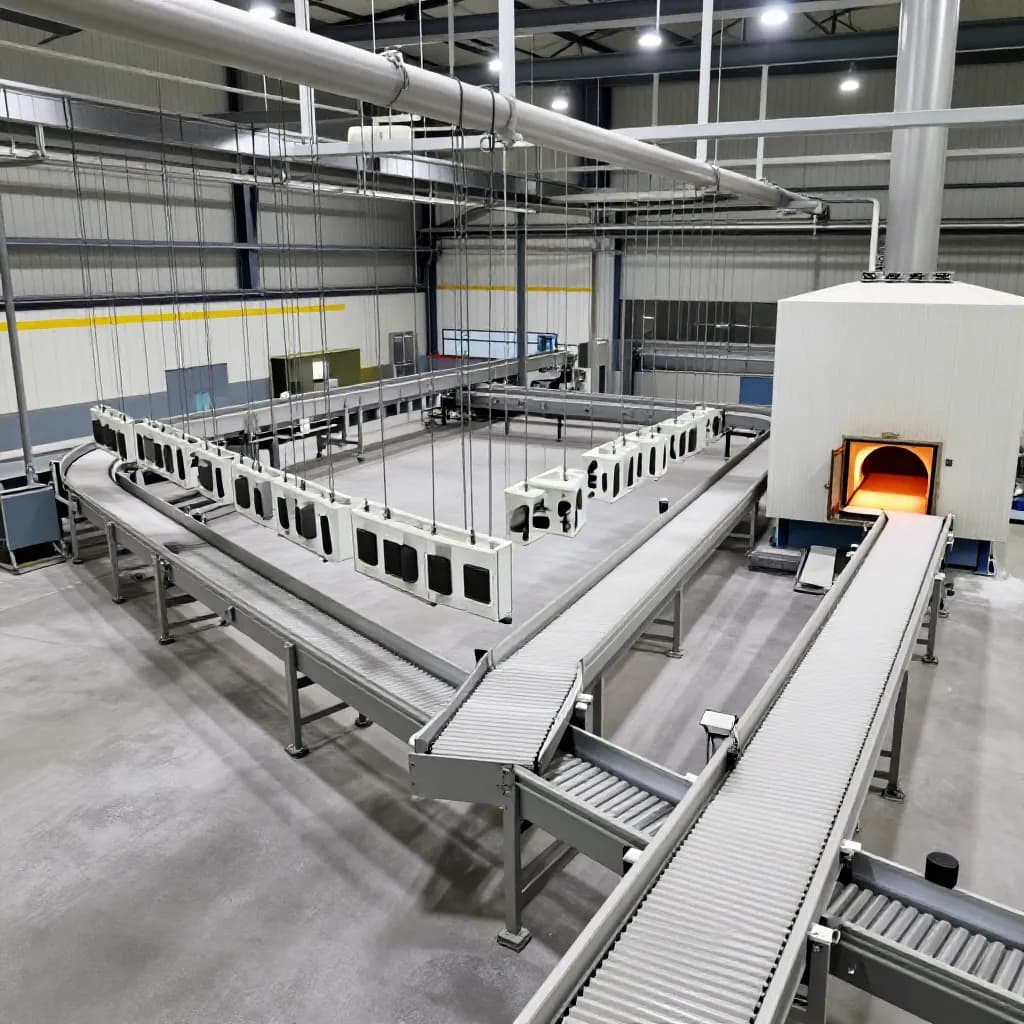
Modern powder coating conveyors must satisfy multiple competing demands. They must move parts at speeds compatible with each process stage — slower through spray booths for adequate coverage, faster through transfer zones to maintain throughput. They must support the weight and geometry of the parts being coated while minimizing the masking of surfaces that need coating. They must also withstand the thermal environment of cure ovens, which typically operate at 180–200°C for thermoset powders.
Ready to Start Your Project?
From one-off customs to 15,000-part production runs — get precise pricing in 24 hours.
On This Page
The Role of Conveyor Systems in Powder Coating Operations
Conveyor selection begins with a thorough analysis of the parts to be coated: their weight, dimensions, geometry, required production rate, and the number of color changes per shift. These parameters determine not only the conveyor type but also the chain specification, carrier design, line speed, and overall layout. Industry standards such as CEMA (Conveyor Equipment Manufacturers Association) guidelines and OSHA safety requirements govern the mechanical design, guarding, and maintenance access for all conveyor types used in finishing operations.
Overhead Monorail Conveyors: Simple and Reliable
The overhead monorail conveyor is the most common conveyor type in powder coating facilities. It consists of a single enclosed track mounted at ceiling height, with a continuous chain carrying load bars or hooks from which parts are suspended. The entire chain moves at a constant speed, meaning every part spends the same amount of time in each process zone. This simplicity makes monorail systems reliable, easy to maintain, and cost-effective for operations that run a consistent product mix.
Monorail conveyors are typically designed to CEMA Class II or Class III standards, with chain pull capacities ranging from 500 to 5,000 pounds depending on the application. The enclosed track protects the chain and trolleys from powder overspray and pretreatment chemicals, extending service life and reducing contamination risk. Standard track sections include straights, horizontal curves, vertical curves (inclines and declines), and take-up sections that compensate for chain stretch and thermal expansion.
The primary limitation of monorail systems is their fixed speed. Because the chain moves at a single velocity, the line speed must be set to accommodate the slowest process stage — typically the cure oven. This means parts may move faster than ideal through the spray booth or slower than necessary through transfer zones. For operations with a single product type and consistent production volume, this trade-off is acceptable. However, facilities that handle diverse part sizes or require frequent color changes often find monorail systems too inflexible, leading them to consider power-and-free alternatives.
Power-and-Free Conveyor Systems: Maximum Flexibility
Power-and-free conveyors represent the most versatile conveyor technology for powder coating operations. The system uses two tracks: an upper power track carrying a continuously moving chain, and a lower free track on which individual carriers (trolleys) ride independently. Mechanical dogs on the power chain engage and disengage with the free carriers, allowing individual parts or groups of parts to be stopped, accumulated, switched between spurs, and released independently of the main chain movement.
This independence between the power chain and the free carriers provides enormous operational flexibility. Parts can be accumulated in buffer zones before the spray booth, allowing color batching to minimize changeover waste. Individual carriers can be diverted to different cure ovens based on the powder chemistry being applied. Parts requiring longer cure times can be held in the oven while other carriers continue through the system. Multiple line speeds can effectively coexist within a single conveyor layout.
Power-and-free systems are designed per CEMA standards with typical chain speeds of 10–40 feet per minute on the power track. The free track supports carrier weights from 100 to 2,000 pounds per trolley, depending on the system class. Key components include engagement dogs, anti-runaway devices on inclines, switching mechanisms at divert points, and accumulation zones with proximity sensors that prevent carrier collisions. While power-and-free systems carry higher initial capital and maintenance costs than monorail systems, they deliver superior throughput flexibility and are the standard choice for high-volume, multi-product powder coating operations serving automotive, appliance, and general industrial markets.
Inverted Conveyors and Floor-Level Systems
Inverted conveyors mount the track and chain below the parts rather than above them. Parts are carried on fixtures attached to trolleys that ride on a track positioned at or near floor level, with the parts extending upward. This configuration eliminates the overhead structure and reduces building height requirements, making inverted conveyors attractive for facilities with limited ceiling clearance or for retrofit installations where overhead structural steel is insufficient to support a conventional overhead system.
Inverted conveyors offer a significant advantage in contamination control. Because the chain and track are below the parts, lubricant drips and wear debris fall away from the coated surfaces rather than onto them. This is particularly important for high-quality automotive and appliance finishes where even microscopic contamination causes visible defects. The inverted orientation also simplifies part loading and unloading, as operators work at a comfortable ergonomic height rather than reaching overhead.
Floor-level conveyor systems, including skid conveyors, belt conveyors, and chain-on-edge systems, transport parts horizontally through the coating process. These systems are commonly used for large, heavy parts such as structural steel, agricultural equipment frames, and industrial enclosures that are difficult to suspend from overhead hooks. Floor conveyors can handle part weights exceeding 10,000 pounds per carrier, far beyond the capacity of most overhead systems. The trade-off is that floor conveyors occupy more floor space, may require parts to be rotated or repositioned between process stages for complete coverage, and can be more difficult to integrate with enclosed spray booths and ovens. Chain-on-edge conveyors, which carry parts on fixtures attached to a chain running in a floor-mounted track, offer a compromise between floor and overhead systems for medium-weight parts.
Chain Types, Specifications, and Selection Criteria
The conveyor chain is the most critical wear component in any powder coating system, and its selection directly affects reliability, maintenance intervals, and operating costs. The three primary chain types used in finishing conveyors are rivetless chain, roller chain, and enclosed track chain, each suited to different load and environmental conditions.
Rivetless chain, also called drop-forged chain, is the workhorse of overhead monorail and power-and-free systems. It consists of interlocking forged steel links that assemble without rivets or pins, allowing easy field repair by adding or removing individual links. Standard rivetless chain is available in X-348, X-458, and X-678 sizes, with ultimate tensile strengths ranging from 3,400 to 16,000 pounds. The X-458 size is the most common for powder coating conveyors, offering a good balance of strength, weight, and cost for typical part loads.
Roller chain, conforming to ANSI standards, is used in some floor conveyor and transfer applications where smooth, low-friction operation is required. Roller chain provides more precise positioning than rivetless chain but is more susceptible to contamination from powder overspray and pretreatment chemicals. Enclosed track chain runs inside a tubular or C-channel track that protects the chain from environmental exposure, making it ideal for harsh pretreatment and oven environments. Chain selection must account for the maximum working load, the operating temperature (standard carbon steel chains are rated to approximately 230°C, while high-temperature alloys extend this to 370°C), the chemical environment, and the required lubrication interval. Proper chain lubrication with high-temperature, non-contaminating lubricants is essential — chain failure is the leading cause of unplanned downtime in powder coating conveyor systems.
Conveyor Layout Design and Line Speed Calculations
Designing a conveyor layout for a powder coating line requires balancing production throughput requirements against the process time needed at each stage. The fundamental calculation begins with the required production rate in parts per hour, the part spacing (center-to-center distance on the conveyor), and the process dwell times for pretreatment, dry-off, powder application, and curing.
Line speed is calculated by dividing the required parts per hour by the number of parts per foot of conveyor, yielding the necessary chain speed in feet per minute. For example, a production requirement of 300 parts per hour with parts spaced at 2-foot centers requires a line speed of 10 feet per minute. The cure oven length is then determined by multiplying the line speed by the required cure dwell time — at 10 FPM with a 20-minute cure, the oven must be 200 feet of conveyor length.
Layout design must also account for elevation changes between process stages, the turning radius of horizontal and vertical curves (which affects the minimum aisle width and ceiling height), and the location of load and unload stations relative to the spray booth and oven. Accumulation zones in power-and-free systems require additional conveyor length — typically 1.5 to 2 times the batch size — to buffer parts between process stages. The conveyor drive unit must be sized to handle the total chain pull, which includes the weight of the chain, carriers, and parts, plus friction losses at curves, inclines, and take-up sections. Drive motors are typically specified at 150–200% of the calculated steady-state chain pull to accommodate startup loads and minor chain binding.
Maintenance, Lubrication, and Chain Wear Monitoring
Conveyor maintenance is the single most important factor in preventing unplanned downtime in a powder coating operation. A structured preventive maintenance program should include daily visual inspections of chain condition, trolley wheels, and track wear; weekly lubrication of chain and trolley bearings; monthly measurement of chain elongation; and quarterly inspection of drives, take-ups, curves, and switches.
Chain elongation is the primary indicator of chain wear and the most reliable predictor of remaining service life. New rivetless chain has a nominal pitch (link-to-link distance) that increases as the bearing surfaces wear. Industry practice is to replace the chain when elongation reaches 3% of the original pitch, as elongation beyond this point accelerates rapidly and increases the risk of chain failure. Chain elongation is measured using a calibrated chain gauge or by measuring a fixed number of links and comparing to the nominal length.
Lubrication is critical for chain longevity but must be carefully managed in powder coating environments. Excess lubricant can drip onto parts and cause coating defects — fisheyes, craters, and adhesion failures. High-temperature dry-film lubricants and automatic lubrication systems that deliver precise, metered amounts of lubricant to each chain link are the standard solution. These systems reduce lubricant consumption by 60–80% compared to manual lubrication while providing more consistent chain protection. Track wear, trolley wheel condition, and drive chain tension should be monitored on a regular schedule, with replacement parts kept in inventory to minimize downtime when components reach their service limits.
Emerging Conveyor Technologies and Smart Monitoring
The powder coating industry is increasingly adopting smart conveyor technologies that improve reliability, reduce maintenance costs, and enable real-time production optimization. IoT-enabled conveyor monitoring systems use sensors mounted on the chain, track, and drive units to continuously measure chain tension, vibration, temperature, and elongation. This data is transmitted wirelessly to a central monitoring platform that tracks trends, predicts maintenance needs, and alerts operators before failures occur.
Predictive maintenance based on conveyor sensor data can reduce unplanned downtime by 40–60% compared to traditional time-based maintenance schedules. By replacing components based on actual condition rather than fixed intervals, facilities also reduce spare parts inventory and maintenance labor costs. Some advanced systems integrate conveyor data with production scheduling software, automatically adjusting line speed and carrier routing to optimize throughput based on real-time demand.
Friction-drive conveyors represent another emerging technology, using powered wheels or belts to propel carriers along the track rather than a continuous chain. These systems eliminate chain wear entirely, reduce energy consumption, and allow individual carrier speed control — each carrier can move at a different speed through different process zones. While friction-drive systems are more common in automotive assembly than in powder coating today, their advantages in flexibility and maintenance reduction are driving adoption in high-volume finishing operations. As powder coating lines become more automated and data-driven, conveyor systems will continue to evolve from simple mechanical transport into intelligent, adaptive material handling platforms.
Frequently Asked Questions
What is the difference between a monorail and a power-and-free conveyor?
A monorail conveyor uses a single track with a continuous chain that moves all parts at the same speed. A power-and-free conveyor has two tracks — a powered chain track and an independent free track — allowing individual carriers to stop, accumulate, and divert independently. Power-and-free systems offer much greater flexibility for color changes and mixed production.
How fast do powder coating conveyors typically run?
Powder coating conveyor line speeds typically range from 5 to 30 feet per minute, depending on the production rate, part spacing, and cure oven length. The speed is calculated based on the required parts per hour and the dwell time needed in each process zone, particularly the cure oven.
When should chain be replaced on a powder coating conveyor?
Conveyor chain should be replaced when elongation reaches 3% of the original pitch. Beyond this point, wear accelerates rapidly and the risk of chain failure increases significantly. Regular measurement with a calibrated chain gauge is the standard method for monitoring chain condition.
What chain type is most common for powder coating conveyors?
X-458 rivetless (drop-forged) chain is the most common type for overhead powder coating conveyors. It offers a good balance of tensile strength (approximately 6,200 pounds ultimate), weight, ease of field repair, and cost for typical part loads encountered in finishing operations.
Can conveyor lubricant contaminate powder-coated parts?
Yes. Excess chain lubricant can drip onto parts and cause coating defects including fisheyes, craters, and adhesion failures. High-temperature dry-film lubricants and automatic metered lubrication systems are used to minimize this risk while maintaining adequate chain protection.
Ready to Start Your Project?
From one-off customs to 15,000-part production runs — get precise pricing in 24 hours.