Compressed air is the lifeblood of a powder coating operation, used for powder fluidization, powder transport, spray gun atomization, booth air supply, and general plant utilities. The quality of this compressed air — its cleanliness, dryness, and freedom from oil contamination — directly determines coating quality. Contaminated compressed air is the single most common cause of powder coating defects including fisheyes, craters, pinholes, poor adhesion, and inconsistent film build.
Technical
Powder Coating Compressed Air Requirements: CFM, Pressure, Dew Point, and System Sizing
Sundial Powder Coating·April 23, 2026·13 min
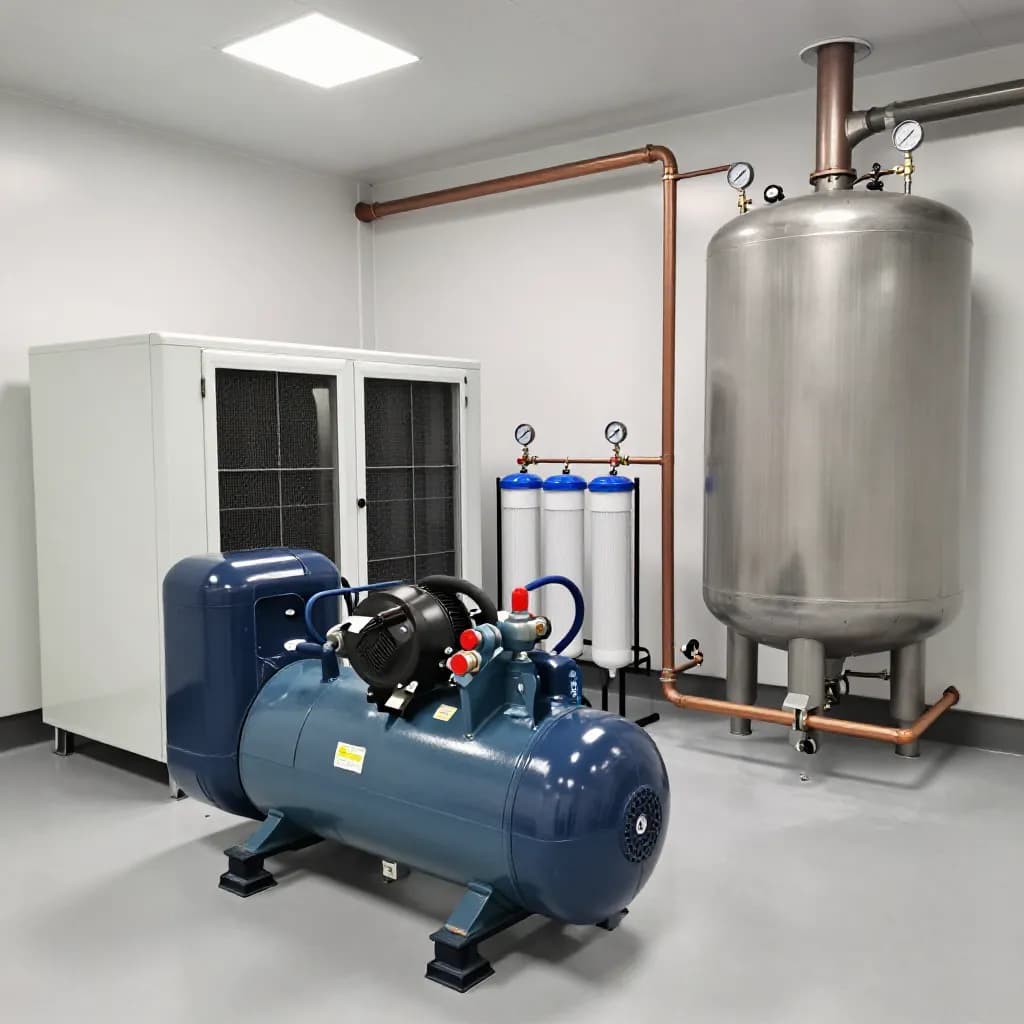
The problem is that standard industrial compressed air is far from clean. Atmospheric air drawn into a compressor contains moisture, oil vapor, particulate matter, and microorganisms. The compression process concentrates these contaminants and adds compressor lubricant oil in the form of aerosol and vapor. A typical lubricated rotary screw compressor operating at 7 bar produces compressed air containing 2–50 mg/m³ of oil, saturated with water vapor, and carrying particulate from the compressor and piping system. Without proper treatment, this contaminated air will ruin powder coating quality.
Ready to Start Your Project?
From one-off customs to 15,000-part production runs — get precise pricing in 24 hours.
On This Page
Why Compressed Air Quality Is Critical for Powder Coating
The compressed air quality required for powder coating is defined by ISO 8573-1, the international standard for compressed air purity. For powder coating applications, the minimum recommended quality class is 1.2.1 — Class 1 for particulate (maximum 0.1 mg/m³), Class 2 for moisture (pressure dew point of -40°C), and Class 1 for oil (maximum 0.01 mg/m³ total oil including vapor). Achieving this quality requires a properly designed air treatment system downstream of the compressor.
CFM Requirements and System Sizing
Sizing a compressed air system for a powder coating operation begins with calculating the total air demand in cubic feet per minute (CFM) at the required pressure. Each piece of equipment in the coating line has a specific air consumption rate that must be accounted for in the system design.
Spray guns are the primary air consumers in the powder application area. Each manual spray gun typically requires 5–10 CFM at 6–7 bar (85–100 psi), while automatic guns require 8–15 CFM depending on the gun type and powder feed system. A typical automatic spray booth with 12 guns consumes 96–180 CFM for gun operation alone. Powder feed systems — hoppers, fluidized beds, and venturi or dense-phase pumps — add another 5–15 CFM per feed point. Booth air supply for blow-off stations, air knives, and pneumatic actuators can add 20–50 CFM.
Beyond the spray booth, compressed air is used for pretreatment blow-off (10–30 CFM per nozzle), part cleaning stations (15–40 CFM), pneumatic tools and actuators throughout the facility (variable), and general plant air. The total demand should be calculated by summing all individual consumers and applying a diversity factor of 0.7–0.85 (not all equipment operates simultaneously) plus a 20–25% safety margin for future expansion and peak demand events. The compressor must be sized to deliver this total CFM at the required pressure, with the compressor output rated at the actual operating pressure rather than the free air delivery (FAD) rating, which is measured at atmospheric pressure.
Pressure Requirements and Regulation
Powder coating equipment operates at relatively low pressures compared to many industrial applications, but pressure stability is critical for consistent coating quality. Spray guns require 3–7 bar (45–100 psi) at the gun inlet, with atomizing air, pattern air, and powder transport air each requiring independent pressure regulation. Pressure fluctuations of even 0.3–0.5 bar can cause visible changes in spray pattern width, powder flow rate, and film thickness uniformity.
The compressed air system should be designed to maintain stable pressure at the point of use despite varying demand from other equipment on the same supply. This requires adequate compressor capacity, properly sized distribution piping, and dedicated pressure regulators at each point of use. The system operating pressure should be set 1.5–2.0 bar above the highest point-of-use requirement to account for pressure drops through filters, dryers, piping, and fittings. For a spray gun requiring 7 bar at the inlet, the system should operate at 8.5–9.0 bar.
Pressure drop through the distribution system must be minimized through proper piping design. The total pressure drop from the compressor discharge to the farthest point of use should not exceed 1.0 bar, with individual components contributing as follows: aftercooler 0.1–0.2 bar, refrigerated dryer 0.2–0.4 bar, coalescing filters 0.1–0.3 bar (each), desiccant dryer 0.3–0.5 bar, and piping 0.1–0.5 bar depending on length and diameter. Pressure gauges at the compressor discharge, after each treatment component, and at major points of use allow monitoring of pressure drops and identification of components that need maintenance or replacement.
Moisture Removal: Dew Point and Drying Systems
Moisture is the most damaging contaminant in compressed air for powder coating. Water in any form — liquid, aerosol, or vapor — causes powder to clump in feed systems, disrupts fluidization, creates adhesion failures, and produces blistering and pinholes in the cured film. The moisture content of compressed air is expressed as pressure dew point (PDP) — the temperature at which water vapor in the compressed air begins to condense at the operating pressure.
For powder coating, a pressure dew point of -40°C is the standard recommendation, corresponding to ISO 8573-1 Class 2 for moisture. At this dew point, the air contains less than 0.1 g/m³ of water vapor, which is insufficient to cause condensation in any normal operating environment. Some critical applications and humid climates may require -70°C PDP (Class 1) for additional safety margin.
Achieving -40°C PDP requires a two-stage drying approach. The first stage is a refrigerated dryer, which cools the compressed air to approximately 3°C, condensing the bulk of the water vapor and draining it through an automatic trap. Refrigerated dryers achieve a PDP of +3°C, removing approximately 75–85% of the moisture in the incoming air. The second stage is a desiccant dryer (also called an adsorption dryer), which passes the pre-dried air through a bed of desiccant material (activated alumina, silica gel, or molecular sieve) that adsorbs the remaining water vapor to achieve -40°C or -70°C PDP. Desiccant dryers use twin towers — one drying while the other regenerates — to provide continuous dry air supply. Regeneration can be heatless (using a portion of the dried air), heated (using external heat to reduce purge air consumption), or blower-purge (using a separate blower and heater for maximum efficiency).
Oil Removal and Filtration Systems
Oil contamination in compressed air causes some of the most visible and damaging defects in powder coating — fisheyes, craters, and circular adhesion failures that are immediately apparent on the finished surface. Oil enters the compressed air system from the compressor lubricant (in lubricated compressors), from atmospheric oil vapor drawn in with the intake air, and from degraded lubricant in pneumatic tools and equipment connected to the air system.
Removing oil from compressed air requires a multi-stage filtration approach. Coalescing filters are the primary oil removal technology, using progressively finer filter media to capture oil aerosol and coalesce it into droplets that drain from the filter housing. A two-stage coalescing filter arrangement — a general-purpose filter (1.0 micron, 0.5 mg/m³ oil removal) followed by a high-efficiency filter (0.01 micron, 0.01 mg/m³ oil removal) — is the standard configuration for powder coating air supply.
Activated carbon adsorption filters are used downstream of coalescing filters to remove oil vapor that passes through the coalescing media in gaseous form. Carbon filters reduce total oil content (aerosol plus vapor) to less than 0.003 mg/m³, exceeding the ISO 8573-1 Class 1 requirement. The carbon bed must be replaced periodically — typically every 6–12 months depending on the oil loading — as the adsorption capacity is finite. For the highest air quality assurance, oil-free compressors eliminate lubricant oil from the compression process entirely. Oil-free rotary screw and scroll compressors produce air with zero compressor-derived oil, simplifying the downstream filtration requirements. However, atmospheric oil vapor still requires activated carbon filtration regardless of the compressor type.
Piping Design and Distribution
The compressed air distribution system — the piping network that delivers treated air from the compressor room to the points of use — must be designed to maintain air quality and minimize pressure drop. Piping material, diameter, layout, and drainage provisions all affect the performance of the compressed air system at the point of use.
Piping material should be non-corroding to prevent rust and scale from contaminating the air supply. Aluminum piping systems with push-to-connect fittings have become the standard for powder coating facilities, offering corrosion resistance, light weight, easy installation, and smooth interior surfaces that minimize pressure drop and particulate generation. Stainless steel is used for critical applications. Black iron pipe, while common in older installations, corrodes internally and generates rust particles that contaminate the air supply and clog filters — it should be avoided for new installations and replaced in existing systems where air quality problems persist.
Piping diameter must be sized to limit air velocity to 6–8 m/s (20–25 ft/s) in main headers and 15–20 m/s in branch lines. Undersized piping increases velocity, which increases pressure drop (proportional to the square of velocity) and can re-entrain condensate from pipe walls. A loop layout — where the main header forms a closed loop around the facility — provides more uniform pressure distribution than a dead-end layout and allows air to reach any point of use from two directions, effectively doubling the pipe capacity. Drop legs to points of use should be taken from the top of the header pipe (not the bottom) to prevent condensate from flowing to the equipment. Each drop leg should include a filter-regulator-lubricator (FRL) unit — minus the lubricator for powder coating air — with a coalescing filter as the final point-of-use protection.
Monitoring, Maintenance, and Troubleshooting
Maintaining compressed air quality requires ongoing monitoring and regular maintenance of all treatment components. Dew point monitors installed downstream of the desiccant dryer provide continuous verification that the drying system is performing to specification. A sudden rise in dew point indicates desiccant exhaustion, valve failure, or dryer malfunction that must be addressed immediately to prevent moisture-related coating defects.
Filter differential pressure gauges indicate when filter elements are loaded and require replacement. Coalescing filters should be replaced when the differential pressure reaches 0.5–0.7 bar above the clean element baseline — operating beyond this point increases the risk of filter media rupture and downstream contamination. Activated carbon elements should be replaced on a time-based schedule (typically every 6–12 months) because carbon adsorption capacity cannot be reliably monitored by pressure drop alone.
Common compressed air quality problems and their symptoms in powder coating include: moisture contamination (blistering, pinholes, poor fluidization, powder clumping), oil contamination (fisheyes, craters, adhesion failures in circular patterns), particulate contamination (seeds, inclusions, rough texture), and pressure instability (inconsistent film thickness, varying spray pattern). When coating defects suggest air quality issues, systematic testing should include dew point measurement at the point of use, oil content measurement using an oil vapor detector or indicator tube, particulate testing using a white cloth blow test, and pressure logging over a full production cycle to identify fluctuations. Addressing compressed air quality issues at their source — the treatment system — is always more effective than attempting to compensate through spray parameter adjustments.
Frequently Asked Questions
What dew point is required for powder coating compressed air?
A pressure dew point of -40°C (ISO 8573-1 Class 2) is the standard recommendation for powder coating. This requires a two-stage drying system: a refrigerated dryer to achieve +3°C PDP, followed by a desiccant dryer to reach -40°C. Some critical applications in humid climates may require -70°C PDP.
How much CFM does a powder coating spray booth need?
A typical automatic spray booth with 12 guns requires 96–180 CFM for gun operation, plus 5–15 CFM per powder feed point, plus 20–50 CFM for ancillary air uses. Total booth air demand is typically 150–300 CFM. Add a 20–25% safety margin for system sizing.
Can you use a lubricated compressor for powder coating?
Yes, with proper downstream filtration. Two-stage coalescing filters plus activated carbon adsorption can reduce oil content to below 0.003 mg/m³. However, oil-free compressors eliminate compressor-derived oil entirely and simplify the filtration requirements. Either approach can achieve the required ISO 8573-1 Class 1 oil quality.
What causes fisheyes in powder coating from compressed air?
Fisheyes are caused by oil contamination in the compressed air supply. Even trace amounts of oil (above 0.01 mg/m³) can cause circular craters and adhesion failures in the cured film. The solution is proper coalescing filtration and activated carbon adsorption, or use of oil-free compressors.
What piping material is best for powder coating air systems?
Aluminum piping is the current standard for powder coating compressed air systems. It is corrosion-resistant, lightweight, easy to install, and has smooth interior surfaces that minimize pressure drop and particulate generation. Black iron pipe should be avoided as it corrodes internally and contaminates the air supply.
Ready to Start Your Project?
From one-off customs to 15,000-part production runs — get precise pricing in 24 hours.