Color is not an inherent property of objects — it is a perceptual experience created by the interaction of light, matter, and the human visual system. Understanding this fundamental principle is essential for anyone working with powder coatings, where precise color control is a critical quality requirement.
Technical
Powder Coating Color Science Explained: Light Physics, CIE Color Space, and Metamerism
Sundial Powder Coating·April 23, 2026·12 min
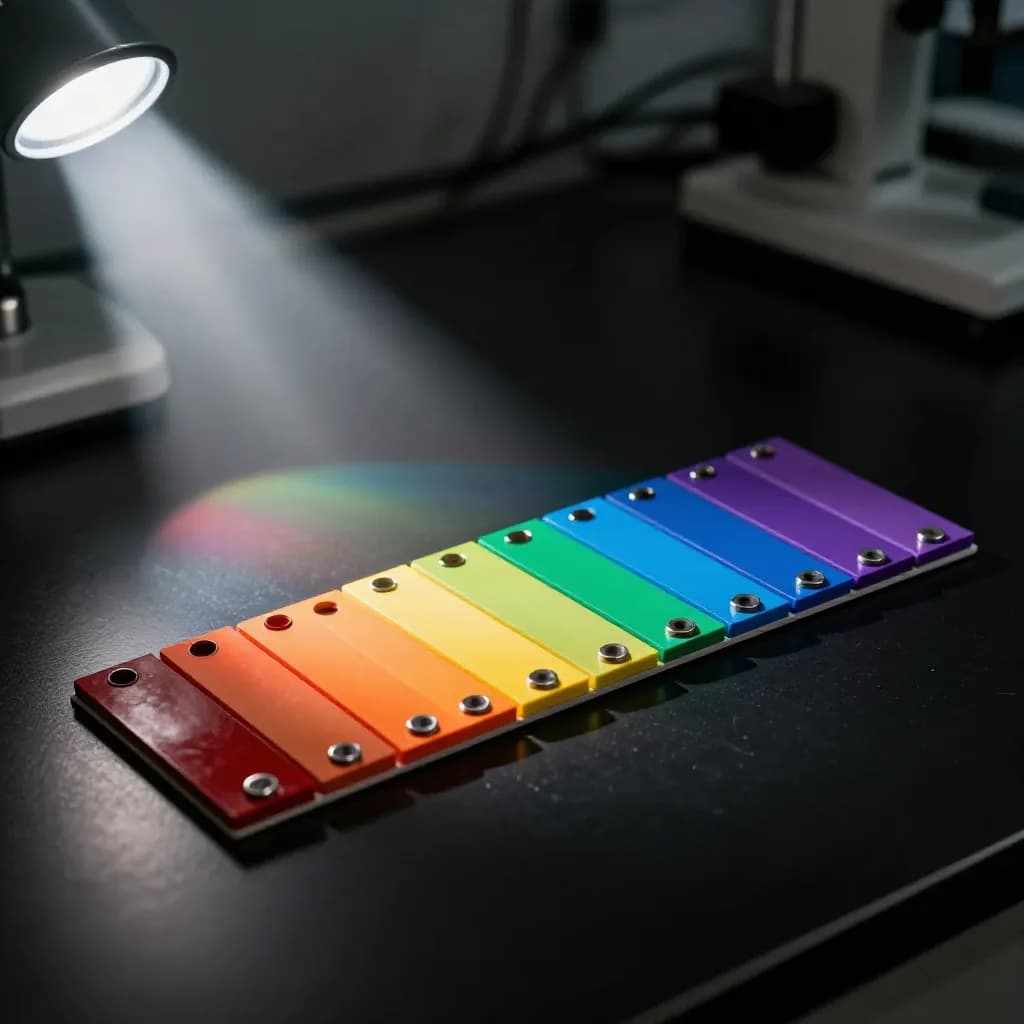
Visible light is electromagnetic radiation with wavelengths between approximately 380 and 780 nanometers. Within this range, different wavelengths are perceived as different colors: short wavelengths (380-450 nm) appear violet and blue, medium wavelengths (500-570 nm) appear green and yellow, and long wavelengths (590-780 nm) appear orange and red. White light, such as sunlight, contains a continuous spectrum of all visible wavelengths.
Ready to Start Your Project?
From one-off customs to 15,000-part production runs — get precise pricing in 24 hours.
On This Page
The Physics of Color and Light
When white light strikes a powder-coated surface, three things can happen to each wavelength: it can be reflected, absorbed, or transmitted. The color we perceive is determined by which wavelengths are reflected back to our eyes. A red powder coating appears red because it absorbs most short and medium wavelengths while reflecting long wavelengths in the red portion of the spectrum. A white coating reflects most wavelengths equally, while a black coating absorbs nearly all wavelengths.
The specific pattern of wavelength absorption and reflection is determined by the pigments in the powder coating formulation. Each pigment has a characteristic absorption spectrum that defines which wavelengths it absorbs and which it reflects or transmits. The combination of pigments in a formulation creates a composite spectral reflectance curve that defines the coating's color under any given illumination.
This interaction between light source, coating surface, and observer is known as the tristimulus model of color, and it has profound practical implications. The same powder coating can appear to be different colors under different light sources — a phenomenon called metamerism — because different light sources have different spectral power distributions. A coating that looks perfectly matched to a reference under daylight may appear noticeably different under fluorescent or LED lighting.
CIE Color Space and Lab* Coordinates
The Commission Internationale de l'Éclairage (CIE), the international authority on light and color, developed standardized color measurement systems that form the foundation of color quality control in the powder coating industry. The most widely used system is the CIE Lab* color space, introduced in 1976, which provides a mathematical framework for describing and comparing colors.
The Lab* color space is a three-dimensional coordinate system where every perceivable color occupies a unique position defined by three values. L* represents lightness, ranging from 0 (absolute black) to 100 (perfect white). The a* axis represents the red-green dimension, with positive values indicating redness and negative values indicating greenness. The b* axis represents the yellow-blue dimension, with positive values indicating yellowness and negative values indicating blueness.
This coordinate system was designed to be perceptually uniform, meaning that equal numerical distances in any direction correspond to approximately equal perceived color differences. A change of one unit in L* is intended to be perceived as the same magnitude of color difference as a change of one unit in a* or b*. While perfect perceptual uniformity has not been fully achieved, Lab* is a much better approximation than earlier color systems.
Color differences between two samples are quantified using the Delta E (ΔE) metric, calculated as the Euclidean distance between their Lab* coordinates: ΔE = √[(ΔL*)² + (Δa*)² + (Δb*)²]. A ΔE of 1.0 is generally considered the threshold of perceptibility — the smallest color difference that a trained observer can detect under controlled viewing conditions. In practice, powder coating specifications typically allow ΔE tolerances of 0.5-2.0, depending on the application and the criticality of color matching.
Refined Delta E formulas — including ΔE94 and the current standard CIEDE2000 (ΔE00) — incorporate corrections for the non-uniformities in the original Lab* space, providing better correlation with visual perception. CIEDE2000 includes adjustments for lightness, chroma, and hue weighting, as well as corrections for the interaction between chroma and hue differences. Most modern spectrophotometers and color quality software report both the classic ΔE*ab and the CIEDE2000 ΔE00 values.
Spectral Reflectance Curves and Color Measurement
While Lab* coordinates provide a convenient numerical description of color, the most complete characterization of a powder coating's color is its spectral reflectance curve — a graph showing the percentage of light reflected at each wavelength across the visible spectrum. The spectral reflectance curve is the fingerprint of a color, containing all the information needed to predict how the coating will appear under any light source.
Spectrophotometers — the instruments used to measure color in the powder coating industry — work by illuminating a sample with a known light source and measuring the intensity of reflected light at each wavelength, typically in 10-nanometer intervals across the 400-700 nm range. The resulting spectral data is then mathematically combined with the spectral power distribution of a standard illuminant and the CIE standard observer functions to calculate Lab* coordinates and other color metrics.
The choice of measurement geometry — the angles at which light is directed onto the sample and at which reflected light is collected — significantly affects the measured color values. The two most common geometries are 45°/0° (light at 45 degrees, detection at 0 degrees perpendicular to the surface) and diffuse/8° (light from an integrating sphere, detection at 8 degrees). These geometries handle surface gloss differently: 45°/0° excludes specular (mirror-like) reflection, measuring only the diffuse color, while diffuse/8° can include or exclude the specular component.
For powder coatings, the measurement geometry must be consistent between the standard (reference color) and the production sample to ensure meaningful comparison. Mixing measurements from different geometries or instruments can introduce systematic errors that lead to incorrect color acceptance or rejection decisions.
Metallic and effect powder coatings present special measurement challenges because their appearance changes with viewing angle. Multi-angle spectrophotometers that measure color at several angles (typically 15°, 25°, 45°, 75°, and 110° from the specular reflection angle) are required to fully characterize these coatings. The color at each angle provides information about the metallic flake orientation, size, and concentration, as well as the base color of the coating.
Metamerism: When Colors Match Under One Light But Not Another
Metamerism is one of the most challenging color phenomena in powder coating, and understanding it is essential for avoiding costly color matching failures. Two colors are metameric when they appear identical under one light source but visibly different under another. This occurs because the two samples have different spectral reflectance curves that happen to produce the same tristimulus values (and therefore the same perceived color) under one illuminant but not under others.
Metamerism arises from the fundamental nature of human color vision. The human eye has three types of cone cells, each sensitive to a different range of wavelengths (roughly corresponding to red, green, and blue). The brain interprets color based on the relative stimulation of these three cone types. Because three receptor types must encode the entire visible spectrum, many different spectral distributions can produce the same three-receptor response — and therefore the same perceived color. These spectrally different but perceptually identical colors are called metamers.
In powder coating, metamerism typically occurs when a production color is formulated using different pigments than the reference standard. For example, a reference panel colored with a specific organic red pigment might be matched in production using a combination of a different organic red and an inorganic red oxide. The two formulations may produce identical Lab* values under D65 daylight illuminant but diverge significantly under fluorescent (F2 or F11) or incandescent (illuminant A) lighting.
The metamerism index (MI) quantifies the degree of metamerism between two samples by calculating the color difference under a second illuminant after the samples have been matched under a primary illuminant. A metamerism index below 0.5 is generally considered acceptable; values above 1.0 indicate significant metamerism that may cause visible color mismatch in real-world viewing conditions.
Minimizing metamerism requires using the same pigments (or pigments with very similar spectral characteristics) in both the reference standard and the production formulation. When this is not possible — due to pigment availability, regulatory restrictions, or performance requirements — the formulator must carefully evaluate the spectral reflectance curves of alternative pigments and select combinations that minimize spectral mismatch across the visible range.
Color specifications for critical applications often include metamerism limits and require color matching under multiple illuminants (typically D65, F2 or F11, and illuminant A) to ensure acceptable appearance across the range of lighting conditions the coated product will encounter in service.
Pigment Selection and Color Formulation
The art and science of color formulation in powder coatings involves selecting and combining pigments to achieve a target color while meeting performance requirements for lightfastness, heat stability, chemical resistance, and opacity. This process requires deep knowledge of pigment properties and their interactions within the powder coating matrix.
Inorganic pigments — including titanium dioxide (white), iron oxides (yellows, reds, browns, blacks), chromium oxide (green), and ultramarine (blue) — are the workhorses of powder coating color formulation. These pigments offer excellent heat stability (essential for surviving the extrusion and curing processes), outstanding lightfastness, good chemical resistance, and high opacity. Their color range, however, is limited to relatively muted, earthy tones.
Organic pigments provide the bright, saturated colors that inorganic pigments cannot achieve. Azo pigments, quinacridones, phthalocyanines, perylenes, and diketopyrrolopyrroles (DPP) offer vivid reds, oranges, yellows, greens, blues, and violets. However, organic pigments vary widely in their heat stability, lightfastness, and chemical resistance. Selecting organic pigments for powder coatings requires careful evaluation of their ability to withstand extrusion temperatures (80-130°C) and curing temperatures (160-200°C) without decomposition or color shift.
Carbon black is the universal darkening pigment, used in virtually every dark-colored powder coating formulation. Its extremely high tinting strength means that very small additions produce significant darkening. Carbon black also contributes to UV protection by absorbing ultraviolet radiation that would otherwise degrade the polymer matrix.
Effect pigments — aluminum flakes, mica particles coated with metal oxides, and interference pigments — create metallic, pearlescent, and color-shifting effects that add visual depth and interest to powder coatings. These pigments work by reflecting and refracting light in ways that change with viewing angle, creating the dynamic appearance that distinguishes metallic and effect finishes from solid colors.
Computer-aided color matching systems have transformed the formulation process. These systems use spectral databases of pigment properties and mathematical algorithms to predict the color that a given pigment combination will produce, dramatically reducing the number of physical trial batches required to achieve a target color. However, experienced colorists remain essential for evaluating the visual quality of matches, assessing metamerism risk, and making the subtle adjustments that computer algorithms cannot fully capture.
Human Color Perception and Visual Assessment
Despite the sophistication of instrumental color measurement, human visual assessment remains an essential component of color quality control in powder coating. The human eye is remarkably sensitive to color differences — capable of distinguishing millions of distinct colors — and can detect aspects of color appearance that instruments may miss, such as texture effects, gloss variations, and the overall visual impression of a color match.
However, human color perception is also highly variable and subject to numerous influences that can compromise the reliability of visual assessments. Individual differences in color vision, adaptation to ambient lighting, simultaneous contrast effects (where surrounding colors influence the perception of a target color), and psychological factors all contribute to variability in visual color judgments.
Approximately 8% of males and 0.5% of females have some form of color vision deficiency (commonly called color blindness), most commonly affecting the ability to distinguish red from green. Color quality personnel should be tested for normal color vision using standardized tests such as the Ishihara plates or the Farnsworth-Munsell 100 Hue Test.
Controlled viewing conditions are essential for reliable visual color assessment. The standard viewing environment for color evaluation specifies a neutral gray surround (Munsell N7 or equivalent), standardized illumination (typically D65 daylight simulation at 1000-4000 lux), and a viewing angle of approximately 45 degrees. Light booths that provide multiple illuminant options (daylight, fluorescent, incandescent) allow visual assessment of metamerism.
The phenomenon of chromatic adaptation — the eye's tendency to adjust its color sensitivity to the ambient illumination — means that observers must allow time to adapt to the viewing booth lighting before making color judgments. Moving directly from a warm-toned office environment to a daylight-balanced viewing booth can temporarily distort color perception.
Visual assessment and instrumental measurement are complementary rather than competing methods. Instruments provide objective, repeatable numerical data that is essential for specification compliance and process control. Visual assessment provides the holistic evaluation of color appearance that captures the full complexity of human color perception. Best practice in powder coating color quality control uses both methods in combination.
Color Consistency Challenges in Powder Coating
Achieving and maintaining consistent color across production batches, between different application lines, and over the service life of coated products is one of the most demanding challenges in powder coating. Multiple factors can introduce color variation, and managing these factors requires systematic quality control throughout the supply chain.
Batch-to-batch variation in powder coating color can arise from variations in raw material properties (pigment strength, resin color), manufacturing process parameters (extrusion temperature, screw speed, grinding conditions), and measurement uncertainty. Powder coating manufacturers control these variables through incoming raw material testing, statistical process control during manufacturing, and rigorous final product color measurement against master standards.
Application-related color variation can occur due to differences in film thickness, cure conditions, and substrate characteristics. Film thickness affects color because thicker films have greater hiding power and may appear slightly darker or more saturated than thinner films. Under-cure or over-cure can shift color, particularly in formulations containing heat-sensitive organic pigments. And substrate color or reflectivity can influence the perceived color of the coating, especially at lower film thicknesses where the substrate is not fully hidden.
Color stability over time is a critical consideration for exterior powder coatings. UV radiation, moisture, temperature cycling, and atmospheric pollutants can all cause color change through pigment degradation, polymer yellowing, or chalking (the formation of a white, powdery surface layer due to polymer degradation). The rate of color change depends on the pigment system, the resin chemistry, the UV stabilizer package, and the severity of the exposure environment.
Super-durable polyester powder coatings with carefully selected pigments and UV stabilizers can maintain color stability (ΔE < 3-5) for 15-25 years in moderate climates. Fluoropolymer-based powder coatings offer even better color retention, with some systems maintaining ΔE < 3 for 30 years or more in aggressive environments. These long-term color stability requirements are specified in architectural coating standards such as Qualicoat Class 2 and 3, GSB Master, and AAMA 2605.
Digital color management systems that track color data across the entire supply chain — from powder manufacturer to coating applicator to finished product — are increasingly used to ensure color consistency. These systems enable real-time monitoring of color trends, early detection of drift, and rapid corrective action before out-of-specification product reaches the customer.
Frequently Asked Questions
What is CIE L*a*b* color space?
CIE L*a*b* is a three-dimensional color measurement system where L* represents lightness (0-100), a* represents the red-green axis, and b* represents the yellow-blue axis. It provides a standardized mathematical framework for describing and comparing colors, with Delta E (ΔE) measuring the numerical distance between two colors.
What is metamerism in powder coating?
Metamerism occurs when two powder coatings appear identical under one light source but visibly different under another. It happens because different pigment combinations can produce the same perceived color under specific lighting but have different spectral reflectance curves that diverge under other illuminants. Minimizing metamerism requires using similar pigments in matched formulations.
What Delta E value is acceptable for powder coating color matching?
A Delta E of 1.0 is generally the threshold of perceptibility for trained observers. Powder coating specifications typically allow ΔE tolerances of 0.5-2.0 depending on the application. Critical architectural and automotive applications may require ΔE < 1.0, while general industrial applications may accept ΔE up to 2.0.
Why do metallic powder coatings need multi-angle measurement?
Metallic and effect powder coatings change appearance with viewing angle due to the orientation and reflection characteristics of metallic flakes. Multi-angle spectrophotometers measure color at several angles (typically 15°, 25°, 45°, 75°, and 110° from specular) to fully characterize the coating's appearance across all viewing conditions.
How long do powder coating colors last outdoors?
Super-durable polyester powder coatings maintain color stability (ΔE < 3-5) for 15-25 years in moderate climates. Fluoropolymer-based systems can maintain ΔE < 3 for 30+ years in aggressive environments. Color longevity depends on pigment selection, resin chemistry, UV stabilizer package, and exposure severity.
Ready to Start Your Project?
From one-off customs to 15,000-part production runs — get precise pricing in 24 hours.