Coastal and marine environments represent the most corrosive atmospheric conditions that powder coatings routinely encounter. The combination of airborne salt particles, high humidity, UV radiation, and wind-driven moisture creates a multi-vector attack on coating systems that demands the highest levels of specification and quality control. ISO 9223, the international standard for classification of corrosivity of atmospheres, categorizes coastal environments as C4 (High) to C5 (Very High) corrosivity, with marine splash zones classified separately under the even more demanding Im2 (seawater immersion) category.
Technical
Powder Coating in Coastal and Saltwater Environments: Corrosion Protection and Specification
Sundial Powder Coating·April 22, 2026·12 min
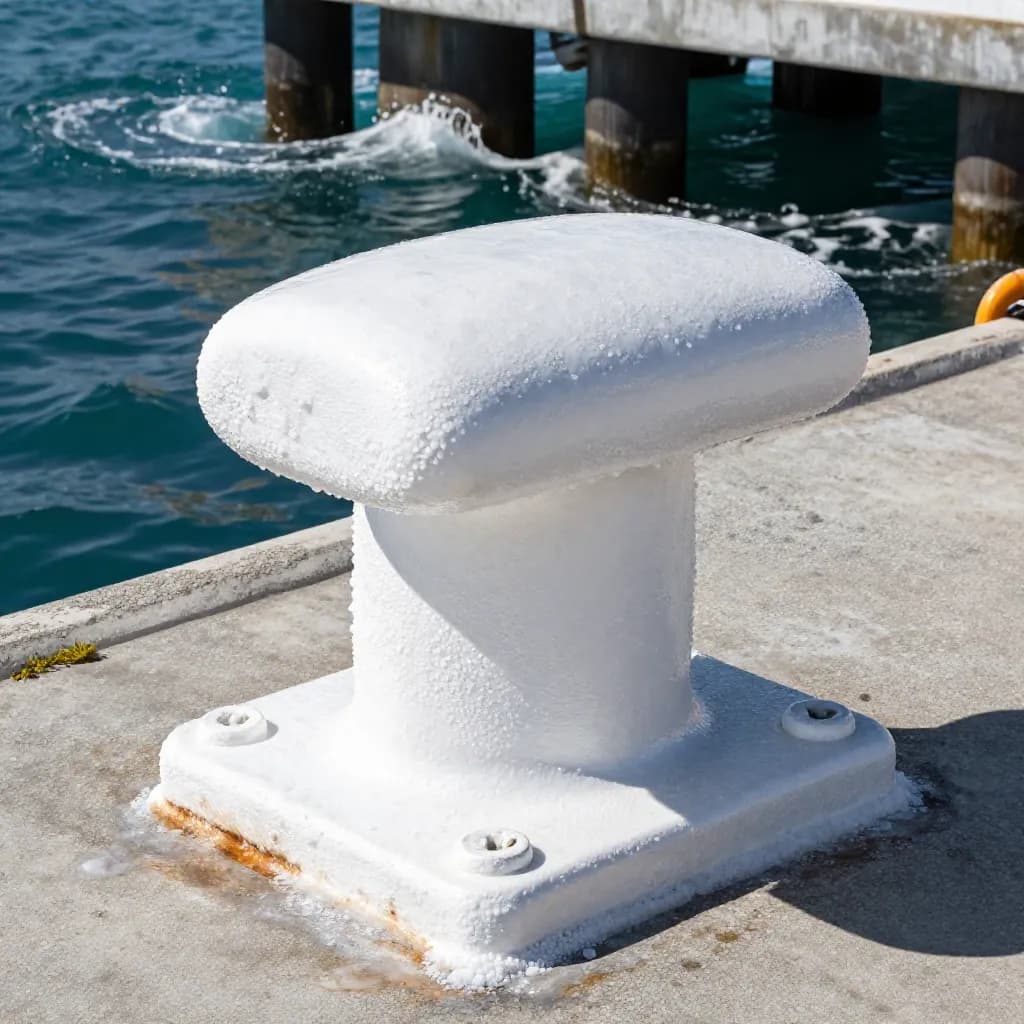
The corrosive agent in coastal environments is primarily sodium chloride, carried inland as aerosol particles generated by wave action and wind. Salt deposition rates decrease exponentially with distance from the shoreline — from over 300 mg/m²/day at the waterline to less than 50 mg/m²/day at 1 km inland in typical conditions. However, during storms, salt-laden air can penetrate 10-20 km inland, and in some coastal geographies, prevailing onshore winds maintain elevated salt levels at considerable distances from the sea.
Ready to Start Your Project?
From one-off customs to 15,000-part production runs — get precise pricing in 24 hours.
On This Page
Coastal Environments: The Ultimate Corrosion Challenge
The economic impact of coastal corrosion is enormous. Structures within 1 km of the coastline experience corrosion rates 5-10 times higher than identical structures in rural inland locations. For powder-coated architectural aluminum and steel, this translates to significantly shorter service lives unless the coating system is specifically designed and certified for coastal exposure. The difference between a standard inland specification and a proper coastal specification can mean the difference between 20+ years of service and failure within 5-8 years.
ISO 9223 Corrosivity Classification for Coastal Zones
ISO 9223 provides the internationally recognized framework for classifying atmospheric corrosivity, and understanding this classification system is essential for specifying powder coatings in coastal environments. The standard defines six corrosivity categories — C1 (Very Low) through CX (Extreme) — based on measured corrosion rates of standard metal specimens and environmental parameters including time of wetness, sulfur dioxide concentration, and chloride deposition rate.
Coastal environments typically fall into categories C4 (High) or C5 (Very High). C4 conditions are found in moderate coastal areas with chloride deposition rates of 60-300 mg/m²/day, while C5 applies to severe coastal and marine environments with chloride deposition exceeding 300 mg/m²/day. The CX category, introduced in the 2012 revision, covers extreme environments including offshore platforms and tropical coastal industrial zones.
For powder coating specification, the ISO 9223 category directly determines the required coating system design per ISO 12944-5. A C4 environment requires minimum total dry film thicknesses of 160-200 microns for a High durability (15-25 year) system on steel, while C5 demands 200-320 microns. These thicknesses are typically achieved using multi-coat systems: zinc-rich primer, epoxy intermediate coat, and polyester or polyurethane topcoat.
Site-specific corrosivity assessment is strongly recommended for coastal projects rather than relying on generic distance-from-coast guidelines. ISO 9225 provides methods for measuring environmental parameters — chloride deposition using wet candle or dry plate methods, and time of wetness using electronic sensors — that enable accurate classification of the specific project location. This data-driven approach prevents both under-specification (leading to premature failure) and over-specification (unnecessary cost).
Salt Spray Testing and Real-World Correlation
Salt spray testing per ISO 9227 (neutral salt spray, NSS) is the most widely used accelerated corrosion test for evaluating powder coating performance in coastal environments. The test exposes coated panels to a continuous fog of 5% sodium chloride solution at 35°C, creating an aggressive corrosive environment that accelerates the degradation mechanisms encountered in real coastal service.
Standard salt spray test durations for coastal powder coating specifications range from 500 hours for moderate coastal exposure (C3-C4) to 1,500-3,000 hours for severe marine environments (C5-CX). Performance is evaluated by measuring corrosion creep from scribed lines (typically limited to 1-2 mm maximum), assessing blistering per ISO 4628-2, and checking for any loss of adhesion in unscribed areas.
However, the correlation between salt spray test hours and real-world coastal service life is imperfect and widely debated within the coatings industry. Salt spray testing provides continuous wet exposure at a single temperature, while real coastal environments involve wet-dry cycling, UV exposure, temperature variation, and biological contamination — none of which are replicated in the salt spray cabinet. As a general guideline, 1,000 hours of NSS testing corresponds roughly to 5-10 years of moderate coastal exposure, but this ratio varies significantly depending on the specific coastal environment.
Cyclic corrosion testing methods — such as ISO 16701 (cyclic salt spray with humidity and drying phases) and ASTM G85 Annex A5 (prohesion test) — provide better correlation with real-world coastal performance because they incorporate wet-dry cycling that more closely replicates natural exposure conditions. Increasingly, coastal specifications are requiring cyclic corrosion testing in addition to or instead of traditional continuous salt spray testing.
Qualicoat Seaside Certification
Qualicoat Seaside is a specialized certification within the Qualicoat quality label system, specifically designed for powder-coated aluminum destined for coastal and marine environments. Introduced to address the higher performance demands of seaside installations, Qualicoat Seaside imposes additional requirements beyond the standard Qualicoat Class 1, 1.5, 2, and 3 certifications.
The key additional requirements of Qualicoat Seaside certification include enhanced pretreatment specifications, extended accelerated corrosion testing, and mandatory use of approved powder coating formulations that have demonstrated coastal performance. The pretreatment must achieve a minimum conversion coating weight and pass enhanced adhesion testing after boiling water immersion — a test that stresses the coating-substrate interface in a manner representative of sustained coastal moisture exposure.
Accelerated corrosion testing for Qualicoat Seaside includes both acetic acid salt spray (AASS) testing per ISO 9227 and filiform corrosion testing per EN 3665. Filiform corrosion — the thread-like corrosion that propagates beneath coatings on aluminum in chloride-containing environments — is the primary failure mode for powder-coated aluminum in coastal service. The filiform corrosion test exposes scribed panels to hydrochloric acid vapor followed by humidity exposure, and maximum filament length is limited to strict thresholds.
For architects and specifiers working on coastal projects, Qualicoat Seaside certification provides a comprehensive, independently verified assurance that the complete coating system — pretreatment, powder formulation, and application process — has been qualified for coastal service. Specifying Qualicoat Seaside eliminates the need to separately verify each component of the coating system and provides a single point of accountability through the certified applicator.
Duplex Coating Systems for Maximum Coastal Protection
Duplex coating systems — combining metallic zinc or zinc-aluminum coatings with powder coating topcoats — represent the gold standard for corrosion protection of steel in coastal environments. The synergistic interaction between the metallic and organic layers provides protection that significantly exceeds the sum of the individual layer performances, with duplex system service lives typically 1.5-2.5 times the combined individual service lives.
The metallic base layer — applied by hot-dip galvanizing, thermal spray (metallizing), or zinc-rich primer — provides cathodic (sacrificial) protection to the steel substrate. At any point where the powder coating is damaged, exposing the metallic layer, the zinc preferentially corrodes instead of the steel, preventing rust formation and undercutting. This self-healing mechanism is particularly valuable in coastal environments where mechanical damage from wind-borne debris, maintenance activities, and thermal cycling is common.
The powder coating topcoat protects the metallic layer from direct atmospheric attack, dramatically slowing the consumption rate of the sacrificial zinc. In a C5 coastal environment, bare hot-dip galvanizing at 85 microns thickness has an expected service life of 15-25 years. Adding a 60-80 micron powder coating topcoat extends this to 40-60+ years — a transformative improvement in lifecycle performance.
Application of powder coatings over hot-dip galvanized steel requires specific surface preparation to ensure adhesion. The smooth, passive zinc surface must be lightly abraded (sweep blasting with fine alumina or garnet) and treated with a suitable conversion coating or adhesion-promoting primer. T-wash (copper-bearing acidic solution) or proprietary zinc-specific conversion coatings create a chemically bonded interface that ensures long-term adhesion of the powder coating to the galvanized surface.
For aluminum in coastal environments, anodizing-plus-powder-coating duplex systems provide enhanced protection. A 15-20 micron sulfuric acid anodic oxide layer beneath the powder coating creates a hard, corrosion-resistant interface that significantly improves filiform corrosion resistance compared to conversion coating alone.
Pretreatment Critical Factors for Coastal Performance
Pretreatment quality is the single most important factor determining powder coating longevity in coastal environments. Field failure analysis consistently shows that the majority of premature coating failures in coastal service originate at the pretreatment-substrate interface rather than within the powder coating film itself. Inadequate pretreatment allows chloride ions to reach the metal surface, initiating corrosion that undercuts the coating from beneath.
For aluminum substrates in coastal environments, the pretreatment process must achieve three objectives: thorough removal of surface contaminants (oils, oxides, and embedded particles), creation of a micro-roughened surface profile for mechanical adhesion, and deposition of a chemically bonded conversion coating that provides both adhesion promotion and corrosion inhibition.
Multi-stage chrome-free pretreatment processes — typically 6-8 stages including alkaline cleaning, acid etching, de-smutting, conversion coating, and deionized water rinsing — are required for coastal aluminum applications. The conversion coating, based on titanium, zirconium, or rare earth chemistry, must achieve minimum coating weights specified by Qualicoat Seaside and demonstrate adhesion retention after boiling water immersion testing.
Water quality in the pretreatment process is critical for coastal performance. Rinse water conductivity should be maintained below 30 µS/cm (ideally below 10 µS/cm) to prevent ionic contamination of the conversion coating. Deionized water final rinse is mandatory for Qualicoat Seaside certification and strongly recommended for all coastal applications.
For steel substrates, abrasive blasting to Sa 2.5 (ISO 8501-1) followed by zinc phosphate conversion coating provides the optimal pretreatment for coastal powder coating. The zinc phosphate crystal structure, weight, and morphology must be controlled within tight parameters to ensure consistent coating adhesion and corrosion resistance. Phosphate coating weights of 2-5 g/m² with fine, uniform crystal structure are targeted for optimal performance.
Design Considerations for Coastal Powder-Coated Structures
The design of structures and components for coastal environments significantly influences powder coating performance and longevity. Even the best coating system will fail prematurely if applied to a poorly designed structure that traps moisture, creates crevices, or concentrates salt deposits.
Drainage is the most critical design consideration. All powder-coated surfaces should be designed to shed water freely, with no horizontal surfaces that can pond water or accumulate salt deposits. Where horizontal surfaces are unavoidable, they should incorporate drainage slopes of at least 2% and drainage holes at low points. Trapped water in coastal environments becomes a concentrated salt solution through evaporation, creating localized corrosion cells that can penetrate even high-quality coating systems.
Crevice design must be carefully managed. Overlapping joints, back-to-back angles, and enclosed box sections create crevices where salt-laden moisture can accumulate and remain wet for extended periods. Crevice corrosion is one of the most aggressive forms of coastal corrosion and is extremely difficult to prevent with coatings alone. Design strategies include sealing crevices with appropriate sealants, providing ventilation openings for enclosed sections, and using continuous welded joints instead of bolted connections where possible.
Edge protection is particularly important in coastal environments. Sharp edges and cut ends receive thinner coating coverage during powder application due to the Faraday cage effect and electrostatic repulsion at edges. In coastal service, these thin areas are the first points of coating breakdown and corrosion initiation. Specifying minimum edge radii of 2 mm, using edge-building powder formulations, and applying additional coating to edges and cut ends significantly improves coastal durability.
Bimetallic (galvanic) corrosion must be considered wherever dissimilar metals are in contact in coastal environments. The salt-laden moisture provides an excellent electrolyte for galvanic cells, accelerating corrosion of the less noble metal. Insulating washers, gaskets, and coatings should be used to prevent direct metal-to-metal contact between dissimilar materials.
Maintenance Protocols for Coastal Powder-Coated Surfaces
Regular maintenance is essential to achieving the full service life potential of powder coatings in coastal environments. Salt deposits, if allowed to accumulate, create concentrated corrosive conditions that can overwhelm even the most robust coating systems. A structured maintenance program combining regular cleaning, inspection, and timely repair is the most cost-effective strategy for maximizing coastal coating longevity.
Cleaning frequency for coastal powder-coated surfaces should be determined by salt deposition rate and rainfall patterns. As a general guideline, surfaces within 500 meters of the shoreline should be cleaned every 3-6 months, while those 500 meters to 2 km inland may require cleaning every 6-12 months. In areas with regular rainfall, natural washing provides partial salt removal, but supplementary cleaning is still recommended to address sheltered areas and horizontal surfaces where salt accumulates.
The cleaning method should use fresh water (not seawater) with mild neutral detergent (pH 6-8) applied with soft cloths or brushes. Abrasive cleaning materials, strong alkaline or acidic cleaners, and high-pressure washing above 50 bar should be avoided as they can damage the coating surface and accelerate degradation. Particular attention should be paid to joints, crevices, and drainage channels where salt deposits concentrate.
Inspection during cleaning should focus on early signs of coating degradation: blistering, filiform corrosion tracks (visible as worm-like lines beneath the coating surface), chalking, and corrosion staining at edges, fasteners, and mechanical damage points. Early detection and repair of coating defects is critical in coastal environments because corrosion propagation rates are high — a small defect that might remain stable for years in an inland environment can develop into significant coating failure within months in coastal conditions.
Repair of coating defects should be carried out promptly using compatible touch-up systems. The damaged area should be cleaned, lightly abraded, treated with conversion coating or adhesion promoter, and coated with a color-matched liquid repair coating. For larger areas of damage, professional recoating by a qualified applicator may be necessary.
Frequently Asked Questions
What ISO corrosivity category applies to coastal environments?
Coastal environments are typically classified as ISO 9223 C4 (High) or C5 (Very High) depending on distance from the shoreline and salt deposition rates. C4 applies to moderate coastal areas with chloride deposition of 60-300 mg/m²/day, while C5 covers severe coastal zones exceeding 300 mg/m²/day. Site-specific measurement per ISO 9225 is recommended.
What is Qualicoat Seaside certification?
Qualicoat Seaside is a specialized certification for powder-coated aluminum in coastal and marine environments. It requires enhanced pretreatment, extended corrosion testing including filiform corrosion evaluation, and use of approved powder formulations. It provides independently verified assurance that the complete coating system is qualified for coastal service.
How long does powder coating last near the ocean?
With proper specification (Qualicoat Seaside or equivalent), super-durable polyester powder coatings on aluminum last 15-20 years within 1 km of the coastline. Duplex systems on steel (galvanizing plus powder coating) can achieve 40-60+ years. Without coastal-specific specification, standard coatings may fail within 5-8 years.
What is a duplex coating system for coastal steel?
A duplex system combines hot-dip galvanizing or thermal spray zinc with a powder coating topcoat. The zinc provides cathodic protection at damage points while the powder coating slows zinc consumption. Service life is 1.5-2.5 times the sum of individual layer lives, making duplex systems the gold standard for coastal steel protection.
How often should coastal powder-coated surfaces be cleaned?
Surfaces within 500 meters of the shoreline should be cleaned every 3-6 months, while those 500m to 2 km inland need cleaning every 6-12 months. Use fresh water with mild neutral detergent and soft brushes. Regular cleaning removes salt deposits that create concentrated corrosive conditions and is essential for achieving full coating service life.
Ready to Start Your Project?
From one-off customs to 15,000-part production runs — get precise pricing in 24 hours.