Cast iron presents one of the most demanding substrates for powder coating due to its inherent porosity and the outgassing problems that result from it. Unlike wrought steel or aluminum, cast iron is produced by pouring molten metal into molds, and the solidification process inevitably traps microscopic gas pockets, sand inclusions, and moisture within the metal matrix. These voids are invisible on the surface but become active during the powder coating cure cycle when the part is heated to 180-200°C, causing trapped gases to expand and escape through the curing powder film.
Technical
Powder Coating Cast Iron: Solving Outgassing, Porosity, and Pretreatment Challenges
Sundial Powder Coating·April 22, 2026·15 min
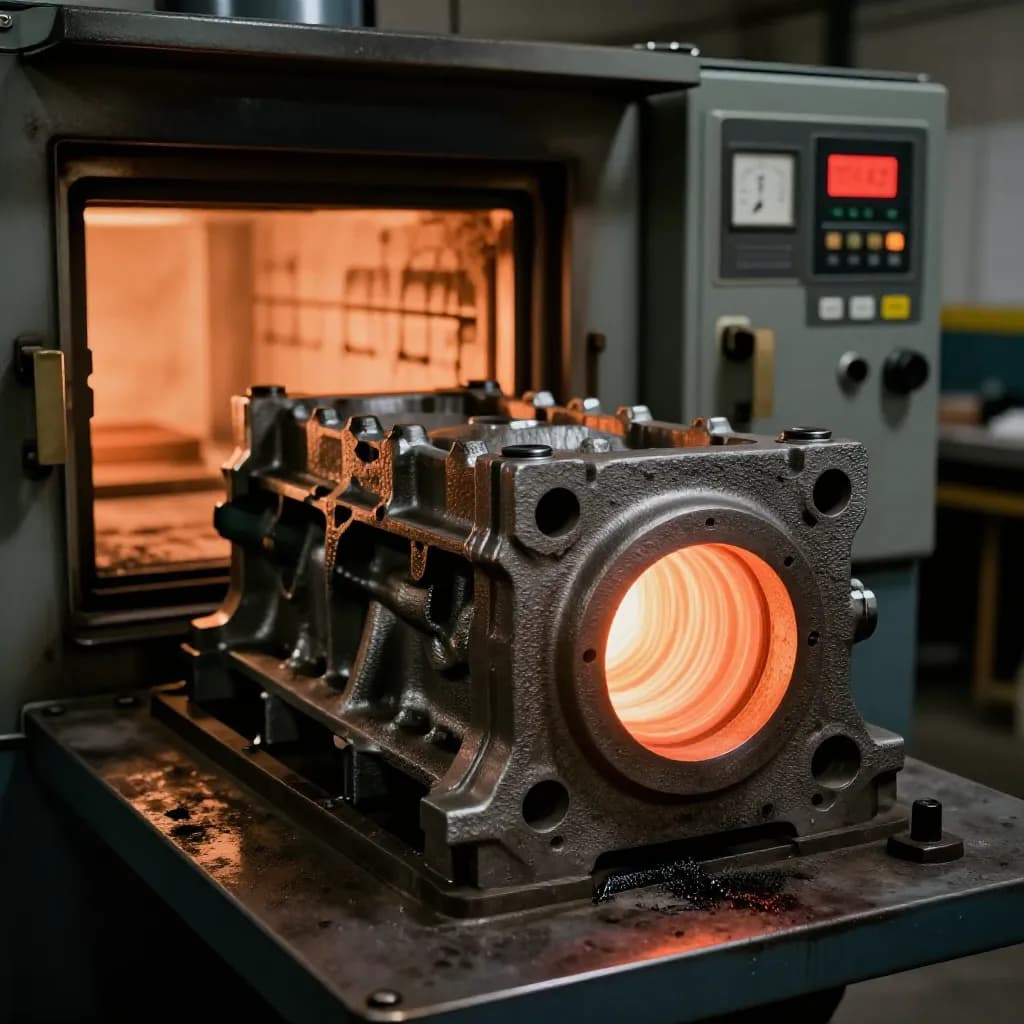
The result is a range of surface defects — pinholes, craters, bubbles, and fisheyes — that compromise both the appearance and protective performance of the coating. For decorative applications such as cast iron furniture, fireplace surrounds, and architectural hardware, these defects are aesthetically unacceptable. For functional applications such as engine blocks, pump housings, and valve bodies, pinholes create pathways for moisture and corrosive agents to reach the substrate, undermining the very purpose of the coating.
Ready to Start Your Project?
From one-off customs to 15,000-part production runs — get precise pricing in 24 hours.
On This Page
The Unique Challenges of Powder Coating Cast Iron
Despite these challenges, cast iron is one of the most commonly powder-coated substrates in industrial manufacturing. The combination of cast iron's excellent machinability, vibration damping, and compressive strength with powder coating's durability and environmental advantages makes it a natural pairing — provided the coating process is properly engineered to manage outgassing. This guide covers the complete process from pretreatment through cure, with specific attention to the techniques that distinguish successful cast iron coating from failed attempts.
Understanding Outgassing: Causes and Mechanisms
Outgassing in cast iron occurs because the metal's porous microstructure acts as a reservoir for gases, moisture, and volatile contaminants that are released when the part is heated. The primary sources of outgassing include residual moisture absorbed into the casting's pore network, trapped air from the casting process, decomposition products from mold binders and core sands, and oils or cutting fluids that have penetrated the porous surface during machining operations.
Grey cast iron, the most common type encountered in powder coating, has a microstructure characterized by graphite flakes distributed throughout a ferrite-pearlite matrix. These graphite flakes create an interconnected network of microscopic channels that readily absorb and retain liquids and gases. Ductile (nodular) cast iron, with its spheroidal graphite structure, is somewhat less porous but still susceptible to outgassing. White cast iron and malleable cast iron present their own porosity characteristics depending on heat treatment history.
The outgassing mechanism during powder coating follows a predictable sequence. As the part enters the cure oven and its temperature rises, absorbed moisture begins to vaporize at around 100°C. Between 120-160°C, the powder particles begin to melt and flow together, forming a continuous film. If gases are still escaping from the substrate at this point, they push through the softened powder, creating pinholes. As the temperature continues to rise toward the full cure temperature of 180-200°C, deeper-seated contaminants — oils, binder residues, and trapped air — begin to volatilize and escape. If the powder film has already gelled or begun to crosslink, these late-escaping gases create larger bubbles and craters that cannot heal. The timing mismatch between gas release and film formation is the fundamental cause of outgassing defects.
The Degas Cycle: Pre-Bake Protocols
The degas cycle — also called pre-baking or outgassing bake — is the single most important process step for achieving defect-free powder coatings on cast iron. The principle is straightforward: heat the casting to a temperature at or above the powder cure temperature before applying any coating, allowing trapped gases and volatiles to escape from the bare metal surface where they cause no harm. Once the part has been thoroughly degassed, it is cooled to the appropriate application temperature and coated normally.
Standard degas parameters for grey cast iron call for heating the part to 230-260°C and holding at temperature for 30-60 minutes, depending on wall thickness and porosity level. Heavier castings with thicker cross-sections require longer soak times because heat penetration is slower and the volume of trapped gas is greater. A 10 mm wall section may degas adequately in 30 minutes, while a 50 mm section may require 60 minutes or more. The degas temperature should exceed the powder cure temperature by at least 20-30°C to ensure that all volatiles released during the actual cure cycle have already been driven off.
Monitoring the degas process is critical. Visual observation of the part surface during the degas bake can reveal active outgassing — look for shimmering heat distortion above the surface, which indicates gas release. Some facilities use a simple test: apply a thin dusting of powder to a small area of the hot part after the degas cycle and observe whether pinholes form during cure. If defects appear, the degas cycle was insufficient and must be extended. Production environments should establish degas parameters through systematic trials on representative castings, documenting the minimum time and temperature required to eliminate outgassing for each part geometry and casting source. Casting quality can vary between foundries and even between production batches, so periodic verification is essential.
Pretreatment for Cast Iron Substrates
Effective pretreatment of cast iron for powder coating must accomplish three objectives: remove surface contaminants (oil, grease, rust, scale), create a surface profile for mechanical adhesion, and apply a conversion coating that enhances corrosion resistance and coating adhesion. The porous nature of cast iron complicates each of these steps because contaminants penetrate below the surface and are difficult to remove completely.
Grit blasting is the preferred mechanical preparation method for cast iron. Steel grit (G25 or G40) or angular aluminum oxide (80-120 mesh) propelled at 4-6 bar produces a surface profile of 50-75 micrometers, which provides excellent mechanical keying for the powder coating. Shot blasting with steel shot is also effective and is commonly used in automated blast systems for high-volume production. The blast process removes casting skin, sand residues, rust, and scale, exposing clean metal. However, blasting alone does not remove oils and greases that have penetrated the porous surface — these must be addressed through chemical cleaning or thermal degreasing during the degas cycle.
Chemical pretreatment following blasting typically involves an alkaline wash to remove residual oils, followed by an iron phosphate conversion coating. The iron phosphate layer — typically 0.3-1.0 g/m² — provides a micro-crystalline surface that enhances powder adhesion and provides a degree of under-film corrosion resistance. For higher-performance applications, zinc phosphate conversion coatings offer superior corrosion protection but require more complex multi-stage chemistry. In many cast iron coating operations, the degas bake effectively serves as a thermal degreasing step, burning off surface oils and contaminants at temperatures above their decomposition point. When this approach is used, the sequence becomes: blast, degas bake, cool, chemical conversion coat, dry, powder apply, and cure.
Powder Selection and Cure Optimization
Powder selection for cast iron applications should account for the substrate's outgassing tendency and the thermal mass of typical castings. Powders with extended gel times — the period during which the melting powder remains fluid before crosslinking begins — are advantageous because they allow more time for residual gases to escape through the liquid film before it solidifies. Some powder manufacturers offer formulations specifically designed for outgassing-prone substrates, incorporating degassing additives that promote gas release and film healing during the early stages of cure.
Epoxy and epoxy-polyester hybrid powders are commonly used for cast iron components in industrial, automotive, and under-hood applications where UV resistance is not required. These chemistries offer excellent adhesion to iron substrates, good chemical resistance, and the mechanical toughness needed for heavy-duty service. Polyester powders are specified when UV resistance is required — outdoor furniture, architectural castings, and decorative hardware. For extreme corrosion protection, zinc-rich epoxy primers applied as a first coat followed by a polyester topcoat provide a duplex system with both galvanic and barrier protection.
Cure optimization for cast iron requires attention to the part's thermal mass. Heavy castings absorb significant heat energy and take longer to reach cure temperature than thin-gauge sheet metal. Oven profiles must be adjusted to ensure that the entire part — including the thickest cross-sections — reaches the minimum cure temperature for the required duration. Infrared temperature measurement of the actual part surface, rather than relying on oven air temperature, is essential for verifying cure. Under-cured powder coatings on cast iron will exhibit poor adhesion, reduced chemical resistance, and premature failure. Conversely, excessive cure temperatures or times can cause yellowing, gloss reduction, and embrittlement of the coating.
Automotive and Industrial Applications
The automotive industry is one of the largest consumers of powder-coated cast iron components. Engine blocks, cylinder heads, transmission housings, brake calipers, and differential covers are routinely powder coated for corrosion protection, fluid resistance, and identification marking. Brake calipers represent a particularly demanding application — the coating must withstand sustained temperatures of 200-300°C during heavy braking, resist brake fluid exposure, and maintain adhesion through extreme thermal cycling. High-temperature polyester or silicone-modified polyester powders rated for continuous service at 200°C or intermittent exposure to 300°C are specified for these applications.
Industrial pump and valve manufacturers powder coat cast iron housings, impellers, and bodies for corrosion protection in water treatment, chemical processing, and HVAC systems. Fusion-bonded epoxy (FBE) coatings applied at 300-500 micrometers provide heavy-duty barrier protection for buried or submerged cast iron pipe fittings and flanges. The thick film build of FBE coatings is particularly effective at bridging the surface porosity of cast iron, reducing the risk of pinhole-related corrosion initiation.
The furniture and architectural sectors use powder-coated cast iron for bench ends, table bases, lamp posts, bollards, and decorative railings. These applications demand high aesthetic quality with no visible outgassing defects, making thorough degassing essential. The weight and thermal mass of architectural castings can make oven processing challenging — large bench ends or lamp post bases may weigh 20-50 kg each and require extended oven times to reach cure temperature throughout. Batch oven processing with carefully controlled ramp rates and soak times is typical for these heavy components, as conveyor ovens designed for lighter parts may not provide adequate heat exposure.
Quality Control and Testing Protocols
Quality control for powder-coated cast iron must address both the standard coating quality parameters and the substrate-specific risks of outgassing and porosity-related defects. Visual inspection under controlled lighting is the first line of defense — trained inspectors examine every coated surface for pinholes, craters, bubbles, orange peel, and color inconsistency. Raking light at a low angle is particularly effective for revealing pinhole defects that may not be visible under direct overhead illumination.
Film thickness measurement using magnetic gauges (ISO 2178) should be performed at multiple points on each part, with particular attention to edges, corners, and recessed areas where thin spots are most likely. Target film thickness for cast iron applications is typically 60-100 micrometers for standard industrial use and 80-120 micrometers for high-corrosion environments. Adhesion testing per ISO 2409 (cross-hatch) should achieve a classification of 0-1, and pull-off testing per ISO 4624 should exceed 5 MPa.
For corrosion-critical applications, salt spray testing per ISO 9227 provides accelerated corrosion resistance data. Cast iron components should achieve a minimum of 500 hours neutral salt spray without blistering, rusting, or delamination for standard industrial applications, with 1000+ hours expected for high-performance systems. Humidity resistance testing per ISO 6270 evaluates the coating's ability to resist moisture-driven adhesion loss and blistering — a particularly relevant test for cast iron because residual porosity can create pathways for moisture to reach the substrate. Impact resistance testing per ISO 6272 verifies that the coating can withstand mechanical damage during handling, installation, and service without cracking or delaminating from the cast iron surface.
Troubleshooting Common Cast Iron Coating Defects
When outgassing defects persist despite a degas cycle, the first step is to verify that the degas temperature and time are adequate. Increase the degas temperature by 20°C and extend the soak time by 15-20 minutes, then retest. If defects continue, the casting source may have changed — different foundries produce castings with varying porosity levels, and even the same foundry may produce inconsistent results between batches. Incoming inspection of raw castings, including sectioning and microscopic examination of representative samples, can identify porosity problems before they reach the coating line.
Oil staining or discoloration visible after the degas bake indicates that machining oils or cutting fluids have penetrated deeply into the casting's pore structure. Alkaline cleaning before degassing may help, but severely contaminated castings may require multiple degas cycles or solvent vapor degreasing to remove embedded oils. Switching to water-soluble cutting fluids in upstream machining operations can reduce this problem at its source.
Edge pull-back — where the powder coating thins or recedes from sharp edges during cure — is common on cast iron parts with machined features, bolt holes, and chamfers. This occurs because surface tension in the molten powder draws it away from sharp edges toward flat surfaces. Applying a heavier initial coat to edges, using powders formulated for improved edge coverage, or radiusing sharp edges to a minimum of 0.5 mm during machining can mitigate this defect. For parts with complex geometries combining thick and thin sections, differential heating rates can cause the powder to cure unevenly — thin sections reach temperature first and may over-cure while thick sections are still ramping. Oven programming with controlled ramp rates and extended soak times at cure temperature helps equalize the cure across the entire part.
Frequently Asked Questions
Why does powder coating bubble on cast iron?
Bubbling is caused by outgassing — trapped gases, moisture, and volatile contaminants in the porous cast iron escape during the cure cycle and push through the softening powder film. The solution is a pre-bake degas cycle at 230-260°C for 30-60 minutes before powder application, which drives out trapped volatiles from the bare metal surface.
How long should you degas cast iron before powder coating?
Standard degas parameters are 230-260°C for 30-60 minutes, depending on wall thickness and porosity. Thin-walled castings (under 10 mm) may degas in 30 minutes, while heavy castings (50+ mm walls) may require 60 minutes or more. The degas temperature should exceed the powder cure temperature by at least 20-30°C.
What is the best powder type for cast iron?
Epoxy and epoxy-polyester hybrid powders are most commonly used for industrial cast iron applications due to their excellent adhesion and chemical resistance. For outdoor or UV-exposed applications, polyester powders are required. Powders with extended gel times or degassing additives are preferred because they allow residual gases to escape before the film solidifies.
Can you powder coat cast iron without degassing?
It is possible on some low-porosity castings, but it is risky and not recommended for quality-critical applications. Without degassing, any trapped gases will escape during the cure cycle and create pinholes, bubbles, or craters in the coating. The degas step adds time to the process but is essential for achieving defect-free results on most cast iron parts.
What blast media is best for cast iron pretreatment?
Steel grit (G25 or G40) and angular aluminum oxide (80-120 mesh) are both effective for cast iron. Steel grit is commonly used in automated blast systems for high-volume production, while aluminum oxide is preferred for manual blasting. Both produce surface profiles of 50-75 micrometers suitable for powder coating adhesion.
Ready to Start Your Project?
From one-off customs to 15,000-part production runs — get precise pricing in 24 hours.