Brass and copper are valued for their warm, distinctive appearance, but both metals are chemically reactive and tarnish readily when exposed to atmospheric conditions. Copper develops a green patina (verdigris) through oxidation and reaction with carbon dioxide and moisture, while brass — an alloy of copper and zinc — darkens and develops a dull brown or black tarnish layer. While some applications deliberately exploit this patina for aesthetic effect, many require the original bright, polished appearance to be preserved indefinitely.
Technical
Powder Coating Brass and Copper: Tarnish Prevention, Pretreatment, and Decorative Applications
Sundial Powder Coating·April 22, 2026·13 min
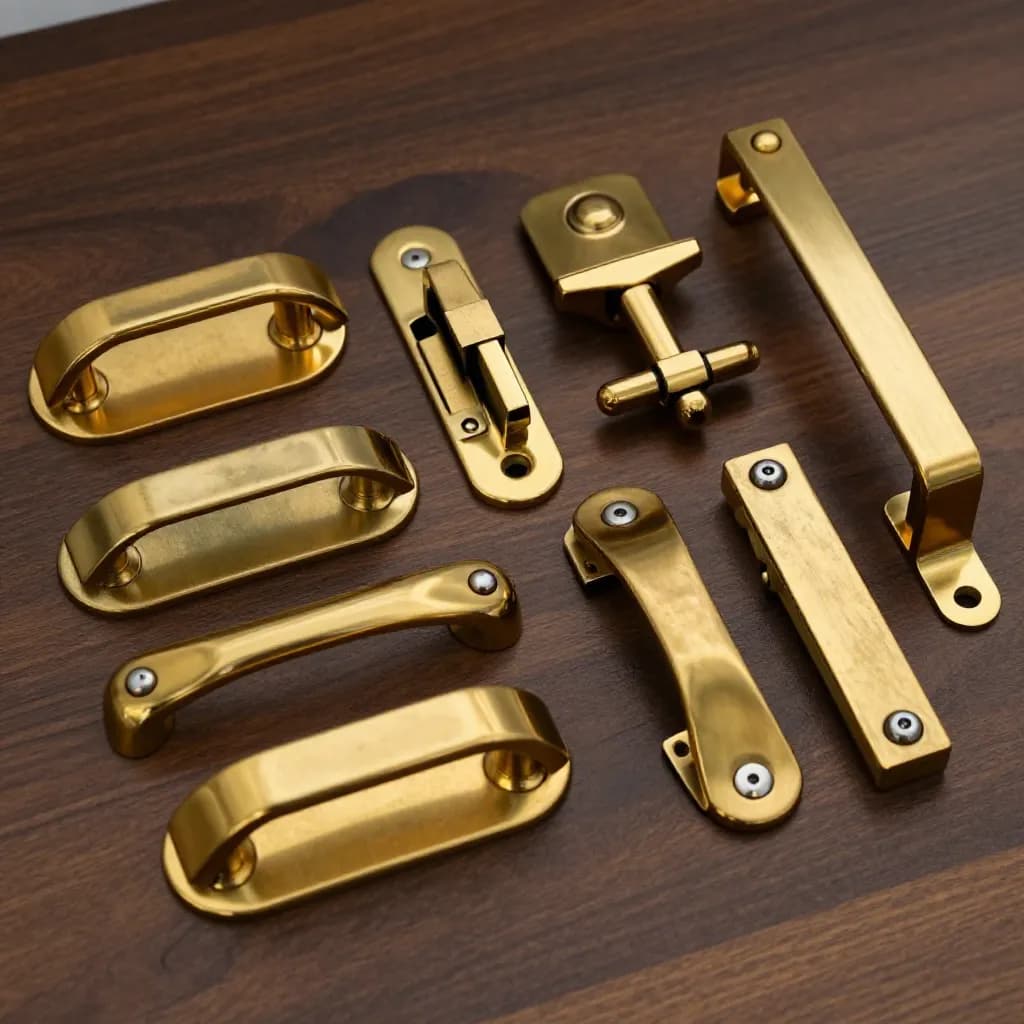
Powder coating provides a durable, transparent or colored barrier that prevents atmospheric tarnishing while adding mechanical protection against scratching, fingerprinting, and handling damage. Clear powder coatings are particularly popular for brass and copper hardware, allowing the natural metal color and luster to show through while preventing tarnish. This approach is widely used for door handles, cabinet hardware, light fixtures, plumbing fixtures, and decorative architectural elements where the warm metallic appearance is desired but ongoing polishing and maintenance is impractical.
Ready to Start Your Project?
From one-off customs to 15,000-part production runs — get precise pricing in 24 hours.
On This Page
Why Powder Coat Brass and Copper?
Colored powder coatings on brass and copper are specified when the substrate is chosen for its mechanical properties — excellent machinability, antimicrobial characteristics, or electrical conductivity — rather than its appearance. Electrical enclosures, bus bars, heat exchangers, and marine hardware may be powder coated in standard industrial colors for identification, protection, or aesthetic integration with surrounding equipment. The combination of copper's thermal and electrical conductivity with powder coating's protective and decorative capabilities creates a versatile material system for demanding applications.
Surface Chemistry and Adhesion Considerations
Brass and copper present unique adhesion challenges due to their surface chemistry. Both metals form oxide layers when exposed to air — copper oxide (CuO and Cu₂O) on copper, and a complex mixture of copper and zinc oxides on brass. These oxide layers are less stable and less uniform than the chromium oxide passive layer on stainless steel, but they still interfere with coating adhesion if not properly managed. The oxide layer on copper is typically 2-5 nanometers thick under ambient conditions but can grow significantly thicker in humid or polluted environments.
A more insidious adhesion problem arises from the migration of copper ions through the coating film. Copper is a catalytically active metal that can accelerate the degradation of organic coatings through oxidation reactions at the coating-metal interface. This phenomenon, sometimes called 'copper poisoning,' can cause adhesion loss, discoloration, and premature coating failure even when initial adhesion testing shows acceptable results. The effect is most pronounced with epoxy-based coatings and in warm, humid environments where ion mobility is highest.
To mitigate these issues, pretreatment for brass and copper must accomplish three things: remove the existing oxide layer and any tarnish products, create a surface condition that promotes mechanical and chemical adhesion, and deposit a barrier layer that prevents copper ion migration into the coating. Chromate conversion coatings have historically been the most effective solution, but environmental restrictions on hexavalent chromium have driven the development of alternative chemistries based on silanes, zirconium compounds, and trivalent chromium that provide comparable performance without the toxicity concerns.
Pretreatment Methods for Brass and Copper
Mechanical pretreatment of brass and copper requires careful media selection to avoid embedding contaminants or damaging the soft metal surface. Brass and copper are significantly softer than steel — brass has a Vickers hardness of 80-180 HV depending on alloy and temper, compared to 120-300 HV for mild steel. Aggressive blasting with hard angular media can deform the surface, embed particles, and create stress concentrations that promote corrosion. Fine glass bead (100-170 mesh) at low pressure (2-3 bar) is the preferred mechanical pretreatment, producing a uniform matte finish with a surface profile of 10-20 micrometers without excessive material removal or surface damage.
Chemical pretreatment is generally preferred over mechanical methods for brass and copper, particularly for decorative applications where surface quality is paramount. A typical chemical pretreatment sequence consists of alkaline cleaning to remove oils and handling soils, acid pickling in dilute sulfuric acid (5-10%) or citric acid solution to remove oxides and tarnish, thorough rinsing, and application of a conversion coating. The acid pickle step is critical — it must remove all visible tarnish and oxide without excessively etching the surface or preferentially dissolving one component of the brass alloy (dezincification).
Conversion coatings for brass and copper include chromate (where still permitted), trivalent chromium, benzotriazole (BTA), and silane-based systems. Benzotriazole is particularly effective on copper alloys — it forms a stable, protective complex with copper ions on the surface that inhibits further oxidation and provides an excellent adhesion-promoting layer for organic coatings. BTA treatment involves immersion in a 1-3% aqueous solution at 50-70°C for 30-60 seconds, followed by rinsing and drying. Silane-based conversion coatings offer a chrome-free alternative with good adhesion promotion and are compatible with both clear and pigmented powder coatings.
Clear Coating Brass and Copper: Preserving the Natural Finish
Clear powder coating over polished brass and copper is one of the most demanding applications in the powder coating industry. The coating must be optically transparent with minimal haze or yellowing, thin enough to preserve the metallic luster and reflectivity of the substrate, and durable enough to resist scratching, fingerprinting, and UV-induced degradation over years of service. Achieving all three simultaneously requires careful powder selection, precise application, and optimized cure parameters.
Clear polyester powders are the standard choice for exterior applications where UV resistance is required. These formulations are specifically designed for transparency and non-yellowing performance, with cure schedules typically at 180-190°C for 10-15 minutes. Film thickness for clear coats on brass and copper should be 40-60 micrometers — thinner than standard pigmented coatings to maximize the visual impact of the underlying metal. Excessively thick clear coats appear milky or hazy and diminish the metallic appearance. Clear epoxy-polyester hybrids offer superior hardness and chemical resistance for interior applications but may yellow slightly over time under UV exposure.
The cure cycle for clear coatings on brass and copper requires particular attention because over-curing causes yellowing of the clear film and can trigger oxidation of the metal surface beneath the coating, producing a visible darkening effect. Oven temperature profiles should be validated with contact thermocouples on actual parts to ensure that the metal surface temperature does not exceed the powder manufacturer's recommended maximum. Infrared cure ovens can be advantageous for clear-coated brass and copper because they allow rapid, controlled heating with precise temperature management, reducing the risk of over-cure compared to convection ovens where parts may spend extended time at elevated temperatures during ramp-up and cool-down.
Decorative and Architectural Applications
Powder-coated brass and copper are extensively used in architectural and decorative applications where the combination of aesthetic warmth and long-term durability is valued. Door hardware — handles, knobs, hinges, kick plates, and push plates — represents one of the largest application segments. Clear-coated polished brass hardware maintains its bright appearance without the regular polishing that uncoated brass demands, while colored powder coatings allow brass hardware to be finished in matte black, oil-rubbed bronze, satin nickel, and other designer finishes that are currently popular in residential and commercial interiors.
Architectural lighting is another significant market. Copper and brass light fixtures, sconces, lanterns, and decorative poles are powder coated to prevent tarnishing and maintain consistent appearance across large installations. Exterior lighting fixtures face particular challenges from UV exposure, moisture, and thermal cycling, requiring high-performance polyester clear coats or pigmented coatings with proven weathering resistance. Interior fixtures may use epoxy-polyester hybrids for their superior hardness and scratch resistance in high-traffic environments.
The hospitality and retail sectors specify powder-coated brass and copper for signage, display fixtures, railing systems, elevator interiors, and decorative panels. These applications demand flawless visual quality — any pinhole, orange peel, or color inconsistency is immediately visible on the warm metallic surface. Production quality control for decorative brass and copper coating typically includes 100% visual inspection under controlled lighting, with rejection criteria significantly more stringent than for industrial applications. The investment in rigorous quality control is justified by the high value of the finished components and the cost of rework on precision-machined decorative hardware.
Thermal Considerations and Cure Optimization
Brass and copper have significantly higher thermal conductivity than steel — copper at 385 W/m·K and brass at 109-159 W/m·K compared to 50 W/m·K for carbon steel. This high thermal conductivity means that brass and copper parts heat up and cool down much faster than steel parts of equivalent mass, which has important implications for powder coating application and cure. Parts reach cure temperature quickly, reducing oven dwell time, but they also cool rapidly after leaving the oven, which can affect coating flow and leveling.
The rapid heating characteristic of copper and brass can be advantageous — shorter cure cycles improve productivity and reduce energy consumption. However, it also means that temperature overshoot is a risk if oven controls are not responsive. A copper part entering a convection oven set at 200°C will reach 200°C significantly faster than a steel part of the same mass, and if the oven temperature overshoots during recovery after loading, the copper part may experience temperatures well above the target. For clear coatings, where over-cure causes visible yellowing, this temperature sensitivity demands precise oven control and monitoring.
The high thermal conductivity also affects electrostatic powder deposition. Warm parts attract less powder than cold parts because the electrostatic charge dissipates more readily on a conductive, warm surface. If parts are preheated (for example, after a degas cycle or warm rinse), the powder application window may be narrow. Conversely, the rapid heat transfer through copper and brass substrates means that the powder film reaches its melt and flow temperature quickly and uniformly, which can produce excellent surface smoothness and leveling — a significant advantage for decorative applications where surface quality is paramount.
Antimicrobial Properties and Specialized Applications
Copper and brass possess inherent antimicrobial properties — the 'oligodynamic effect' — that kill bacteria, viruses, and fungi on contact. This property has driven increased specification of copper alloy touch surfaces in healthcare facilities, public transit, and commercial buildings. However, powder coating these surfaces creates a barrier between the antimicrobial metal and the microorganisms, effectively negating the antimicrobial benefit. This presents a design trade-off: coating preserves appearance and prevents tarnishing but eliminates the antimicrobial function.
For applications where both antimicrobial performance and coating protection are required, several approaches are available. Antimicrobial powder coating formulations incorporating copper-based or silver-based biocidal additives can provide surface antimicrobial activity independent of the substrate. These coatings release controlled amounts of antimicrobial ions at the surface, killing microorganisms on contact. They can be applied to any substrate — not just copper — but when applied over copper or brass, they provide both the aesthetic benefits of coating and the antimicrobial functionality.
Selective coating is another strategy — coating non-touch surfaces for aesthetic protection while leaving high-touch areas (handles, push plates, grab rails) uncoated to maintain direct antimicrobial contact. This approach requires careful masking during the coating process and acceptance that uncoated areas will tarnish over time, requiring periodic cleaning or polishing. Some designers embrace this contrast, using the developing patina on touch surfaces as a visual indicator of the antimicrobial copper beneath. Marine and industrial applications for powder-coated copper alloys include seawater piping components, heat exchanger shells, and electrical bus bars where the coating provides insulation or identification rather than corrosion protection.
Frequently Asked Questions
Can you clear coat brass with powder coating to prevent tarnishing?
Yes, clear polyester powder coating is the most effective method for preserving the polished appearance of brass indefinitely. Apply at 40-60 micrometers film thickness to maintain metallic luster without haze. Proper pretreatment with acid pickling and benzotriazole conversion coating is essential for adhesion and to prevent copper ion migration that causes discoloration.
What pretreatment does copper need before powder coating?
Copper requires acid pickling in dilute sulfuric acid (5-10%) or citric acid to remove oxides and tarnish, followed by a conversion coating such as benzotriazole (BTA), silane, or trivalent chromium. Mechanical pretreatment with fine glass bead at low pressure (2-3 bar) is an alternative. The key is removing all tarnish and creating an adhesion-promoting surface layer.
Does powder coating copper affect its thermal conductivity?
Yes, the powder coating layer acts as a thermal insulator, reducing effective heat transfer. At typical film thicknesses of 60-80 micrometers, the impact is modest — roughly 2-5% reduction in heat transfer for most applications. For heat exchangers and thermal management components, thinner coatings (40-50 micrometers) minimize thermal impact while still providing protection.
Why does powder coating turn yellow on brass?
Yellowing of clear coats on brass is typically caused by over-curing — excessive temperature or time in the oven causes thermal degradation of the clear powder and oxidation of the brass surface beneath. Precise oven temperature control, validated with contact thermocouples, and adherence to the powder manufacturer's cure window are essential to prevent yellowing.
Does powder coating brass eliminate its antimicrobial properties?
Yes, a continuous powder coating film creates a barrier that prevents direct contact between microorganisms and the antimicrobial copper surface. To maintain antimicrobial function, either leave high-touch surfaces uncoated or use antimicrobial powder formulations containing copper or silver biocidal additives that provide surface antimicrobial activity independent of the substrate.
Ready to Start Your Project?
From one-off customs to 15,000-part production runs — get precise pricing in 24 hours.