The powder coating spray booth is the enclosed environment where powder is applied to parts, and its design directly impacts coating quality, transfer efficiency, color change speed, operator safety, and environmental compliance. A well-designed booth contains overspray powder, maintains clean air for the operator, recovers unused powder for reuse, and provides the controlled airflow environment needed for consistent electrostatic deposition.
Technical
Powder Coating Booth Design Guide: Cartridge, Cyclone, Quick Color Change, and Airflow Systems
Sundial Powder Coating·April 23, 2026·14 min
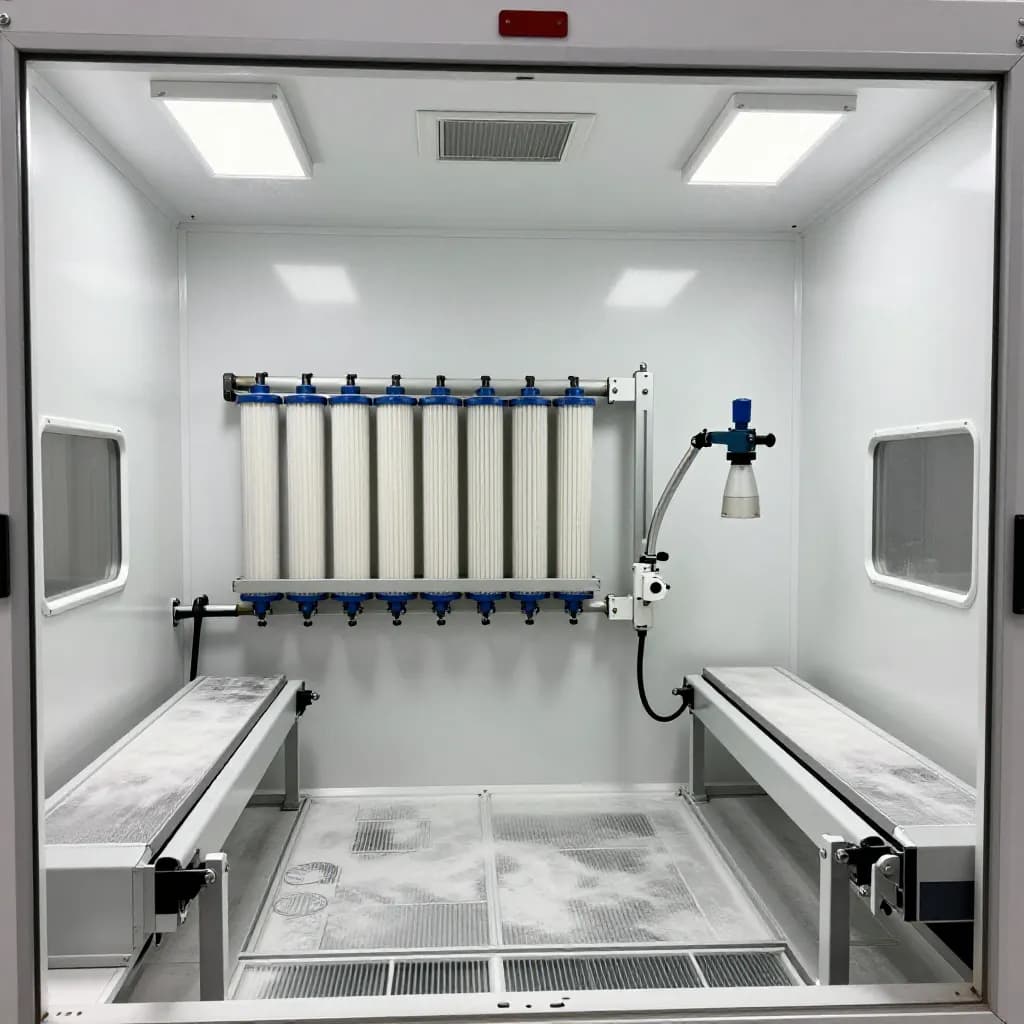
Booth design must satisfy multiple competing requirements. Airflow must be sufficient to contain overspray and prevent powder from escaping the booth enclosure, but not so aggressive that it strips deposited powder from parts or creates turbulence that disrupts spray patterns. The booth interior must be easy to clean for color changes, yet durable enough to withstand daily production. The reclaim system must efficiently separate powder from the air stream for reuse, while preventing cross-contamination between colors.
Ready to Start Your Project?
From one-off customs to 15,000-part production runs — get precise pricing in 24 hours.
On This Page
The Spray Booth: Heart of the Powder Coating System
The two fundamental booth types — cartridge filter booths and cyclone reclaim booths — represent different engineering approaches to these requirements. Cartridge booths use replaceable filter elements to capture overspray directly from the booth air stream. Cyclone booths use centrifugal separation to remove powder from the air before it reaches the final filters. Each type has distinct advantages for different production scenarios, and the choice between them is one of the most consequential decisions in powder coating system design.
Cartridge Filter Booths: Design and Operation
Cartridge filter booths capture overspray powder by drawing booth air through cylindrical or flat-panel filter cartridges made of pleated polyester or PTFE-coated media. The powder collects on the outer surface of the filter cartridges, and periodic reverse-pulse air jets dislodge the accumulated powder into a collection hopper below the filters. The cleaned air passes through the filter media and is either exhausted outside or recirculated to the plant.
The filter cartridges are the critical component of this booth type. Pleated polyester cartridges provide high surface area in a compact package — a standard 12-inch diameter by 26-inch long cartridge has approximately 200 square feet of filter media. PTFE (polytetrafluoroethylene) membrane-coated cartridges offer superior powder release during pulse cleaning, maintaining lower pressure drop and more consistent airflow over the filter life. The number and size of cartridges are determined by the booth airflow volume and the maximum allowable air-to-cloth ratio — typically 4:1 to 6:1 (CFM per square foot of filter media) for powder coating applications.
Cartridge booths excel in quick color change applications because the smooth booth interior surfaces and the filter cartridges can be cleaned rapidly. Modern quick-change cartridge booths feature smooth, non-porous interior panels (stainless steel, polypropylene, or powder-coated aluminum), rounded interior corners that eliminate powder accumulation points, and automated cleaning systems that blow down interior surfaces with compressed air. Color change times of 3–10 minutes are achievable with well-designed cartridge booths, making them the standard choice for operations that change colors frequently — 5 or more times per shift.
Cyclone Reclaim Booths: Design and Operation
Cyclone reclaim booths use centrifugal separation to remove overspray powder from the booth air stream. Powder-laden air is drawn from the booth into one or more cyclone separators, where the air enters tangentially and spins in a vortex. The centrifugal force drives the heavier powder particles to the cyclone wall, where they spiral downward into a collection hopper. The cleaned air exits through the top of the cyclone and passes through a final filter bank before exhaust or recirculation.
Cyclone separation efficiency depends on particle size — larger particles are separated more efficiently than smaller ones. A well-designed cyclone achieves 95–98% separation efficiency for particles above 10 microns, which represents the majority of powder coating overspray. However, fine particles below 10 microns (fines) pass through the cyclone and are captured by the after-filter. These fines are typically discarded rather than returned to the reclaim system, as they can cause surface finish defects and inconsistent fluidization.
Cyclone booths are preferred for high-volume, single-color or limited-color operations where reclaim efficiency and powder quality are priorities. The cyclone separation process is gentler on the powder than cartridge filtration — powder collected from a cyclone retains its original particle size distribution more closely than powder scraped from filter cartridges, which tends to include more fines from particle attrition. This higher-quality reclaim powder produces more consistent coating results when blended back with virgin powder. However, cyclone booths are slower to change colors than cartridge booths because the cyclone interior, ductwork, and collection hopper must all be cleaned — a process that typically takes 15–30 minutes. For operations running fewer than 3–4 color changes per shift, the superior reclaim quality of cyclone booths may outweigh the longer changeover time.
Quick Color Change Booth Design Principles
Quick color change (QCC) booth design is a specialized discipline focused on minimizing the time and labor required to switch between powder colors. Every minute of color change time is a minute of lost production, and in operations that change colors 10–20 times per shift, changeover time can consume 15–30% of available production time if the booth is not designed for rapid cleaning.
The fundamental principles of QCC booth design are: minimize interior surface area, eliminate powder traps, use non-stick materials, and automate the cleaning process. Interior surface area is minimized by making the booth as compact as possible while still providing adequate space for the parts and spray equipment. Powder traps — ledges, corners, joints, fastener heads, and rough surfaces where powder accumulates — are eliminated through smooth, seamless interior construction with radiused corners and flush-mounted fixtures.
Non-stick interior materials prevent powder from adhering to booth surfaces. Polypropylene panels, PTFE-coated surfaces, and electropolished stainless steel all provide low surface energy that allows powder to be easily blown off with compressed air. Some booths use conductive plastic panels that dissipate electrostatic charge, preventing powder from being electrostatically attracted to the booth walls.
Automated cleaning systems use arrays of compressed air nozzles mounted inside the booth that activate during color change to blow residual powder from all interior surfaces into the reclaim system. The cleaning sequence is programmable, with nozzles activating in a coordinated pattern that sweeps powder from top to bottom and from the booth interior toward the exhaust. Combined with automatic purging of the powder feed system and gun hoses, a fully automated QCC system can complete a color change in 3–5 minutes with no manual intervention.
Airflow Design and Containment Engineering
Booth airflow design must achieve two objectives: contain overspray powder within the booth enclosure to protect operators and the surrounding environment, and provide a controlled air environment within the booth that supports consistent electrostatic deposition. These objectives require careful engineering of air velocity, flow direction, and uniformity across the booth cross-section.
NFPA 33 (Standard for Spray Application Using Flammable or Combustible Materials) establishes the minimum airflow requirements for powder coating booths. The standard requires a minimum average face velocity of 60 feet per minute (0.3 m/s) at the booth openings, with no point below 50 FPM. This velocity is sufficient to prevent powder from escaping the booth during normal operation. However, many booth designers target 80–100 FPM (0.4–0.5 m/s) to provide a safety margin for door openings, operator movement, and transient air disturbances.
Airflow direction within the booth affects powder deposition patterns and transfer efficiency. Cross-draft booths draw air horizontally from the booth opening to the exhaust plenum on the opposite wall. Downdraft booths draw air vertically from ceiling-mounted supply plenums to floor-level exhaust. Downdraft designs generally provide more uniform airflow and better containment but require more complex booth construction and higher fan power. Cross-draft designs are simpler and less expensive but can create asymmetric deposition patterns if the airflow velocity is too high on the exhaust side of the booth.
Airflow uniformity across the booth cross-section is critical for consistent coating quality. Variations in air velocity create corresponding variations in powder deposition — areas of high velocity strip powder from parts, while areas of low velocity allow powder to escape containment. Perforated exhaust plenums, adjustable dampers, and CFD-optimized booth geometry are used to achieve velocity uniformity within ±15% across the booth opening.
Reclaim Powder Management and Virgin/Reclaim Blending
Managing reclaimed overspray powder is essential for maintaining coating quality while maximizing material utilization. Reclaimed powder differs from virgin powder in several ways: it has a broader particle size distribution (more fines from attrition and more agglomerates from electrostatic clumping), it may contain trace contaminants from the booth environment, and it may have reduced electrostatic charging efficiency due to residual charge on the particles.
The standard practice is to blend reclaimed powder with virgin powder at a controlled ratio, typically 70–80% virgin and 20–30% reclaim for high-quality applications, or 50–60% virgin and 40–50% reclaim for less critical applications. The blend ratio is determined by testing — coating panels with increasing reclaim percentages and evaluating surface finish, color consistency, and film properties until the maximum acceptable reclaim ratio is identified.
Reclaim powder quality is maintained through sieving — passing the reclaimed powder through a vibrating screen (typically 150–200 mesh / 75–100 microns) to remove agglomerates, contaminants, and oversized particles before blending with virgin powder. Automatic sieving systems integrated into the reclaim path provide continuous quality control without operator intervention. Particle size analysis of the reclaim powder using laser diffraction should be performed periodically (weekly or monthly) to verify that the size distribution remains within acceptable limits.
For operations running multiple colors, cross-contamination between colors during reclaim is a critical concern. Even trace amounts of a contrasting color in the reclaim stream can cause visible color defects. Dedicated reclaim systems for each high-volume color, combined with thorough booth cleaning during color changes, minimize cross-contamination risk. Low-volume colors are typically sprayed to waste (no reclaim) to avoid contaminating the reclaim system.
Safety, Compliance, and Explosion Protection
Powder coating booths operate with combustible dust suspended in air — a condition that creates an explosion hazard if the dust concentration exceeds the minimum explosible concentration (MEC) and an ignition source is present. NFPA 33 and NFPA 652 (Standard on the Fundamentals of Combustible Dust) establish the safety requirements for powder coating booth design and operation.
The primary explosion prevention strategy is maintaining the powder concentration in the booth air well below the MEC, which is typically 20–30 g/m³ for most powder coating materials. At normal operating conditions, the powder concentration in a well-ventilated booth is 1–5 g/m³ — well below the MEC. However, localized concentrations near the spray guns can be higher, and upset conditions (reclaim system failure, excessive powder flow, or loss of booth ventilation) can allow concentrations to approach dangerous levels.
Explosion protection measures required by NFPA 33 include: explosion relief venting (panels that open to relieve pressure in the event of a deflagration), electrical classification of the booth interior as a Class II, Division 2 hazardous location (requiring explosion-proof or dust-ignition-proof electrical equipment), grounding and bonding of all conductive components to prevent static discharge, interlocks that shut down powder delivery if booth airflow drops below the minimum, and fire detection and suppression systems. Ductwork connecting the booth to the reclaim system must be designed to prevent powder accumulation (minimum transport velocity of 4,000 FPM per ACGIH guidelines) and must include explosion isolation devices (chemical suppression barriers or fast-acting valves) to prevent flame propagation between the booth and the reclaim equipment.
Regular housekeeping — preventing powder accumulation on booth exteriors, ductwork, structural steel, and building surfaces — is a critical safety requirement. NFPA 652 specifies that combustible dust accumulations exceeding 1/32 inch over 5% of the floor area constitute a deflagration hazard requiring immediate cleaning.
Frequently Asked Questions
What is the difference between cartridge and cyclone powder coating booths?
Cartridge booths capture overspray on filter elements and excel at quick color changes (3–10 minutes). Cyclone booths use centrifugal separation and produce higher-quality reclaim powder but take longer to change colors (15–30 minutes). Cartridge booths suit frequent color changes; cyclone booths suit high-volume, limited-color operations.
How fast can a quick color change booth switch colors?
Well-designed quick color change booths with automated cleaning systems can complete a color change in 3–5 minutes with no manual intervention. This requires smooth non-stick interior surfaces, radiused corners, automated blow-down nozzles, and automatic powder feed system purging.
What airflow velocity is required in a powder coating booth?
NFPA 33 requires a minimum average face velocity of 60 FPM (0.3 m/s) at booth openings, with no point below 50 FPM. Many designers target 80–100 FPM for a safety margin. Airflow must be uniform across the booth cross-section within ±15% for consistent coating quality.
What ratio of reclaim to virgin powder should be used?
Typical blend ratios are 70–80% virgin with 20–30% reclaim for high-quality applications, or 50–60% virgin with 40–50% reclaim for less critical work. The maximum acceptable ratio is determined by testing coated panels for surface finish, color consistency, and film properties at increasing reclaim percentages.
Are powder coating booths an explosion hazard?
Yes. Suspended powder in air is a combustible dust hazard. NFPA 33 requires explosion relief venting, hazardous location electrical classification, grounding and bonding, airflow interlocks, and fire suppression. Normal operating concentrations (1–5 g/m³) are well below the minimum explosible concentration (20–30 g/m³), but upset conditions must be prevented.
Ready to Start Your Project?
From one-off customs to 15,000-part production runs — get precise pricing in 24 hours.