Powder coating operations fall into two broad categories based on how parts move through the process: batch systems and continuous (conveyor) systems. The choice between these approaches is one of the most consequential decisions a coating operation makes, affecting throughput capacity, labor requirements, energy consumption, quality consistency, flexibility, and capital investment. Understanding the strengths and limitations of each approach helps operators, investors, and buyers make informed decisions about coating line design and coater selection.
Technical
Powder Coating Batch vs Continuous Lines: Throughput, Investment, and Choosing the Right System
Sundial Powder Coating·April 22, 2026·13 min
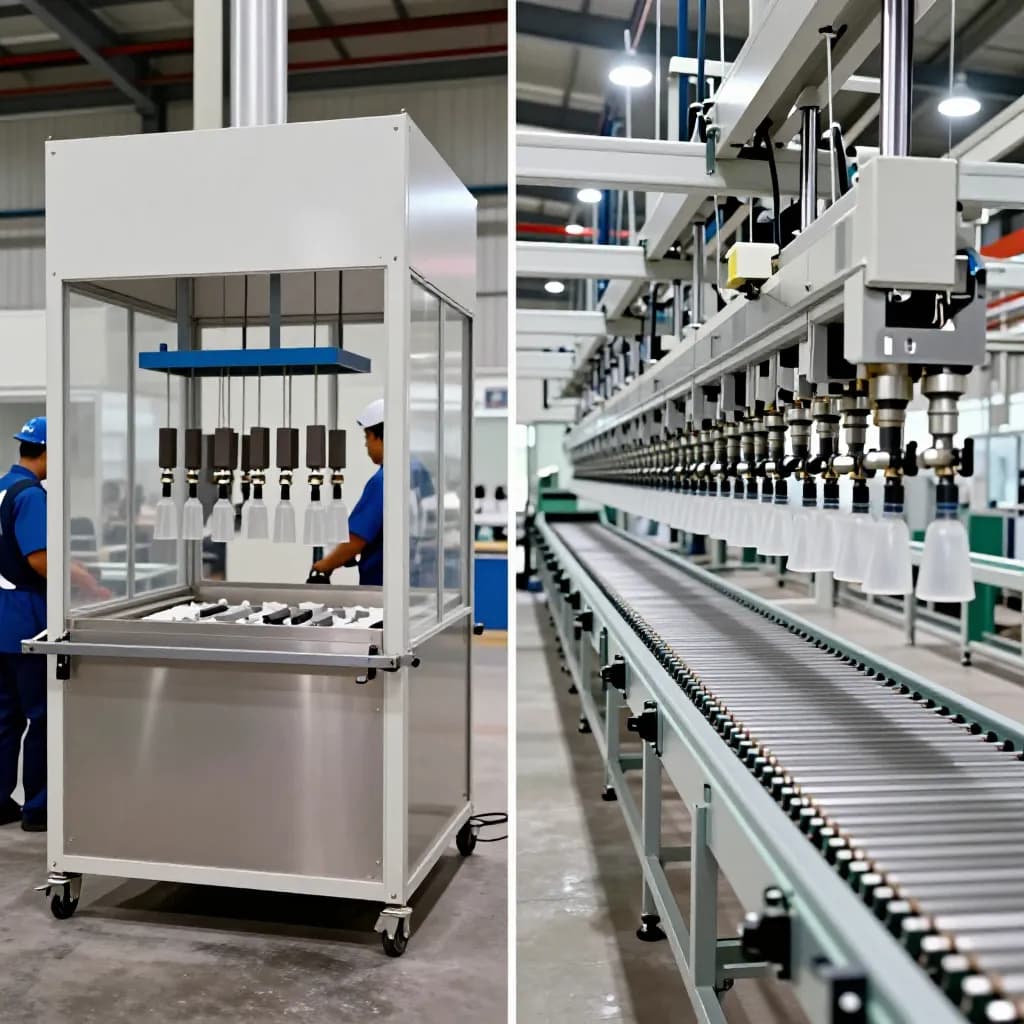
In a batch system, parts are loaded onto racks or carts, moved manually or semi-automatically through each process stage — pretreatment, drying, powder application, and curing — and unloaded after cooling. Each batch of parts completes one stage before moving to the next, and the oven processes one load at a time. Batch systems are the simpler, lower-cost option and are the standard configuration for job shops, small manufacturers, and operations that coat a wide variety of part sizes and types.
Ready to Start Your Project?
From one-off customs to 15,000-part production runs — get precise pricing in 24 hours.
On This Page
Two Fundamentally Different Production Approaches
In a continuous system, parts are hung on an overhead conveyor that moves them through all process stages in a continuous flow — pretreatment tunnel, dry-off oven, spray booth, cure oven, and cooling zone — without stopping. The conveyor runs at a constant speed, and parts enter and exit the system continuously. Continuous systems are designed for high-volume production of similar parts and offer superior throughput, consistency, and labor efficiency compared to batch systems.
Batch Systems: Flexibility and Accessibility
Batch powder coating systems are the entry point for most coating operations and remain the preferred choice for job shops, custom coaters, and manufacturers with diverse product mixes. The defining characteristic of a batch system is its flexibility — the ability to accommodate parts of widely varying sizes, shapes, and coating requirements without the constraints imposed by a fixed conveyor path and speed.
A typical batch system consists of a pretreatment station (which may be a multi-stage spray washer, a dip tank system, or manual cleaning), a batch oven that serves as both dry-off and cure oven (or separate ovens for each function), and a powder spray booth. Parts are racked on wheeled carts or stationary racks, moved between stations by forklift, overhead crane, or manual pushing, and loaded into the oven one rack at a time.
The flexibility advantages of batch systems are significant. Parts of any size that fit in the oven can be coated — from small brackets to large structural assemblies. Color changes are straightforward because the spray booth can be cleaned between batches without affecting a continuous production flow. Different cure schedules can be used for different products simply by adjusting the oven time and temperature for each batch. And the system can be operated by a small crew, making it economical for low to moderate production volumes.
The trade-offs are lower throughput per hour, higher labor intensity per part, less consistent process conditions (oven temperature varies as doors open and close), and higher energy consumption per part because the oven must reheat after each door opening cycle.
Continuous Lines: Throughput and Consistency
Continuous powder coating lines are engineered for high-volume production where throughput, consistency, and labor efficiency are priorities. The overhead conveyor — typically a power-and-free or monorail system — moves parts through the entire process at a constant speed, creating a steady-state production flow where parts are continuously entering and exiting the system.
The throughput advantage of continuous lines is substantial. A well-designed continuous line can process hundreds or thousands of parts per shift, with cycle times measured in minutes per part rather than hours per batch. The conveyor speed determines the production rate: a faster conveyor processes more parts per hour but requires longer ovens and pretreatment tunnels to maintain adequate exposure time at each stage. Line speed is typically expressed in meters per minute, and the relationship between line speed, oven length, and cure time is the fundamental design equation for continuous systems.
Process consistency is another major advantage. In a continuous system, every part experiences the same pretreatment exposure time, the same dry-off temperature, the same spray booth conditions, and the same cure temperature and time. The oven maintains a stable temperature because it is never opened — parts enter and exit through openings designed to minimize heat loss. This consistency translates directly into more uniform coating quality, fewer defects, and more predictable performance across large production runs.
Labor efficiency improves because the conveyor eliminates the manual handling required to move parts between stations in a batch system. Operators focus on loading parts at the entry point, monitoring the spray booth, and unloading finished parts at the exit — the conveyor handles all intermediate transport. Automatic spray systems with reciprocating or robotic guns further reduce labor requirements in the application stage.
Throughput Calculation and Line Sizing
Calculating the throughput of a powder coating line — whether batch or continuous — requires understanding the relationship between part size, process times, and system capacity. Getting this calculation right during the design phase prevents the costly problem of a line that cannot meet production requirements.
For batch systems, throughput is determined by the oven capacity (how many parts fit in one load), the total cycle time per batch (load time + heat-up time + cure time + cool-down time + unload time), and the number of operating hours per shift. A batch oven that holds 20 parts, with a total cycle time of 90 minutes including loading and unloading, can process approximately 5 to 6 batches in an 8-hour shift, yielding 100 to 120 parts per shift. Increasing throughput requires either a larger oven, a shorter cycle time, or additional shifts.
For continuous systems, throughput is determined by the conveyor speed, the part spacing (center-to-center distance between parts on the conveyor), and the operating hours. If parts are spaced 0.5 meters apart on a conveyor running at 2 meters per minute, the line produces 4 parts per minute or 240 parts per hour. Over an 8-hour shift with 85% uptime (accounting for color changes, maintenance, and breaks), the line produces approximately 1,630 parts per shift.
The oven length required for a continuous line is calculated from the conveyor speed and the required cure time. If the cure schedule requires 15 minutes at metal temperature and the conveyor runs at 2 meters per minute, the cure zone must be at least 30 meters long — plus additional length for the heat-up zone where parts reach cure temperature. Pretreatment tunnel length is calculated similarly based on the required exposure time at each chemical stage.
Capital Investment and Operating Costs
The capital investment required for a powder coating line varies enormously depending on the system type, capacity, automation level, and pretreatment complexity. Understanding the cost structure helps operators make investment decisions that align with their production requirements and financial constraints.
Batch systems represent the lower end of the investment spectrum. A basic batch system — manual pretreatment, a single batch oven, and a manual spray booth with basic reclaim — can be established for a relatively modest investment. This makes batch systems accessible to small manufacturers, startup job shops, and operations testing the powder coating market before committing to larger investments. The trade-off is higher per-part operating costs due to lower throughput and higher labor intensity.
Continuous lines require significantly higher capital investment. The conveyor system alone — including track, carriers, drives, and controls — represents a major cost element. Add a multi-stage pretreatment tunnel with chemical management systems, a dry-off oven, an automatic spray booth with multi-gun reciprocators and advanced reclaim, a cure oven sized for the required line speed, and a cooling zone, and the total investment is substantial. However, the per-part operating cost is much lower due to higher throughput, lower labor per part, and better energy efficiency.
Energy costs differ significantly between the two approaches. Batch ovens lose heat every time the door opens, requiring energy to reheat. Continuous ovens maintain stable temperature with minimal heat loss, consuming less energy per part. Pretreatment energy costs are also lower in continuous systems because the tunnel maintains temperature continuously rather than heating and cooling with each batch. Over high production volumes, the energy savings of a continuous system contribute meaningfully to the return on the higher capital investment.
Flexibility vs Efficiency: Making the Right Choice
The batch-versus-continuous decision ultimately comes down to the balance between flexibility and efficiency that best serves the operation's business model and customer requirements.
Choose a batch system when the product mix is diverse — many different part sizes, shapes, colors, and specifications — and production volumes per color or part type are relatively low. Job shops that coat parts for multiple customers across different industries are natural batch operations. Custom coaters specializing in small-lot, high-variety work need the flexibility to change colors frequently, accommodate unusual part geometries, and adjust cure schedules for different powder types. Batch systems also make sense for operations with limited capital, limited floor space, or uncertain demand that does not justify a large fixed investment.
Choose a continuous system when production volumes are high, the product mix is relatively narrow, and throughput efficiency is a competitive requirement. Manufacturers coating their own products — appliance makers, furniture manufacturers, automotive component suppliers — often reach a volume threshold where the labor and energy savings of a continuous line justify the investment. Architectural coating operations processing large quantities of aluminum extrusions and panels for building projects benefit from the consistency and throughput of continuous lines.
Hybrid approaches are increasingly common. Some operations run a continuous line for their high-volume standard products and maintain a batch system alongside it for custom colors, prototypes, and small-lot work. This combination captures the efficiency of continuous production for the bulk of the volume while preserving the flexibility needed for diverse, lower-volume work.
Automation and Industry 4.0 Integration
Modern powder coating lines — both batch and continuous — are increasingly incorporating automation and digital technologies that improve quality, efficiency, and traceability. These Industry 4.0 capabilities are transforming coating operations from labor-intensive manual processes into data-driven, semi-autonomous production systems.
Automatic spray systems using reciprocating guns, robotic arms, or a combination of both can apply powder with greater consistency and speed than manual operators. Reciprocators move guns in a programmed pattern across the part surface, adjusting stroke length and speed to match the part geometry. Robots offer even greater flexibility, following complex three-dimensional paths programmed from CAD models of the parts. Automatic systems reduce labor costs, improve film thickness consistency, and minimize powder waste through optimized spray patterns.
Process monitoring and control systems collect real-time data from sensors throughout the line — oven temperatures, conveyor speed, pretreatment chemical concentrations, spray gun parameters, and film thickness measurements. This data is logged, analyzed, and used to detect process deviations before they produce defective parts. Alerts notify operators when parameters drift outside acceptable ranges, enabling immediate corrective action.
Digital traceability systems link each part to its complete process history — which pretreatment chemicals it was exposed to, which powder batch was used, what the oven temperature profile was, and what the inspection results were. This traceability supports quality management, warranty documentation, and root cause analysis when defects occur. Barcode or RFID tags on racks or individual parts enable automatic tracking through the production process, eliminating manual data entry and reducing the risk of documentation errors.
Frequently Asked Questions
What is the main difference between batch and continuous powder coating?
In batch systems, parts are loaded into an oven one rack at a time and processed in discrete batches. In continuous systems, parts move on an overhead conveyor through all process stages in a continuous flow. Batch systems offer more flexibility for diverse products; continuous systems offer higher throughput and consistency for volume production.
How do I calculate the throughput of a powder coating line?
For batch systems: divide operating hours by total cycle time per batch, then multiply by parts per batch. For continuous systems: divide conveyor speed by part spacing to get parts per minute, then multiply by operating minutes per shift. Account for downtime, color changes, and maintenance when calculating effective throughput.
When should I upgrade from batch to continuous powder coating?
Consider upgrading when production volumes consistently exceed batch system capacity, when labor costs for manual handling become a significant expense, when quality consistency across large runs is critical, or when per-part cost reduction is needed to remain competitive. The investment must be justified by sufficient volume to achieve a reasonable payback period.
Can a continuous line handle frequent color changes?
Continuous lines can handle color changes, but each change requires purging the spray booth and reclaim system, which takes time and generates waste powder. Lines designed for frequent color changes use quick-change booth systems that minimize changeover time. If your operation requires many color changes per shift, a batch system or a hybrid approach may be more practical.
What is a power-and-free conveyor in powder coating?
A power-and-free conveyor has two tracks — a powered track that runs continuously and a free track that carries the part carriers. Parts can be stopped, accumulated, switched between tracks, and routed to different stations independently of the main conveyor movement. This flexibility allows different parts to receive different process sequences on the same line.
Ready to Start Your Project?
From one-off customs to 15,000-part production runs — get precise pricing in 24 hours.