The chassis and frame of a vehicle are its structural foundation, bearing the weight of the body, engine, drivetrain, and occupants while absorbing the dynamic loads of acceleration, braking, cornering, and road impacts. Corrosion of these critical structural members compromises vehicle safety, reduces service life, and can render a vehicle unroadworthy. In regions where road salt is used for winter de-icing, chassis corrosion is the primary factor limiting vehicle longevity, with unprotected steel frames showing significant structural degradation within 8-12 years.
Automotive
Powder Coating for Automotive Chassis and Frames: Underbody Protection for Road and Off-Road Vehicles
Sundial Powder Coating·April 22, 2026·12 min
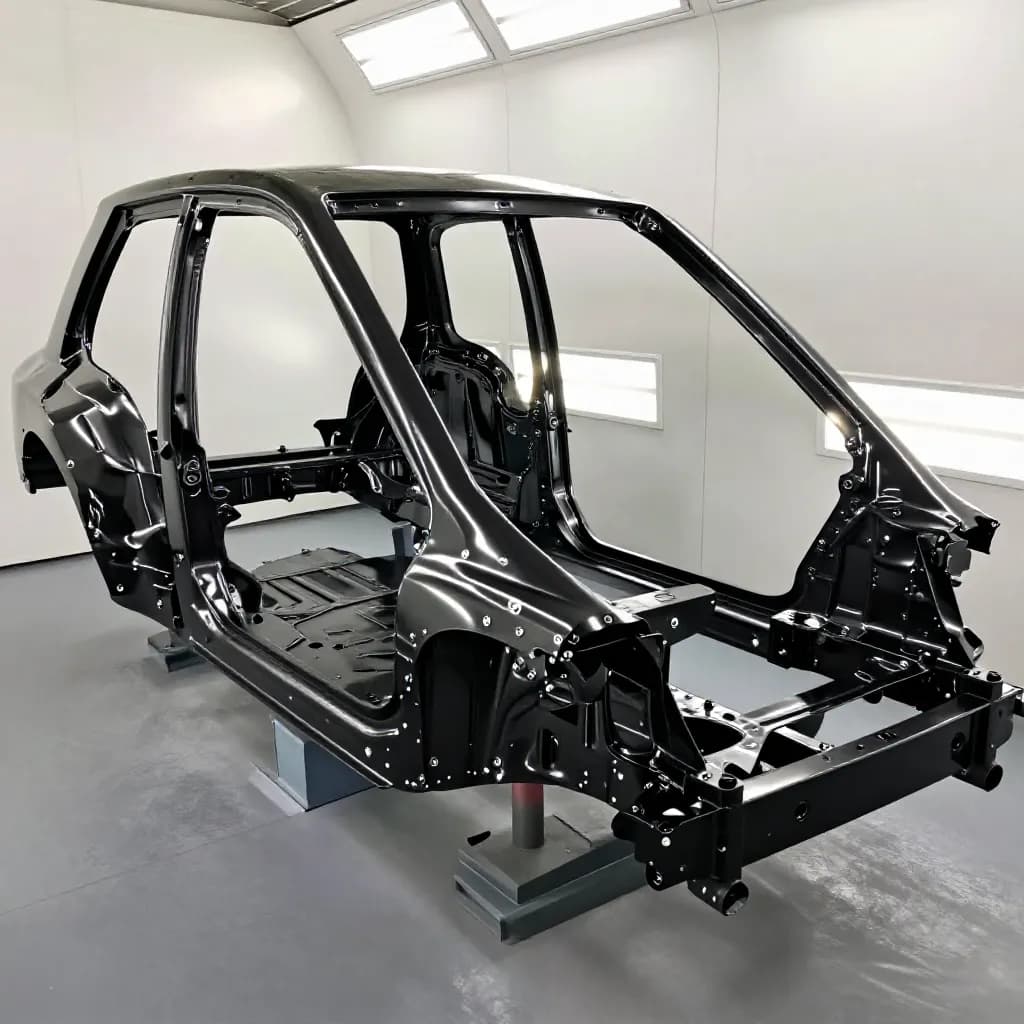
Powder coating has established itself as a premium chassis protection technology, offering advantages over traditional underbody treatments such as bituminous underseal, wax-based cavity protection, and rubberized spray coatings. Unlike these soft, sacrificial coatings that gradually wear away and require periodic reapplication, powder coating creates a hard, permanently bonded barrier that resists stone chips, abrasion, and chemical attack for the life of the vehicle.
Ready to Start Your Project?
From one-off customs to 15,000-part production runs — get precise pricing in 24 hours.
On This Page
Why Chassis and Frame Protection Matters
The automotive OEM sector uses powder coating extensively for chassis components, subframes, suspension parts, and structural brackets. In the aftermarket, powder coating has become the finish of choice for vehicle restoration, off-road vehicle preparation, and performance vehicle builds where maximum corrosion protection and a professional appearance are required.
This article examines the specific requirements, preparation methods, coating systems, and performance standards for powder coating automotive chassis and frame components, covering both OEM production and aftermarket applications.
Underbody Exposure Conditions and Corrosion Mechanisms
Understanding the exposure conditions that automotive chassis components face is essential for specifying the correct powder coating system. The underbody environment is one of the most aggressive corrosion scenarios encountered in any powder coating application, combining multiple corrosion mechanisms simultaneously.
Stone chip impact is the primary mechanical threat to underbody coatings. Stones, gravel, and road debris thrown up by the vehicle's own tires and by other vehicles impact the chassis at velocities of 50-100 km/h, creating localized coating damage that exposes the steel substrate. The standard test for stone chip resistance is ISO 20567-1 (multi-impact test using a gravelometer), which fires standardized steel shot at coated panels under controlled conditions. Automotive chassis coatings must achieve a rating of 2 or better on the 0-5 scale, indicating minimal coating removal.
Road salt creates an electrolytic environment that dramatically accelerates corrosion. Sodium chloride and calcium chloride solutions, used for winter de-icing in cold climates, penetrate any coating defects and establish galvanic corrosion cells at the steel surface. Salt spray testing per ASTM B117 is the standard accelerated corrosion test, with automotive chassis coatings typically required to achieve 1,000-1,500 hours without significant corrosion creep from scribed lines.
Moisture retention in box sections, seams, and crevices creates persistent wet conditions that sustain corrosion even in dry weather. Chassis designs that trap water and road debris in enclosed sections are particularly vulnerable, and coating systems for these areas must provide excellent adhesion and moisture barrier properties to prevent underfilm corrosion.
Chemical exposure from road surface treatments, fuel, brake fluid, engine oil, and transmission fluid adds another dimension to the corrosion challenge. Powder coatings for chassis applications must resist these chemicals without softening, swelling, or losing adhesion.
Powder Coating Systems for Chassis Protection
The optimal powder coating system for automotive chassis depends on the severity of the exposure conditions and the required service life. Single-coat, dual-coat, and duplex systems each offer different levels of protection at different cost points.
Single-coat polyester powder coating at 80-100 microns provides good general-purpose chassis protection suitable for vehicles operating in mild to moderate climates without heavy road salt exposure. The polyester chemistry offers a good balance of UV resistance (important for exposed underbody surfaces), flexibility, and chemical resistance. This system is commonly used for aftermarket restoration of classic vehicles that will see limited winter driving.
Dual-coat systems using an epoxy primer (40-60 microns) followed by a polyester topcoat (60-80 microns) provide significantly enhanced corrosion protection. The epoxy primer delivers excellent adhesion to the steel substrate and superior moisture barrier properties, while the polyester topcoat provides UV resistance and mechanical durability. This system routinely achieves 1,000-1,500 hours of salt spray resistance and is the standard specification for chassis components on vehicles operating in salt-belt regions.
For maximum protection, a triplex system combining hot-dip galvanizing, epoxy powder primer, and polyester powder topcoat provides the ultimate chassis coating. The zinc galvanizing layer offers sacrificial cathodic protection at any coating damage sites, the epoxy primer seals the zinc surface and provides adhesion, and the polyester topcoat delivers UV and mechanical protection. This system can achieve 2,000+ hours of salt spray resistance and is specified for premium off-road vehicles, military vehicles, and vehicles intended for extreme environments.
Epoxy-polyester hybrid powder coatings offer a single-coat compromise that provides better corrosion resistance than straight polyester but with reduced UV stability. For chassis components that are largely shielded from direct sunlight, hybrids at 80-120 microns provide excellent protection at lower cost than dual-coat systems.
Surface Preparation for Automotive Chassis Components
Surface preparation is the single most important factor determining the longevity of powder coating on automotive chassis. The complex geometries of chassis components — box sections, flanged joints, spot-welded seams, and threaded mounting points — create numerous areas where contamination can hide and corrosion can initiate if preparation is inadequate.
For new steel chassis components in OEM production, the preparation sequence typically includes alkaline degreasing to remove stamping oils and forming lubricants, followed by zinc phosphate conversion coating applied by spray or immersion. The zinc phosphate layer (coating weight 1.5-4.0 g/m²) provides a crystalline surface that enhances powder adhesion and adds a secondary corrosion barrier at the metal-coating interface. OEM chassis coating lines achieve consistent preparation quality through automated process control, with regular monitoring of bath chemistry, temperature, and contact time.
Aftermarket chassis restoration requires more intensive preparation because the substrate condition is far more variable. Existing paint, underseal, surface rust, and deep pitting must all be addressed before powder coating can be applied. Abrasive blasting is the standard preparation method, with the following considerations specific to chassis work.
Media selection affects both surface cleanliness and profile. Steel grit (G25 or G40) produces an angular profile of 50-75 microns that is ideal for powder adhesion on heavy chassis sections. Aluminum oxide (36-60 grit) is preferred for thinner gauge components where the aggressive cutting action of steel grit might cause warping. Garnet and glass bead media are too gentle for chassis preparation and should be avoided.
Blasting to Sa 2.5 (near-white metal) per ISO 8501-1 is the minimum acceptable standard for chassis components. Sa 3 (white metal) preparation is recommended for components that will operate in severe corrosion environments. All mill scale, rust, old coatings, and surface contamination must be removed, and the blasted surface must be coated within 4 hours (or 2 hours in humid conditions) to prevent flash rusting.
Threaded holes, mounting points, and mating surfaces that must remain uncoated require masking before powder application. High-temperature silicone plugs and tape rated for 200°C+ withstand the powder curing cycle without degradation.
Off-Road Vehicle and 4x4 Chassis Applications
Off-road vehicles subject their chassis to the most extreme conditions of any automotive application. In addition to the stone chips, salt, and moisture that affect all vehicles, off-road chassis must withstand mud immersion, water crossing, rock impacts, sand abrasion, and exposure to vegetation acids and soil chemicals. The coating system must maintain protection under these conditions while also surviving the flexing and torsional loads that off-road driving imposes on the chassis structure.
For serious off-road vehicles — including competition vehicles, expedition vehicles, and military applications — the duplex system of hot-dip galvanizing plus powder coating is the gold standard. The galvanizing provides sacrificial protection at the inevitable damage sites that off-road driving creates, while the powder coating prevents the rapid zinc consumption that would occur if the galvanizing were left exposed to mud, water, and abrasive debris.
Rock sliders, skid plates, and underbody armor are high-wear components that benefit from heavy-duty powder coating at 100-150 microns. These components experience direct rock impacts and sliding abrasion that would quickly destroy thinner coatings. Some off-road builders specify textured powder coatings for these components, as the rough surface texture provides additional abrasion resistance and disguises minor damage.
Suspension components — control arms, radius arms, panhard rods, and spring hangers — are commonly powder coated in the aftermarket as part of lift kit installations and suspension upgrades. These components experience continuous vibration, flexing, and stone impact, requiring coatings with excellent adhesion and flexibility. Epoxy primer plus polyester topcoat systems are standard for suspension components, with particular attention to coating coverage at weld joints and stress concentration points.
Water crossing capability is a key requirement for expedition and military vehicles. Chassis coatings must withstand prolonged immersion in fresh and brackish water without blistering, delaminating, or losing adhesion. Immersion testing per ASTM D870 (distilled water) and ASTM D1735 (salt water) for 500-1,000 hours validates coating performance under these conditions.
Classic Vehicle Restoration and Chassis Refinishing
The classic vehicle restoration market has embraced powder coating as the premium chassis finishing option, replacing the brush-applied chassis black paint and bituminous underseal that were standard when these vehicles were originally manufactured. For restoration enthusiasts investing significant time and money in bringing a classic vehicle back to concours condition, powder coating provides a level of protection and finish quality that original-specification coatings cannot match.
The restoration process begins with complete disassembly of the chassis, removing all mechanical components, brackets, and hardware. This bare-chassis approach ensures that every surface is accessible for preparation and coating, eliminating the hidden corrosion traps that plague partial restoration efforts. Disassembly also allows thorough inspection of the chassis for structural damage, fatigue cracking, and corrosion that may require repair before coating.
Chemical stripping or abrasive blasting removes all existing coatings, underseal, and corrosion products. For chassis with heavy underseal buildup, thermal stripping in a burn-off oven at 400-450°C is an effective first step that reduces the old coating to ash, which is then removed by blasting. This two-stage approach is faster and more thorough than blasting alone for heavily coated chassis.
Color selection for restored chassis is an area where powder coating offers significant advantages. While original chassis finishes were typically limited to black or dark grey, powder coating allows restoration to original colors or the selection of custom colors that complement the vehicle's body color. Satin black remains the most popular choice for concours restorations, providing an authentic appearance with far superior protection. Gloss black, semi-gloss, and color-matched options are popular for custom and restomod builds.
Heat management is an important consideration for chassis components near exhaust systems. Standard polyester powder coatings are rated for continuous service at 80-120°C, which is adequate for most chassis surfaces. However, exhaust hangers, heat shields, and components within 150 mm of exhaust pipes may require high-temperature powder coatings rated for 200-300°C continuous service.
Reassembly after powder coating requires care to avoid damaging the new finish. Torque specifications for bolted connections should be followed precisely, as over-torquing can crack the coating at washer contact points. Anti-seize compound on threaded fasteners prevents galling without damaging the surrounding coating.
Salt Spray Testing and Corrosion Performance Standards
Quantifying the corrosion protection provided by powder coating on automotive chassis requires standardized testing methods that simulate years of real-world exposure in compressed timeframes. Several test methods are used, each evaluating different aspects of coating performance.
ASTM B117 neutral salt spray testing is the most widely used accelerated corrosion test for automotive coatings. Test panels are scribed through the coating to the bare steel substrate and exposed to a continuous 5% sodium chloride fog at 35°C. Corrosion creep from the scribe line is measured at intervals, with maximum allowable creep of 2-3 mm after the specified test duration. Automotive chassis coatings are typically tested for 500-1,500 hours depending on the coating system and intended application severity.
Cyclic corrosion testing per SAE J2334 or GMW 14872 provides a more realistic simulation of real-world automotive corrosion by alternating between salt spray, humidity, and drying phases. These cyclic tests correlate better with field performance than continuous salt spray because they replicate the wet-dry cycling that drives corrosion in actual service. A typical automotive cyclic corrosion test runs for 60-120 cycles (each cycle lasting 24 hours), equivalent to 5-10 years of field exposure in severe salt-belt environments.
Stone chip resistance testing per ISO 20567-1 evaluates the coating's ability to withstand gravel impact without chipping. The gravelometer test fires 500 g of standardized steel shot at the coated panel at a pressure of 2 bar, and the resulting damage is rated on a 0-5 scale. Automotive chassis coatings should achieve a rating of 2 or better.
Adhesion after environmental exposure is tested by performing cross-cut adhesion tests (ISO 2409) on panels that have been subjected to salt spray, humidity, or water immersion. Adhesion retention of 4B or better after 500 hours of salt spray exposure indicates a robust coating system suitable for chassis applications.
Real-world correlation studies by automotive OEMs have established that 1,000 hours of ASTM B117 salt spray testing corresponds approximately to 5-7 years of service in severe salt-belt environments (northern US, Canada, Scandinavia) for well-prepared, dual-coat powder coating systems.
OEM Chassis Coating Processes and Industry Trends
Automotive OEMs apply powder coating to chassis components using highly automated production lines that achieve consistent quality at volumes of thousands of parts per hour. Understanding OEM processes provides context for the performance expectations and quality standards that define the automotive chassis coating market.
Modern automotive chassis coating lines use a combination of electrostatic spray application and electrocoat (e-coat) technology. E-coat — an electrodeposition process where the entire chassis or body-in-white is immersed in a paint bath and coating is deposited by electrical current — provides the primary corrosion protection layer at 18-25 microns. Powder coating is then applied to specific high-exposure areas such as underbody panels, subframes, and suspension mounting points to provide additional protection where it is most needed.
The trend toward lightweight vehicle construction has introduced new substrate materials that require adapted coating approaches. High-strength steel (HSS) and ultra-high-strength steel (UHSS) grades used in modern chassis structures have different surface chemistries than conventional mild steel, requiring modified pretreatment processes to achieve equivalent adhesion. Aluminum chassis components, increasingly common in premium vehicles, require chromate-free conversion coatings and powder formulations optimized for aluminum's thermal expansion characteristics.
Multi-material chassis designs that combine steel, aluminum, and composite materials present particular coating challenges. Different materials require different pretreatment chemistries, and the curing temperature of the powder coating must be compatible with all materials in the assembly. Low-temperature cure powder coatings (140-160°C) have been developed partly in response to this need, enabling powder coating of assemblies that include heat-sensitive components.
The electric vehicle revolution is creating new chassis coating requirements. Battery enclosures and structural battery packs require coatings with electrical insulation properties, thermal management characteristics, and resistance to battery electrolyte chemicals. Dielectric powder coatings that provide both corrosion protection and electrical isolation are being developed specifically for EV chassis applications, representing a significant growth area for the powder coating industry.
Frequently Asked Questions
How long does powder coating last on a vehicle chassis?
A dual-coat system (epoxy primer plus polyester topcoat) typically provides 10-15 years of protection in severe salt-belt environments and 20+ years in mild climates. Duplex systems with hot-dip galvanizing plus powder coating can last the entire vehicle life of 25-30 years even in aggressive conditions.
Is powder coating better than underseal for chassis protection?
Yes, for long-term protection. Powder coating creates a hard, permanently bonded barrier that resists stone chips and chemical attack, while underseal is a soft, sacrificial coating that wears away and requires reapplication every 2-3 years. Powder coating achieves 1,000-1,500 hours of salt spray resistance versus 200-400 hours for typical underseal products.
Can you powder coat a rusty chassis?
Yes, but all rust must be completely removed first. Abrasive blasting to Sa 2.5 or Sa 3 standard removes rust, old coatings, and mill scale. Any remaining rust under the powder coating will continue to corrode and cause coating failure. Thorough preparation is the single most important factor in chassis coating longevity.
What about powder coating near exhaust components?
Standard polyester powder coatings handle up to 120°C continuously. Components within 150 mm of exhaust pipes may need high-temperature silicone-modified polyester (200-300°C) or ceramic-based coatings. Exhaust manifolds and headers themselves require specialized high-temperature coatings rated for 500-600°C.
Does powder coating add significant weight to a chassis?
No. A typical dual-coat powder coating system adds approximately 100-150 grams per square meter of coated surface. For a complete vehicle chassis, this translates to roughly 1-2 kg of total coating weight — negligible compared to the chassis weight and far less than the weight of traditional underseal products.
Ready to Start Your Project?
From one-off customs to 15,000-part production runs — get precise pricing in 24 hours.