Powder coating has become the finish of choice for automotive enthusiasts, restoration shops, and aftermarket manufacturers seeking a durable, attractive, and chemically resistant coating for engine bay components, suspension parts, and chassis hardware. Unlike conventional spray paint or rattle-can finishes, powder coating creates a thermoset polymer film that bonds at the molecular level to properly prepared metal substrates, delivering impact resistance, chemical resistance, and UV stability that far exceed what liquid paints can achieve in automotive environments.
Automotive
Powder Coating Automotive Aftermarket Parts: The Complete Guide to Engine Bay, Suspension, and Restoration Finishing
Sundial Powder Coating·April 22, 2026·12 min
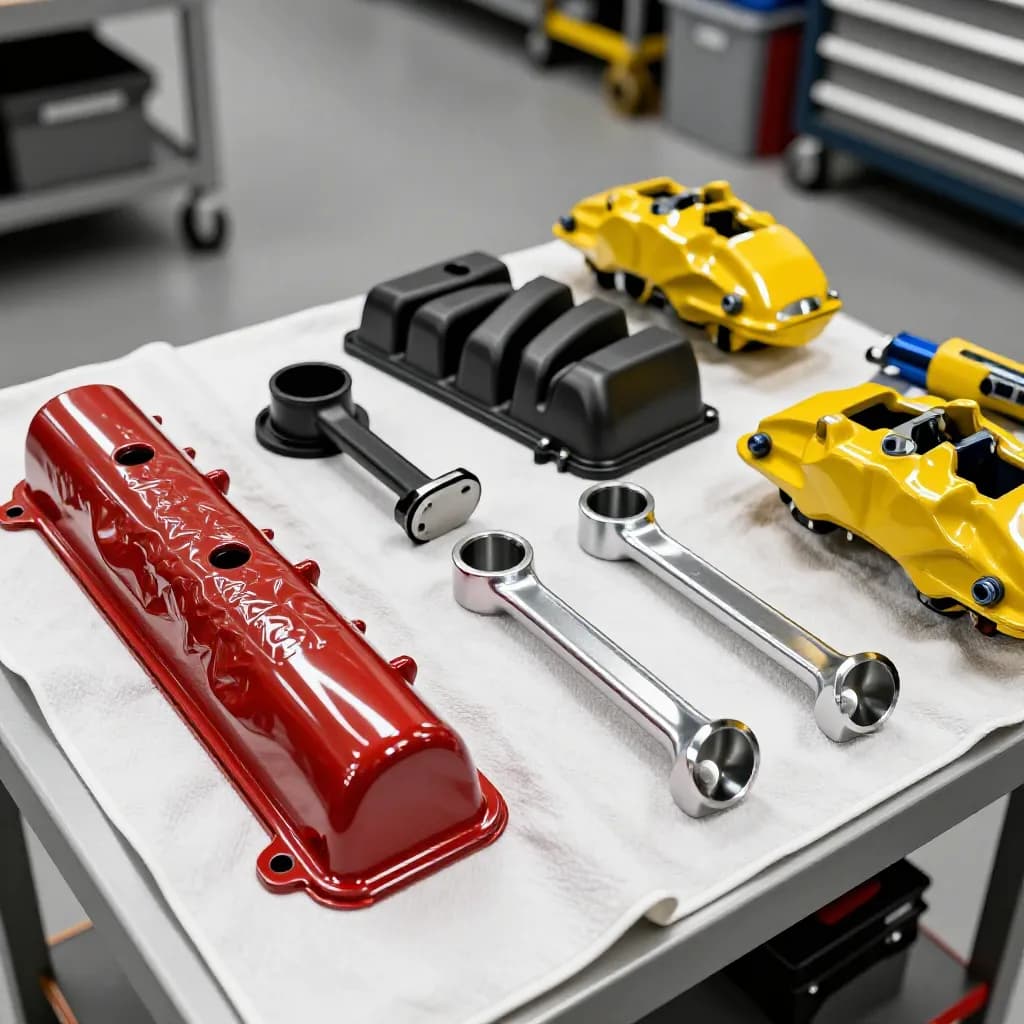
The automotive aftermarket sector demands coatings that can withstand engine heat cycling from ambient to over 200°C, exposure to brake fluid, coolant, fuel, and road salt, as well as stone chip impacts and vibration fatigue. Powder coating meets these demands through its dense, cross-linked film structure, which typically ranges from 50 to 100 microns on automotive components. This film thickness provides a robust barrier against corrosion while maintaining the precise dimensional tolerances required for threaded fastener holes, mating surfaces, and press-fit assemblies.
Ready to Start Your Project?
From one-off customs to 15,000-part production runs — get precise pricing in 24 hours.
On This Page
Why Powder Coating Is the Standard for Automotive Aftermarket Parts
For classic car restoration, powder coating offers the additional advantage of complete coverage in recesses, edges, and complex geometries that are difficult to reach with liquid spray guns. The electrostatic application process wraps powder around edges and into cavities, producing uniform coverage that protects the entire part rather than just the visible surfaces.
Valve Covers and Intake Manifolds: Heat-Resistant Finishing
Valve covers and intake manifolds are among the most popular automotive components for powder coating, serving as both functional engine parts and visual centerpieces of a detailed engine bay. These components present specific challenges related to heat exposure, oil contact, and the need to maintain gasket sealing surfaces free of coating buildup.
For valve covers on naturally aspirated engines, standard high-temperature polyester powder coatings rated to 200°C provide excellent performance and color retention. Turbocharged and high-performance applications may require silicone-modified polyester or ceramic-hybrid formulations rated to 315°C or higher. These specialty powders sacrifice some color range for thermal stability, but are available in popular automotive colors including wrinkle black, cast iron grey, and metallic finishes.
Intake manifolds require careful consideration of the coating's thermal conductivity properties. On aluminum intake manifolds, a thin powder coat of 40-60 microns can actually provide mild thermal insulation, reducing heat soak from the engine bay into the intake charge. This is a functional benefit beyond aesthetics, though the effect is modest compared to dedicated thermal barrier coatings.
Critical to both components is proper masking of gasket surfaces, threaded holes, and sensor ports before coating. Professional automotive powder coaters use high-temperature silicone plugs and tape rated to withstand the 190-200°C cure cycle. Any coating on mating surfaces must be removed to prevent gasket leaks and ensure proper torque specifications on fasteners.
Suspension and Chassis Components: Durability Under Stress
Suspension components including control arms, sway bars, subframes, spring perches, and shock towers operate in the most demanding environment on a vehicle — subjected to constant mechanical stress, road debris impact, water immersion, and road salt exposure. Powder coating these components requires a coating system engineered for maximum corrosion protection and mechanical durability rather than purely aesthetic considerations.
The preferred coating system for suspension components is an epoxy primer followed by a polyester topcoat, applied as a two-coat system with a combined film thickness of 100-150 microns. The epoxy primer provides exceptional adhesion and corrosion resistance, while the polyester topcoat delivers UV stability, chemical resistance, and the desired color and gloss. Single-coat hybrid epoxy-polyester powders offer a compromise for budget-conscious applications, providing good corrosion resistance with moderate UV performance.
Pretreatment is critical for suspension components. Iron phosphate conversion coating is the minimum acceptable pretreatment, but zinc phosphate provides superior corrosion protection for components exposed to road salt and standing water. Some high-end restoration shops specify zinc-rich epoxy primers beneath the powder coat for maximum protection on subframes and structural components.
Flexibility is another important consideration. Suspension components experience significant deflection and vibration during operation. Standard powder coatings with elongation values of 2-5% may crack at stress concentration points. Flexible powder formulations with elongation values of 10-15% are available specifically for suspension applications, maintaining film integrity through the dynamic loading cycles these components endure.
Engine Bay Brackets, Alternator Housings, and Small Hardware
The engine bay contains dozens of brackets, mounts, pulleys, and small hardware items that collectively define the visual quality of a restoration or build. Powder coating these components transforms an engine bay from functional to show-quality, and the process is particularly well-suited to the complex geometries and batch processing typical of these small parts.
Brackets and mounts are ideal candidates for powder coating because they are typically stamped or cast from steel or aluminum, have relatively simple geometries, and can be batch-processed in large quantities on a single rack. A standard TGIC-free polyester powder in semi-gloss black, satin black, or factory-correct colors provides excellent results at film thicknesses of 50-75 microns. For concours-level restorations, factory-correct finishes such as GM semi-gloss black, Ford corporate blue, or Mopar turquoise are available from specialty powder manufacturers who have color-matched original factory finishes.
Alternator and power steering pump brackets present a specific challenge: they must dissipate heat effectively. While powder coating does add a thin insulating layer, the thermal impact on brackets is negligible at standard film thicknesses. However, coating should be kept off electrical grounding surfaces where brackets serve as part of the vehicle's ground circuit.
Small hardware — bolts, nuts, washers, and clips — can be powder coated but requires careful consideration of dimensional changes. A 50-75 micron coating on bolt threads will affect thread engagement and torque values. For fasteners, either mask the threads before coating or use zinc plating as an alternative that provides corrosion protection without dimensional impact. Many restoration shops use a combination approach: powder coat the visible brackets and components, zinc plate the fasteners.
Classic Car Restoration: Matching Factory Finishes
The classic car restoration community has embraced powder coating as a superior alternative to the original factory finishes used on chassis, suspension, and engine components. While purists may debate the authenticity of powder coating versus original paint processes, the practical advantages in durability and consistency have made it the standard for high-quality restorations from driver-quality builds to concours competitors.
Factory finish matching requires careful color development. Original automotive component finishes varied significantly from the body paint colors — chassis components were typically finished in semi-gloss or satin black, while engine blocks and accessories used manufacturer-specific colors. Chevrolet orange, Ford blue, Mopar blue, Pontiac blue, and Buick red are among the most commonly requested engine colors. Specialty powder manufacturers have developed formulations that closely match these original colors in both hue and gloss level.
For concours-level restorations, the texture and gloss of the powder coat must match the original finish character. Factory components were often finished with relatively crude processes — dip coating, flow coating, or basic spray application — that produced finishes with visible texture, orange peel, or inconsistent coverage. Ironically, a perfect powder coat finish can look too good for a concours restoration. Some applicators deliberately adjust their application parameters to introduce slight texture that mimics original factory finishes.
Media blasting preparation for restoration components must be carefully controlled. Aggressive blasting with aluminum oxide or steel grit can warp thin sheet metal brackets and remove material from cast surfaces. Glass bead blasting at 40-60 psi provides effective cleaning and surface profiling without distortion, and is the preferred method for delicate restoration components. Soda blasting is another option for removing old paint and corrosion without altering the substrate profile.
Wheel Finishing: Powder Coating vs. Other Methods
Wheels represent one of the highest-volume applications for automotive powder coating, with both OEM manufacturers and aftermarket refinishers using the technology extensively. Powder-coated wheels offer superior chip resistance, chemical resistance to brake dust and road salt, and a wider range of finish options compared to conventional liquid paint systems.
The standard wheel powder coating process begins with chemical stripping of the existing finish, followed by media blasting to achieve a clean, profiled surface. Aluminum wheels receive a chromate or non-chromate conversion coating pretreatment, followed by an epoxy primer and polyester topcoat. The two-coat system is essential for wheels because the epoxy primer provides the adhesion and corrosion resistance needed to withstand the harsh wheel environment, while the polyester topcoat delivers the gloss, color, and UV resistance that define the wheel's appearance.
Clear-over-color systems are popular for metallic and chrome-effect wheel finishes. A metallic or chrome-look base coat is applied and partially cured, followed by a clear polyester topcoat that provides depth, gloss, and protection. These systems can achieve striking visual effects including candy colors, chameleon shifts, and mirror-like chrome alternatives that approach the appearance of traditional chrome plating without the environmental concerns of hexavalent chromium processes.
Dimensional considerations are important for wheel coating. The powder coat adds 50-100 microns per surface to the wheel dimensions, which can affect tire bead seating, hub centering, and lug nut engagement. Professional wheel coaters mask the hub bore, lug seat areas, and tire bead seats to maintain critical dimensions. The valve stem hole must also remain clear to ensure proper valve stem installation and sealing.
Preparation and Pretreatment for Automotive Components
Surface preparation is the single most important factor determining the performance and longevity of a powder coat on automotive components. Inadequate preparation is responsible for the vast majority of coating failures in automotive applications, manifesting as adhesion loss, blistering, corrosion undercutting, and premature chalking or fading.
The preparation process for automotive components typically follows a sequence: disassembly, degreasing, stripping of existing coatings, media blasting, chemical pretreatment, and drying. Each step must be executed thoroughly, as contaminants trapped beneath the powder coat will inevitably cause failure. Engine components are particularly challenging because decades of oil, grease, and carbon deposits can penetrate into the pores of cast iron and aluminum castings.
For cast aluminum components such as intake manifolds, valve covers, and transmission cases, a hot alkaline soak at 70-80°C for 30-60 minutes is effective at drawing embedded oils out of the porous casting. This is followed by media blasting with aluminum oxide at 40-60 psi to create a surface profile of 25-50 micrometers, which provides mechanical adhesion for the powder coat. Chemical conversion coating — iron phosphate for steel, chromate or zirconium-based for aluminum — completes the pretreatment by creating a chemically bonded layer that enhances adhesion and corrosion resistance.
Outgassing is a critical concern for cast components. Porous castings can trap air and moisture that expand during the cure cycle, creating pinholes and bubbles in the finished coating. The standard mitigation technique is a pre-bake at the cure temperature (190-200°C) for 15-30 minutes before powder application. This drives out trapped gases and moisture, allowing the powder to flow and cure over a clean, degassed surface.
Choosing the Right Powder Chemistry for Automotive Use
Selecting the appropriate powder chemistry is essential for achieving the desired performance on automotive components. The four main powder chemistries — epoxy, polyester, hybrid epoxy-polyester, and specialty high-temperature formulations — each offer distinct advantages and limitations that must be matched to the specific application environment.
Epoxy powders provide the best chemical resistance and adhesion of any standard powder chemistry, making them ideal as primers for suspension components, subframes, and underbody parts. However, epoxy powders chalk and degrade rapidly under UV exposure, limiting their use to components that are not exposed to direct sunlight. Under-vehicle and engine bay components that are shielded from UV can use epoxy as a single-coat system for maximum corrosion protection.
TGIC-free polyester powders are the workhorse of automotive aftermarket finishing, offering excellent UV resistance, good chemical resistance, and a wide range of colors and effects. These powders are suitable for any component that will be exposed to sunlight, including wheels, exterior trim, and engine bay components visible through the hood. Standard polyester powders are rated for continuous service temperatures up to approximately 150°C, which is adequate for most engine bay applications.
For components exposed to temperatures above 150°C — exhaust manifold heat shields, turbo piping, and headers — silicone-modified polyester or ceramic-based high-temperature powders are required. These formulations maintain film integrity at temperatures up to 315°C for silicone polyester and up to 650°C for ceramic-based systems. Color options are limited compared to standard polyester, but black, silver, grey, and cast iron finishes are readily available.
Hybrid epoxy-polyester powders offer a balanced combination of chemical resistance and UV stability, making them a cost-effective single-coat option for components with moderate exposure to both chemicals and sunlight. They are commonly used for brackets, mounts, and interior engine bay components where a two-coat system is not justified by the application requirements.
Frequently Asked Questions
Can you powder coat cast aluminum intake manifolds and valve covers?
Yes, cast aluminum components are excellent candidates for powder coating. The key is proper preparation: hot alkaline degreasing to remove embedded oils, media blasting for surface profile, and a pre-bake at cure temperature to outgas trapped moisture and air from the porous casting. This prevents pinholes and bubbles in the finished coating.
What temperature can powder-coated engine parts withstand?
Standard polyester powder coatings handle continuous temperatures up to 150°C, suitable for most engine bay components. Silicone-modified polyester extends this to 315°C for turbo piping and heat shields. Ceramic-based high-temperature powders can withstand up to 650°C for exhaust components and headers.
Should I mask gasket surfaces before powder coating valve covers?
Absolutely. Powder coating on gasket mating surfaces will prevent proper sealing and can cause oil leaks. Professional coaters use high-temperature silicone plugs and tape to mask gasket surfaces, threaded holes, sensor ports, and any surface that mates with another component. All masking materials must be rated for the 190-200°C cure cycle.
Is powder coating better than paint for car restoration?
For chassis, suspension, and engine bay components, powder coating is superior to liquid paint in durability, chemical resistance, and corrosion protection. The thermoset film is significantly harder and more resistant to chipping, brake fluid, and road salt. For concours restorations, specialty powders are available that match original factory colors and textures.
How do I prevent outgassing on cast parts during powder coating?
Outgassing occurs when trapped air and moisture in porous castings expand during curing, creating pinholes. The standard prevention method is a pre-bake at the cure temperature (190-200°C) for 15-30 minutes before applying powder. This drives out gases so the powder can flow and cure over a clean, degassed surface.
Can powder coating affect bolt thread engagement on automotive parts?
Yes. A 50-75 micron powder coat on bolt threads will change thread dimensions and affect torque values. Best practice is to mask threaded holes and fastener surfaces before coating, or use zinc plating for fasteners that need corrosion protection without dimensional change.
Ready to Start Your Project?
From one-off customs to 15,000-part production runs — get precise pricing in 24 hours.