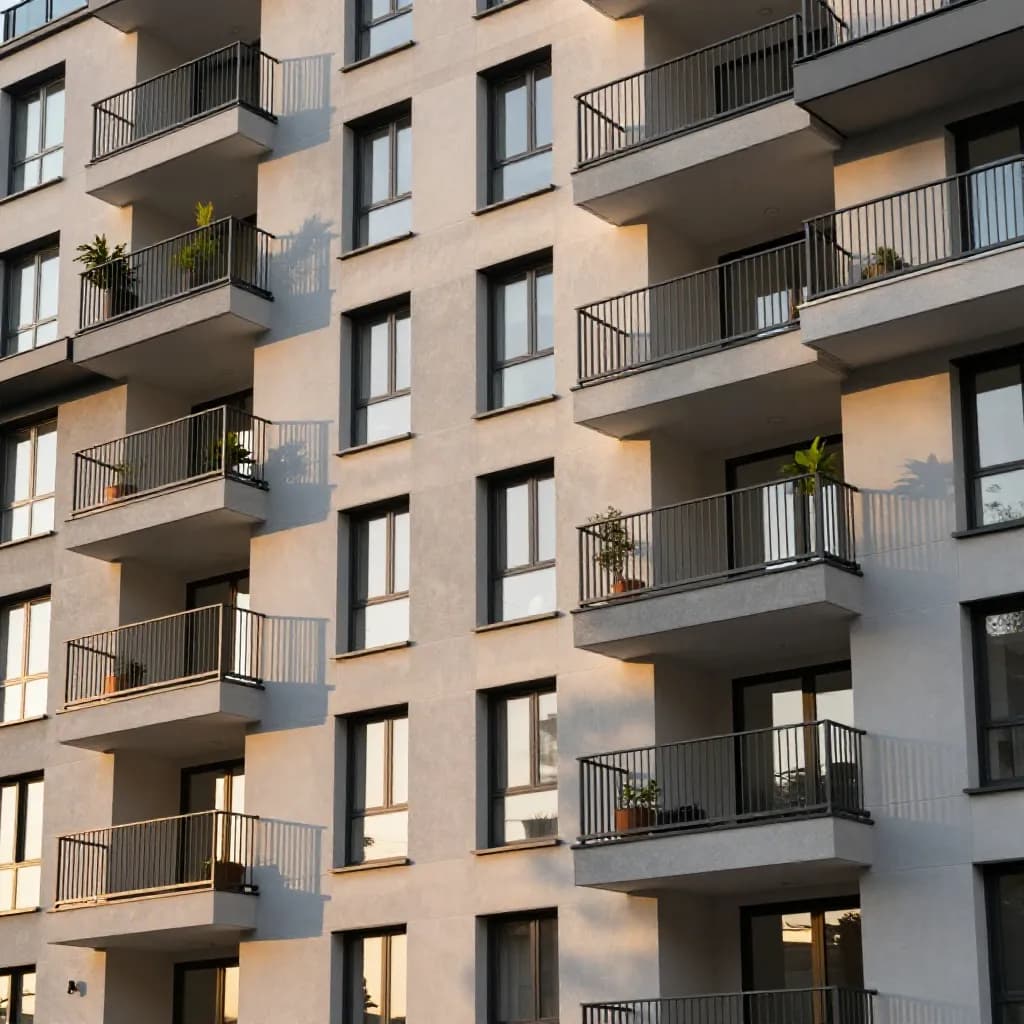
Apartment blocks and multi-residential buildings present a distinctive set of coating challenges driven by their scale, shared-use patterns, and the expectations of residents who live with these finishes daily. A typical apartment development may contain hundreds of individual units, each with its own windows, balcony railings, and door hardware, plus extensive shared spaces including lobbies, corridors, stairwells, and external communal areas.
Architecture
Powder Coating for Apartment Blocks and Multi-Residential Buildings
Sundial Powder Coating·April 20, 2026·9 min
The shared nature of multi-residential buildings creates wear patterns that exceed those of single-family homes. Entrance lobbies and corridors serve every resident and their visitors, with pushchairs, bicycles, delivery trolleys, and moving furniture creating constant impact risks for wall-mounted metalwork, railings, and door frames. Stairwells and lift lobbies concentrate this traffic at pinch points where coating damage is most likely and most visible.
Ready to Start Your Project?
From one-off customs to 15,000-part production runs — get precise pricing in 24 hours.
On This Page
Multi-Residential Coating Demands
Residents expect their building to maintain its appearance over the long term, and any visible deterioration of common area finishes affects satisfaction and property values. Building managers must balance maintenance quality with the practical constraints of working in occupied buildings, where noise, dust, and chemical odors from painting operations directly affect residents' daily lives.
Balcony Railings and Privacy Screens
Balcony railings are among the most visible and exposed elements of any apartment building. Repeated across every unit on every floor, they define the building's facade character and are subject to full weather exposure including UV radiation, driving rain, and in coastal locations, salt-laden air. Any inconsistency in coating quality or color between balcony panels is immediately apparent on the repetitive facade pattern of a residential tower.
Powder coating at 60-120 microns provides the weather resistance and color stability that balcony applications demand. The thick film resists UV degradation, moisture penetration, and the thermal cycling that causes expansion and contraction stress on coating systems. Color retention over 20-25 years ensures that the building's facade maintains its designed appearance without the progressive fading that affects liquid paint within 8-12 years.
Privacy screens and balcony dividers add design complexity, often incorporating perforated patterns, laser-cut decorative elements, or louvered profiles. Powder coating's electrostatic application process provides consistent coverage on these complex geometries, wrapping around edges and penetrating perforations to deliver uniform protection. This is a significant advantage over liquid spray application, which tends to build up on flat surfaces while leaving edges and perforations under-coated.
Entrance and Lobby Metalwork
The entrance lobby creates the first impression for residents, visitors, and prospective buyers. Entrance canopies, door frames, mailbox assemblies, and intercom housings must project quality and durability, setting the tone for the entire building. These components face the dual challenge of exterior weather exposure on their outer faces and interior wear from daily resident traffic on their inner surfaces.
Powder coating delivers the premium finish quality that entrance areas demand while providing the mechanical durability to withstand years of heavy use. The 60-120 micron film resists the scratches and scuffs from keys, bags, and delivery packages that accumulate on entrance metalwork, maintaining the polished appearance that residents expect. Custom color matching allows entrance elements to be coordinated with the building's architectural design palette.
Lobby interior metalwork, including handrails, elevator surrounds, signage frames, and decorative features, operates in a more sheltered environment but faces constant physical contact from residents. Powder coating's hard, cross-linked film resists the fingerprints, scuffs, and minor impacts of daily residential use while maintaining its finish quality through years of routine cleaning with standard household and commercial cleaning agents.
Window and Door Systems for Hundreds of Units
The scale of window and door systems in apartment developments creates both challenges and opportunities for powder coating specification. A mid-rise apartment block may contain a thousand or more individual window units, all of which must present consistent color and finish quality when viewed from the exterior. Powder coating's batch-to-batch consistency ensures this uniformity across production runs that may span weeks or months of manufacturing activity.
Window frames in residential buildings must perform for the lifetime of the building, typically 25-30 years or more between major refurbishment cycles. Powder coating's 20-25 year service life aligns well with this expectation, providing reliable weather protection and color retention throughout the window system's operational life. Liquid paint at 25-50 microns would require at least one interim recoating cycle, involving the disruption of accessing and repainting windows across hundreds of occupied apartments.
Door systems, including apartment entrance doors, communal fire doors, and external access doors, require finishes that combine weather resistance with the mechanical durability to withstand millions of opening and closing cycles. Powder coating provides both, with the added advantage of zero VOC emissions that is particularly important for doors opening directly into residential living spaces.
Lifecycle Advantages for Building Managers
Building managers responsible for multi-residential portfolios face the challenge of maintaining presentation standards across hundreds or thousands of units while managing limited maintenance budgets. The lifecycle performance of the coating system applied to building metalwork has a direct impact on both maintenance expenditure and resident satisfaction.
Powder coating's 20-25 year service life transforms the maintenance equation for apartment buildings. Compared to liquid paint's 8-12 year lifespan, powder coating reduces the frequency of major recoating projects by half or more. Each avoided recoating cycle eliminates the disruption of scaffolding, surface preparation, and painting operations in and around occupied apartments — activities that generate noise, dust, and chemical odors that directly affect residents' quality of life.
Across a large residential portfolio, the cumulative maintenance advantage is substantial. A building manager overseeing ten apartment blocks, each with hundreds of powder-coated windows, balconies, and entrance systems, can expect to manage far fewer coating maintenance projects over a 25-year period than would be required with liquid-painted equivalents. This reduced maintenance burden frees resources for other building improvements and contributes to the long-term value preservation that apartment owners and investors expect.
Frequently Asked Questions
How long does powder coating last on apartment building facades?
Powder coating on apartment building components typically lasts 20-25 years, compared to 8-12 years for liquid paint. This extended service life is particularly valuable for multi-residential buildings where recoating involves disruptive access to hundreds of individual units and shared spaces.
Is powder coating consistent enough for large apartment developments?
Yes. Powder coating delivers precise batch-to-batch color consistency across production runs spanning weeks or months. This ensures that balcony railings, window frames, and facade elements across hundreds of units present uniform color and finish quality when viewed together on the building's exterior.
Does powder coating affect indoor air quality in apartments?
Powder coating produces zero volatile organic compound emissions throughout its service life, ensuring no harmful off-gassing into residential living spaces. This is particularly important for window frames and door systems that interface directly with apartment interiors, and it contrasts with liquid paint which can emit VOCs for weeks after application.
What components in apartment buildings benefit most from powder coating?
Balcony railings, privacy screens, window frames, entrance canopies, door systems, lobby metalwork, mailbox assemblies, and stairwell handrails all benefit significantly. Balcony railings and window frames see the greatest advantage due to their full weather exposure and high visibility on the building facade.
Ready to Start Your Project?
From one-off customs to 15,000-part production runs — get precise pricing in 24 hours.