Aluminum castings are among the most challenging substrates for powder coating due to the porosity inherent in the casting process. Whether produced by die casting, sand casting, permanent mold casting, or investment casting, aluminum castings contain microscopic voids, gas pockets, and shrinkage porosity that trap air, moisture, and process contaminants. When heated during the powder coating cure cycle, these trapped substances expand and escape through the curing powder film, creating the pinholes, craters, and bubbles collectively known as outgassing defects.
Technical
Powder Coating Aluminum Castings: Outgassing, Degas Cycles, and Application Best Practices
Sundial Powder Coating·April 22, 2026·14 min
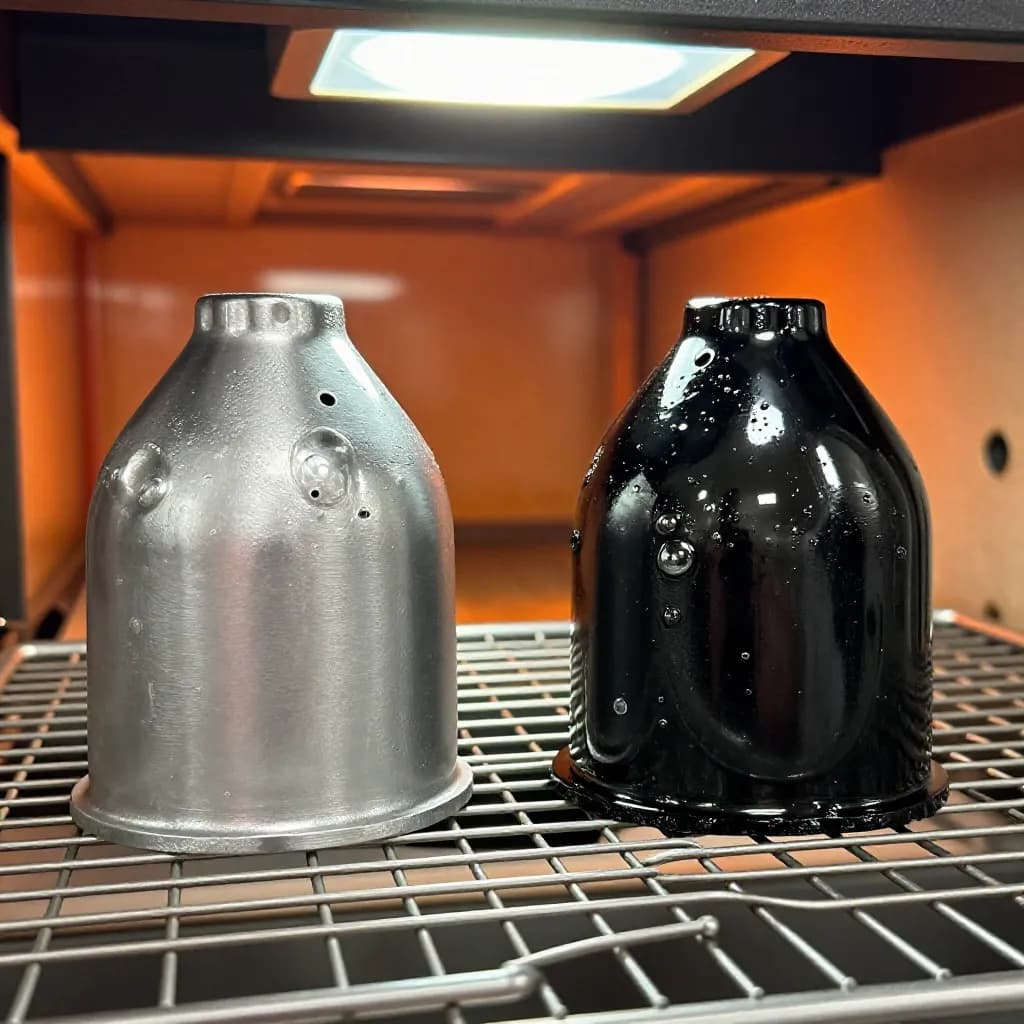
The severity of outgassing varies significantly with the casting method. High-pressure die castings (HPDC) are the most problematic because the high injection speed traps air in the molten aluminum, creating distributed microporosity throughout the casting wall. The porosity level in HPDC parts can reach 2-5% by volume, with individual pores ranging from 10 to 500 micrometers in diameter. Gravity die castings and sand castings generally have lower porosity levels but can contain larger individual voids from shrinkage and gas evolution. Investment castings typically have the lowest porosity but are less commonly powder coated due to their higher cost and specialized applications.
Ready to Start Your Project?
From one-off customs to 15,000-part production runs — get precise pricing in 24 hours.
On This Page
Aluminum Castings: A Challenging Substrate
Common aluminum casting alloys include A380 (the most widely used die casting alloy), A356 and A357 (gravity and sand casting alloys with excellent mechanical properties), and ADC12 (a Japanese die casting alloy equivalent to A383). Each alloy has different solidification characteristics that affect porosity distribution and severity. Silicon content — typically 7-12% in casting alloys — also affects surface chemistry and pretreatment response, as silicon-rich phases on the casting surface can interfere with conversion coating formation.
Understanding Outgassing in Aluminum Castings
Outgassing in aluminum castings follows a similar mechanism to cast iron but with some important differences. The primary gas sources are trapped air from the casting process, hydrogen dissolved in the molten aluminum (aluminum has high hydrogen solubility in the liquid state), moisture absorbed into surface porosity during storage and handling, and residual die lubricant or mold release agents that penetrate the porous surface.
The outgassing sequence during powder coating cure begins as the part temperature rises above 100°C, when absorbed moisture starts to vaporize. Between 120-160°C, the powder particles melt and begin to flow together into a continuous film. If moisture vapor is still escaping at this point, it creates pinholes in the forming film. As temperature continues to rise toward 180-200°C, deeper-seated gases — trapped air and hydrogen — expand and escape. Die lubricant residues, which can penetrate 50-200 micrometers into surface porosity, begin to decompose and volatilize at 150-250°C, producing additional gas that disrupts the curing film.
The critical factor is the timing relationship between gas release and film formation. If all gases escape before the powder melts and flows together (below approximately 120°C), no defects occur. If gases escape after the film has fully crosslinked (above approximately 180°C for standard polyester), the rigid film traps the gas as subsurface bubbles that may not be visible but weaken the coating. The most damaging scenario is gas release during the gel phase (140-170°C), when the film is semi-liquid — soft enough for gas to push through but too viscous to flow back and heal the resulting crater. Understanding this timing is the key to developing effective outgassing mitigation strategies.
Degas Cycles and Pre-Bake Protocols
The degas cycle is the most effective countermeasure against outgassing on aluminum castings. The principle is identical to cast iron degassing: heat the bare casting to a temperature at or above the powder cure temperature, hold for a sufficient time to drive off trapped gases and volatiles, then cool to application temperature and coat. The degas cycle allows gases to escape from the uncoated surface where they cause no harm, rather than through the curing powder film where they create defects.
Recommended degas parameters for aluminum die castings are 220-250°C for 20-45 minutes, depending on wall thickness and porosity level. The degas temperature should exceed the powder cure temperature by at least 20-40°C to ensure that all volatiles released during the actual cure have already been driven off. Thicker castings require longer soak times — a general guideline is 20 minutes for wall thicknesses up to 5 mm, 30 minutes for 5-15 mm, and 45 minutes for sections exceeding 15 mm. These are starting points; actual parameters should be validated through systematic trials on production-representative parts.
Multiple degas cycles may be necessary for heavily contaminated castings or those with severe porosity. The first cycle drives off surface moisture and shallow contaminants, while subsequent cycles address deeper-seated gases and decomposition products. Some facilities use a 'test dust' approach: after the degas cycle, a light dusting of powder is applied to a test area and cured. If pinholes appear, the degas was insufficient and the cycle is repeated. This iterative approach is time-consuming but effective for establishing reliable degas parameters for new part geometries. Once validated, the parameters are documented in the work instruction and applied consistently to all production parts.
Pretreatment for Aluminum Castings
Pretreatment of aluminum castings must address both the standard requirements of surface cleaning and adhesion promotion and the casting-specific challenges of porosity, die lubricant contamination, and silicon-rich surface phases. The pretreatment sequence typically begins with alkaline degreasing to remove surface oils, handling soils, and die lubricant residues. Alkaline cleaners for aluminum castings should be formulated with low-etch chemistry to avoid opening surface porosity further, which would increase outgassing during cure.
Acid etching or deoxidizing follows the alkaline clean, removing the natural aluminum oxide layer and any silicon-rich surface phases (known as 'smut') that form during solidification. A nitric acid-based deoxidizer with hydrofluoric acid addition is effective at removing silicon smut without excessive base metal attack. The etch depth should be controlled to 2-5 micrometers — enough to remove surface contamination and create micro-roughness for adhesion, but not so deep that it exposes subsurface porosity.
Conversion coating for aluminum castings follows the same chemistry options as for extrusions — chromate (where still permitted), trivalent chromium, titanium/zirconium nano-ceramic, or silane-based systems. However, the porous surface of castings can absorb conversion coating chemicals into the pore network, creating reservoirs of acidic or alkaline solution that later cause blistering or adhesion failure. Thorough rinsing after each chemical stage is critical, and the final rinse should use deionized water to prevent mineral deposits in surface pores. The dry-off temperature after pretreatment should be high enough (140-160°C) to drive moisture from surface porosity but not so high that it constitutes an uncontrolled degas cycle that could deposit volatiles on the freshly treated surface.
Automotive Wheel Coating
Aluminum alloy wheels represent one of the highest-volume and most demanding applications for powder-coated aluminum castings. The global automotive wheel market consumes millions of cast aluminum wheels annually, virtually all of which receive some form of surface finishing. Powder coating — either as a complete finish system or as a primer/basecoat beneath a liquid clear coat — is the dominant technology for OEM and aftermarket wheel finishing.
The wheel coating process typically involves multiple layers: a powder primer (epoxy or epoxy-polyester at 50-80 micrometers) for corrosion protection and outgassing management, followed by a powder or liquid color coat, and a clear topcoat for gloss, scratch resistance, and chemical resistance. The primer coat serves a dual function — it provides corrosion protection at the casting surface and acts as a barrier that absorbs and conceals minor outgassing defects that might otherwise be visible in the topcoat. Some wheel manufacturers apply the primer coat using a 'hot coat' technique, where the powder is applied to the warm casting immediately after the degas cycle, taking advantage of the residual heat to achieve rapid melt and flow that seals surface porosity.
Wheel coating specifications are demanding. The finish must withstand brake dust exposure (highly alkaline iron oxide particles at elevated temperature), road salt, car wash chemicals, curb scuffing, and stone chip impact while maintaining a showroom-quality appearance. Corrosion testing requirements typically include 480-1000 hours of CASS (copper-accelerated acetic acid salt spray) testing per ISO 9227, which is more aggressive than standard neutral salt spray. Adhesion must be maintained after thermal cycling (-40°C to +120°C) and after exposure to simulated brake dust solutions. The combination of aesthetic perfection and extreme durability requirements makes wheel coating one of the most technically challenging applications in the powder coating industry.
Marine and Outdoor Hardware Applications
Aluminum castings are widely used for marine hardware — cleats, chocks, fairleads, winch housings, and helm components — where the combination of light weight, corrosion resistance, and complex geometry makes casting the preferred manufacturing method. Powder coating these components provides color customization, UV protection, and supplementary corrosion resistance in the aggressive marine environment. The challenges are compounded by the combination of casting porosity (outgassing risk) and severe service conditions (salt spray, UV, mechanical abuse).
Marine-grade powder coating of aluminum castings requires the highest level of pretreatment — typically multi-stage with acid etch and high-performance conversion coating — combined with a multi-coat system for maximum corrosion protection. An epoxy primer at 50-80 micrometers provides adhesion and corrosion resistance at the casting surface, while a super-durable polyester topcoat at 60-80 micrometers provides UV resistance and aesthetic durability. Total system thickness of 120-160 micrometers is typical for marine applications. The primer coat also helps manage outgassing by sealing surface porosity before the topcoat is applied.
Outdoor furniture, lighting fixtures, and architectural castings face similar challenges on a less extreme scale. These applications demand defect-free aesthetic quality — any pinhole or crater is visible and unacceptable on a decorative casting. Thorough degassing is essential, and many manufacturers of decorative aluminum castings specify a degas cycle as a mandatory process step regardless of the casting's apparent porosity level. The cost of the degas cycle is small compared to the cost of stripping and recoating a defective part, particularly for large or complex castings where stripping risks damaging the substrate. Quality control for decorative castings includes 100% visual inspection under raking light, with any pinhole or surface defect resulting in rejection and rework.
Powder Selection and Process Optimization
Powder formulations designed for aluminum castings incorporate features that mitigate outgassing and improve finish quality on porous substrates. Extended gel time formulations remain fluid longer during the cure cycle, allowing gas bubbles to rise through the molten film and escape before crosslinking locks the surface. Degassing additives — typically low-molecular-weight waxes or flow agents — reduce surface tension in the molten powder, facilitating bubble release and film healing. Some manufacturers offer 'casting grade' or 'outgassing-tolerant' powders specifically formulated for die-cast and sand-cast substrates.
Cure schedule optimization is critical for aluminum castings. A slow initial ramp rate — 3-5°C per minute through the 100-170°C range — gives trapped gases more time to escape before the powder reaches its gel point. Once past the gel point, the ramp rate can increase to bring the part to full cure temperature efficiently. This 'slow-fast' profile is the opposite of what is optimal for thin-gauge sheet metal (where rapid heating produces the best flow and leveling) and requires oven programming capability or dedicated oven zones with different temperature settings.
Film thickness management on castings requires attention to the rough, irregular surface typical of as-cast aluminum. Surface roughness of 5-15 micrometers Ra on machined surfaces and 15-50 micrometers Ra on as-cast surfaces means that more powder is needed to achieve a given film thickness compared to smooth extruded or sheet aluminum. Film thickness measurements on rough surfaces should use the appropriate calibration standard and measurement technique — readings on rough surfaces are inherently more variable than on smooth surfaces, and multiple measurements should be averaged. Target film thickness for single-coat applications on castings is typically 70-100 micrometers, higher than the 60-80 micrometers typical for extrusions, to ensure adequate coverage of the rough surface topography.
Frequently Asked Questions
Why do aluminum castings outgas during powder coating?
Aluminum castings contain microscopic porosity from the casting process that traps air, hydrogen, moisture, and die lubricant residues. When heated during cure (180-200°C), these trapped substances expand and escape through the curing powder film, creating pinholes, craters, and bubbles. Die castings are most affected, with porosity levels of 2-5% by volume.
How do you degas aluminum castings before powder coating?
Heat the bare casting to 220-250°C and hold for 20-45 minutes depending on wall thickness. The degas temperature should exceed the powder cure temperature by 20-40°C. Thicker sections need longer soak times. Validate parameters using a 'test dust' method — apply a light powder dusting after degassing and check for pinholes during cure.
What powder coating system is used for aluminum wheels?
Automotive wheels typically use a multi-layer system: epoxy or epoxy-polyester powder primer (50-80 micrometers) for corrosion protection and outgassing management, followed by a color coat and clear topcoat. The primer seals surface porosity and conceals minor outgassing defects. The system must pass 480-1000 hours of CASS testing and resist brake dust, road salt, and thermal cycling.
Can you powder coat sand castings and gravity castings?
Yes, sand castings and gravity castings can be powder coated successfully. They generally have lower porosity than die castings but can contain larger individual voids. Degassing is still recommended, particularly for decorative applications. The rougher surface of sand castings requires higher film thickness targets (70-100 micrometers) to ensure adequate coverage.
What pretreatment removes silicon smut from aluminum castings?
A nitric acid-based deoxidizer with hydrofluoric acid addition effectively removes silicon-rich surface phases (smut) that form during solidification of high-silicon casting alloys. The etch depth should be controlled to 2-5 micrometers to remove contamination without exposing subsurface porosity. Thorough rinsing with deionized water after etching prevents chemical residues from entering surface pores.
Ready to Start Your Project?
From one-off customs to 15,000-part production runs — get precise pricing in 24 hours.