Airport terminals are among the most complex and demanding building types in contemporary architecture. Operating 24 hours a day, 365 days a year, these facilities process millions of passengers annually while maintaining strict security protocols, environmental controls, and aesthetic standards. The metalwork within and surrounding airport terminals — from vast curtain wall systems and external cladding to internal column casings, ceiling systems, and wayfinding infrastructure — must perform flawlessly under conditions that would rapidly degrade lesser finishes.
Architecture
Powder Coating for Airport Terminal Architecture: Durability, Wayfinding, and Curtain Wall Performance
Sundial Powder Coating·April 22, 2026·12 min
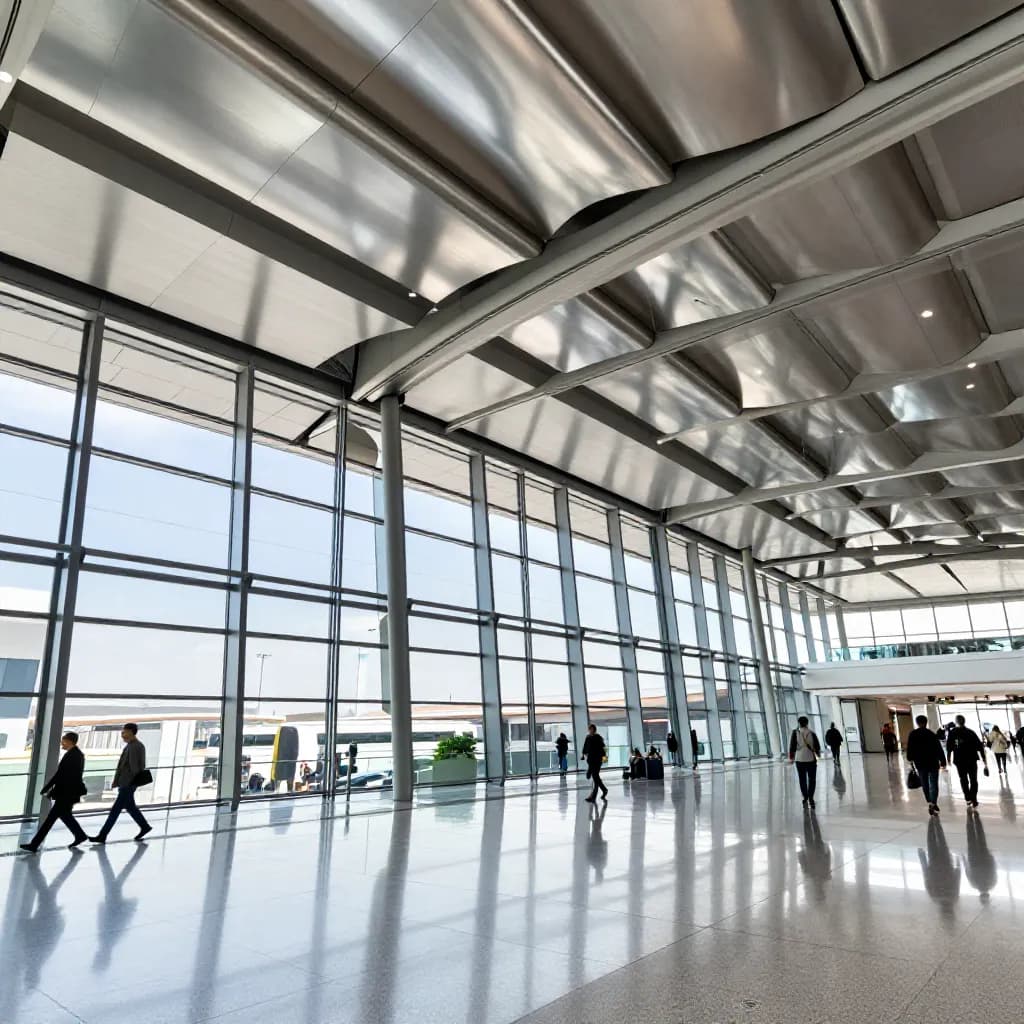
Powder coating has become the standard finishing technology for airport terminal metalwork because it delivers the combination of durability, design flexibility, and environmental performance that these buildings demand. The 60-120 micron film thickness provides a robust barrier against the mechanical wear, chemical exposure, and UV degradation that airport environments impose, while the zero VOC characteristic supports the indoor air quality standards critical for enclosed spaces occupied by millions of people annually.
Ready to Start Your Project?
From one-off customs to 15,000-part production runs — get precise pricing in 24 hours.
On This Page
Airport Terminals: Where Architecture Meets Extreme Operational Demands
The scale of airport terminal projects also favors powder coating. Terminal buildings routinely encompass hundreds of thousands of square meters of finished metalwork, and the 95-98% material utilization efficiency of powder application translates into significant material savings and waste reduction compared to liquid painting at this scale. For airport authorities with sustainability mandates and environmental management systems, this efficiency is both an environmental and economic advantage.
Curtain Wall Systems: Performance at Monumental Scale
Modern airport terminals are defined by their expansive curtain wall systems, which flood interior spaces with natural light while managing solar gain, thermal performance, and acoustic isolation. The aluminum mullions, transoms, and pressure plates that form these curtain wall frameworks represent enormous surface areas of powder-coated metal, and the coating must perform consistently across the full extent of the facade.
Powder coating on curtain wall aluminum achieves the demanding performance requirements of airport facade specifications. Super-durable polyester formulations certified to Qualicoat Class 2 or AAMA 2605 provide 20-25 years of color and gloss retention, ensuring that the facade maintains its architectural intent throughout its service life. The uniform film build achieved by electrostatic powder application — typically 60-80 microns on curtain wall profiles — provides consistent appearance across thousands of identical mullion sections, avoiding the color and gloss variation that can occur with liquid spray application on repetitive elements.
Thermal break curtain wall systems, which incorporate insulating barriers within the aluminum profile to reduce heat transfer, require careful coating specification. The powder coating must be applied and cured before thermal break assembly, and the coating process must not compromise the dimensional accuracy of the profile. Modern powder coating lines achieve the tight tolerances required, with automated film thickness control and profile-specific spray programs ensuring consistent results on complex curtain wall sections.
For airports in extreme climates, the thermal cycling performance of powder coating is critical. Curtain wall systems experience significant temperature differentials between interior and exterior faces, and the coating must accommodate the resulting thermal movement without cracking or delaminating. Powder coating's inherent flexibility — verified through mandrel bend testing to ISO 1519 — ensures that the film maintains its integrity through daily and seasonal thermal cycles over the building's service life.
Wayfinding and Color-Coded Navigation Systems
Effective wayfinding is essential in airport terminals, where passengers must navigate complex routes between check-in, security, immigration, gates, baggage claim, and ground transportation under time pressure and often in unfamiliar environments. Color-coded systems are a fundamental component of airport wayfinding design, and the surface finishes that deliver these colors must maintain their accuracy and visibility over decades of service.
Powder coating provides the color precision and durability that airport wayfinding demands. Custom color matching to any reference standard — including airline brand colors, terminal zone identifiers, and international safety colors defined by ISO 3864 — is achieved through spectrophotometric formulation and verified through production quality control. The resulting colors are consistent across all coated elements, from column casings and wall panels to signage frames and directional markers.
The long-term color stability of powder coating is particularly important in airport environments. Wayfinding systems that fade, discolor, or become inconsistent over time lose their navigational effectiveness and create confusion for passengers. Super-durable polyester powder coatings maintain color within Delta E values of less than 5 after the equivalent of 10 years of exterior exposure, and interior applications — protected from direct UV radiation — maintain even tighter color consistency over the building's service life.
Luminance contrast between wayfinding elements and their backgrounds is critical for accessibility compliance under standards such as ADA, BS 8300, and local equivalents. Powder coating's precise color control allows designers to specify exact Light Reflectance Values (LRV) for each element, ensuring that the minimum contrast ratios required for visual accessibility are achieved and maintained. This precision is difficult to achieve with liquid paint, where color variation between batches and application inconsistency can compromise contrast ratios.
Security Infrastructure and Screening Areas
Airport security infrastructure operates under extreme conditions. Screening equipment housings, barrier systems, queue management rails, and security checkpoint metalwork are subjected to continuous use, frequent cleaning with aggressive disinfectants, and occasional impact from luggage trolleys and passenger equipment. The surface finishes on these elements must maintain both their protective function and their professional appearance under this demanding service regime.
Powder coating's 60-120 micron film thickness provides the mechanical robustness needed for security infrastructure. The hard thermoset film resists scratching from belt buckles, keys, and luggage hardware, while its impact resistance prevents chipping and delamination from trolley collisions. This durability contrasts sharply with the 25-50 micron liquid paint films that rapidly show wear patterns on security checkpoint metalwork, creating an unkempt appearance that undermines passenger confidence.
Chemical resistance is equally important. Security areas are cleaned multiple times daily with hospital-grade disinfectants, and the coating must withstand this chemical exposure without degradation. Powder coatings formulated for high-traffic applications resist the full range of commercial cleaning agents, maintaining gloss, color, and adhesion through years of intensive cleaning. Testing to EN ISO 2812 confirms chemical resistance against specific cleaning product formulations.
For blast-resistant security elements — including anti-vehicle barriers, blast walls, and security-rated glazing frames — powder coating maintains its adhesion and integrity under extreme mechanical loading. The coating does not generate secondary projectiles or sharp fragments under blast conditions, contributing to the overall safety performance of the security system. The ability to finish security infrastructure in colors that integrate with the terminal's architectural design, rather than the utilitarian grey of unfinished metal, supports the airport authority's objective of maintaining a welcoming passenger environment even in security-critical zones.
Airside Structures: Jet Bridges, Apron Equipment, and Control Towers
The airside environment presents some of the most aggressive exposure conditions for architectural metalwork. Jet bridges, apron-level structures, control towers, and ground support equipment housings are exposed to jet fuel vapors, de-icing chemicals, hydraulic fluid, UV radiation, and extreme temperature variations. Surface finishes in this environment must provide exceptional chemical and corrosion resistance while maintaining their appearance under conditions that would rapidly destroy conventional paint systems.
Powder coating on airside structures benefits from the technology's inherent chemical resistance. The fully cross-linked thermoset polymer film resists degradation from aviation fuels, de-icing glycols, and hydraulic fluids that would soften or dissolve many liquid paint systems. The 60-120 micron film thickness provides a substantial barrier against chemical penetration, and the absence of solvent-related porosity in the cured film eliminates the micro-channels through which aggressive chemicals can reach the substrate in liquid-painted systems.
Jet bridges are a particularly demanding application. These enclosed walkways connect the terminal to the aircraft and must operate reliably in all weather conditions while maintaining a comfortable, attractive environment for passengers. The external surfaces are fully exposed to weather, UV radiation, and jet blast, while internal surfaces must resist cleaning chemicals and passenger traffic. Powder coating provides the dual performance needed — weather-resistant exterior finish and durable, cleanable interior finish — in a single coating technology.
Control towers and air traffic management buildings require surface finishes that minimize glare and visual distraction while providing long-term weather protection. Matte and satin powder coating finishes achieve the low-reflectance surfaces needed for these critical facilities, with the added benefit of superior UV stability compared to liquid matte finishes, which tend to develop inconsistent sheen levels as they weather.
Interior Finishes: Ceilings, Columns, and Retail Frontages
The interior of an airport terminal is a complex commercial and operational environment where surface finishes must balance aesthetic quality with extreme durability. Ceiling systems spanning vast departure halls, column casings in concourse areas, retail frontage systems, and food court metalwork all contribute to the passenger experience and must maintain their appearance despite continuous use by millions of travelers.
Powder-coated aluminum ceiling systems are standard in modern airport terminals. The lightweight aluminum substrate minimizes structural loading on the terminal's roof system, while the powder coating provides a durable, cleanable surface that maintains its appearance over the 15-20 year ceiling replacement cycle typical of airport interiors. The smooth, non-porous powder film resists dust accumulation and can be cleaned with standard methods, maintaining the bright, clean appearance that passengers expect.
Column casings in terminal concourses are subjected to continuous contact from passengers, luggage, and cleaning equipment. Powder coating's superior abrasion resistance — the 60-120 micron film maintaining its integrity through years of contact wear — ensures that column finishes remain presentable without the frequent touch-up painting required for liquid-painted columns. For high-profile columns in departure lounges and arrival halls, metallic and special-effect powder finishes provide the premium aesthetic quality expected in these showcase spaces.
Retail frontage systems in airport terminals must accommodate frequent tenant changes while maintaining a consistent architectural quality. Powder-coated aluminum shopfront systems provide the durability needed for the high-traffic retail environment, and the ability to refinish or replace individual elements without affecting adjacent units supports the operational flexibility that airport retail management requires. The wide color range available in powder coating allows each retail unit to express its brand identity within the architectural framework of the terminal design.
Lifecycle Management and Maintenance Strategy
Airport terminals are long-life assets with design lives of 40-60 years, and the lifecycle management of surface finishes is a significant component of the facility's total cost of ownership. The maintenance strategy for powder-coated metalwork differs fundamentally from that required for liquid-painted surfaces, with significant advantages in terms of cost, operational disruption, and environmental impact.
Powder coating's 20-25 year service life between recoating cycles means that a terminal building will require only 1-2 major recoating interventions over its design life, compared to 3-5 cycles for liquid paint with its 8-12 year service life. Each recoating event in an operational airport terminal is enormously disruptive and costly, requiring phased closures of terminal areas, temporary passenger routing, dust and fume containment measures, and coordination with airline operations. Reducing the frequency of these interventions delivers substantial operational and financial benefits.
Routine maintenance of powder-coated surfaces is straightforward and can be performed during normal terminal operations. Periodic cleaning with mild detergent and water maintains appearance and removes accumulated dirt and pollutants. The hard, smooth powder film resists staining and can be cleaned more effectively than the softer, more porous surface of liquid paint, reducing cleaning time and chemical consumption.
For localized damage repair — scratches, chips, or impact marks on individual elements — powder-coated components can be removed, stripped, and recoated off-site to factory-quality standards. This approach avoids the quality compromises inherent in on-site touch-up painting and ensures that repaired elements are indistinguishable from the surrounding finish. The modular nature of most airport metalwork systems — curtain wall caps, ceiling tiles, column casing panels — facilitates this remove-and-replace maintenance strategy, minimizing disruption to terminal operations.
Frequently Asked Questions
How long does powder coating last on airport curtain wall systems?
Super-durable polyester powder coatings certified to Qualicoat Class 2 or AAMA 2605 provide 20-25 years of color and gloss retention on airport curtain walls. This extended service life reduces the frequency of disruptive recoating interventions in operational terminal buildings.
Can powder coating withstand jet fuel and de-icing chemicals?
Yes. The fully cross-linked thermoset polymer film resists degradation from aviation fuels, de-icing glycols, and hydraulic fluids. The 60-120 micron film thickness provides a substantial barrier against chemical penetration, outperforming liquid paint systems in airside environments.
How does powder coating support airport wayfinding systems?
Powder coating provides precise custom color matching verified by spectrophotometry, with color stability maintained within Delta E values below 5 for over 10 years. This ensures wayfinding colors remain accurate and accessible, with controlled Light Reflectance Values for luminance contrast compliance.
Is powder coating fire-safe for airport terminal buildings?
Yes. Powder-coated aluminum achieves A1 or A2 Euroclass fire ratings under EN 13501-1, classifying it as non-combustible. This meets the stringent fire safety requirements of airport terminal buildings and satisfies aviation authority regulations for terminal construction materials.
What are the maintenance requirements for powder-coated airport metalwork?
Routine maintenance involves periodic cleaning with mild detergent and water. The hard, smooth film resists staining and dirt accumulation. Damaged components can be removed and recoated off-site to factory standards, avoiding quality compromises of on-site touch-up painting.
Does powder coating reduce airport construction waste?
Yes. Powder coating achieves 95-98% material utilization with overspray reclaimed and reused, compared to 30-70% transfer efficiency for liquid paint. At the scale of airport terminal projects, this efficiency translates into significant waste reduction and material cost savings.
Ready to Start Your Project?
From one-off customs to 15,000-part production runs — get precise pricing in 24 hours.