While powder coatings eliminate the volatile organic compound emissions associated with liquid paints, powder coating operations do generate air emissions that require management. The primary emission sources are particulate matter from the powder application process, combustion products from gas-fired curing ovens, and minor organic emissions from the thermal decomposition of powder coating materials during curing. Understanding these emission sources and their characteristics is essential for designing effective air quality management systems.
Environmental
Air Quality Management in Powder Coating Facilities: Particulate Emissions, Booth Filtration, and Monitoring
Sundial Powder Coating·April 22, 2026·11 min
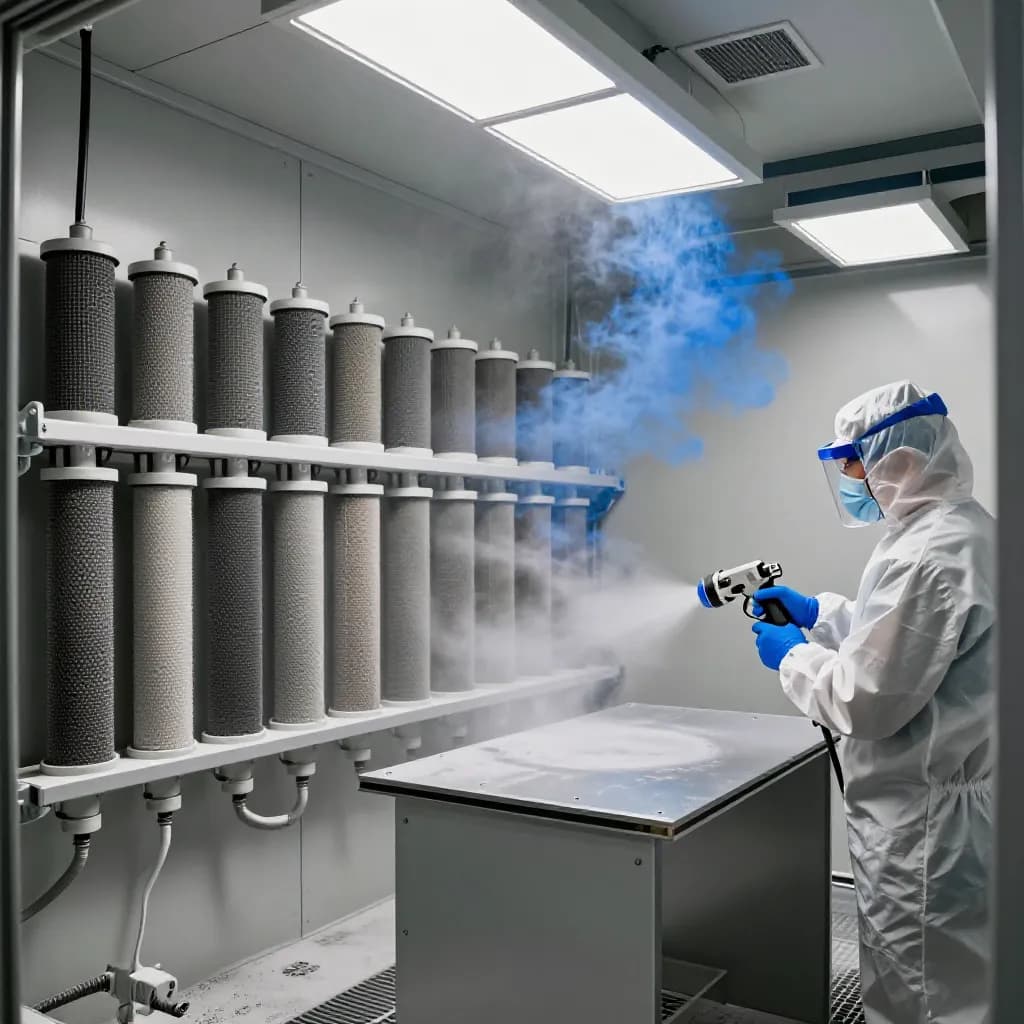
Particulate emissions from powder application are the most visible air quality concern. During electrostatic spray application, a portion of the charged powder particles does not adhere to the workpiece and becomes airborne within the spray booth. While the majority of this overspray is captured by the booth's reclaim system for reuse, fine particles can escape the booth enclosure if containment and filtration systems are inadequate. The particle size distribution of powder coating overspray typically ranges from 1 to 100 micrometers, with the finest particles posing the greatest challenge for capture and the greatest concern for respiratory health.
Ready to Start Your Project?
From one-off customs to 15,000-part production runs — get precise pricing in 24 hours.
On This Page
Air Emission Sources in Powder Coating Operations
Curing oven emissions include combustion products from gas-fired burners (NOx, CO, CO2, and water vapor) and organic decomposition products from the powder coating material itself. During curing, the powder melts, flows, and crosslinks, and this process can release small quantities of volatile organic compounds, blocking agents (from blocked isocyanate systems), and other thermal decomposition products. The composition and quantity of these emissions depend on the powder coating chemistry, curing temperature, and oven design. While typically small in absolute terms, these emissions may require monitoring and control depending on local air quality regulations.
Spray Booth Design and Containment
The spray booth is the primary containment system for powder coating particulate emissions, and its design directly determines both emission control effectiveness and powder reclaim efficiency. Modern powder coating spray booths are designed as negative-pressure enclosures, where exhaust fans maintain airflow from the booth opening inward, preventing powder escape into the surrounding facility. The booth air velocity at the operator opening should be maintained at 0.3-0.5 m/s (60-100 fpm) to provide effective containment without creating excessive turbulence that could interfere with powder deposition.
Booth construction materials and geometry influence both containment and reclaim performance. Smooth, non-porous interior surfaces — typically constructed from polypropylene, stainless steel, or powder-coated steel — minimize powder adhesion to booth walls and facilitate color changes. The booth floor design should promote powder collection, with flat floors for manual sweeping or hopper-bottom designs for automated reclaim. Booth dimensions should provide adequate clearance around workpieces for uniform coating while minimizing the enclosed volume that must be ventilated.
For automatic application systems, enclosed booth designs with minimal openings for conveyor entry and exit provide the best containment. Flexible strip curtains or air curtains at conveyor openings reduce powder escape while allowing workpiece passage. The booth exhaust system should be designed to maintain consistent negative pressure across all operating conditions, including during color changes when booth doors may be opened. Regular monitoring of booth face velocity using anemometers or smoke tubes verifies that containment performance is maintained over time.
Filtration Systems for Particulate Control
The filtration system is the critical component that separates powder particles from the booth exhaust air before it is either recirculated to the facility or discharged to the atmosphere. Two primary filtration technologies are used in powder coating operations: cartridge filters and cyclone separators, often in combination. The choice of filtration system affects emission control efficiency, powder reclaim quality, energy consumption, and maintenance requirements.
Cartridge filter systems use pleated filter media — typically polyester, cellulose, or blended materials — to capture powder particles from the exhaust air stream. Modern cartridge filters achieve filtration efficiencies of 99.5-99.9% for particles above 1 micrometer, producing exhaust air with particulate concentrations well below regulatory limits. The filters are cleaned periodically by reverse pulse-jet air blasts that dislodge accumulated powder from the filter surface, allowing it to fall into collection hoppers for reclaim. Filter media selection should consider the powder coating chemistry, operating temperature, and desired reclaim quality.
Cyclone separators use centrifugal force to separate powder particles from the air stream, directing heavier particles to a collection hopper while allowing cleaned air to exit through a central vortex finder. Cyclones are highly effective for particles above 10 micrometers but less efficient for fine particles. In many powder coating systems, a cyclone serves as the primary separator for bulk powder reclaim, followed by a cartridge filter as the final polishing stage to capture fine particles before air discharge. This two-stage approach optimizes both reclaim efficiency and emission control while extending cartridge filter life by reducing the particulate loading on the filter media.
Curing Oven Exhaust Management
Curing oven exhaust contains a mixture of combustion products, water vapor, and organic compounds released during the powder coating cure cycle. The composition of oven exhaust varies with the powder coating chemistry, curing temperature, and oven loading. Polyester and epoxy-polyester hybrid coatings typically produce minimal organic emissions during curing, while blocked isocyanate (polyurethane) systems release blocking agents such as caprolactam or methyl ethyl ketoxime that may require specific emission control measures.
Oven exhaust ventilation rates must balance emission control with energy efficiency. Excessive exhaust rates waste heated air and increase energy consumption, while insufficient exhaust can allow organic compound concentrations to build up inside the oven, potentially creating explosion hazards and degrading coating quality. The oven exhaust rate should maintain organic compound concentrations well below the lower explosive limit (LEL) — typically at or below 25% of LEL as required by NFPA 86 (Standard for Ovens and Furnaces) and equivalent standards. LEL monitoring systems with automatic exhaust damper control provide real-time safety management.
For facilities where oven exhaust organic emissions exceed regulatory limits, thermal oxidation is the most common control technology. Regenerative thermal oxidizers (RTOs) and catalytic oxidizers can achieve 95-99% destruction efficiency for organic compounds in oven exhaust. However, the relatively low organic compound concentrations in powder coating oven exhaust mean that oxidizer systems often operate at low efficiency, consuming significant supplemental fuel to maintain operating temperature. Heat recovery from the oxidizer to preheat oven supply air or provide facility heating improves the overall energy balance. In many jurisdictions, powder coating oven emissions are below regulatory thresholds that trigger oxidizer requirements, but facilities should verify their specific obligations.
Emission Monitoring and Compliance Programs
A comprehensive emission monitoring program provides the data needed to demonstrate regulatory compliance, optimize emission control systems, and identify emerging issues before they become problems. The monitoring program should address both stack emissions (from booth exhaust and oven exhaust points) and fugitive emissions (from booth openings, material handling, and other non-point sources).
Stack emission testing for particulate matter typically follows EPA Method 5 (gravimetric determination of particulate emissions from stationary sources) in the United States, or EN 13284-1 in Europe. These methods involve isokinetic sampling of the exhaust gas stream through a filter, with the collected particulate weighed to determine the emission rate. For organic compound emissions from curing ovens, EPA Method 25A (total gaseous organic concentration using a flame ionization analyzer) or equivalent continuous emission monitoring provides real-time data on organic compound concentrations.
Continuous emission monitoring systems (CEMS) are required in some jurisdictions for facilities exceeding specified emission thresholds. Even where not required, continuous monitoring of key parameters — booth exhaust particulate concentration, oven exhaust organic compound concentration, and exhaust flow rates — provides valuable operational data. Modern monitoring systems with data logging and trending capabilities enable facility managers to track emission performance over time, correlate emissions with production variables, and demonstrate continuous compliance to regulators. Regular calibration and maintenance of monitoring equipment, documented in a quality assurance plan, ensures data reliability and regulatory acceptance.
Indoor Air Quality for Worker Protection
Air quality management in powder coating facilities must address not only external emissions but also the indoor air quality experienced by workers. Powder coating operators are exposed to airborne powder particles during application, color changes, and booth maintenance activities. The occupational exposure limits (OELs) for respirable dust and total inhalable dust set the benchmarks for acceptable indoor air quality, with specific limits varying by jurisdiction and the chemical composition of the powder coating.
In the United States, OSHA's permissible exposure limit for particulates not otherwise regulated (PNOR) is 15 mg/m³ for total dust and 5 mg/m³ for respirable fraction, measured as 8-hour time-weighted averages. The ACGIH threshold limit value for inhalable particles is 10 mg/m³ and for respirable particles is 3 mg/m³. In the EU, national OELs vary but typically range from 4-10 mg/m³ for inhalable dust and 1.25-3 mg/m³ for respirable dust. For powder coatings containing specific hazardous substances — such as epoxy resins (skin sensitizers) or titanium dioxide (IARC Group 2B) — more restrictive substance-specific OELs may apply.
Engineering controls are the primary means of maintaining acceptable indoor air quality. Effective booth containment, local exhaust ventilation at powder handling stations, general dilution ventilation throughout the facility, and regular housekeeping to prevent powder accumulation on surfaces all contribute to controlling airborne dust levels. Personal protective equipment — including respiratory protection (minimum P2/N95 filtering facepiece respirators) and protective clothing — provides an additional layer of protection for workers performing tasks with elevated exposure potential. Regular workplace air monitoring, conducted by qualified industrial hygienists, verifies that engineering controls are maintaining exposures below applicable OELs.
Best Practices for Continuous Improvement
Air quality management in powder coating operations should be approached as a continuous improvement process rather than a static compliance exercise. Regular review of emission monitoring data, maintenance records, and regulatory developments enables facilities to identify improvement opportunities and adapt to changing requirements. Key performance indicators (KPIs) for air quality management include booth capture efficiency, filter differential pressure trends, stack emission concentrations, indoor air quality measurements, and regulatory compliance status.
Preventive maintenance programs for air quality equipment are essential for sustained performance. Filter replacement schedules based on differential pressure monitoring rather than calendar intervals optimize both emission control and operating costs. Booth seal inspections, fan belt checks, damper operation verification, and ductwork integrity assessments should be conducted on regular schedules. Oven exhaust system maintenance, including burner tuning, heat exchanger cleaning, and LEL monitor calibration, ensures both emission control and energy efficiency.
Technology upgrades should be evaluated periodically as new filtration media, monitoring instruments, and control technologies become available. Advances in nanofiber filter media, for example, offer improved filtration efficiency at lower pressure drop compared to conventional media, reducing both emissions and energy consumption. Smart monitoring systems with predictive analytics can identify developing issues before they cause emission exceedances or equipment failures. Engaging with equipment suppliers, industry associations, and regulatory agencies keeps facility managers informed of best available techniques and emerging regulatory requirements, enabling proactive rather than reactive air quality management.
Frequently Asked Questions
Do powder coating operations produce air emissions?
Yes. While powder coatings eliminate VOC emissions from solvents, operations produce particulate emissions from overspray, combustion products from gas-fired curing ovens, and minor organic emissions from thermal decomposition during curing. These emissions require management through booth filtration, oven exhaust control, and monitoring programs.
What filtration efficiency is needed for powder coating booths?
Modern cartridge filter systems achieve 99.5-99.9% efficiency for particles above 1 micrometer. Two-stage systems combining cyclone separators with cartridge filters optimize both powder reclaim and emission control. The specific efficiency requirement depends on local air quality regulations and the facility's emission permit conditions.
How are curing oven emissions controlled?
Oven exhaust ventilation maintains organic compound concentrations below 25% of the lower explosive limit per NFPA 86. Where emissions exceed regulatory limits, thermal or catalytic oxidizers achieve 95-99% destruction efficiency. Many powder coating operations produce oven emissions below regulatory thresholds requiring oxidizer installation.
What are the occupational exposure limits for powder coating dust?
In the US, OSHA limits are 15 mg/m³ total dust and 5 mg/m³ respirable fraction. ACGIH TLVs are 10 mg/m³ inhalable and 3 mg/m³ respirable. EU limits vary by country but typically range from 4-10 mg/m³ inhalable and 1.25-3 mg/m³ respirable. Substance-specific limits may apply for certain powder coating ingredients.
Is continuous emission monitoring required for powder coating?
Requirements vary by jurisdiction and facility size. Some regulations require CEMS for facilities exceeding specified emission thresholds. Even where not mandatory, continuous monitoring of booth exhaust particulate and oven exhaust organic compounds provides valuable operational data and demonstrates ongoing compliance to regulators.
Ready to Start Your Project?
From one-off customs to 15,000-part production runs — get precise pricing in 24 hours.