Agricultural irrigation systems represent a massive global infrastructure investment, with center pivot systems alone irrigating over 25 million hectares worldwide. These systems operate in some of the most challenging environments for protective coatings — continuous outdoor exposure to UV radiation, temperature extremes, wind-driven dust and debris, agricultural chemicals, and the corrosive effects of water containing dissolved minerals, fertilizers, and soil acids.
Industrial
Powder Coating for Agricultural Irrigation Systems: UV and Chemical Resistance for Pivot and Sprinkler Equipment
Sundial Powder Coating·April 22, 2026·11 min
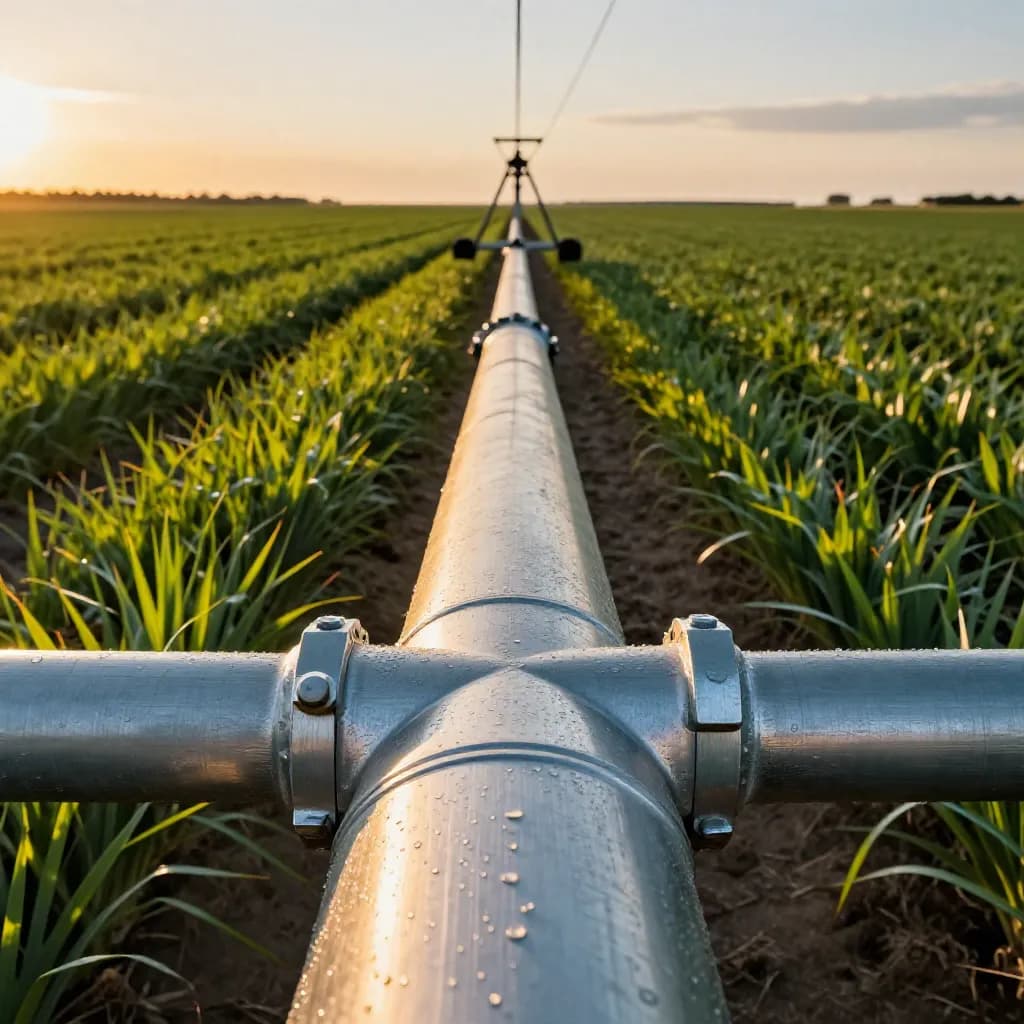
Powder coating has become the standard finishing technology for the structural steel and aluminum components of modern irrigation systems. Center pivot towers, span pipes, drive units, sprinkler heads, and control panels all rely on powder coating for the corrosion protection and UV resistance needed to deliver reliable service over 20-25 year equipment lifetimes in harsh agricultural environments.
Ready to Start Your Project?
From one-off customs to 15,000-part production runs — get precise pricing in 24 hours.
On This Page
Irrigation Equipment: A Demanding Application for Protective Coatings
The economic importance of irrigation equipment coating cannot be overstated. A center pivot irrigation system represents a significant capital investment, and premature corrosion failure of structural components can result in crop loss, water waste, and costly emergency repairs during critical growing seasons. The coating system must provide reliable protection throughout the equipment's design life with minimal maintenance, as irrigation systems are often located in remote areas where maintenance access is limited and costly.
This article examines the specific coating requirements for agricultural irrigation equipment, covering the environmental challenges, chemical exposures, performance standards, and application technologies that ensure powder-coated irrigation systems deliver decades of reliable service.
Center Pivot Systems: Towers, Spans, and Drive Units
Center pivot irrigation systems — the large, wheeled structures that create the distinctive circular crop patterns visible from aircraft — are the most common mechanized irrigation technology worldwide. A typical center pivot consists of a central pivot point connected to 5-12 span sections, each supported by a wheeled tower, extending up to 500 meters from the center to irrigate areas of 50-130 hectares.
The structural steel components of center pivot systems — tower legs, span pipes, truss rods, and cross bracing — are fabricated from galvanized steel that is then powder coated in a duplex system. The hot-dip galvanizing (typically 85-100 microns of zinc per ISO 1461) provides sacrificial cathodic protection at damage sites, while the powder coating (polyester at 60-80 microns) prevents premature zinc consumption from UV exposure and atmospheric corrosion, and provides the white or light color finish that reduces solar heat absorption.
The white or light grey color standard for center pivot systems is not merely aesthetic — it serves a functional purpose. Dark-colored steel structures absorb significantly more solar radiation than light-colored ones, reaching surface temperatures of 60-80°C in direct sunlight compared to 40-50°C for white surfaces. These elevated temperatures accelerate coating degradation, increase thermal expansion stresses on bolted connections, and can affect the performance of rubber and plastic components (gaskets, seals, drive belts) in proximity to the heated steel.
Span pipes (typically 168 mm or 203 mm diameter steel tube) are the longest individual components in a center pivot system, with standard lengths of 9-12 meters. Coating these long, cylindrical components requires extended spray booths and curing ovens, with the pipes suspended vertically or horizontally on overhead conveyors. Uniform film thickness around the pipe circumference is achieved through rotation of the pipe during spraying or through multi-gun arrangements that coat all surfaces simultaneously.
Drive unit housings — the gearbox and motor enclosures at each tower — require enhanced coating protection because they are located at ground level where they are exposed to soil splash, crop debris, and the concentrated moisture environment near the soil surface. Epoxy primer plus polyester topcoat systems at 100-120 microns total thickness provide the enhanced corrosion protection these critical components require.
Sprinkler Heads, Nozzles, and Water Distribution Components
The water distribution components of irrigation systems — sprinkler heads, spray nozzles, drop tubes, and regulators — operate in continuous contact with irrigation water that may contain dissolved minerals, fertilizers, and soil-derived acids. The coating on these components must resist both the external atmospheric environment and the internal water chemistry.
Sprinkler head bodies are typically manufactured from engineering plastics (ABS, nylon) or die-cast zinc alloy. Metal sprinkler bodies benefit from powder coating for corrosion protection against the irrigation water chemistry and the external atmospheric environment. The coating must resist the erosive effect of water flowing through the sprinkler at pressures of 1-4 bar and velocities of 2-5 m/s, which can gradually wear thin coatings at flow transition points.
Drop tubes — the vertical pipes that hang from the span pipe to position sprinkler heads closer to the crop canopy — are typically galvanized steel or PVC. Galvanized steel drop tubes benefit from powder coating to extend the life of the zinc coating and provide color identification for different nozzle sizes or flow rates. The coating must resist the flexing and swinging motion that drop tubes experience as the pivot moves through the field.
Pressure regulators, which maintain consistent water pressure at each sprinkler regardless of elevation changes across the field, use powder-coated steel or brass bodies. The coating must resist the continuous water contact and the pressure cycling that occurs during system startup and shutdown. Epoxy powder coatings provide the water immersion resistance needed for these continuously wetted components.
Filtration system components — screen filters, disc filters, and sand media filters — use powder-coated steel housings that must resist the abrasive action of filtered particles and the chemical cleaning solutions used to backwash the filters. Acid cleaning (using hydrochloric or phosphoric acid at 5-10% concentration) is common for removing mineral scale from filter elements, and the housing coating must resist these periodic acid exposures without degradation.
Chemigation equipment — the injection systems used to apply fertilizers, herbicides, and other chemicals through the irrigation water — requires coatings with specific chemical resistance to the injected products. The coating specification for chemigation components must be validated against the specific chemicals used, as the concentrated chemical solutions at the injection point are far more aggressive than the diluted solutions in the main irrigation water stream.
Fertilizer and Chemical Exposure Resistance
Agricultural chemicals represent one of the most significant coating challenges in the irrigation equipment sector. Fertilizers, herbicides, fungicides, and soil amendments create chemical exposures that can degrade coatings through direct chemical attack, pH extremes, and the synergistic effects of chemical exposure combined with UV radiation and moisture.
Nitrogen fertilizers — urea, ammonium nitrate, and UAN (urea-ammonium nitrate) solutions — are the most commonly applied chemicals through irrigation systems. UAN solution (28-32% nitrogen) is mildly corrosive to steel and can degrade some coating systems through its combination of urea (which can hydrolyze to form ammonia) and ammonium nitrate (which creates acidic conditions). Polyester powder coatings resist UAN solution exposure at application concentrations without significant degradation, but concentrated UAN at storage and injection points requires enhanced chemical resistance from epoxy or epoxy-polyester hybrid coatings.
Phosphoric acid-based fertilizers (MAP, DAP) create acidic conditions (pH 3-5) that can attack coatings with inadequate acid resistance. The acid exposure is most concentrated at fertilizer injection points and in the first few meters of pipe downstream of the injection point. Epoxy powder coatings provide excellent resistance to phosphoric acid at the concentrations encountered in fertigation applications.
Potassium chloride (muriate of potash) fertilizer creates a saline environment that accelerates corrosion at any coating defects. The chloride ions in potassium chloride solution are particularly aggressive to steel, penetrating the passive oxide layer and initiating pitting corrosion. Enhanced coating systems with zinc phosphate pretreatment and increased film thickness (80-100 microns) provide additional protection against chloride-induced corrosion.
Herbicides and fungicides applied through irrigation systems (chemigation) include a wide range of chemical classes — triazines, glyphosate, chlorothalonil, mancozeb — each with different effects on coating materials. Chemical resistance testing per ASTM D1308 against the specific products used in the farming operation validates the coating's suitability. In practice, the dilute concentrations of these chemicals in the irrigation water stream (typically 0.01-0.1% active ingredient) are well within the chemical resistance capability of standard polyester powder coatings.
Sulfur-based soil amendments and acidifying agents create hydrogen sulfide gas in wet conditions, which is highly corrosive to many metals and can attack some coating systems. Equipment used in sulfur-amended soils or with sulfur-based water treatment requires coatings with validated resistance to hydrogen sulfide exposure.
UV Resistance and Outdoor Durability in Agricultural Environments
Agricultural irrigation equipment experiences some of the highest UV exposure levels of any coated product. Located in open fields with no shading from buildings or vegetation, irrigation structures receive full-sky UV radiation for the entire daylight period. In arid and semi-arid regions where irrigation is most critical — the American Southwest, Middle East, North Africa, and Australia — UV intensity is among the highest on Earth, with annual UV doses of 200-300 MJ/m² compared to 100-150 MJ/m² in temperate regions.
Standard polyester powder coatings provide good UV resistance for moderate environments, maintaining acceptable color and gloss for 8-12 years of full outdoor exposure. However, in high-UV agricultural environments, standard polyester may show noticeable chalking and color fade within 5-7 years, which is insufficient for equipment with a 20-25 year design life.
Super-durable polyester powder coatings, formulated with UV-stabilized resins and enhanced HALS (hindered amine light stabilizer) packages, extend UV resistance to 15-20 years in high-UV environments. These formulations meet AAMA 2604 requirements (5 years South Florida exposure with ≥50% gloss retention) and are the standard specification for premium irrigation equipment manufacturers.
For the most demanding UV environments — desert regions, high-altitude locations, and equatorial zones — fluoropolymer-modified powder coatings (PVDF or FEVE-based) provide the ultimate UV resistance, maintaining color and gloss for 20-30 years. While more expensive than polyester formulations, the extended service life justifies the premium for equipment that is expected to operate for decades with minimal maintenance.
The interaction between UV exposure and chemical exposure creates synergistic degradation that exceeds the effect of either stress alone. UV radiation breaks polymer chain bonds in the coating surface, creating micro-cracks and increased porosity that allow chemicals to penetrate more deeply into the coating film. This UV-chemical synergy means that coatings in agricultural environments must be specified for the combined exposure, not just the individual stresses.
Dust and soil abrasion in agricultural environments also affect coating durability. Wind-blown soil particles, crop residue, and dust from field operations create a continuous low-level abrasion that gradually wears the coating surface. This abrasion removes the UV-stabilized surface layer of the coating, exposing less-stabilized material beneath and accelerating UV degradation. Coatings with good abrasion resistance (Taber abrasion loss <100 mg per 1,000 cycles) maintain their UV-protective surface layer longer, extending overall coating life.
Pipe Fittings, Valves, and Underground Components
The pipe network that distributes water from the source to the irrigation system includes a wide range of fittings, valves, and connection components that require corrosion protection appropriate to their specific exposure conditions. Powder coating addresses the needs of above-ground components, while specialized coatings are required for buried and submerged elements.
Above-ground pipe fittings — flanges, couplings, tees, elbows, and reducers — are exposed to atmospheric corrosion, UV radiation, and splash from irrigation water. Standard polyester powder coating at 60-80 microns over zinc phosphate pretreatment provides adequate protection for these components in most agricultural environments. Color coding of fittings by pipe function (supply, return, drain, chemical injection) follows facility-specific standards and aids maintenance and troubleshooting.
Gate valves, butterfly valves, and check valves in irrigation systems use powder-coated cast iron or ductile iron bodies. The coating must resist the continuous water contact on internal surfaces and the atmospheric exposure on external surfaces. Dual-chemistry systems — epoxy on internal water-contact surfaces for chemical and immersion resistance, polyester on external surfaces for UV resistance — provide optimized protection for each exposure zone.
Buried pipe and fittings require coating systems designed for soil contact and cathodic protection compatibility. Fusion-bonded epoxy (FBE) at 300-500 microns is the standard coating for buried steel irrigation pipe, providing the moisture barrier and chemical resistance needed for soil immersion service. The FBE coating must be compatible with the cathodic protection system (if installed) and resist cathodic disbondment per ASTM G8.
Pump stations — the heart of any irrigation system — use powder-coated steel frames, motor housings, and control panels. The pump station environment combines water splash, chemical exposure (from fertilizer injection equipment), vibration from pump operation, and outdoor weather exposure. Enhanced coating systems with epoxy primer and super-durable polyester topcoat at 100-120 microns total thickness provide the robust protection these critical components require.
Control panels and electrical enclosures for irrigation systems must achieve IP55 or IP65 ratings for outdoor installation. The powder coating contributes to the IP rating by providing a smooth, continuous surface for gasket sealing and by protecting the steel enclosure from corrosion that could compromise structural integrity and seal effectiveness. UV-stabilized polyester powder coatings maintain the enclosure's appearance and protection over the 15-20 year typical service life of irrigation control equipment.
Maintenance, Inspection, and Lifecycle Management
Effective maintenance of powder-coated irrigation equipment extends coating life, prevents structural corrosion, and maximizes the return on the equipment investment. The remote location and seasonal operation of most irrigation systems create unique maintenance challenges that must be addressed through planned inspection and repair programs.
Annual inspection of coating condition should be performed during the off-season when the irrigation system is not in operation. Key inspection points include: tower leg bases (where soil contact and moisture accumulation create the highest corrosion risk), span pipe joints (where mechanical stress and water leakage can damage coatings), drive unit housings (where ground-level exposure is most aggressive), and any areas where previous coating damage has been repaired.
Coating damage from field operations — impacts from farm equipment, abrasion from crop contact, and damage from maintenance activities — should be repaired promptly to prevent corrosion from establishing at damage sites. Touch-up repair using color-matched liquid paint is acceptable for small damage areas (less than 50 cm²). Larger damage areas should be prepared by power tool cleaning to St 3 per ISO 8501-1 and repaired with a compatible liquid coating system applied to the manufacturer's specification.
The galvanized steel substrate of most irrigation equipment provides a safety margin against corrosion at coating damage sites. The zinc galvanizing layer sacrificially protects the steel at small damage areas, preventing rust formation for several years even without coating repair. However, this sacrificial protection is consumed over time, and eventually the zinc layer will be depleted at damage sites, allowing steel corrosion to begin. Prompt coating repair preserves the zinc layer and extends the overall system life.
Water quality monitoring is an indirect but important aspect of coating maintenance. Changes in irrigation water chemistry — increased salinity, pH shifts, or elevated chemical concentrations — can accelerate coating degradation on water-contact components. Regular water analysis and adjustment of chemical treatment programs help maintain water conditions within the range that the coating system was designed to resist.
End-of-life assessment for irrigation equipment coatings typically occurs at 15-20 years, when the cumulative effects of UV degradation, chemical exposure, and mechanical damage have reduced the coating's protective capability to the point where widespread corrosion is beginning. At this stage, the equipment owner faces a decision between comprehensive re-coating (stripping, re-preparation, and re-powder-coating of all components) and equipment replacement. The economic analysis depends on the structural condition of the equipment, the cost of re-coating versus replacement, and the expected remaining service life after re-coating.
Frequently Asked Questions
Why are center pivot irrigation systems usually white?
White or light colors reduce solar heat absorption, keeping surface temperatures 20-30°C lower than dark colors in direct sunlight. This reduces thermal stress on bolted connections, extends the life of rubber and plastic components, and slows UV-driven coating degradation. The light color also improves visibility for aircraft and field operations safety.
How long does powder coating last on irrigation equipment?
Duplex systems (galvanizing plus super-durable polyester powder coating) provide 15-20 years of protection in moderate agricultural environments and 10-15 years in high-UV desert conditions. Standard polyester coatings may show significant degradation after 8-12 years in high-UV environments. Annual inspection and prompt repair of damage extends coating life.
Can powder coating resist fertilizer chemicals?
Yes. Standard polyester powder coatings resist dilute fertilizer solutions (UAN, MAP, DAP) at application concentrations. Concentrated fertilizer at injection points requires epoxy or hybrid coatings with enhanced chemical resistance. Chemical resistance should be validated through ASTM D1308 testing against the specific fertilizer products used.
What coating is used for buried irrigation pipe?
Fusion-bonded epoxy (FBE) at 300-500 microns is the standard for buried steel irrigation pipe. FBE provides the moisture barrier and chemical resistance needed for soil immersion and is compatible with cathodic protection systems. Above-ground pipe uses standard polyester powder coating at 60-80 microns.
How does dust abrasion affect irrigation equipment coatings?
Wind-blown soil and crop debris create continuous low-level abrasion that gradually wears the UV-stabilized surface layer of the coating, accelerating UV degradation. Coatings with good abrasion resistance (Taber loss <100 mg/1,000 cycles) maintain their protective surface layer longer. Regular cleaning removes abrasive deposits and extends coating life.
Ready to Start Your Project?
From one-off customs to 15,000-part production runs — get precise pricing in 24 hours.