Adhesion is the most fundamental property of any powder coating system. Without adequate adhesion, every other coating property — corrosion resistance, weathering durability, mechanical toughness, and aesthetic appearance — becomes irrelevant because the coating will eventually separate from the substrate. Adhesion failures range from catastrophic full-sheet delamination to subtle localized lifting that only becomes apparent after months of service exposure. Both types represent a failure in the bond between the coating and the substrate, or between coating layers in multi-coat systems.
Technical
Powder Coating Adhesion Failure: Testing Methods, Root Causes, and Troubleshooting
Sundial Powder Coating·April 22, 2026·14 min
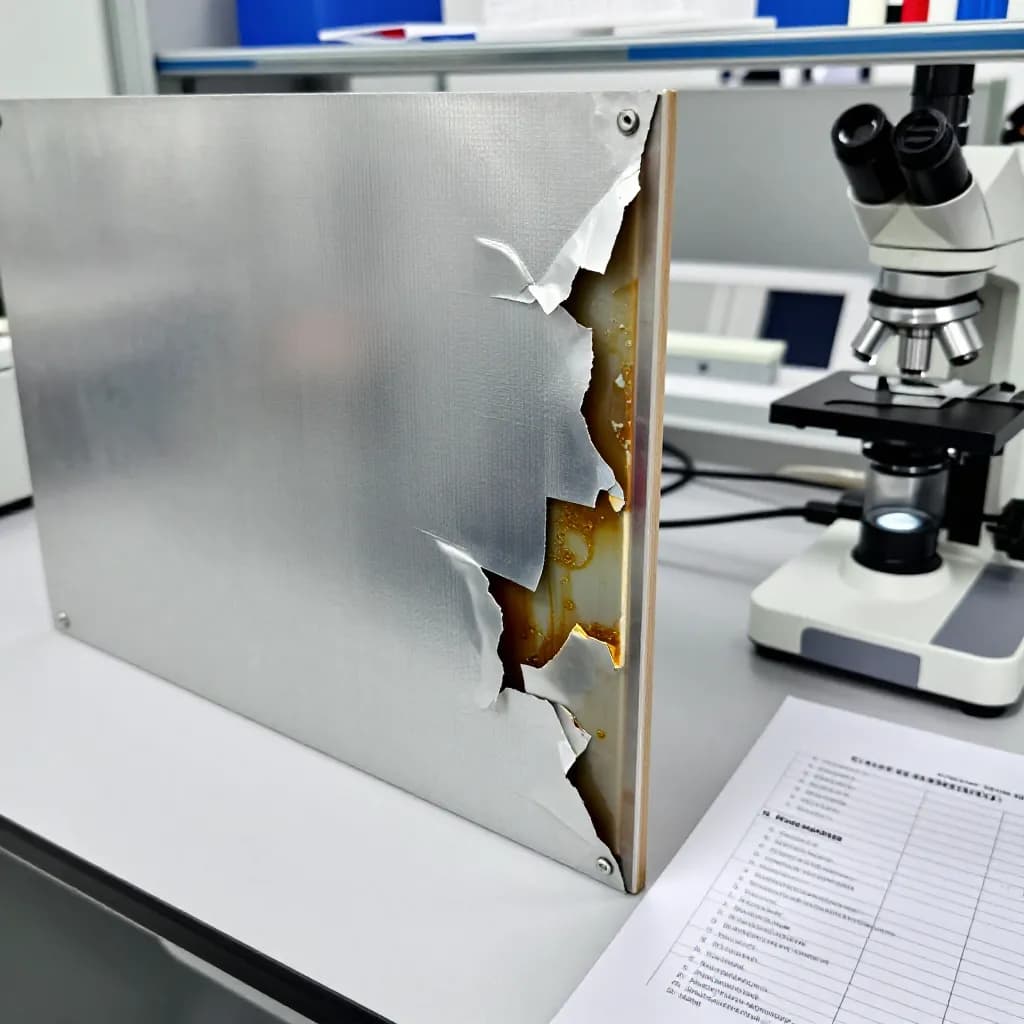
The adhesion bond in powder coating is primarily mechanical and chemical in nature. Mechanical adhesion results from the molten powder flowing into the microscopic peaks and valleys of the substrate surface, creating a physical interlock when the coating solidifies. Chemical adhesion results from molecular-level interactions between the coating resin and the substrate surface — including hydrogen bonding, van der Waals forces, and covalent bonding through the conversion coating layer. A properly prepared and coated surface relies on both mechanisms working together.
Ready to Start Your Project?
From one-off customs to 15,000-part production runs — get precise pricing in 24 hours.
On This Page
Why Adhesion Is the Foundation of Coating Performance
Adhesion failures are among the most costly quality problems in powder coating because they often manifest after parts have been shipped, installed, or placed in service. A batch of architectural extrusions that passes initial quality inspection but delaminates after six months of weathering exposure represents not just the cost of recoating but also the cost of removal, logistics, and reputational damage. Understanding the root causes of adhesion failure and implementing robust testing protocols is essential for preventing these costly field failures.
Cross-Hatch Adhesion Testing: Method and Interpretation
The cross-hatch adhesion test, standardized as ASTM D3359 Method B and ISO 2409, is the most widely used adhesion test in the powder coating industry. The test involves cutting a lattice pattern of parallel lines through the coating to the substrate using a multi-blade cutting tool, applying a specified pressure-sensitive tape over the lattice, and then removing the tape with a rapid pull. The amount of coating removed with the tape is evaluated against a classification scale from 0B (complete removal) to 5B (no removal) in the ASTM system, or from 0 (no removal) to 5 (greater than 65% removal) in the ISO system.
Proper execution of the cross-hatch test requires attention to several details that are frequently overlooked. The cutting tool must have sharp blades spaced at the correct interval — 1 mm for coatings up to 60 μm thick, 2 mm for coatings 60-120 μm thick, and 3 mm for coatings above 120 μm. Dull blades tear rather than cut the coating, producing ragged edges that can be mistakenly interpreted as adhesion failure. The cuts must penetrate completely through the coating to the substrate — incomplete cuts that leave a thin layer of coating at the bottom do not properly test the coating-substrate interface.
The tape used must meet the specification requirements: ASTM D3359 specifies a tape with adhesion strength of 36 ± 2.5 N per 25 mm width. Using weaker tape may miss adhesion problems, while stronger tape may pull coating from surfaces with adequate but not exceptional adhesion. The tape should be pressed firmly over the lattice using a rubber eraser or roller to ensure full contact, then removed with a smooth, rapid pull at approximately 180° within 90 seconds of application. Results should be evaluated immediately under good lighting, preferably with magnification, and classified according to the standard's photographic reference scale.
Pull-Off Adhesion Testing: Quantitative Measurement
While the cross-hatch test provides a qualitative ranking of adhesion, the pull-off adhesion test per ASTM D4541 or ISO 4624 provides a quantitative measurement in megapascals (MPa) or pounds per square inch (psi). This test involves bonding a metal dolly (typically 20 mm diameter) to the coated surface using a high-strength adhesive, allowing the adhesive to cure, and then pulling the dolly perpendicular to the surface using a calibrated hydraulic or pneumatic tester until the bond fails. The maximum pull-off force divided by the dolly area gives the adhesion strength.
Pull-off adhesion values for properly prepared and coated powder systems typically range from 5-15 MPa (725-2175 psi), depending on the substrate, pretreatment, and powder formulation. Values below 3.5 MPa (500 psi) generally indicate an adhesion problem requiring investigation. The failure mode is as important as the numerical value — the test report should describe where the failure occurred: at the coating-substrate interface (adhesive failure), within the coating itself (cohesive failure), within the adhesive layer, or at the dolly-adhesive interface. Adhesive failure at the coating-substrate interface indicates a pretreatment or surface preparation problem. Cohesive failure within the coating suggests under-cure or a formulation issue.
The pull-off test has several practical limitations. The adhesive must be stronger than the coating adhesion being measured — if the adhesive fails before the coating, the test is invalid. Epoxy adhesives cured at room temperature for 24 hours typically achieve bond strengths of 15-25 MPa, which is adequate for most powder coating adhesion measurements. The test is destructive and leaves a visible mark, so it cannot be performed on finished production parts. Surface preparation of the dolly and proper adhesive application are critical — contamination or air bubbles in the adhesive bond will produce artificially low readings that do not reflect the actual coating adhesion.
Pretreatment Failures: The Most Common Adhesion Root Cause
Inadequate or failed pretreatment is the single most common root cause of powder coating adhesion failure. The pretreatment process — which typically includes cleaning, rinsing, conversion coating, and final rinsing — serves two critical functions: it removes surface contaminants that would prevent coating adhesion, and it creates a conversion coating layer that provides both chemical bonding sites for the powder and a corrosion-resistant barrier at the coating-substrate interface.
Iron phosphate conversion coatings on steel should produce a coating weight of 0.3-1.0 g/m² (approximately 0.3-1.0 μm thickness), measured by the gravimetric method per ASTM B680 or by XRF. Coating weights below 0.2 g/m² indicate insufficient conversion and poor adhesion potential. Zinc phosphate coatings target higher weights of 1.5-4.0 g/m² with a fine, uniform crystal structure — coarse or non-uniform crystals indicate process control problems. Zirconium-based conversion coatings operate at much lower coating weights of 20-80 mg/m², measured by XRF, and require precise pH and concentration control.
Common pretreatment failures include: insufficient cleaning that leaves residual oils, drawing compounds, or corrosion products on the surface; depleted or out-of-specification chemical baths that produce inadequate conversion coating; poor rinse quality that leaves chemical residues on the surface; and excessive drying temperatures that dehydrate and crack the conversion coating. Water break testing — observing whether rinse water sheets uniformly across the surface or beads up — is a simple but effective in-process check for cleaning adequacy. A water-break-free surface indicates that organic contaminants have been removed. Regular titration of pretreatment bath concentrations, pH monitoring, and conversion coating weight measurements are essential process controls.
Contamination-Related Adhesion Failures
Surface contamination is the second most common cause of adhesion failure, and it can occur at any point between pretreatment and powder application. Even a properly pretreated surface can lose adhesion if it becomes contaminated before coating. Common contaminants include: silicone from mold releases, lubricants, and personal care products; hydrocarbon oils from compressed air systems, conveyor lubricants, and handling; moisture from condensation or inadequate drying; and particulate contamination from grinding dust, weld spatter, or airborne debris.
Silicone contamination is particularly insidious because extremely small quantities — as little as 0.1 parts per million on the surface — can cause complete adhesion failure. Silicone migrates readily across surfaces and through the air, contaminating parts that were never in direct contact with the silicone source. Common sources in coating operations include silicone-based conveyor lubricants, silicone sealants used in building maintenance, silicone-containing hand creams used by operators, and silicone mold releases on incoming parts from fabrication shops. Once silicone contamination enters a coating line, it can be extremely difficult to eliminate because it adsorbs onto conveyor chains, hooks, oven walls, and booth surfaces.
Compressed air contamination is another frequent culprit. Compressed air used for blow-off operations or powder fluidization must be clean and dry — oil carryover from compressors, even at levels of 0.1 mg/m³, can deposit a thin hydrocarbon film on pretreated surfaces that prevents adhesion. Compressed air quality should meet ISO 8573-1 Class 1.2.1 or better for coating operations, requiring oil-removing filters, desiccant dryers, and regular filter maintenance. Testing compressed air quality with a white cloth blow-down test or an oil vapor detector should be part of the routine quality control program.
Inter-Coat Adhesion in Multi-Layer Systems
Multi-coat powder systems — primer plus topcoat, or basecoat plus clearcoat — introduce the additional challenge of inter-coat adhesion: the bond between successive coating layers. Inter-coat adhesion failure manifests as delamination at the interface between coating layers rather than at the coating-substrate interface, and it has different root causes than substrate adhesion failure.
The most common cause of inter-coat adhesion failure is over-cure of the primer or basecoat layer. When the first coat is fully cured to its maximum crosslink density, the surface becomes chemically inert with few remaining reactive functional groups available to bond with the topcoat. The topcoat then relies primarily on mechanical adhesion to the primer surface, which may be insufficient for demanding service conditions. Best practice for multi-coat systems is to apply the topcoat while the primer is in a partially cured state — typically 80-90% of full cure — so that residual reactive groups in the primer can participate in chemical bonding with the topcoat during the final cure cycle.
Surface contamination between coats is another common cause. If primer-coated parts are handled, stored, or transported before topcoating, they can accumulate fingerprints, dust, moisture, or other contaminants that interfere with inter-coat adhesion. Minimizing the time between primer and topcoat application — ideally coating both layers in the same production cycle — reduces this risk. If storage between coats is unavoidable, parts should be kept in a clean, dry environment and lightly abraded or solvent-wiped before topcoating.
Chemical incompatibility between coating layers can also cause inter-coat adhesion failure. Not all powder chemistries are compatible with each other — for example, some acrylic topcoats have poor adhesion to polyester primers, and certain epoxy primers may not bond well with fluoropolymer topcoats. Powder manufacturers publish compatibility guides for their multi-coat systems, and these recommendations should be followed strictly. When combining powders from different manufacturers, inter-coat adhesion testing should be performed during qualification before committing to production.
Environmental and Service-Related Adhesion Failures
Some adhesion failures only manifest after exposure to specific environmental conditions, making them difficult to detect during production quality inspection. These delayed failures are often the most damaging because parts are already in service when the problem appears.
Moisture-driven adhesion failure occurs when water penetrates through the coating film or enters at cut edges and damaged areas, accumulating at the coating-substrate interface. If the pretreatment conversion coating is inadequate or the coating has micro-porosity from under-cure or outgassing, water molecules can reach the metal surface and initiate corrosion that undermines the adhesion bond. This mechanism is accelerated by elevated temperature and humidity, and is the primary failure mode evaluated by salt spray testing (ASTM B117) and cyclic corrosion testing (ASTM D5894). Scribe creep — the progressive loss of adhesion radiating outward from an intentional scribe line — is the standard metric for evaluating this failure mode.
Thermal cycling can cause adhesion failure due to differential thermal expansion between the coating and substrate. Powder coatings have coefficients of thermal expansion (CTE) of approximately 50-80 × 10⁻⁶/°C, while steel has a CTE of approximately 12 × 10⁻⁶/°C and aluminum approximately 23 × 10⁻⁶/°C. This mismatch generates shear stresses at the coating-substrate interface during temperature changes, and repeated cycling can fatigue the adhesion bond. Thicker coatings generate higher thermal stresses, which is one reason why maximum film thickness specifications exist for demanding applications.
Chemical exposure can also degrade adhesion over time. Alkaline cleaning solutions, acidic rain, industrial chemicals, and UV radiation can all attack the coating-substrate interface or degrade the conversion coating layer. Accelerated testing protocols such as QUV weathering (ASTM G154), xenon arc exposure (ASTM G155), and chemical resistance testing (ASTM D1308) evaluate the coating system's resistance to these environmental stressors.
Root Cause Analysis Framework for Adhesion Failures
When adhesion failure occurs, a structured root cause analysis (RCA) framework prevents wasted time on trial-and-error troubleshooting. The framework begins with characterizing the failure: Where does the failure occur — at the coating-substrate interface, within the coating, or between coating layers? Is the failure localized or widespread? Is it immediate or delayed? Does it correlate with specific part geometries, substrate batches, or production dates?
Interface failure (coating separates cleanly from the substrate) points to pretreatment or contamination issues. Examine the exposed substrate surface — is the conversion coating visible, or is bare metal exposed? If bare metal is visible, the conversion coating failed or was never properly formed. If the conversion coating is intact but the coating still separated, contamination between pretreatment and coating is the likely cause. Test the exposed substrate surface with contact angle measurement or surface energy testing to detect hydrophobic contaminants.
Cohesive failure (coating splits within itself, leaving coating on both the substrate and the tape or dolly) indicates a coating integrity problem — typically under-cure, excessive film thickness, or internal stress from thermal mismatch. Perform MEK rub testing on the failed area to check cure completeness. Measure film thickness to verify it is within specification. If the failure occurs at a specific depth within the coating, it may indicate a boundary between application passes where the powder did not fully fuse.
For systematic investigation, collect and preserve samples of failed parts, retain powder samples from the production batch, document all process parameters (pretreatment chemistry, oven profiles, application settings), and review any changes that occurred before the failure appeared. The most common finding in adhesion failure RCA is that a process parameter drifted out of specification without being detected — reinforcing the importance of statistical process control and regular verification testing.
Frequently Asked Questions
What is the most common cause of powder coating adhesion failure?
Inadequate pretreatment is the most common root cause. This includes insufficient cleaning that leaves residual oils or contaminants, depleted chemical baths producing inadequate conversion coatings, poor rinse quality, and excessive drying temperatures. Regular monitoring of pretreatment bath chemistry, conversion coating weight, and rinse water quality is essential for preventing adhesion failures.
How do you perform a cross-hatch adhesion test correctly?
Use a multi-blade cutter with sharp blades spaced at the correct interval (1-3 mm depending on film thickness) to cut a lattice pattern through the coating to the substrate. Apply specified pressure-sensitive tape (36 ± 2.5 N/25mm adhesion) firmly over the lattice, then remove with a rapid 180° pull within 90 seconds. Evaluate coating removal against the ASTM D3359 or ISO 2409 classification scale.
Why does powder coating sometimes pass initial adhesion testing but fail later in service?
Delayed adhesion failure typically results from under-cure (incomplete crosslinking generates internal stresses over time), inadequate conversion coating (moisture penetrates to the interface and initiates corrosion), or thermal cycling fatigue (differential expansion between coating and substrate fatigues the bond). Accelerated testing such as salt spray, humidity exposure, and thermal cycling can detect these latent failures before parts ship.
How do you prevent inter-coat adhesion failure in primer-topcoat systems?
Apply the topcoat while the primer is partially cured (80-90% of full cure) so residual reactive groups can bond with the topcoat. Minimize time between coats to prevent contamination. Verify chemical compatibility between primer and topcoat formulations. If storage between coats is necessary, keep parts clean and dry, and consider light abrasion before topcoating.
What pull-off adhesion values are acceptable for powder coating?
Properly prepared and coated powder systems typically achieve pull-off adhesion values of 5-15 MPa (725-2175 psi). Values below 3.5 MPa (500 psi) generally indicate a problem requiring investigation. The failure mode is as important as the value — adhesive failure at the coating-substrate interface indicates pretreatment issues, while cohesive failure within the coating suggests under-cure or formulation problems.
Ready to Start Your Project?
From one-off customs to 15,000-part production runs — get precise pricing in 24 hours.