Exterior powder coatings are subjected to a relentless combination of environmental stresses: ultraviolet radiation that breaks chemical bonds in the resin and pigment system, moisture that penetrates and swells the film, temperature cycling that generates mechanical stress, and atmospheric pollutants that chemically attack the coating surface. Over time, these stresses cause visible degradation — gloss loss, color change, chalking, cracking, and eventually loss of protective function. Accelerated weathering testing compresses years of natural exposure into weeks or months of laboratory testing, enabling coating engineers to predict long-term performance and compare formulations without waiting for years of outdoor results.
Technical
Powder Coating Accelerated Weathering Testing: QUV, Xenon Arc, and Outdoor Exposure Correlation
Sundial Powder Coating·April 22, 2026·13 min
The degradation mechanisms in weathering are fundamentally different from those in corrosion testing. Salt spray testing evaluates the coating's barrier properties and the pretreatment's corrosion resistance, while weathering testing evaluates the coating's resistance to photochemical degradation — the breakdown of polymer chains and pigment structures by UV radiation. A coating that excels in salt spray testing may fail rapidly in weathering if its resin chemistry is UV-sensitive (as with epoxy coatings), and a coating with excellent weathering resistance may perform poorly in salt spray if the pretreatment is inadequate.
Ready to Start Your Project?
From one-off customs to 15,000-part production runs — get precise pricing in 24 hours.
On This Page
Why Weathering Testing Is Essential for Exterior Powder Coatings
For architectural, automotive, and other exterior applications, weathering resistance is often the primary performance requirement. Quality standards such as Qualicoat, GSB, and AAMA 2605 include specific accelerated weathering requirements, and many end-use specifications require both accelerated and natural outdoor weathering data. Understanding the available test methods, their capabilities, and their limitations is essential for specifying and evaluating exterior powder coatings.
QUV Accelerated Weathering: Fluorescent UV Testing
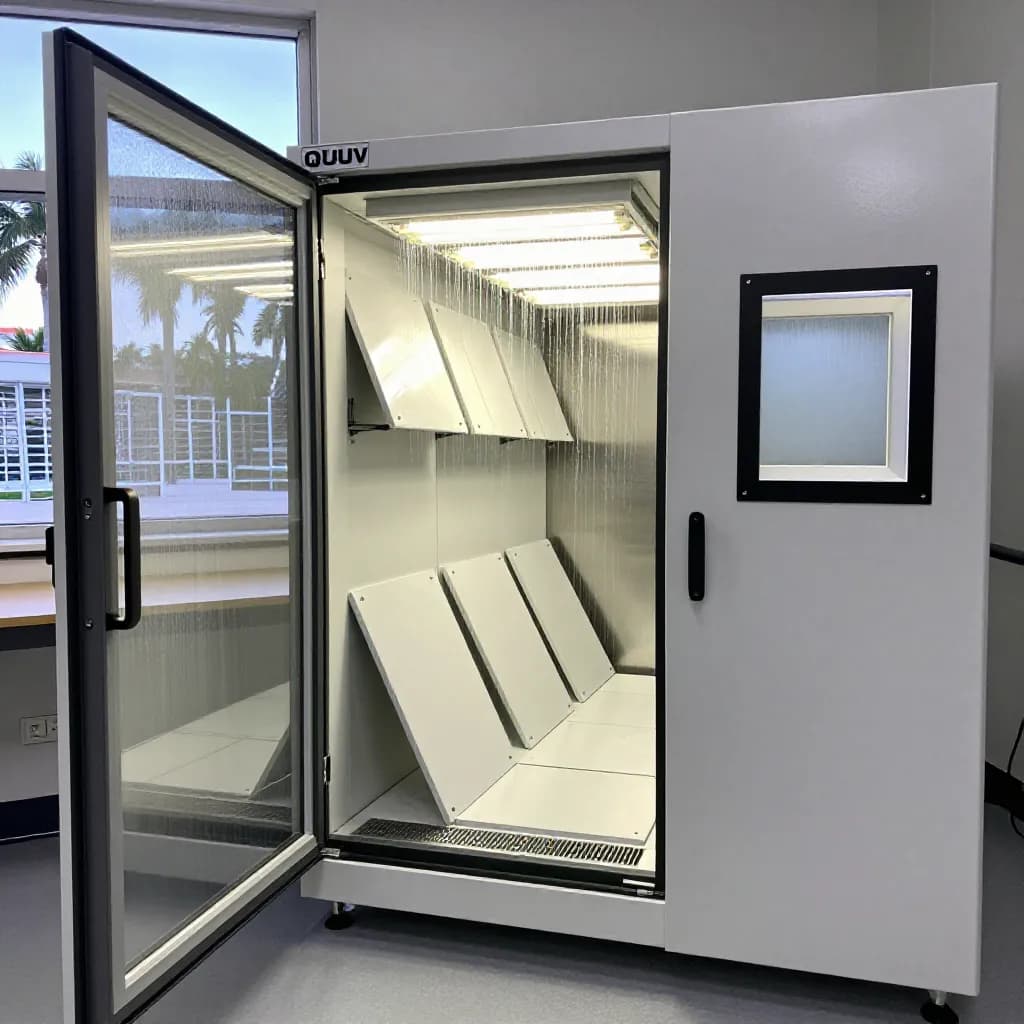
The QUV accelerated weathering tester is the most widely used laboratory weathering instrument in the powder coating industry. It uses fluorescent UV lamps to simulate the UV component of sunlight, combined with condensation or water spray cycles to simulate moisture exposure. The test is standardized under ASTM G154 (Standard Practice for Operating Fluorescent Ultraviolet Light Apparatus) and ISO 4892-3.
The QUV uses two types of fluorescent UV lamps: UVA-340 and UVB-313. UVA-340 lamps provide the best simulation of natural sunlight in the critical short-wavelength UV region (295-365 nm) that causes most photochemical degradation. Their spectral output closely matches the solar spectrum from 295 to 365 nm, making them the preferred choice for realistic weathering simulation. UVB-313 lamps emit shorter-wavelength UV (280-315 nm) that is more aggressive than natural sunlight, producing faster degradation but with a risk of causing failure modes that do not occur in natural exposure. UVB-313 lamps are useful for rapid screening and quality control but should not be used for predicting real-world performance.
A typical QUV test cycle alternates between UV exposure and condensation: 8 hours of UV at 60°C followed by 4 hours of condensation at 50°C, repeated continuously for the specified test duration. The UV irradiance is controlled at 0.89 W/m²/nm at 340 nm for UVA-340 lamps, which corresponds to the peak noon summer sunlight intensity at this wavelength. Some test protocols include a water spray step instead of or in addition to condensation, which provides thermal shock and mechanical erosion effects.
QUV test durations for powder coatings typically range from 500 to 4000 hours depending on the application. General industrial polyester coatings are often tested to 1000-2000 hours, while high-performance super-durable polyester and fluoropolymer coatings may be tested to 3000-4000 hours or more. Qualicoat Class 1 requires 1000 hours of QUV-A exposure, while Qualicoat Class 2 (super-durable) requires 2000 hours.
Xenon Arc Weathering: Full-Spectrum Solar Simulation
Xenon arc weathering testers provide a more complete simulation of natural sunlight than fluorescent UV instruments because they reproduce the full solar spectrum — including visible light and infrared — rather than just the UV component. The test is standardized under ASTM G155 (Standard Practice for Operating Xenon Arc Light Apparatus) and ISO 4892-2. Xenon arc testing is generally considered more representative of natural weathering than QUV testing, particularly for evaluating color change and the effects of visible light on pigment stability.
Xenon arc lamps produce a broad-spectrum output that is filtered to match the spectral power distribution of natural sunlight. Different filter combinations simulate different exposure conditions: daylight filters simulate direct sunlight through the atmosphere, window glass filters simulate sunlight filtered through automotive or architectural glass, and extended UV filters provide enhanced short-wavelength UV for accelerated testing. For exterior powder coating evaluation, daylight filters are the standard choice.
The irradiance in xenon arc testers is typically controlled at 0.35-0.55 W/m²/nm at 340 nm, with a black panel temperature of 63 ± 3°C and a chamber air temperature of 38 ± 3°C. Water spray cycles of 18 minutes on / 102 minutes off simulate rain exposure. These conditions are specified in ASTM G155 Cycle 1, which is the most commonly referenced xenon arc test cycle for exterior coatings.
Xenon arc testing is required by several major coating specifications. AAMA 2605, the highest-performance architectural coating specification in North America, requires 4000 hours of xenon arc exposure per ASTM G155 with specific gloss retention and color change limits. GSB Master certification requires xenon arc testing as part of its qualification protocol. The longer test durations and higher equipment costs of xenon arc testing compared to QUV mean that it is typically used for qualification and specification compliance rather than routine production quality control.
Natural Outdoor Exposure: The Ultimate Performance Benchmark
Despite the convenience of accelerated laboratory testing, natural outdoor exposure remains the ultimate benchmark for weathering performance because it subjects coatings to the actual combination of stresses they will encounter in service. The most widely recognized outdoor exposure site for coatings is South Florida (specifically the Miami area), which provides intense UV radiation, high humidity, frequent rain, salt air, and elevated temperatures — a combination that produces rapid weathering degradation and has been used as a reference exposure site for over 70 years.
South Florida exposure is standardized under ASTM D1014 (Standard Practice for Conducting Exterior Exposure Tests of Paints and Coatings on Metal Substrates) and ASTM G7 (Standard Practice for Atmospheric Environmental Exposure Testing of Nonmetallic Materials). Test panels are mounted on exposure racks at 5° from horizontal (facing south) to maximize UV exposure and moisture retention, or at 45° for a more moderate exposure that better represents vertical facade conditions. The 5° angle produces the most aggressive degradation and is the standard for most coating specifications.
AAMA 2605 requires 10 years of South Florida exposure at 5° south for the highest-performance architectural coatings, with specific limits on color change (ΔE ≤ 5.0), gloss retention (minimum 50% of original), and chalking (rating 8 or better per ASTM D4214). This 10-year requirement is the most demanding natural weathering specification in the coatings industry and is met only by premium super-durable polyester and fluoropolymer (PVDF/FEVE) powder coatings.
Other outdoor exposure sites are used for specific environments: Arizona (hot, dry, high UV), Jacksonville, Florida (moderate marine), and various European sites for Qualicoat and GSB testing. The limitation of natural exposure is time — waiting 5-10 years for results is impractical for new product development. This is why accelerated testing is used for screening and development, with natural exposure providing the definitive long-term validation.
Evaluating Weathering Performance: Gloss, Color, and Chalking
Weathering performance is evaluated by measuring changes in three primary properties: gloss, color, and chalking. Each property degrades through different mechanisms and at different rates, and specifications typically set limits for all three.
Gloss retention is measured using a glossmeter at 60° angle per ASTM D523. The initial gloss of the unexposed panel is measured, and the gloss of exposed panels is measured at specified intervals. Gloss retention is expressed as a percentage: (exposed gloss / initial gloss) × 100. UV radiation breaks polymer chains at the coating surface, creating a micro-rough layer that scatters reflected light and reduces gloss. Polyester-TGIC coatings typically retain 50-70% of initial gloss after 2000 hours of QUV-A exposure, while super-durable polyester formulations retain 70-90%, and fluoropolymer coatings retain 80-95%.
Color change is measured using a spectrophotometer and reported as Delta E per the agreed formula (CIE76, CMC, or CIEDE2000). UV degradation of pigments causes color fading, while resin degradation can cause yellowing. The rate of color change depends on both the resin chemistry and the pigment system — inorganic pigments (iron oxides, titanium dioxide, chromium oxide) are generally more UV-stable than organic pigments (phthalocyanines, quinacridones, azo pigments). Dark colors tend to show less visible color change than light colors because the higher pigment loading provides more UV absorption and protection of the resin.
Chalking is the formation of a loose, powdery layer on the coating surface caused by UV degradation of the resin at the surface, leaving exposed pigment particles. Chalking is evaluated per ASTM D4214 using a felt pad rubbed across the surface — the amount of pigment transferred to the pad is rated on a scale from 10 (no chalking) to 0 (severe chalking). Chalking ratings of 8 or higher are typically required for acceptable performance. Chalking is most visible on dark colors and is a primary degradation mode for polyester coatings in high-UV environments.
Correlation Between Accelerated and Natural Weathering
Establishing a reliable correlation between accelerated weathering test results and natural outdoor exposure is one of the most challenging aspects of coating performance evaluation. Unlike salt spray testing, where the lack of correlation with real-world performance is well documented, accelerated weathering tests — particularly QUV with UVA-340 lamps and xenon arc with daylight filters — generally show reasonable correlation with South Florida exposure for the ranking of coating systems, though the absolute acceleration factor varies.
For polyester powder coatings, a rough correlation of 1 hour of QUV-A (UVA-340, 0.89 W/m²/nm at 340 nm) to approximately 3-5 hours of South Florida exposure at 5° south has been observed in multiple studies, though this ratio varies with the specific formulation, color, and the property being measured. This means that 1000 hours of QUV-A corresponds to approximately 3000-5000 hours (roughly 1-2 years) of South Florida exposure. However, this correlation is approximate and should not be used for precise service life predictions.
Xenon arc testing generally shows better correlation with natural exposure than QUV because it reproduces the full solar spectrum. The acceleration factor for xenon arc (ASTM G155 Cycle 1) relative to South Florida is approximately 2-4x, meaning 1000 hours of xenon arc corresponds to roughly 2000-4000 hours of Florida exposure. Again, this is an approximation that varies with the coating system.
The most reliable approach is to develop correlation data specific to the coating system and property of interest by running accelerated and natural exposure tests in parallel on the same formulations. Over time, this builds a database that allows accelerated test results to be interpreted with confidence for that specific coating technology. Major powder coating manufacturers maintain extensive correlation databases developed over decades of parallel testing, and their technical data sheets typically reference both accelerated and natural exposure data.
Resin Chemistry and Weathering Performance Hierarchy
The resin chemistry of a powder coating is the primary determinant of its weathering resistance, and a clear performance hierarchy exists among the major resin types. Understanding this hierarchy is essential for selecting the right coating for a given exterior application.
Epoxy resins have the poorest UV resistance of any common powder coating resin. The bisphenol-A backbone of epoxy resins absorbs UV radiation strongly, leading to rapid chain scission, chalking, and yellowing. Epoxy coatings can lose 50-80% of their initial gloss within 200-500 hours of QUV-A exposure and are unsuitable for any exterior application where appearance retention is required. They are used exclusively for interior applications or as primers beneath UV-resistant topcoats.
Hybrid (epoxy-polyester) coatings offer slightly better UV resistance than pure epoxy but are still limited to interior or sheltered exterior applications. The polyester component provides some UV stability, but the epoxy component remains the weak link. Typical gloss retention after 1000 hours of QUV-A is 20-40%.
Standard polyester coatings (TGIC or HAA crosslinked) provide good weathering resistance suitable for most exterior applications. The saturated polyester backbone is inherently more UV-stable than epoxy, and the addition of UV absorbers and hindered amine light stabilizers (HALS) further extends durability. Gloss retention of 50-70% after 2000 hours of QUV-A is typical.
Super-durable polyester coatings use modified resin formulations with enhanced UV stability, achieving gloss retention of 70-90% after 2000 hours of QUV-A. These coatings meet Qualicoat Class 2 and GSB Master requirements and are the standard choice for architectural applications.
Fluoropolymer coatings — including PVDF (polyvinylidene fluoride) and FEVE (fluoroethylene vinyl ether) — provide the highest weathering resistance, with gloss retention of 80-95% after 4000 hours of QUV-A and proven performance over 10+ years of South Florida exposure. The carbon-fluorine bond is one of the strongest in organic chemistry, providing exceptional resistance to UV degradation. PVDF-based powder coatings meet AAMA 2605 requirements and are specified for the most demanding architectural applications.
Specification Requirements and Testing Programs
Major coating quality standards specify detailed weathering test requirements that define the minimum acceptable performance for different application categories. Understanding these requirements is essential for specifying and qualifying exterior powder coatings.
Qualicoat, the European architectural coating quality label, defines three performance classes. Class 1 requires 1000 hours of QUV-A exposure with gloss retention ≥ 50% and Delta E ≤ 1.5 (measured against an unexposed reference). Class 2 (super-durable) requires 2000 hours of QUV-A with the same limits. Class 3 requires 3000 hours with enhanced limits. Additionally, Qualicoat requires 1 year of natural Florida exposure for Class 1 and 2 years for Class 2, with specific gloss retention and color change limits.
AAMA specifications define three tiers for North American architectural coatings. AAMA 2603 is the basic tier with minimal weathering requirements. AAMA 2604 requires 3000 hours of xenon arc exposure (ASTM G155) with specific performance limits. AAMA 2605 is the premium tier, requiring 4000 hours of xenon arc exposure plus 10 years of South Florida exposure at 5° south, with color change ΔE ≤ 5.0, gloss retention ≥ 50%, chalk rating ≥ 8, and no erosion exceeding 10% of original film thickness.
GSB International specifies weathering requirements for its Standard, Premium, and Master certification levels, using both QUV and xenon arc testing along with natural Florida exposure. GSB Master, the highest tier, requires performance equivalent to Qualicoat Class 2 or better.
A comprehensive weathering testing program for a new exterior powder coating should include: QUV-A testing to 2000-4000 hours with periodic evaluation at 500-hour intervals; xenon arc testing to 2000-4000 hours if required by the target specification; and initiation of South Florida exposure panels for long-term correlation. Periodic evaluation during the test — rather than only at the endpoint — provides valuable information about the degradation rate and can identify formulations that are approaching their performance limits.
Frequently Asked Questions
What is the difference between QUV and xenon arc weathering testing?
QUV uses fluorescent UV lamps to simulate only the UV portion of sunlight, while xenon arc reproduces the full solar spectrum including visible light and infrared. Xenon arc provides more realistic simulation and better correlation with natural exposure, but is more expensive and slower. QUV with UVA-340 lamps is widely used for routine testing and quality control, while xenon arc is preferred for specification compliance and qualification.
How long should powder coating last outdoors?
Service life depends on the resin chemistry and environment. Standard polyester coatings maintain acceptable appearance for 5-10 years in moderate climates. Super-durable polyester coatings last 15-20 years. Fluoropolymer (PVDF/FEVE) coatings can exceed 25 years. These estimates assume proper pretreatment, adequate film thickness, and the specific UV intensity and climate of the installation location.
What is chalking in powder coating?
Chalking is the formation of a loose, powdery layer on the coating surface caused by UV degradation of the resin, leaving exposed pigment particles. It is evaluated per ASTM D4214 by rubbing a felt pad across the surface and rating the pigment transfer on a scale from 10 (none) to 0 (severe). Chalking is most visible on dark colors and indicates that the resin at the surface has been broken down by UV exposure.
Can QUV hours be converted to years of outdoor exposure?
Only approximately. For polyester powder coatings, 1 hour of QUV-A roughly corresponds to 3-5 hours of South Florida exposure at 5° south, but this ratio varies with formulation, color, and the property measured. Precise conversion is not reliable. The best approach is to develop correlation data specific to your coating system through parallel accelerated and natural exposure testing.
Why do epoxy powder coatings chalk and yellow outdoors?
The bisphenol-A backbone of epoxy resins absorbs UV radiation strongly, causing rapid chain scission at the coating surface. This breaks down the resin matrix, exposing pigment particles (chalking) and generating chromophoric degradation products (yellowing). Epoxy coatings can lose 50-80% of gloss within 200-500 hours of QUV-A exposure and are unsuitable for exterior applications where appearance retention is required.
Ready to Start Your Project?
From one-off customs to 15,000-part production runs — get precise pricing in 24 hours.