Military camouflage is far more than simply painting equipment in green or brown colors. Modern camouflage coatings are engineered to manage an object's signature across multiple regions of the electromagnetic spectrum, including the visible light range that the human eye perceives, the near-infrared (NIR) band used by night vision devices, and in some cases the thermal infrared band used by heat-seeking sensors. A coating that looks perfectly camouflaged to the naked eye may stand out like a beacon under night vision if its infrared reflectance properties are not correctly matched to the surrounding terrain.
Technical
Military Camouflage Coatings: Colors, Patterns, and Infrared Requirements
Sundial Powder Coating·April 20, 2026·12 min
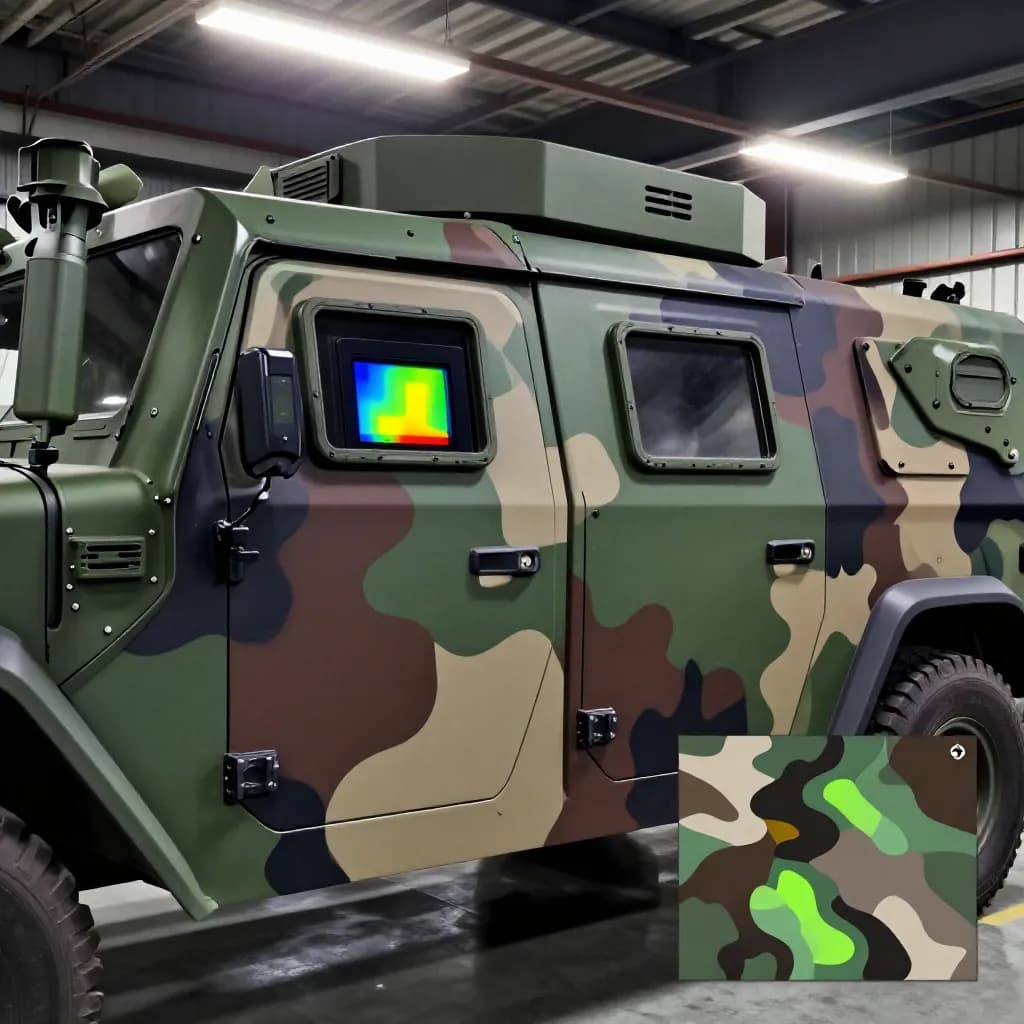
The fundamental principle of visual camouflage is to break up the recognizable outline of military equipment by applying patterns of colors that match the surrounding environment. This involves both color matching — selecting hues that blend with local vegetation, soil, and shadows — and pattern design that disrupts the distinctive shapes of vehicles, aircraft, and structures. The human visual system is highly attuned to recognizing regular geometric shapes and uniform colors, so effective camouflage must introduce visual noise that prevents the brain from assembling these cues into a recognizable object.
Ready to Start Your Project?
From one-off customs to 15,000-part production runs — get precise pricing in 24 hours.
On This Page
The Science of Military Camouflage Coatings
Modern military camouflage coatings must satisfy requirements defined in multiple specifications simultaneously. The coating must match the specified Federal Standard 595 or RAL color within tight tolerances, achieve the correct gloss level (typically low gloss or matte to minimize specular reflection), meet near-infrared reflectance targets at specific wavelengths, resist fading and chalking from UV exposure to maintain camouflage effectiveness over the coating's service life, and withstand the mechanical and chemical demands of military operations. This multi-dimensional performance requirement makes military camouflage coatings among the most technically sophisticated products in the coatings industry.
NATO Three-Tone Camouflage
The NATO three-tone camouflage pattern is one of the most widely recognized military camouflage schemes in the world, used by the German Bundeswehr and adopted in various forms by numerous NATO member nations. The standard NATO three-tone pattern consists of three colors: RAL 6031 Bronze Green (approximately equivalent to FS 34094), RAL 8027 Leather Brown (approximately equivalent to FS 30051), and RAL 9021 Tar Black (approximately equivalent to FS 37030). These three colors are applied in an irregular pattern designed to break up the outline of vehicles and equipment in European temperate woodland environments.
The Bundeswehr specification for these camouflage colors includes detailed requirements for near-infrared reflectance, ensuring that the coated equipment blends with the background not only in visible light but also when observed through image-intensifying night vision devices. The German TL (Technische Lieferbedingungen) specifications define the exact color coordinates, gloss levels, and NIR reflectance curves that coatings must achieve. The pattern application is defined by vehicle-specific camouflage drawings that specify exactly where each color is applied, ensuring consistency across the fleet.
Other NATO nations have adopted similar three-tone schemes with regional variations. The British Army uses a pattern based on similar green, brown, and black tones optimized for Northern European terrain. Scandinavian nations often incorporate lighter green and grey tones suited to their boreal forest environments. While the specific colors vary, the underlying principle remains consistent: three carefully selected colors applied in an irregular pattern to provide effective concealment across the visible and near-infrared spectrum in the intended operating environment.
US Army Camouflage Colors
The US Army has used several camouflage color schemes throughout its history, evolving from the solid olive drab of World War II through various multi-color patterns to the current system of environment-specific schemes. The standard US woodland camouflage pattern uses three CARC colors: FS 34094 (a medium olive green), FS 30051 (a dark earth brown), and FS 37030 (flat black). This pattern was designed for temperate forest environments and has been the default camouflage scheme for US Army tactical vehicles operating in woodland terrain.
For desert operations, the US military primarily uses FS 33446 (desert sand) as a single-color overall finish. This tan color was adopted during Operations Desert Shield and Desert Storm and has remained the standard desert finish. Some desert camouflage schemes use a three-color desert pattern incorporating FS 33446 desert sand, FS 33303 (a lighter sand), and FS 30277 (a darker brown), though the single-color desert sand finish is more common on vehicles. The olive drab green FS 34088 remains in use for certain equipment and is the standard color for items like ammunition cans, tool boxes, and field equipment.
The US Army's camouflage color palette is defined by Federal Standard 595 (now SAE AMS-STD-595), which assigns five-digit numbers to standardized colors. The first digit indicates gloss level (1 for gloss, 2 for semi-gloss, 3 for flat/matte), and the remaining digits define the color. Military camouflage colors are almost exclusively in the 3xxxx (flat) range to minimize light reflection. Each color chip in the standard defines the acceptable color range, and CARC coatings must fall within these tolerances when measured with a spectrophotometer. The standard is periodically updated, and color chips can be obtained from the Defense Logistics Agency for reference.
Near-Infrared Reflectance Requirements
Near-infrared reflectance management is arguably the most critical and technically challenging aspect of military camouflage coatings. Image-intensifying night vision devices, such as the widely used AN/PVS-14 monocular, operate in the near-infrared band from approximately 700nm to 1200nm. In this wavelength range, living vegetation has a dramatically higher reflectance than most man-made materials — a phenomenon known as the chlorophyll reflectance edge or the "red edge." Healthy green vegetation reflects 40-50% of NIR radiation, while conventional green paints typically reflect only 5-15%. This difference makes conventionally painted equipment clearly visible against a vegetated background when viewed through night vision devices, even if the visible color is a perfect match.
CARC coatings are specifically formulated with pigment systems that replicate the NIR reflectance characteristics of natural terrain. The green CARC colors must exhibit high NIR reflectance similar to vegetation, while brown and earth-tone colors must match the NIR reflectance of soil and dead vegetation. Black CARC must have low NIR reflectance consistent with deep shadows. Achieving these NIR reflectance targets requires careful selection of pigments — many conventional pigments that produce the correct visible color have completely wrong NIR reflectance characteristics. For example, carbon black absorbs strongly across the entire NIR band, making it unsuitable for CARC black formulations where a specific low-but-not-zero NIR reflectance is required.
The NIR reflectance requirements are defined as reflectance values at specific wavelengths, typically measured at 50nm intervals from 700nm to 1200nm. Each CARC color has a defined reflectance curve with minimum and maximum values at each wavelength. Coatings are tested using a spectrophotometer equipped with an integrating sphere, and the measured reflectance must fall within the specified envelope at every measurement point. This requirement makes CARC color matching fundamentally different from commercial color matching, where only the visible spectrum (400-700nm) is considered. A coating that is a perfect visual match but fails the NIR requirements is not acceptable for military use.
RAL F9 Camouflage Colors
The RAL F9 color series is a specialized subset of the RAL color system developed specifically for military and camouflage applications. Unlike standard RAL Classic colors, RAL F9 colors include defined near-infrared reflectance requirements, making them suitable for military camouflage coatings that must defeat night vision surveillance. The "F9" designation indicates that these colors conform to the German Bundeswehr's requirements for both visible color and NIR reflectance performance.
The primary RAL F9 camouflage colors include RAL 6031-F9 Bronze Green, RAL 8027-F9 Leather Brown, and RAL 9021-F9 Tar Black, which together form the standard NATO three-tone camouflage pattern. Additional RAL F9 colors include RAL 6014-F9 Yellow Olive (used in some four-color camouflage schemes), RAL 1039-F9 Sand Beige (used for desert and arid environment camouflage), and RAL 6040-F9 (a lighter green variant). Each of these colors has a defined NIR reflectance curve that coatings must match in addition to the visible color specification.
For powder coating manufacturers, producing RAL F9 compliant colors presents significant technical challenges. The pigment systems used in powder coatings differ from those in liquid coatings, and achieving the correct NIR reflectance with powder-compatible pigments requires specialized formulation expertise. The resin chemistry of powder coatings can also influence NIR reflectance, as some resin systems absorb or scatter NIR radiation differently than the solvent-based systems for which the original NIR specifications were developed. Despite these challenges, several powder coating manufacturers have successfully developed RAL F9 compliant formulations, enabling the use of powder coating technology for NATO military equipment.
Powder Coating for Camouflage Applications
Achieving NIR-compliant camouflage performance in powder coating formulations has been one of the most significant technical achievements in military powder coating development. The challenge stems from the fundamental differences between powder and liquid coating chemistry. In liquid CARC, pigments are dispersed in a solvent-borne polyurethane system where the resin is essentially transparent in the NIR band, allowing the pigment reflectance to dominate. In powder coatings, the pigments are dispersed in a solid resin matrix — typically polyester or polyester-epoxy hybrid — that may interact with NIR radiation differently, potentially altering the reflectance characteristics of the pigment system.
Powder coating manufacturers have addressed this challenge through careful pigment selection and formulation optimization. NIR-reflective pigments originally developed for liquid CARC have been adapted for powder coating use, and new pigment technologies specifically designed for powder systems have been introduced. The formulation process involves iterative testing where trial batches are produced, applied to test panels, and measured for both visible color and NIR reflectance across the full 700-1200nm range. Adjustments to pigment loading, pigment ratios, and particle size distribution are made until both the visible and NIR specifications are met simultaneously.
The practical benefits of powder coating for camouflage applications extend beyond the environmental advantages. Powder coatings offer exceptional color consistency from batch to batch, which is important for maintaining uniform camouflage appearance across a fleet of vehicles. The electrostatic application process provides uniform film thickness, which directly affects both color appearance and NIR reflectance. And the durability of powder coatings means that the camouflage performance is maintained longer in service, reducing the frequency of repainting and the associated logistics burden. As powder CARC technology continues to mature, it is expected to play an increasingly important role in military camouflage coating operations.
Frequently Asked Questions
Why can't regular green paint be used for military camouflage?
Regular green paint may look correct to the human eye but typically has very different near-infrared reflectance compared to natural vegetation. Night vision devices operate in the NIR band (700-1200nm), where vegetation reflects 40-50% of radiation while conventional green paint reflects only 5-15%. This makes conventionally painted equipment clearly visible through night vision, defeating the purpose of camouflage.
What is Federal Standard 595?
Federal Standard 595 (now SAE AMS-STD-595) is the US government's standardized color system used to specify colors for military equipment, government buildings, and other federal applications. Each color is identified by a five-digit number where the first digit indicates gloss level (1=gloss, 2=semi-gloss, 3=flat) and the remaining digits define the specific color.
What is the difference between RAL Classic and RAL F9 colors?
RAL Classic colors define only the visible color appearance, while RAL F9 colors include additional near-infrared reflectance requirements for military camouflage applications. A RAL F9 color must match both the visible color specification and a defined NIR reflectance curve, ensuring the coating provides camouflage effectiveness against night vision devices.
Can camouflage patterns be applied with powder coating?
Multi-color camouflage patterns can be applied with powder coating, but the process is more complex than with liquid coatings. Each color must be applied and cured separately, with masking used to define pattern boundaries. This makes powder coating most practical for single-color military finishes like desert sand, while multi-color patterns are often applied using liquid CARC on assembled vehicles.
How often does military camouflage paint need to be reapplied?
CARC camouflage coatings typically last 5 to 8 years before requiring full repainting, though touch-up of damaged areas is performed as needed during regular maintenance. UV exposure causes gradual fading and chalking that degrades both the visual appearance and NIR reflectance performance over time. Desert environments with intense UV tend to degrade coatings faster than temperate climates.
Ready to Start Your Project?
From one-off customs to 15,000-part production runs — get precise pricing in 24 hours.