Metallic powder coatings transform ordinary metal surfaces into eye-catching, luminous finishes that shift and sparkle with changing light and viewing angles. Unlike solid-color coatings that appear uniform from every direction, metallic finishes contain reflective particles — flakes, platelets, or crystals — that bounce light at different angles, creating depth, movement, and visual complexity that flat colors cannot achieve. This optical behavior is what makes metallic finishes so popular in automotive, architectural, consumer electronics, and premium industrial applications.
Guides
Metallic Powder Coating Effects: Aluminum Flake, Mica, Glass Flake, and Color-Shift Finishes
Sundial Powder Coating·April 22, 2026·14 min
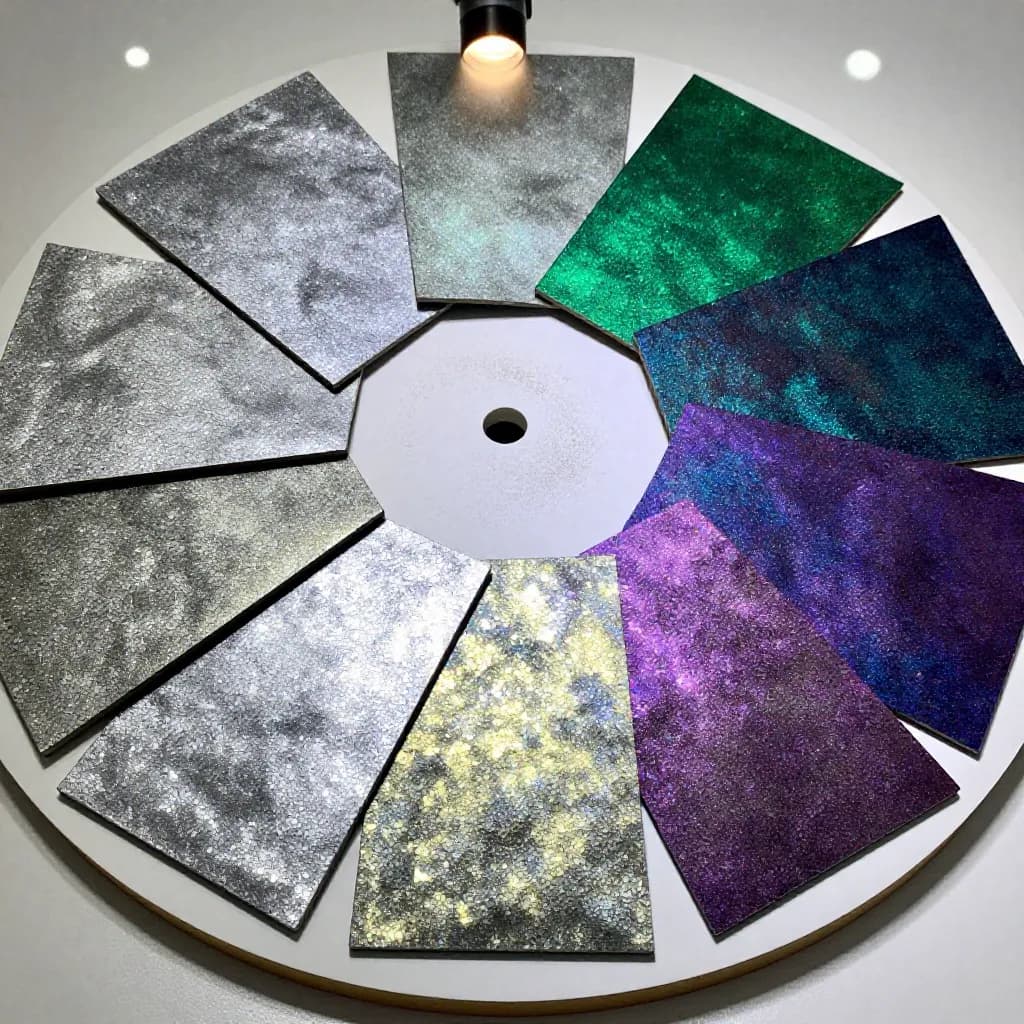
The metallic effect in powder coatings is achieved by incorporating effect pigments into the powder formulation. These pigments are fundamentally different from the organic and inorganic colorants used in solid colors. Effect pigments are physical structures — thin platelets of metal, mineral, or glass — that reflect and refract light rather than simply absorbing specific wavelengths. The size, shape, orientation, and material composition of these platelets determine the character of the metallic effect, from a subtle satin shimmer to an aggressive, high-sparkle flash.
Ready to Start Your Project?
From one-off customs to 15,000-part production runs — get precise pricing in 24 hours.
On This Page
The Appeal of Metallic Powder Coatings
Metallic powder coatings present unique formulation and application challenges compared to solid colors. The effect pigments must be distributed evenly throughout the coating film and oriented consistently to produce a uniform appearance. Achieving this consistency across large production runs, complex part geometries, and varying application conditions is one of the more demanding tasks in powder coating technology. Understanding the different types of metallic effects and how they are produced helps specifiers make informed choices and set realistic expectations for appearance and consistency.
Aluminum Flake: The Foundation of Metallic Effects
Aluminum flake pigments are the workhorses of the metallic powder coating world. These thin, flat particles of aluminum are produced by ball-milling aluminum powder into disc-shaped platelets, typically ranging from 5 to 50 microns in diameter and less than 1 micron thick. When incorporated into a powder coating and applied to a surface, these platelets orient roughly parallel to the substrate during the melt and flow phase, creating a reflective layer within the film that produces the characteristic metallic luster.
The size and shape of the aluminum flakes determine the visual character of the finish. Fine flakes — under 15 microns — produce a smooth, satin metallic appearance with subtle sparkle. Medium flakes — 15 to 30 microns — create a more visible sparkle with distinct light points. Coarse flakes — over 30 microns — produce a bold, glittering effect with individually visible sparkle points, sometimes called a "flop" effect because the appearance changes dramatically as the viewing angle shifts from face-on to oblique.
Aluminum flake pigments come in two main types: leafing and non-leafing. Leafing aluminum floats to the surface of the coating during cure, creating a bright, chrome-like reflective layer at the top of the film. Non-leafing aluminum distributes throughout the film thickness, producing a deeper, more integrated metallic effect with better durability because the flakes are protected within the resin matrix. Non-leafing types are far more common in powder coatings because they offer better weathering resistance and are less prone to the flake exposure and oxidation issues that can affect leafing metallics over time.
Mica and Pearlescent Pigments: Light Interference Effects
Mica-based pigments produce pearlescent and interference effects that are fundamentally different from the direct reflection of aluminum flakes. Natural mica platelets are coated with thin layers of metal oxides — typically titanium dioxide or iron oxide — at precisely controlled thicknesses. When light hits these coated platelets, some wavelengths are reflected from the outer oxide layer while others pass through and reflect from the mica surface beneath. The interaction between these reflected waves creates interference colors — the same phenomenon that produces the iridescent colors in soap bubbles and oil films on water.
The thickness of the metal oxide coating determines which wavelengths are reinforced and which are cancelled, controlling the interference color. Thin oxide layers produce silver and white pearl effects. Progressively thicker layers shift the interference color through gold, red, violet, blue, and green. By selecting the appropriate oxide thickness, formulators can create pearlescent powders that add a specific color shift to the base coating color. A white base with a gold-interference mica produces a warm, creamy pearl. A black base with a blue-interference mica creates a deep, mysterious blue-black that shifts to purple at oblique angles.
Mica pigments produce softer, more diffuse effects than aluminum flakes. The light is partially transmitted through the translucent mica platelet rather than being fully reflected, creating a gentle glow rather than a sharp sparkle. This makes mica-based metallics popular for applications where a refined, sophisticated appearance is desired — luxury goods, premium architectural panels, and high-end automotive finishes. Mica pigments are also more chemically stable than aluminum flakes, offering better resistance to moisture and chemical exposure, which makes them suitable for demanding exterior applications.
Glass Flake and Sparkle Effects
Glass flake pigments represent the high-impact end of the metallic effect spectrum. These are thin platelets of borosilicate glass, typically coated with metal oxide layers similar to mica pigments but with a key difference: glass flakes are larger, flatter, and more optically transparent than mica, producing a bolder, more defined sparkle with greater depth and clarity. Glass flake effects are sometimes described as having a "liquid metal" or "wet look" quality that is difficult to achieve with other effect pigment types.
The larger particle size of glass flakes — often 50 to 200 microns — means that individual sparkle points are clearly visible to the naked eye, creating a dramatic, jewel-like appearance. This makes glass flake finishes popular for custom automotive work, motorcycle parts, and premium consumer products where visual impact is paramount. However, the large particle size also creates application challenges. Glass flakes can be difficult to fluidize in powder coating hoppers, may not charge as consistently as finer pigments in electrostatic spray systems, and can create surface roughness if they protrude above the film surface.
To address these challenges, glass flake powders are often formulated with higher resin content to ensure adequate encapsulation of the large particles, and they may require thicker film builds — 80 to 120 microns or more — to fully embed the flakes within the coating. Clear topcoats are frequently applied over glass flake base coats to provide a smooth surface feel and additional UV protection for the effect pigments. The combination of a glass flake base coat with a high-gloss clear topcoat produces some of the most visually stunning finishes achievable with powder coating technology.
Bonded Metallics: Solving the Consistency Challenge
One of the greatest challenges in metallic powder coating is maintaining consistent metallic effect across production runs. In traditional dry-blended metallic powders, the effect pigment particles are simply mixed with the base powder particles. During application, the different particle types can separate — the lighter metallic flakes may behave differently in the electrostatic field than the heavier base powder particles, leading to uneven metallic distribution, picture framing at part edges, and inconsistent appearance between the first and last parts coated from a batch as the ratio of metallic to base powder shifts in the hopper.
Bonded metallic technology solves this problem by physically attaching the effect pigment particles to the surface of the base powder particles using a controlled heating process. The base powder is gently warmed — just enough to soften the surface without melting the particle — and the metallic flakes are mixed in so they adhere permanently to the powder particle surfaces. The result is a powder where every particle carries its proportional share of metallic pigment, eliminating the separation issues that plague dry blends.
Bonded metallics offer several practical advantages beyond appearance consistency. Reclaim efficiency improves dramatically because the metallic pigment stays with the base powder through the reclaim system rather than accumulating or depleting over time. Color matching between batches is more reliable because the metallic-to-base ratio is fixed during manufacturing rather than depending on application conditions. And the risk of metallic pigment contaminating subsequent colors run through the same equipment is reduced because the bonded flakes do not become airborne as readily as loose flakes in a dry blend. For production environments running metallic finishes at volume, bonded metallics are now considered the standard approach.
Color-Shift and Chameleon Effects
Color-shift powder coatings — sometimes called chameleon or flip-flop finishes — represent the most visually dramatic category of metallic effects. These coatings appear to change color as the viewing angle changes, shifting from one distinct hue to another across a range of 30 to 60 degrees of viewing angle change. A color-shift finish might appear green when viewed straight on, transition through gold at a moderate angle, and appear copper or red at a steep oblique angle. The effect is striking and unmistakable, making color-shift finishes popular for custom automotive, motorcycle, and show-quality applications.
The color-shift effect is produced by multi-layer interference pigments. Unlike standard mica pigments with a single oxide coating, color-shift pigments feature multiple alternating layers of materials with different refractive indices — typically combinations of metal oxides, silicon dioxide, and aluminum — deposited on a reflective substrate. Each layer boundary reflects a portion of the incoming light, and the multiple reflections interfere constructively and destructively at different angles, producing the angle-dependent color change.
Color-shift powder coatings are among the most challenging metallic finishes to apply consistently. The dramatic angle-dependent color change means that any variation in film thickness, pigment orientation, or surface geometry will be immediately visible as a color difference. Complex part shapes with multiple surface angles will display different colors on each face, which can be either a desired feature or an unacceptable defect depending on the application. These finishes almost always require a clear topcoat for protection and to provide a smooth, uniform surface. They are best suited to relatively simple geometries where the color-shift effect can be appreciated without the visual confusion of too many competing angles.
Automotive and Architectural Applications
Metallic powder coatings serve distinctly different roles in automotive and architectural applications, and the performance requirements for each sector shape the formulation choices. In automotive applications — wheels, trim, engine components, and custom body panels — the emphasis is on visual impact, chip resistance, and chemical resistance to brake dust, road salt, and fuel. Automotive metallic powders are typically based on polyester or polyester-epoxy hybrid resins, applied at 60 to 100 microns, and frequently topped with a clear coat for additional protection and depth.
Architectural applications — curtain wall panels, column covers, canopy structures, and entrance systems — prioritize long-term weathering resistance, color stability, and batch-to-batch consistency across large project quantities. Architectural metallic powders use super-durable polyester or fluoropolymer resins formulated to meet Qualicoat Class 2 or AAMA 2605 weathering requirements. The metallic effects tend to be more restrained than automotive finishes — subtle champagne golds, warm bronzes, and silver-grey tones that complement building design without overwhelming it.
In both sectors, the trend is toward bonded metallic formulations for production consistency and toward more sophisticated effect pigment combinations that create unique, proprietary appearances. Automotive customizers are pushing the boundaries with color-shift and glass flake effects, while architectural specifiers are exploring mica-based pearlescent finishes that add depth and warmth to facade panels without the maintenance concerns associated with exposed aluminum flake pigments. The common thread is that metallic powder coatings continue to expand the design vocabulary available to both industries.
Specifying and Evaluating Metallic Powder Coatings
Specifying metallic powder coatings requires a different approach than specifying solid colors. Standard color measurement instruments — spectrophotometers — struggle with metallic finishes because the appearance changes with viewing angle, and the sparkle effect is not captured by conventional color coordinates. Multi-angle spectrophotometers that measure color at several angles (typically 15°, 25°, 45°, 75°, and 110° from the specular reflection) are necessary for meaningful instrumental evaluation of metallic finishes.
For most practical purposes, visual evaluation against physical reference panels remains the primary method for approving metallic powder coatings. Specifiers should request sprayed sample panels — not color chips or printed swatches — on the actual substrate material and evaluate them under the lighting conditions where the finished product will be seen. Metallic finishes can look dramatically different under fluorescent, incandescent, LED, and natural daylight, so evaluating under a single light source can be misleading.
When writing specifications for metallic finishes, include the following elements: the powder manufacturer and product code, the application method and target film thickness, the requirement for bonded metallic formulation if consistency is critical, the acceptable range of metallic effect intensity as shown by limit samples, and the lighting conditions under which acceptance evaluation will be performed. For architectural projects with large quantities of panels, require the powder manufacturer to reserve a single production lot of powder for the entire project to eliminate batch-to-batch variation. These precautions add modest cost and planning effort but prevent the appearance inconsistencies that are the most common source of disputes with metallic powder coatings.
Frequently Asked Questions
What is the difference between aluminum flake and mica metallic powder coatings?
Aluminum flake pigments produce a bright, reflective sparkle by directly reflecting light from metal platelets. Mica pigments produce softer, pearlescent effects through light interference — thin metal oxide coatings on mica platelets create color shifts and a gentle glow rather than sharp sparkle. Aluminum flake gives a more aggressive metallic look, while mica creates a refined, sophisticated appearance.
What are bonded metallic powder coatings?
Bonded metallics are powder coatings where the metallic effect pigment particles are physically attached to the base powder particles through a controlled heating process. This prevents the separation of metallic and base particles during application, ensuring consistent metallic appearance across production runs and improving reclaim efficiency.
Can metallic powder coatings be used outdoors?
Yes, metallic powder coatings formulated with super-durable polyester or fluoropolymer resins are suitable for exterior architectural applications and meet standards like Qualicoat Class 2 and AAMA 2605. Mica-based metallics generally offer better outdoor durability than aluminum flake types because the mica platelets are more chemically stable.
Why do metallic powder coatings sometimes look inconsistent?
Inconsistency in metallic finishes is usually caused by separation of metallic pigment from base powder during application, variations in film thickness, or differences in pigment orientation on complex part geometries. Using bonded metallic formulations, maintaining consistent film thickness, and controlling application parameters significantly reduces these issues.
What is a color-shift powder coating?
Color-shift or chameleon powder coatings contain multi-layer interference pigments that cause the coating to appear as different colors depending on the viewing angle. A single surface might shift from green to gold to copper as you move around it. These finishes are popular for custom automotive and show-quality applications.
Ready to Start Your Project?
From one-off customs to 15,000-part production runs — get precise pricing in 24 hours.