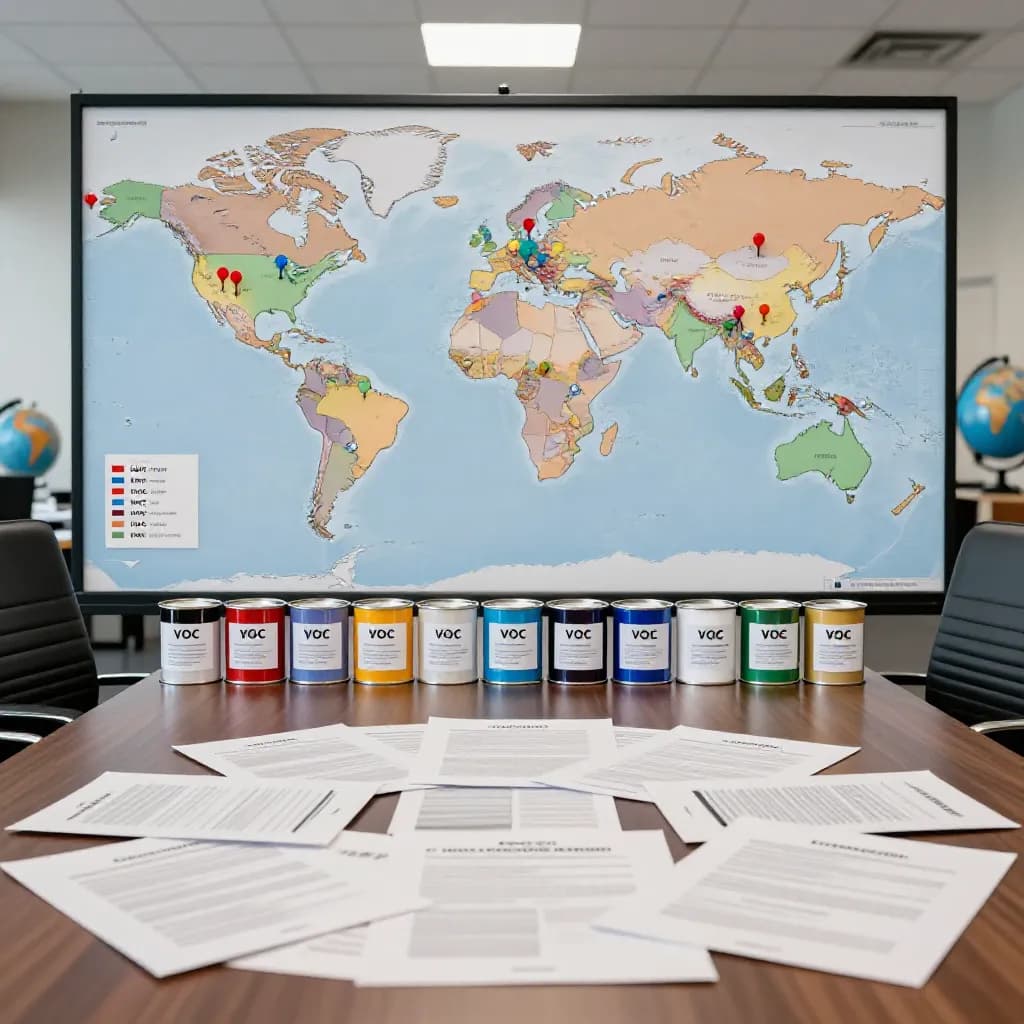
VOC regulations for coatings differ significantly between countries and regions due to variations in air quality challenges, industrial profiles, regulatory philosophies, and economic development priorities. Countries with severe urban smog problems — such as the United States, China, and parts of the EU — have generally adopted the most aggressive VOC limits, driven by the direct link between VOC emissions and ground-level ozone formation.
Environmental
Low-VOC Paint Regulations by Country: A Global Overview
Sundial Powder Coating·April 20, 2026·9 min
Regulatory approaches also differ in structure. Some jurisdictions set VOC content limits for coating products as sold (product-focused regulation), while others set emission limits for coating facilities (process-focused regulation). Some combine both approaches. The definition of what constitutes a VOC can also vary — the US EPA excludes certain compounds with negligible photochemical reactivity (exempt solvents), while the EU definition is based on vapor pressure, leading to different VOC content values for the same product depending on which regulatory framework is applied.
Ready to Start Your Project?
From one-off customs to 15,000-part production runs — get precise pricing in 24 hours.
On This Page
Why VOC Regulations Vary Globally
For manufacturers and specifiers operating internationally, this patchwork of regulations creates complexity. A coating formulation that complies with regulations in one market may not meet requirements in another. Understanding the specific VOC limits and measurement methods applicable in each target market is essential for compliance, and designing products that meet the strictest global standards simplifies international trade.
United States: EPA, SCAQMD, and State-Level Rules
The United States regulates coating VOC content at both federal and state levels. The EPA establishes national VOC content limits for architectural and industrial maintenance (AIM) coatings under the Clean Air Act, with limits varying by product category — for example, flat coatings are limited to 50 g/L and non-flat coatings to 100 g/L under the most recent national AIM rule. Industrial coating operations are regulated through NESHAP and NSPS standards that set emission limits based on coating category and facility size.
California's South Coast Air Quality Management District (SCAQMD) consistently sets the most stringent VOC limits in the nation, and its rules often serve as a model for other states and for federal rulemaking. SCAQMD Rule 1113 for architectural coatings sets limits as low as 0 g/L for some categories, effectively requiring zero-VOC formulations. The Ozone Transport Commission (OTC) model rule provides a framework for northeastern states, with limits generally between EPA national standards and SCAQMD levels.
The result is a multi-layered regulatory landscape where coating manufacturers must track and comply with federal, state, and sometimes local VOC limits. Products sold nationally are typically formulated to meet the strictest applicable state limit, which in practice means California standards often drive national product development.
European Union: Paints Directive, IED, and National Implementations
The EU regulates coating VOC content through the Paints Directive (2004/42/EC), which sets maximum VOC content limits for decorative paints and varnishes and for vehicle refinishing products. The directive establishes two phases of limits, with Phase II (the current requirement) setting limits such as 30 g/L for interior matt wall paints and 40 g/L for interior glossy wall paints. These limits apply to products placed on the EU market and are enforced through national market surveillance.
Industrial coating operations are regulated under the Industrial Emissions Directive (IED, 2010/75/EU), which requires installations above certain solvent consumption thresholds to apply Best Available Techniques (BAT) for emission control. The BAT Reference Document for surface treatment using organic solvents specifies emission limit values and management practices. Member states transpose IED requirements into national law, sometimes adding stricter provisions — Germany's TA Luft (Technical Instructions on Air Quality Control), for example, sets detailed emission limits for coating operations.
The EU's regulatory framework is complemented by voluntary initiatives such as the EU Ecolabel for paints and varnishes, which sets VOC limits well below the Paints Directive requirements. The European Green Deal and associated policy initiatives signal that further tightening of VOC regulations is likely, with the EU's Zero Pollution Action Plan targeting a 50% reduction in air pollution health impacts by 2030.
Asia-Pacific: China GB Standards and Australia NPI
China has rapidly tightened its VOC regulations in response to severe air quality challenges in major urban areas. The national standard GB 18582 sets VOC content limits for architectural coatings, with the 2020 revision establishing limits of 80 g/L for waterborne interior wall coatings and 120 g/L for waterborne exterior wall coatings. Industrial coating emissions are regulated under GB 37824-2019, which sets organized and fugitive emission limits for coating operations across multiple industries. Major cities including Beijing and Shanghai have implemented even stricter local standards.
China's enforcement has intensified significantly, with environmental inspections, facility shutdowns for non-compliance, and a national emissions trading scheme that includes VOCs. The "2+26" cities policy targeting the Beijing-Tianjin-Hebei region and surrounding areas has driven rapid adoption of waterborne and powder coating technologies in manufacturing sectors that previously relied heavily on solvent-based systems.
Australia regulates VOC emissions through the National Pollutant Inventory (NPI) reporting framework and state-level Environment Protection Acts. While Australia does not have national VOC content limits for coatings equivalent to the US AIM rule or EU Paints Directive, state environment protection authorities set emission limits for industrial coating operations through licensing conditions. The Australian Paint Manufacturers' Federation (APMF) has established voluntary VOC limits for architectural coatings that align broadly with international standards.
How Powder Coating Meets the Strictest Global VOC Limits
Powder coating's zero-VOC formulation means it inherently complies with the strictest VOC regulations in any jurisdiction worldwide. Whether the applicable limit is the SCAQMD's 0 g/L for certain categories, the EU Paints Directive's 30 g/L for interior wall coatings, or China's GB 18582 limits, powder coating meets and exceeds every requirement because it contains no volatile organic solvents whatsoever.
This universal compliance eliminates the regulatory complexity that liquid coating manufacturers face when selling into multiple markets. A powder coating formulation qualified for one market does not need reformulation to meet VOC requirements in another. This simplifies product development, inventory management, and regulatory documentation, providing a significant commercial advantage for manufacturers and applicators serving international markets.
As global VOC regulations continue to tighten — with many jurisdictions signaling further reductions in the coming decade — powder coating's position strengthens further. Liquid coating manufacturers face ongoing reformulation costs and potential performance compromises as they reduce solvent content to meet ever-lower limits. Powder coating is already at the endpoint of the VOC reduction trajectory, providing long-term regulatory certainty and eliminating the risk of future non-compliance due to changing VOC limits.
Frequently Asked Questions
Which country has the strictest VOC regulations for coatings?
California's SCAQMD sets some of the world's strictest VOC limits, with certain coating categories limited to 0 g/L. China has also rapidly tightened its standards, and the EU Paints Directive sets stringent product-level limits. The strictest applicable limit depends on the specific coating category and application.
Do VOC regulations apply to powder coatings?
VOC content regulations technically apply to all coatings, but powder coatings inherently comply because they contain no volatile organic solvents. Powder coatings report VOC content of essentially 0 g/L, meeting the requirements of every jurisdiction worldwide without any reformulation.
Why do VOC definitions differ between the US and EU?
The US EPA defines VOCs based on photochemical reactivity, excluding compounds that do not significantly contribute to ozone formation (exempt solvents). The EU defines VOCs based on vapor pressure (boiling point at or below 250°C at standard pressure). This means the same coating can have different reported VOC values depending on which definition is applied.
Are VOC regulations getting stricter globally?
Yes. The global trend is toward progressively tighter VOC limits. The EU's Zero Pollution Action Plan, China's intensifying enforcement, and ongoing US state-level rulemaking all signal further reductions. Manufacturers are advised to plan for stricter future limits when developing new coating products and processes.
Ready to Start Your Project?
From one-off customs to 15,000-part production runs — get precise pricing in 24 hours.