Standard powder coatings are electrical insulators, not conductors. The cured polymer film that forms a powder coating has very high electrical resistivity, typically in the range of 10^12 to 10^16 ohm-centimeters, which effectively blocks the flow of electrical current. This insulating property is an inherent characteristic of the organic polymer resins — epoxy, polyester, hybrid, and others — that form the basis of all conventional powder coating formulations.
Technical
Is Powder Coating Conductive? Insulation, Grounding, and EMI Shielding
Sundial Powder Coating·April 22, 2026·11 min
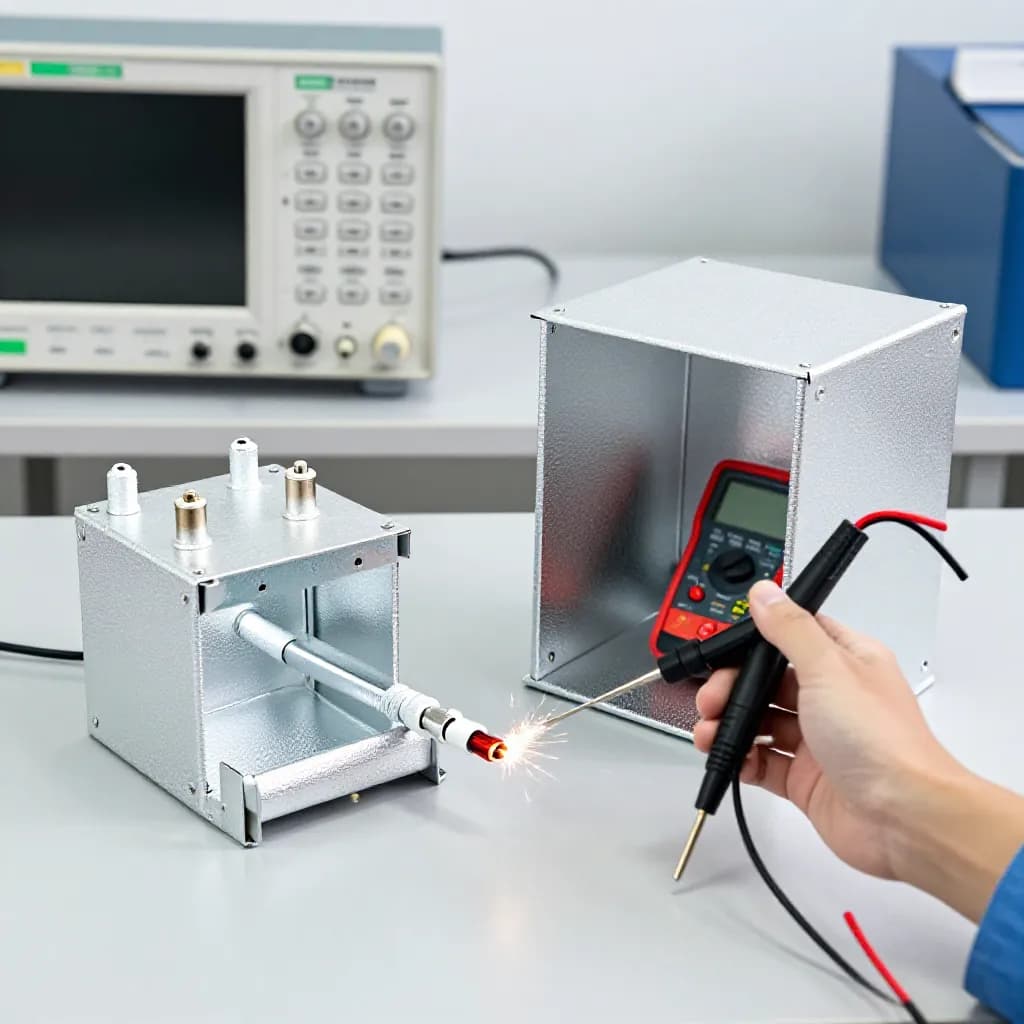
This insulating behavior has important practical implications. Powder-coated metal parts lose their electrical conductivity at the surface, which affects grounding connections, electrical bonding, and electromagnetic compatibility. Engineers and designers must account for this when specifying powder coating on components that require electrical continuity, grounding paths, or electromagnetic interference shielding.
Ready to Start Your Project?
From one-off customs to 15,000-part production runs — get precise pricing in 24 hours.
On This Page
Standard Powder Coating Is an Electrical Insulator
However, the powder coating industry has developed specialized conductive and static-dissipative formulations for applications where electrical conductivity through the coating is required. These specialty products incorporate conductive fillers or additives that create electrical pathways through the otherwise insulating polymer matrix, enabling controlled levels of electrical conductivity while maintaining the protective and aesthetic benefits of powder coating.
Understanding when standard insulating powder coating is appropriate and when conductive alternatives are needed is essential for proper specification in electrical, electronic, and industrial applications.
Why Standard Powder Coatings Insulate
The insulating nature of standard powder coatings stems from the fundamental electrical properties of organic polymers. The resin systems used in powder coatings — polyester, epoxy, acrylic, and their hybrids — are composed of long-chain molecules with covalently bonded atoms. These covalent bonds hold their electrons tightly, leaving no free electrons or mobile charge carriers available to conduct electrical current.
When powder coating is applied and cured, the resin molecules cross-link to form a dense, continuous polymer network. This network acts as a dielectric barrier between the conductive metal substrate and the external environment. The dielectric strength of cured powder coatings is typically 20 to 30 kilovolts per millimeter, meaning a standard 80-micron coating can withstand approximately 1,600 to 2,400 volts before electrical breakdown occurs.
The pigments and additives in standard powder coatings are also non-conductive. Common pigments such as titanium dioxide, iron oxide, and organic color pigments are electrical insulators. Flow agents, degassing additives, and texture agents used in powder formulations similarly contribute no electrical conductivity to the cured film.
This combination of insulating resin, insulating pigments, and insulating additives produces a coating with electrical resistance so high that it is effectively a perfect insulator for most practical purposes. A standard powder-coated surface will show infinite resistance on a typical multimeter, confirming that no measurable current flows through the coating under normal voltage conditions.
The insulating property of powder coating is actually exploited in certain applications. Electrical busbar coatings, motor stator coatings, and transformer component coatings use the insulating nature of powder coating as a functional feature, providing electrical isolation along with environmental protection.
Conductive Powder Coating Formulations
Conductive powder coatings are specialty formulations designed to provide controlled electrical conductivity through the cured coating film. These products achieve conductivity by incorporating conductive fillers into the polymer matrix that create continuous or near-continuous electrical pathways from the coating surface to the metal substrate.
The most common conductive fillers used in powder coatings include carbon black, carbon fiber, graphite, metallic particles such as silver or nickel flakes, and conductive metal oxides. The type and loading level of conductive filler determines the resulting conductivity of the cured coating, which can be tailored across a wide range from mildly static-dissipative to highly conductive.
Static-dissipative powder coatings are formulated to achieve surface resistivity in the range of 10^6 to 10^9 ohms per square. These coatings allow static charges to dissipate slowly and safely rather than accumulating to levels that could cause electrostatic discharge events. They are used in electronics manufacturing environments, explosive atmospheres, and clean rooms where static discharge could damage sensitive components or ignite flammable materials.
More highly conductive powder coatings achieve surface resistivity below 10^5 ohms per square, approaching the conductivity needed for effective electromagnetic interference shielding and electrical grounding through the coating. These formulations typically use higher loadings of metallic fillers or specialized conductive additives to achieve the required conductivity levels.
The trade-off with conductive powder coatings is that the conductive fillers can affect other coating properties. Color options may be limited, particularly for highly conductive formulations where carbon black or metallic fillers dominate the composition. Surface finish, gloss, and mechanical properties may also differ from standard decorative powder coatings. Specifiers should evaluate the full property profile of conductive formulations, not just their electrical characteristics.
Grounding Considerations for Powder-Coated Parts
The insulating nature of standard powder coating creates important grounding considerations that engineers must address during design and assembly. When a metal component is powder coated, its surface can no longer serve as an electrical grounding path. Any grounding connections, bonding jumpers, or earth continuity paths that rely on metal-to-metal contact must be accommodated by masking specific areas during coating or by removing the coating at connection points after application.
In electrical enclosures and control panels, grounding is a safety-critical requirement. Standards such as IEC 61439 and UL 508A require reliable earth continuity throughout the enclosure structure. Powder-coated enclosures must have designated grounding points where the coating is removed or masked to ensure bare metal contact for grounding connections. Self-piercing grounding screws and star washers that cut through the coating to reach the metal substrate are commonly used solutions.
For structural steel in buildings, electrical grounding and lightning protection systems require conductive paths through the steel structure. Powder-coated structural connections must maintain electrical continuity at bolted joints, which typically requires masking contact surfaces or specifying conductive gaskets and washers that penetrate the coating.
In automotive applications, powder-coated chassis and body components must maintain grounding paths for electrical systems. Manufacturers typically mask specific grounding points during the coating process or use self-tapping grounding screws that cut through the coating during assembly.
The key principle is that grounding requirements must be identified during the design phase, before coating specification and application. Retrofitting grounding solutions after coating is more difficult, more expensive, and less reliable than incorporating grounding provisions into the original design and coating specification.
EMI Shielding and Powder Coating
Electromagnetic interference shielding is a critical requirement for electronic enclosures, and the insulating nature of standard powder coating presents a challenge. EMI shielding relies on the enclosure's metal walls to reflect and absorb electromagnetic radiation, preventing it from entering or escaping the enclosure. For effective shielding, the enclosure must maintain electrical continuity across all joints, seams, and access points.
Standard powder coating applied to an EMI shielding enclosure can compromise shielding effectiveness by insulating the mating surfaces at joints and seams. Even a thin insulating layer at a joint can create a gap in the electromagnetic shield, allowing radiation to leak through. This is particularly problematic at frequencies above 100 megahertz, where even small gaps can significantly degrade shielding performance.
Several approaches address this challenge. The most common is selective masking, where coating is excluded from mating surfaces, gasket contact areas, and grounding points. This preserves metal-to-metal contact at critical locations while allowing the remainder of the enclosure to be powder coated for corrosion protection and appearance.
Conductive powder coatings offer an alternative approach for applications where full coating coverage is desired. By using a powder coating with sufficiently low surface resistivity, the coated surfaces can maintain adequate electrical conductivity for EMI shielding purposes. However, the shielding effectiveness of conductive powder coatings is generally lower than bare metal, and testing is required to verify that the specific formulation meets the shielding requirements of the application.
Conductive gaskets and EMI shielding tapes can also be used at joints and seams to maintain shielding continuity over powder-coated surfaces. These solutions compress against the coated surface and either penetrate the coating or provide a conductive bridge across the joint, restoring electromagnetic continuity without requiring coating removal.
Static Dissipation in Hazardous Environments
In environments where flammable gases, vapors, or dust are present, electrostatic discharge from insulating surfaces can be an ignition source. Standard powder coatings, being excellent insulators, can accumulate static charges on their surface that discharge as sparks when a grounded object approaches. In explosive atmospheres classified as ATEX Zone 0, 1, or 2 in Europe, or Class I or II Division 1 or 2 in North America, this static accumulation must be controlled.
Static-dissipative powder coatings are specifically designed for these hazardous environments. By maintaining surface resistivity in the range of 10^6 to 10^9 ohms per square, these coatings allow static charges to dissipate to ground at a controlled rate — fast enough to prevent dangerous charge accumulation but slow enough to avoid the rapid discharge that could itself cause a spark.
The specification of static-dissipative coatings in hazardous areas is governed by standards including IEC 60079 for explosive atmospheres and NFPA 77 for static electricity. These standards define maximum allowable surface resistivity values and testing methods for coatings used in classified areas. Compliance with these standards is mandatory and subject to inspection and certification by authorized bodies.
Beyond explosive atmospheres, static-dissipative powder coatings are used in electronics manufacturing clean rooms where electrostatic discharge can damage sensitive semiconductor devices. The coatings prevent charge accumulation on equipment housings, workstation surfaces, and storage containers, protecting components worth far more than the coating itself.
Medical device housings and pharmaceutical manufacturing equipment also benefit from static-dissipative coatings, which prevent dust attraction to coated surfaces and reduce the risk of static discharge that could interfere with sensitive electronic instruments or ignite flammable anesthetic gases in operating rooms.
Practical Guidelines for Electrical Applications
When specifying powder coating for components with electrical requirements, several practical guidelines help ensure successful outcomes. First, clearly identify all electrical requirements during the design phase, including grounding points, bonding connections, EMI shielding requirements, and static dissipation needs. Document these requirements on engineering drawings with specific callouts for masked areas or conductive coating zones.
For components requiring standard insulating powder coating with grounding provisions, specify masking plugs, tape, or fixtures for all grounding and bonding contact areas. Provide the coating applicator with clear drawings showing masked areas, and verify masking accuracy during quality inspection. Common masking locations include grounding lugs, bolt hole contact surfaces, connector mounting areas, and gasket seating surfaces.
When conductive or static-dissipative powder coating is required, specify the required surface resistivity range and the test method for verification. Request test certificates from the powder manufacturer confirming the formulation meets the specified resistivity range, and include surface resistivity testing in the incoming quality inspection procedure for coated parts.
For EMI shielding enclosures, work with the enclosure designer and EMI engineer to determine which surfaces require conductivity and which can be insulated. Consider hybrid approaches that use standard powder coating for external surfaces and conductive coating or bare metal for internal mating surfaces.
Always test the complete assembly, not just individual coated parts, to verify that electrical requirements are met in the final configuration. Grounding resistance, bonding continuity, EMI shielding effectiveness, and surface resistivity should all be verified on assembled units before production approval. This system-level testing catches issues that component-level testing may miss, such as inadequate contact pressure at coated joints or insufficient masking coverage.
Frequently Asked Questions
Does powder coating block electrical current?
Yes. Standard powder coatings are electrical insulators with resistivity of 10^12 to 10^16 ohm-cm, effectively blocking electrical current flow. A typical 80-micron coating can withstand 1,600-2,400 volts before breakdown. This means powder-coated surfaces cannot serve as grounding paths without modification.
Can you get conductive powder coating?
Yes. Specialty conductive powder coatings incorporate fillers like carbon black, graphite, or metallic particles to create electrical pathways through the coating. These range from static-dissipative (10^6-10^9 ohms/square) to highly conductive (below 10^5 ohms/square), depending on the application requirements.
How do you ground a powder-coated enclosure?
Grounding is achieved by masking specific contact areas during coating to maintain bare metal, or by using self-piercing grounding screws and star washers that cut through the coating to reach the substrate. Grounding points must be identified during design, before coating application.
Does powder coating affect EMI shielding?
Standard insulating powder coating can compromise EMI shielding by insulating joint surfaces, creating gaps in the electromagnetic shield. Solutions include selective masking of mating surfaces, using conductive powder coatings, or installing conductive gaskets at joints to maintain electromagnetic continuity.
Is powder coating safe in explosive atmospheres?
Standard insulating powder coating can accumulate dangerous static charges in explosive atmospheres. Static-dissipative powder coatings with controlled surface resistivity (10^6-10^9 ohms/square) are required for ATEX-classified or Class I/II Division areas to prevent electrostatic discharge ignition.
Ready to Start Your Project?
From one-off customs to 15,000-part production runs — get precise pricing in 24 hours.