Impact resistance testing measures a powder coating's ability to withstand rapid deformation without cracking, chipping, or losing adhesion to the substrate. Unlike hardness testing, which measures resistance to slow, static forces, impact testing subjects the coating to sudden, dynamic forces that simulate real-world events such as dropped tools, stone chips, hail, and handling damage during assembly and transport.
Guides
How to Test Powder Coating Impact Resistance: Direct, Reverse, and Gardner Methods
Sundial Powder Coating·April 22, 2026·12 min
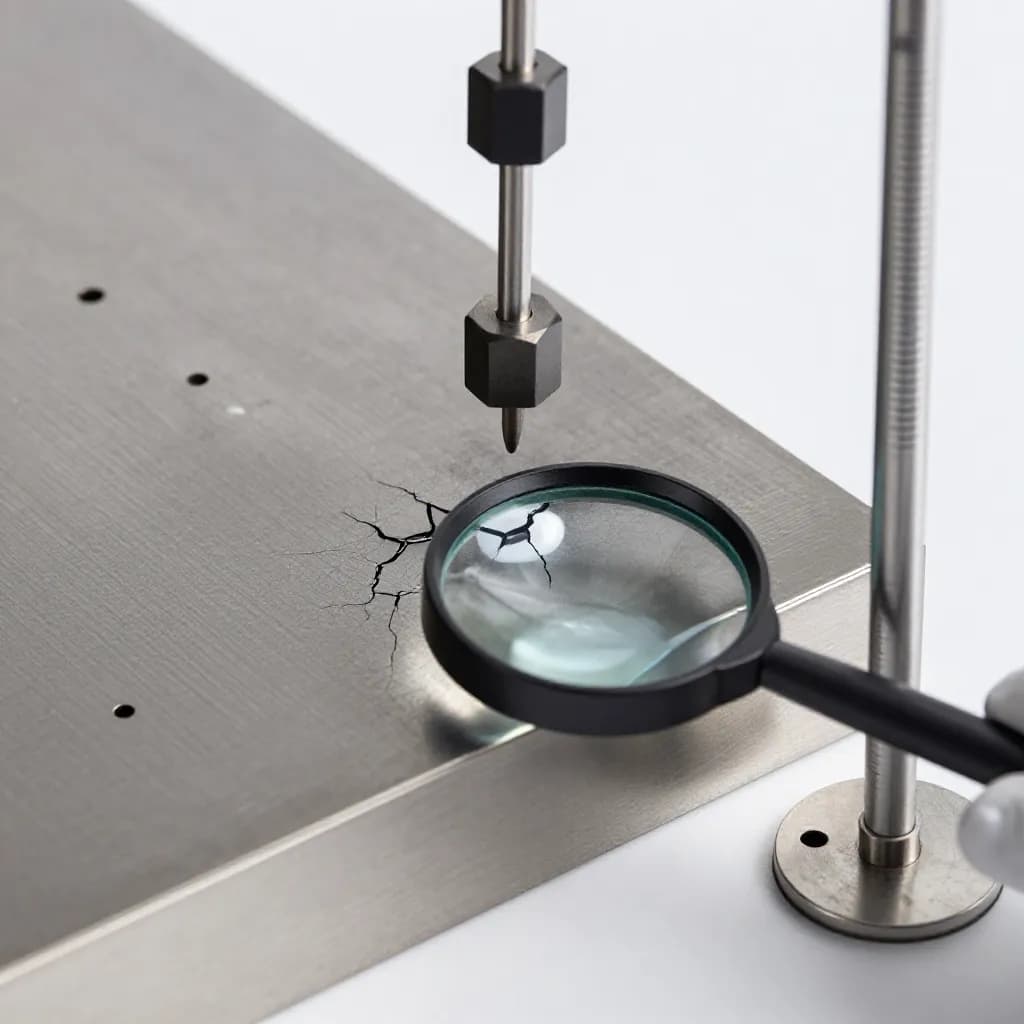
Impact resistance is a function of both the coating's flexibility and its adhesion to the substrate. A coating that is hard but brittle will crack under impact even if it has excellent adhesion. A coating that is flexible but poorly adhered will delaminate under impact even if the film itself remains intact. Only a coating that combines adequate flexibility with strong adhesion will pass impact testing at the levels required by most specifications.
Ready to Start Your Project?
From one-off customs to 15,000-part production runs — get precise pricing in 24 hours.
On This Page
What Impact Resistance Testing Reveals About Powder Coatings
The degree of cure significantly affects impact resistance. Under-cured coatings may be softer and more flexible, sometimes passing impact tests that they would fail if properly cured. Over-cured coatings become brittle and lose flexibility, failing impact tests that they would pass at the correct cure level. This makes impact testing a useful complement to hardness testing for verifying that the cure process is within the correct window — not just reaching minimum cure, but also not exceeding the maximum.
This guide covers the standard impact test methods used in the powder coating industry, including equipment, procedures, result interpretation, and the relationship between impact resistance and other coating properties.
Direct and Reverse Impact Testing: ASTM D2794
The standard impact test for powder coatings is ASTM D2794 (Standard Test Method for Resistance of Organic Coatings to the Effects of Rapid Deformation). This test uses a falling weight — a steel ball or cylindrical indenter — dropped from a measured height onto the coated surface to produce a controlled impact deformation. The test can be performed in two orientations: direct impact (weight strikes the coated face) and reverse impact (weight strikes the uncoated back of the panel).
The test apparatus consists of a vertical tube guide, a weighted indenter (typically a 15.9 mm diameter hemispherical steel punch weighing 0.9 kg or 2.0 kg), and a calibrated height scale. The coated test panel is placed on an anvil beneath the tube, and the weight is dropped from increasing heights until the coating fails. The maximum height at which the coating passes — showing no cracking, chipping, or loss of adhesion — is recorded as the impact resistance in inch-pounds or kilogram-centimeters.
Direct impact tests the coating's ability to stretch over the convex deformation created on the coated face. The coating must elongate without cracking as the substrate deforms outward. This tests the coating's extensibility and its adhesion under tensile stress.
Reverse impact is generally more demanding because the coating must compress into the concave deformation created on the coated face when the back of the panel is struck. The coating experiences compressive forces at the center of the impact and tensile forces at the edges, creating a complex stress state that is more likely to cause cracking and delamination. Many specifications require both direct and reverse impact testing, with the reverse impact requirement often set at a lower value than the direct impact requirement.
Performing the Impact Test Step by Step
Prepare test panels from the same substrate material, with the same surface preparation, pretreatment, and coating as the production parts. Standard test panels are typically 0.8-1.0 mm thick cold-rolled steel or aluminum, cut to approximately 75 x 150 mm. The panel must be flat and free of distortion — warped panels produce inconsistent results because the impact deformation is affected by the panel's initial curvature.
Condition the test panels at standard laboratory conditions — 23 ± 2°C and 50 ± 5% relative humidity — for at least 24 hours before testing. Temperature significantly affects impact resistance; cold coatings are more brittle and produce lower impact values than coatings tested at room temperature. If the specification does not specify conditioning, always test at standard conditions for comparable results.
Set up the impact tester on a solid, level surface. Place the test panel on the anvil with the coated face up for direct impact or coated face down for reverse impact. Ensure the panel is flat against the anvil with no gaps or rocking. Select the starting drop height based on the expected impact resistance — start at a height well below the expected pass level to avoid wasting panels.
Drop the weight from the selected height. Remove the panel and examine the impact area under good lighting and magnification. Look for cracks in the coating radiating from the impact center, chipping or flaking of the coating, loss of adhesion around the deformation, and any exposure of the substrate. If no defects are visible, increase the drop height by one increment and repeat on a fresh area of the panel or a new panel.
To confirm the failure point, perform the test at the failing height on at least two additional panels. If two out of three panels pass at a given height, that height is the impact resistance value. Record the result in inch-pounds (drop height in inches multiplied by weight in pounds) or the metric equivalent.
Gardner Impact Testing
The Gardner impact tester is a specific implementation of the falling weight impact test that has become a standard instrument in the coatings industry. It uses a calibrated weight and tube assembly with a hemispherical indenter, and results are reported in inch-pounds (in-lb) or kilogram-centimeters (kg-cm). The Gardner tester is essentially the apparatus described in ASTM D2794, and the terms are often used interchangeably.
Standard Gardner impact testers are available in several configurations. The most common uses a 2-pound (0.9 kg) weight with a maximum drop height of 40 inches, providing a maximum impact energy of 80 in-lb. Heavy-duty testers use a 4-pound (1.8 kg) weight for higher impact energies. The indenter diameter is standardized at 5/8 inch (15.9 mm) with a hemispherical profile.
Typical impact resistance values for powder coatings vary by chemistry. Polyester powder coatings generally achieve 80-160 in-lb direct impact and 40-120 in-lb reverse impact. Epoxy coatings achieve 60-160 in-lb direct and 40-120 in-lb reverse. Hybrid (polyester-epoxy) coatings typically fall between these ranges. Flexible powder coatings formulated for applications requiring high deformation resistance can achieve 160+ in-lb in both direct and reverse impact.
Specification requirements vary by application. General industrial specifications often require a minimum of 80 in-lb direct and 40 in-lb reverse impact. Automotive specifications may require 80-120 in-lb in both directions. Architectural specifications typically require 100+ in-lb direct impact. Always refer to the specific project or product specification for the required values.
The Gardner impact test is a go/no-go test at each energy level — the coating either passes (no visible defects) or fails (cracking, chipping, or delamination). There is no partial pass. This binary nature makes the test straightforward to perform and interpret, but it also means that the test provides limited information about how close the coating is to failure at the passing energy level.
Evaluating Impact Test Results and Failure Modes
After impact, examine the deformed area carefully under magnification (10x minimum) and good lighting. The evaluation criteria are specific and must be applied consistently to produce meaningful results.
A passing result shows a smooth, continuous coating over the entire deformed area with no visible cracks, chips, or loss of adhesion. The coating has stretched or compressed to follow the substrate deformation without any discontinuities. Minor color change or gloss reduction in the deformed area is acceptable unless the specification states otherwise — these are cosmetic effects of the deformation, not coating failures.
Cracking is the most common failure mode. Fine cracks radiating from the center of the impact indicate that the coating's elongation limit has been exceeded. Circumferential cracks around the edge of the deformation indicate that the coating cannot accommodate the transition between the deformed and undeformed areas. Both types of cracks constitute failure.
Chipping — where pieces of coating break away from the substrate in the impact area — indicates a combination of brittleness and adhesion weakness. The coating cracks under the impact stress and the fragments lose adhesion, exposing the substrate. This is a more severe failure than cracking alone and often indicates over-cure (brittleness) combined with marginal surface preparation (weak adhesion).
Delamination without cracking — where the coating lifts from the substrate in the impact area but the film itself remains intact — indicates good coating flexibility but poor adhesion. This failure mode points to surface preparation or pretreatment problems rather than coating formulation or cure issues.
Applying a piece of adhesive tape over the impact area and removing it can reveal incipient failures that are not visible to the naked eye. If coating fragments transfer to the tape, the coating has failed even if the cracks were not visible before taping. Some specifications require this tape pull as part of the impact test evaluation.
Factors Affecting Impact Resistance Results
Several factors beyond the coating itself affect impact test results, and understanding these factors is essential for obtaining meaningful, reproducible data.
Substrate thickness and type significantly affect results. Thinner substrates deform more under impact, subjecting the coating to greater strain. A coating that passes at 80 in-lb on a 1.0 mm panel may fail at the same energy on a 0.6 mm panel because the thinner panel deforms more. Always test on panels of the same thickness as specified in the test standard or the product specification. Standard test panels are typically 0.8-1.0 mm for steel.
Coating thickness affects impact resistance. Thicker coatings generally provide better impact resistance up to a point, because the thicker film distributes the impact stress over a larger volume of material. However, excessively thick coatings may become more brittle and actually show reduced impact resistance. Test at the specified film thickness range for meaningful results.
Temperature is one of the strongest influences on impact resistance. Most powder coatings become significantly more brittle at low temperatures, and impact resistance can drop by 50% or more between 23°C and -20°C. If the coating will be exposed to cold temperatures in service, consider testing at the expected service temperature in addition to the standard 23°C. Some specifications require cold impact testing at -20°C or -30°C.
Cure level affects impact resistance in a non-linear way. Under-cured coatings may be softer and more flexible, sometimes producing higher impact values than properly cured coatings. Over-cured coatings become brittle and produce lower impact values. The optimal impact resistance occurs at the correct cure level — this is why impact testing alone is not sufficient to verify cure and should be used in conjunction with hardness and solvent resistance testing.
Aging can affect impact resistance. Some powder coatings lose flexibility over time due to continued cross-linking or UV degradation. If long-term impact resistance is important for the application, consider testing aged samples in addition to freshly cured samples.
Integrating Impact Testing into Your Quality Program
Impact testing should be part of a comprehensive quality testing program that includes adhesion, hardness, thickness, and visual inspection. No single test provides a complete picture of coating quality — each test measures a different property, and together they confirm that the entire coating process is performing correctly.
For production quality control, perform impact testing on test panels coated alongside production parts. Test at least one panel per batch, shift, or color change. Record both direct and reverse impact results along with the coating thickness, cure conditions, and any other relevant process parameters. This data enables correlation analysis that can identify the root cause of impact failures.
Establish control limits for impact resistance based on historical data. If your process consistently achieves 120 in-lb direct impact and the specification requires 80 in-lb minimum, a result of 90 in-lb — while still passing — represents a significant drop from normal performance and should trigger investigation. Statistical process control applied to impact data can detect process drift before it produces out-of-specification results.
When impact failures occur, investigate systematically. Check the cure profile first — over-cure is the most common cause of impact failures in operations where adhesion and hardness are acceptable. If cure is correct, check the coating thickness — thin spots are more likely to fail impact. If thickness is correct, investigate the substrate and surface preparation — a change in substrate material, thickness, or surface condition can affect impact results.
For new product qualifications or specification compliance testing, perform impact testing at multiple energy levels to establish the full impact resistance curve, not just the minimum passing value. This provides margin information that is valuable for process control — knowing that the coating passes at 160 in-lb when the specification requires 80 in-lb provides much more confidence than knowing it passes at exactly 80 in-lb.
Frequently Asked Questions
What is the difference between direct and reverse impact testing?
Direct impact strikes the coated face, testing the coating's ability to stretch over the outward deformation. Reverse impact strikes the uncoated back, testing the coating's ability to compress into the inward deformation. Reverse impact is generally more demanding and specifications often set a lower minimum value for reverse than direct impact.
What impact resistance should powder coating achieve?
Typical requirements are 80-160 in-lb direct impact and 40-120 in-lb reverse impact, depending on the application. General industrial specifications often require 80 in-lb direct and 40 in-lb reverse minimum. Automotive and architectural specifications may require higher values. Always refer to the specific product specification.
What causes powder coating to fail impact testing?
The most common cause is over-cure, which makes the coating brittle. Under-cure can also cause failure if adhesion is compromised. Other factors include excessive or insufficient film thickness, cold testing temperature, thin substrate panels, and poor surface preparation that weakens adhesion at the coating-substrate interface.
Does temperature affect impact test results?
Yes, significantly. Most powder coatings become more brittle at low temperatures, and impact resistance can drop by 50% or more between 23°C and -20°C. Always test at the standard temperature of 23 ± 2°C for comparable results. If cold service conditions are expected, consider additional testing at the expected service temperature.
How many panels should you test for impact resistance?
Test at least three panels at each energy level to confirm the result. If two out of three panels pass at a given energy, that energy is the impact resistance value. For production quality control, test at least one panel per batch or shift. For qualification testing, test at multiple energy levels to establish the full impact resistance curve.
Ready to Start Your Project?
From one-off customs to 15,000-part production runs — get precise pricing in 24 hours.